To be present by
RAHUL GAUTAM
M.Sc. Biotech I sem
CRISPR Cas System
 It is a genome editing tool that is creating a buzz in the
science world.
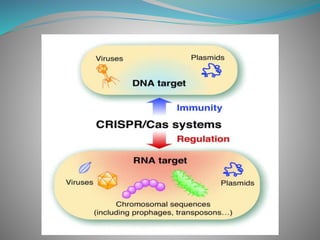
 It acts as adaptive immune systems in bacteria & archaea.
 It provides sequence-specific protection against foreign
invading elements ( viruses, phages & plasmids ) with both
DNA & RNA genomes.
 CRISPR-Cas systems are highly diverse.
I. CRISPR ( Clustered Regularly Interspaced Short
Palindromic Repeats ) loci.
II. Cas ( CRISPR-associated ) proteins can target & cleave
invading DNA in a sequence-specific manner.
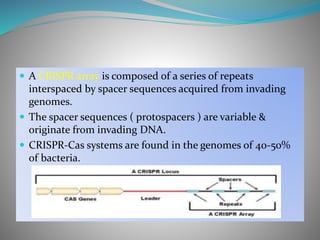
 A CRISPR array is composed of a series of repeats
interspaced by spacer sequences acquired from invading
genomes.
 The spacer sequences ( protospacers ) are variable &
originate from invading DNA.
 CRISPR-Cas systems are found in the genomes of 40-50%
of bacteria.
Stages of CRISPR-Cas System
 CRISPR-Cas immunity can be broken down into three stages:-
adaptation, expression & interference.
a) Adaptation :- Cas1 & Cas2 proteins are required for the
acquisition of DNA spacers by the CRISPR locus, & they display
polarity towards the leader sequence end of the array.
b) Expression :- The CRISPR array provides a precursor transcript
( precursor crRNA ) that is processed into mature crRNA
( CRISPR-RNA ) leading to the formation of crRNA-Cas
effector complexes.
c) Interference :- These complexes recognize & bind to the
complementary nucleic acids, resulting in the degradation of
the target molecule.
Classes of CRISPR-Cas Systems
 These immunogenic systems are classified into two broad
classes on the basis of the crRNA-effector complexes.
I. Class 1 CRISPR-Cas systems have multi-subunit effector
complexes & are of types I, III, IV.
II. Class 2 CRISPR-Cas systems have a single protein & are of
types II, V, VI.
 The 6 types can be broken down into more than 20
subtypes on the basis of gene content & locus
architecture.
 A particular feature of the associated multi-subunit effector
complexes of type III systems is the targeting of both ssRNA &
transcriptionally active DNA.
 The effector complexes of type-IIIA & type-IIIB systems ( Csm &
Cmr complexes respectively ) have been found to have a common
mechanism of RNA-dependent DNA degradation.
 Cas1 integrase is the key enzyme of the CRISPR-Cas adaptation
module that mediates acquisition of spacers derived from foreign
DNA by CRISPR arrays.
 In diverse bacteria, the Cas1 gene is fused to a gene encoding a
reverse transcriptase (RT) related to group-II intron RTs.
 An RT-Cas1 fusion protein has enable acquisition of CRISPR
spacers from RNA ( genomic RNA, plasmid RNA, DNA phage
transcript or RNA phage sequences ).
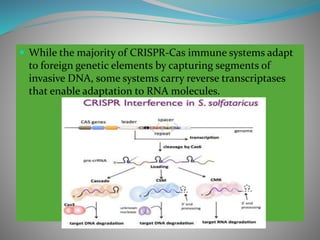
 While the majority of CRISPR-Cas immune systems adapt
to foreign genetic elements by capturing segments of
invasive DNA, some systems carry reverse transcriptases
that enable adaptation to RNA molecules.
CRISPR-Cas9 System
 Type II CRISPR-Cas9 systems have been used in a variety of
organisms including microbes, fungi, plants & animals.
 CRISPR-Cas9 system is a unique technology that enables
geneticists & medical researchers to edit parts of the
genome by removing, adding or altering sections of the
DNA sequence.
 In the type II CRISPR-Cas9 systems, a Cas9 endonuclease &
a guide RNA establish a functional guide RNA-Cas9
complex.
 The guide RNA consists of a DNA-targeting CRISPR-
associated RNA (crRNA) & the trans-activating crRNA
(tracrRNA).
Each crRNA hybridizes with a trans-activating crRNA
(tracrRNA) to form a single guide RNA (sgRNA).
 The sgRNA then combines with the Cas9 nuclease &
directs Cas9 to cleave complementary target DNA
sequences adjacent to a protospacer-adjacent motif (PAM)
thereby creating a double-strand break in the DNA
sequence.
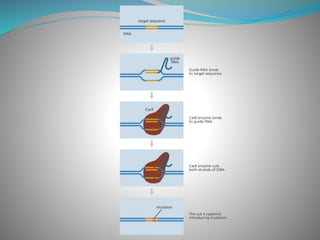
 The CRISPR-Cas9 complex is recruited to the target DNA
site by its guide RNA ( which has a ~20 nucleotide
sequence complementary to its target ).
 The endonuclease activity of Cas9 causes a double –strand
break at the target site.
 Through the generation of a sequence-specific double-
strand break by Cas9 in the host, the error-prone DNA
repair pathway ( non-homologous end joining ) will be
triggered which often results in insertion/deletion of
mutations at the site of editing.
 The Cas9 nuclease is derived from Streptococcus pyogenes
& contains two active sites :-
1) The resistance to ultraviolet C (RuvC) endonuclease site
at the amino-terminal end.
2) The HNH (histidine-asparagine-histidine) endonuclease
site in the middle of the protein.
 Both of the domains can cleave exogenous double-
stranded DNA.
 The HNH nuclease domain cleaves the DNA strand that is
complementary to the crRNA.
 The RuvC nuclease domain cleaves the DNA strand
opposite to the complementary strand.
Crispr cas system
Crispr cas system
Crispr cas system
Crispr cas system
Crispr cas system
Crispr cas system
Crispr cas system
Crispr cas system

Crispr cas system

  • 1.
    To be presentby RAHUL GAUTAM M.Sc. Biotech I sem
  • 2.
    CRISPR Cas System It is a genome editing tool that is creating a buzz in the science world.  It acts as adaptive immune systems in bacteria & archaea.  It provides sequence-specific protection against foreign invading elements ( viruses, phages & plasmids ) with both DNA & RNA genomes.  CRISPR-Cas systems are highly diverse. I. CRISPR ( Clustered Regularly Interspaced Short Palindromic Repeats ) loci. II. Cas ( CRISPR-associated ) proteins can target & cleave invading DNA in a sequence-specific manner.
  • 3.
     A CRISPRarray is composed of a series of repeats interspaced by spacer sequences acquired from invading genomes.  The spacer sequences ( protospacers ) are variable & originate from invading DNA.  CRISPR-Cas systems are found in the genomes of 40-50% of bacteria.
  • 4.
    Stages of CRISPR-CasSystem  CRISPR-Cas immunity can be broken down into three stages:- adaptation, expression & interference. a) Adaptation :- Cas1 & Cas2 proteins are required for the acquisition of DNA spacers by the CRISPR locus, & they display polarity towards the leader sequence end of the array. b) Expression :- The CRISPR array provides a precursor transcript ( precursor crRNA ) that is processed into mature crRNA ( CRISPR-RNA ) leading to the formation of crRNA-Cas effector complexes. c) Interference :- These complexes recognize & bind to the complementary nucleic acids, resulting in the degradation of the target molecule.
  • 7.
    Classes of CRISPR-CasSystems  These immunogenic systems are classified into two broad classes on the basis of the crRNA-effector complexes. I. Class 1 CRISPR-Cas systems have multi-subunit effector complexes & are of types I, III, IV. II. Class 2 CRISPR-Cas systems have a single protein & are of types II, V, VI.  The 6 types can be broken down into more than 20 subtypes on the basis of gene content & locus architecture.
  • 9.
     A particularfeature of the associated multi-subunit effector complexes of type III systems is the targeting of both ssRNA & transcriptionally active DNA.  The effector complexes of type-IIIA & type-IIIB systems ( Csm & Cmr complexes respectively ) have been found to have a common mechanism of RNA-dependent DNA degradation.  Cas1 integrase is the key enzyme of the CRISPR-Cas adaptation module that mediates acquisition of spacers derived from foreign DNA by CRISPR arrays.  In diverse bacteria, the Cas1 gene is fused to a gene encoding a reverse transcriptase (RT) related to group-II intron RTs.  An RT-Cas1 fusion protein has enable acquisition of CRISPR spacers from RNA ( genomic RNA, plasmid RNA, DNA phage transcript or RNA phage sequences ).
  • 10.
     While themajority of CRISPR-Cas immune systems adapt to foreign genetic elements by capturing segments of invasive DNA, some systems carry reverse transcriptases that enable adaptation to RNA molecules.
  • 12.
    CRISPR-Cas9 System  TypeII CRISPR-Cas9 systems have been used in a variety of organisms including microbes, fungi, plants & animals.  CRISPR-Cas9 system is a unique technology that enables geneticists & medical researchers to edit parts of the genome by removing, adding or altering sections of the DNA sequence.  In the type II CRISPR-Cas9 systems, a Cas9 endonuclease & a guide RNA establish a functional guide RNA-Cas9 complex.  The guide RNA consists of a DNA-targeting CRISPR- associated RNA (crRNA) & the trans-activating crRNA (tracrRNA).
  • 13.
    Each crRNA hybridizeswith a trans-activating crRNA (tracrRNA) to form a single guide RNA (sgRNA).
  • 14.
     The sgRNAthen combines with the Cas9 nuclease & directs Cas9 to cleave complementary target DNA sequences adjacent to a protospacer-adjacent motif (PAM) thereby creating a double-strand break in the DNA sequence.
  • 15.
     The CRISPR-Cas9complex is recruited to the target DNA site by its guide RNA ( which has a ~20 nucleotide sequence complementary to its target ).  The endonuclease activity of Cas9 causes a double –strand break at the target site.  Through the generation of a sequence-specific double- strand break by Cas9 in the host, the error-prone DNA repair pathway ( non-homologous end joining ) will be triggered which often results in insertion/deletion of mutations at the site of editing.
  • 17.
     The Cas9nuclease is derived from Streptococcus pyogenes & contains two active sites :- 1) The resistance to ultraviolet C (RuvC) endonuclease site at the amino-terminal end. 2) The HNH (histidine-asparagine-histidine) endonuclease site in the middle of the protein.  Both of the domains can cleave exogenous double- stranded DNA.  The HNH nuclease domain cleaves the DNA strand that is complementary to the crRNA.  The RuvC nuclease domain cleaves the DNA strand opposite to the complementary strand.