Creating Value for Customers
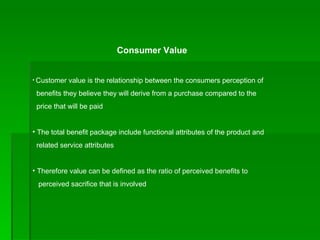
Consumer Value Customer value is the relationship between the consumers perception of  benefits they believe they will derive from a purchase compared to the  price that will be paid The total benefit package include functional attributes of the product and  related service attributes Therefore value can be defined as the ratio of perceived benefits to  perceived sacrifice that is involved
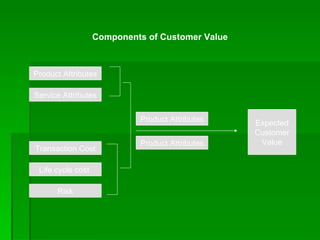
Components of Customer Value Product Attributes Service Attributes Transaction Cost Life cycle cost  Risk Product Attributes Product Attributes Expected Customer Value
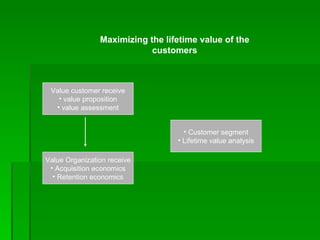
Maximizing the lifetime value of the customers Value customer receive value proposition value assessment Value Organization receive Acquisition economics Retention economics Customer segment Lifetime value analysis
Key steps of the value delivery sequence Choose the Value (Customer value need, value positioning, provide the value (product development, service development,  pricing,  distributing and servicing Communicate the value (sales force message, sales promotion, advertising, PR)
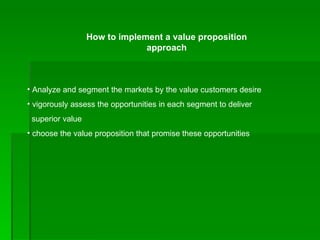
How to implement a value proposition approach Analyze and segment the markets by the value customers desire vigorously assess the opportunities in each segment to deliver  superior value  choose the value proposition that promise these opportunities
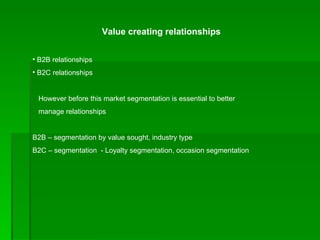
Value creating relationships B2B relationships B2C relationships However before this market segmentation is essential to better  manage relationships B2B – segmentation by value sought, industry type  B2C – segmentation  - Loyalty segmentation, occasion segmentation
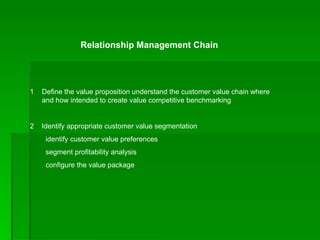
Relationship Management Chain Define the value proposition understand the customer value chain where and how intended to create value competitive benchmarking 2  Identify appropriate customer value segmentation identify customer value preferences  segment profitability analysis configure the value package
Designing value delivery systems Mass customization Value added partnerships Process reengineering Managing and maintaining delivered satisfaction service process monitoring customer satisfaction measurement employee satisfaction measurement

Creating value for customers

  • 1.
  • 2.
    Consumer Value Customervalue is the relationship between the consumers perception of benefits they believe they will derive from a purchase compared to the price that will be paid The total benefit package include functional attributes of the product and related service attributes Therefore value can be defined as the ratio of perceived benefits to perceived sacrifice that is involved
  • 3.
    Components of CustomerValue Product Attributes Service Attributes Transaction Cost Life cycle cost Risk Product Attributes Product Attributes Expected Customer Value
  • 4.
    Maximizing the lifetimevalue of the customers Value customer receive value proposition value assessment Value Organization receive Acquisition economics Retention economics Customer segment Lifetime value analysis
  • 5.
    Key steps ofthe value delivery sequence Choose the Value (Customer value need, value positioning, provide the value (product development, service development, pricing, distributing and servicing Communicate the value (sales force message, sales promotion, advertising, PR)
  • 6.
    How to implementa value proposition approach Analyze and segment the markets by the value customers desire vigorously assess the opportunities in each segment to deliver superior value choose the value proposition that promise these opportunities
  • 7.
    Value creating relationshipsB2B relationships B2C relationships However before this market segmentation is essential to better manage relationships B2B – segmentation by value sought, industry type B2C – segmentation - Loyalty segmentation, occasion segmentation
  • 8.
    Relationship Management ChainDefine the value proposition understand the customer value chain where and how intended to create value competitive benchmarking 2 Identify appropriate customer value segmentation identify customer value preferences segment profitability analysis configure the value package
  • 9.
    Designing value deliverysystems Mass customization Value added partnerships Process reengineering Managing and maintaining delivered satisfaction service process monitoring customer satisfaction measurement employee satisfaction measurement