Unit 2
SERVICES MARKETING
Assessing service market potential - Classification of
services – Expanded marketing mix – Service
marketing – Environment and trends – Service market
segmentation, targeting and positioning.
ASSESSING MARKET POTENTIAL
• Market potential, quite simply, is the total demand for a
product in a given business environment.
5 ELEMENTS TO DETERMINE MARKET
POTENTIAL
• Market Size
• Market Growth
• Competition
• Profitability
• Consumer and Product type
BENEFITS OF ASSESSING MARKET POTENTIAL
• Understand market potential for a single store, network
of stores or a new market
• Deploy resources effectively by ranking markets in
priority order
• Forecast total opportunity in terms of number of
customers and revenue potential
• Estimate your market share
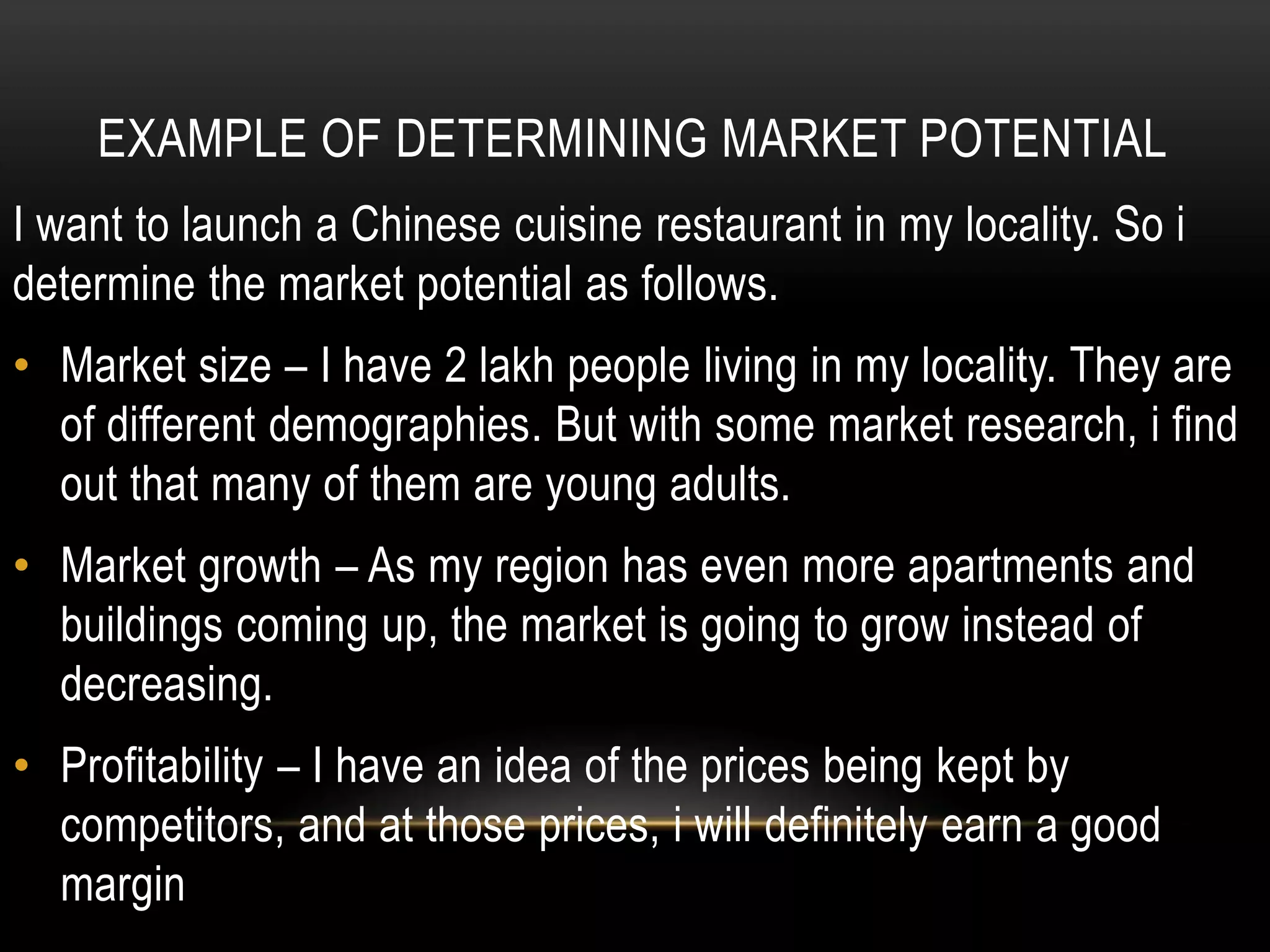
I want to launch a Chinese cuisine restaurant in my locality. So i
determine the market potential as follows.
• Market size – I have 2 lakh people living in my locality. They are
of different demographies. But with some market research, i find
out that many of them are young adults.
• Market growth – As my region has even more apartments and
buildings coming up, the market is going to grow instead of
decreasing.
• Profitability – I have an idea of the prices being kept by
competitors, and at those prices, i will definitely earn a good
margin
EXAMPLE OF DETERMINING MARKET POTENTIAL
• Competition – Strong competition from a local chinese
restaurant. But i believe my cook and experience is
better then him when it comes to serving chinese food.
• Customer type – It is going to be a repeat business
because customers who like my food are more likely to
come again and again. Each customer will be important
because i am in the food industry, and a single mistake
can lose me a lot of customers as well as my
reputation.
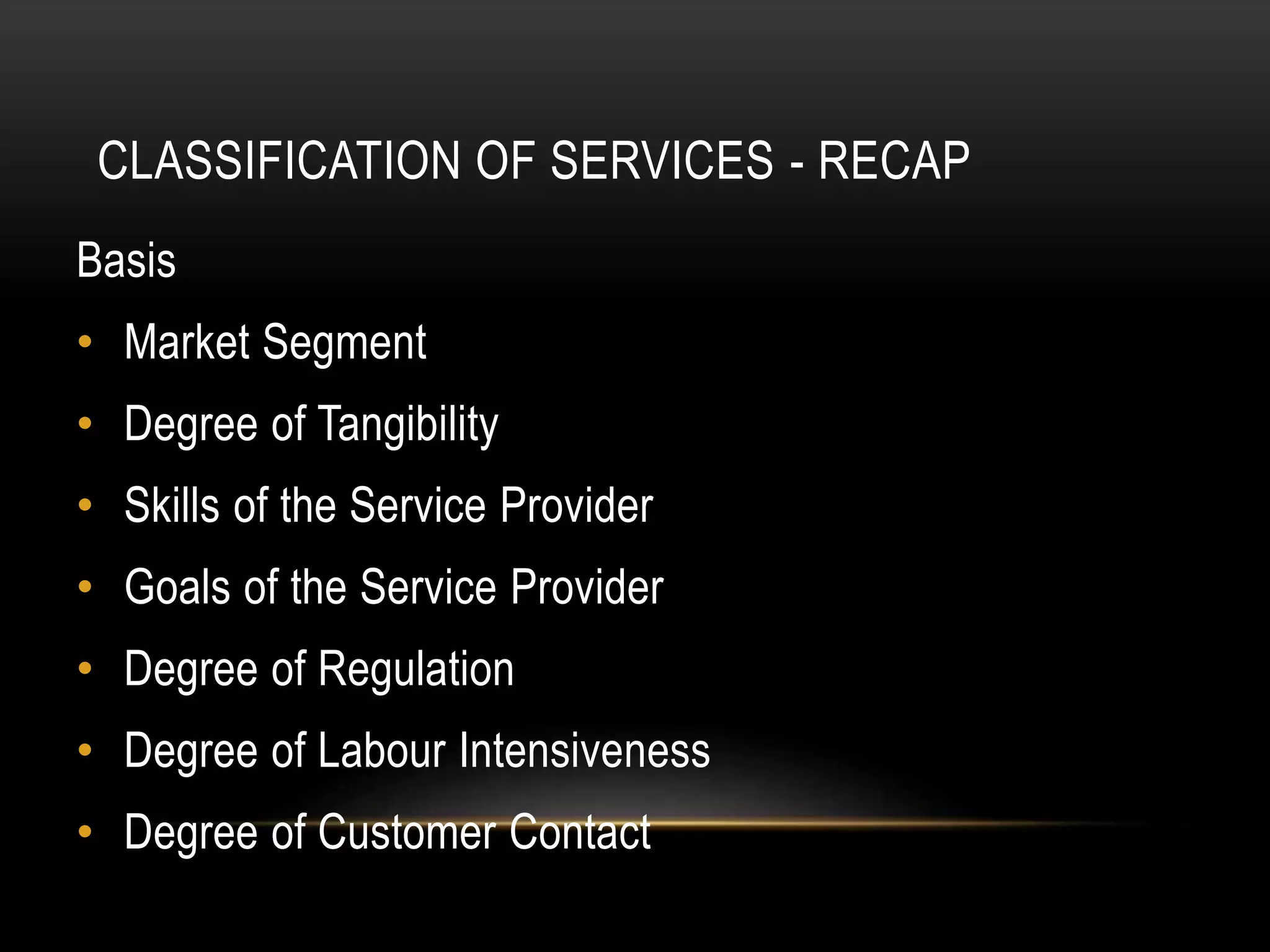
CLASSIFICATION OF SERVICES
Basis
• Market Segment
• Degree of Tangibility
• Skills of the Service Provider
• Goals of the Service Provider
• Degree of Regulation
• Degree of Labour Intensiveness
• Degree of Customer Contact
CLASSIFICATION OF SERVICES
• Market Segment
• B2B
• B2C
• Degree of Tangibility
• Rental Goods (Hotel Room, Car, etc)
• Owned Goods (TV Repair, House repair, etc)
• Non Goods (Education, Banking, etc)
CLASSIFICATION OF SERVICES
• Skills of the Service Provider
• Professional (highly skilled : Legal, Medical,
Management, etc)
• Non-Professional (unskilled : Taxi, Security, Laundry,
etc)
• Goals of the Service Provider
• Profit (Airlines, Hotels, Insurance)
• Non-Profit (Postal services, Public Libraries, NGO)
CLASSIFICATION OF SERVICES
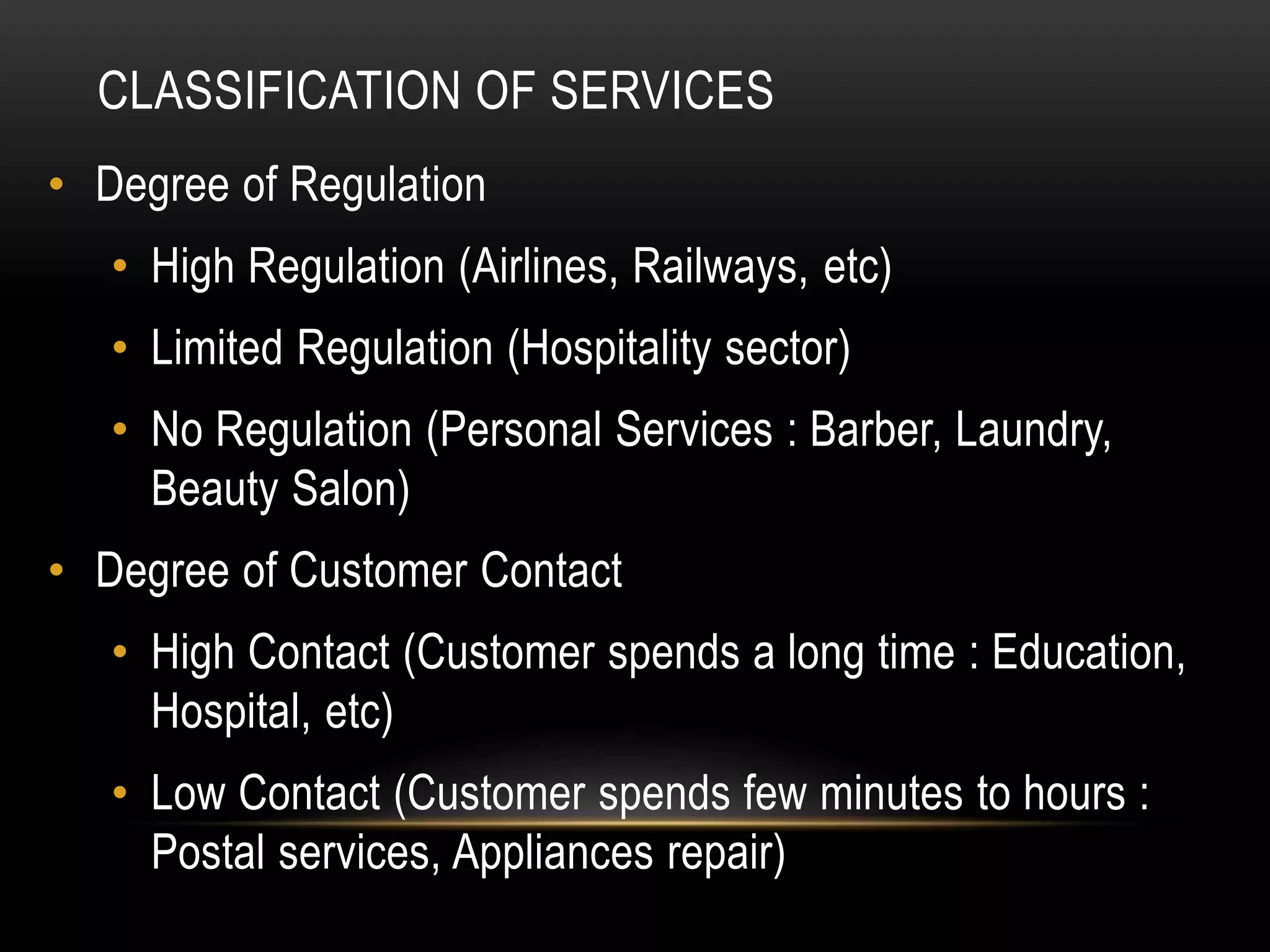
• Degree of Regulation
• High Regulation (Airlines, Railways, etc)
• Limited Regulation (Hospitality sector)
• No Regulation (Personal Services : Barber, Laundry,
Beauty Salon)
• Degree of Customer Contact
• High Contact (Customer spends a long time : Education,
Hospital, etc)
• Low Contact (Customer spends few minutes to hours :
Postal services, Appliances repair)
CLASSIFICATION OF SERVICES
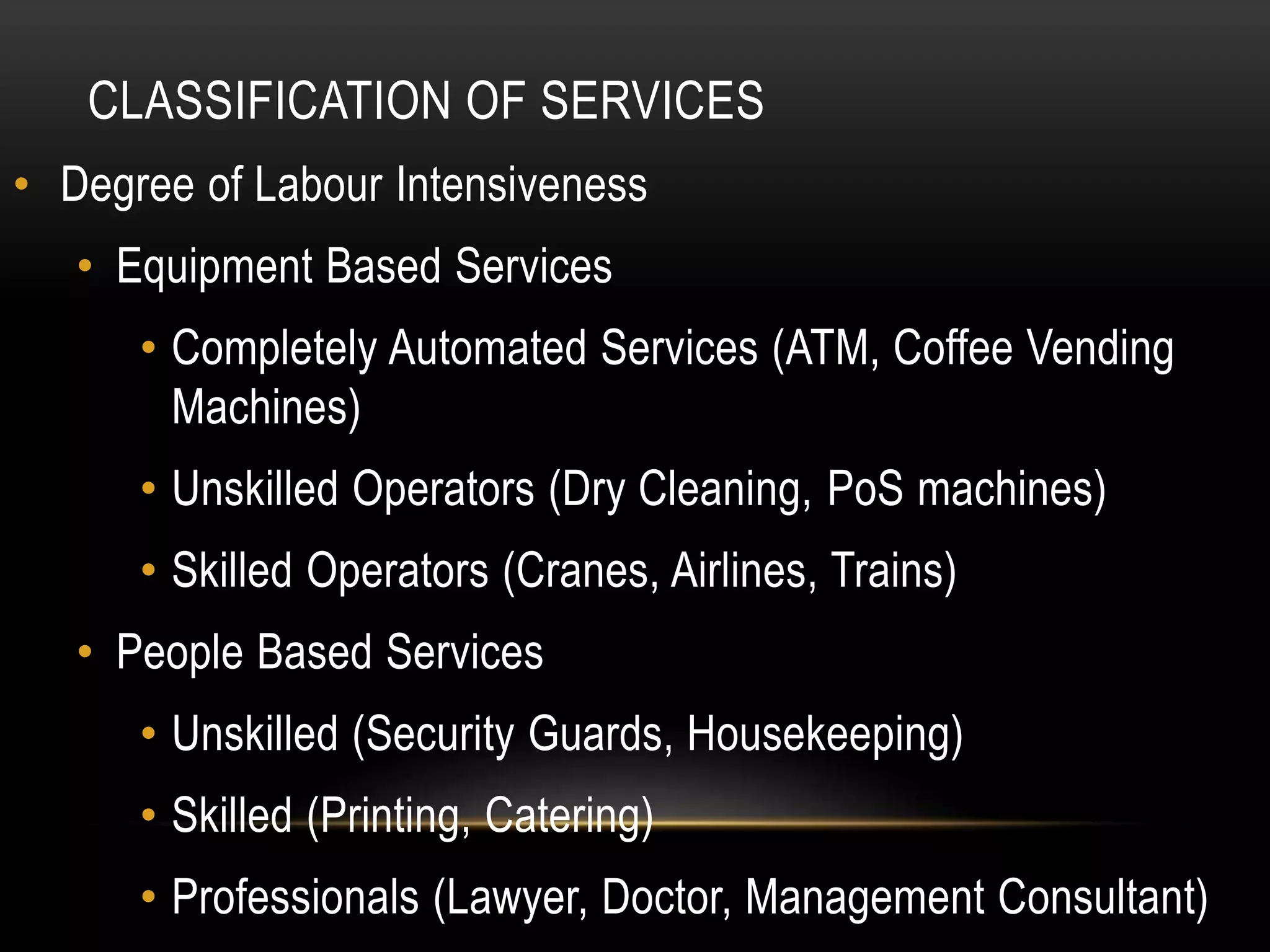
• Degree of Labour Intensiveness
• Equipment Based Services
• Completely Automated Services (ATM, Coffee Vending
Machines)
• Unskilled Operators (Dry Cleaning, PoS machines)
• Skilled Operators (Cranes, Airlines, Trains)
• People Based Services
• Unskilled (Security Guards, Housekeeping)
• Skilled (Printing, Catering)
• Professionals (Lawyer, Doctor, Management Consultant)
CLASSIFICATION OF SERVICES
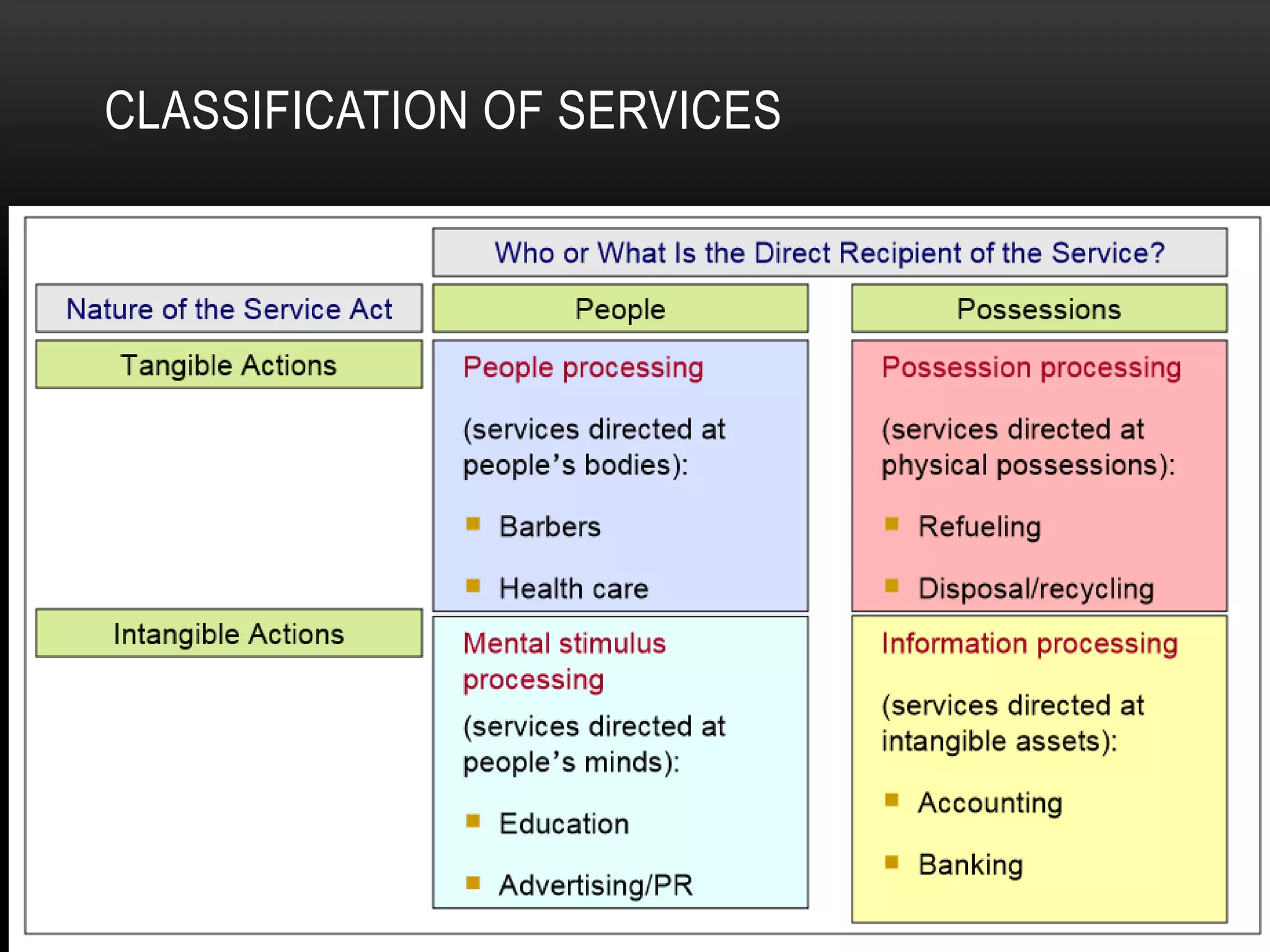
ACTIVITY
• The class breaks into seven groups and each group is
assigned one of the service classifications to come up
with an example for each of the four quadrants in the
matrix.
CLASSIFICATION OF SERVICES - RECAP
Basis
• Market Segment
• Degree of Tangibility
• Skills of the Service Provider
• Goals of the Service Provider
• Degree of Regulation
• Degree of Labour Intensiveness
• Degree of Customer Contact
CLASSIFICATION OF SERVICES - RECAP
• Product Elements (core product –
primary need; supplementary service
elements – help customers to use
effectively)
• Place and Time (where, when,
methods, channels)
• Price (service firm – cost + profit;
customers – cost to obtain benefits)
• Promotion and Education (3 roles :
provide information, persuade target
customers by specifying merits,
encouraging them to buy)
MARKETINGMIX–7P’S
EXPANDED MARKETING MIX
• Process : How a firm does things – underlying
processes
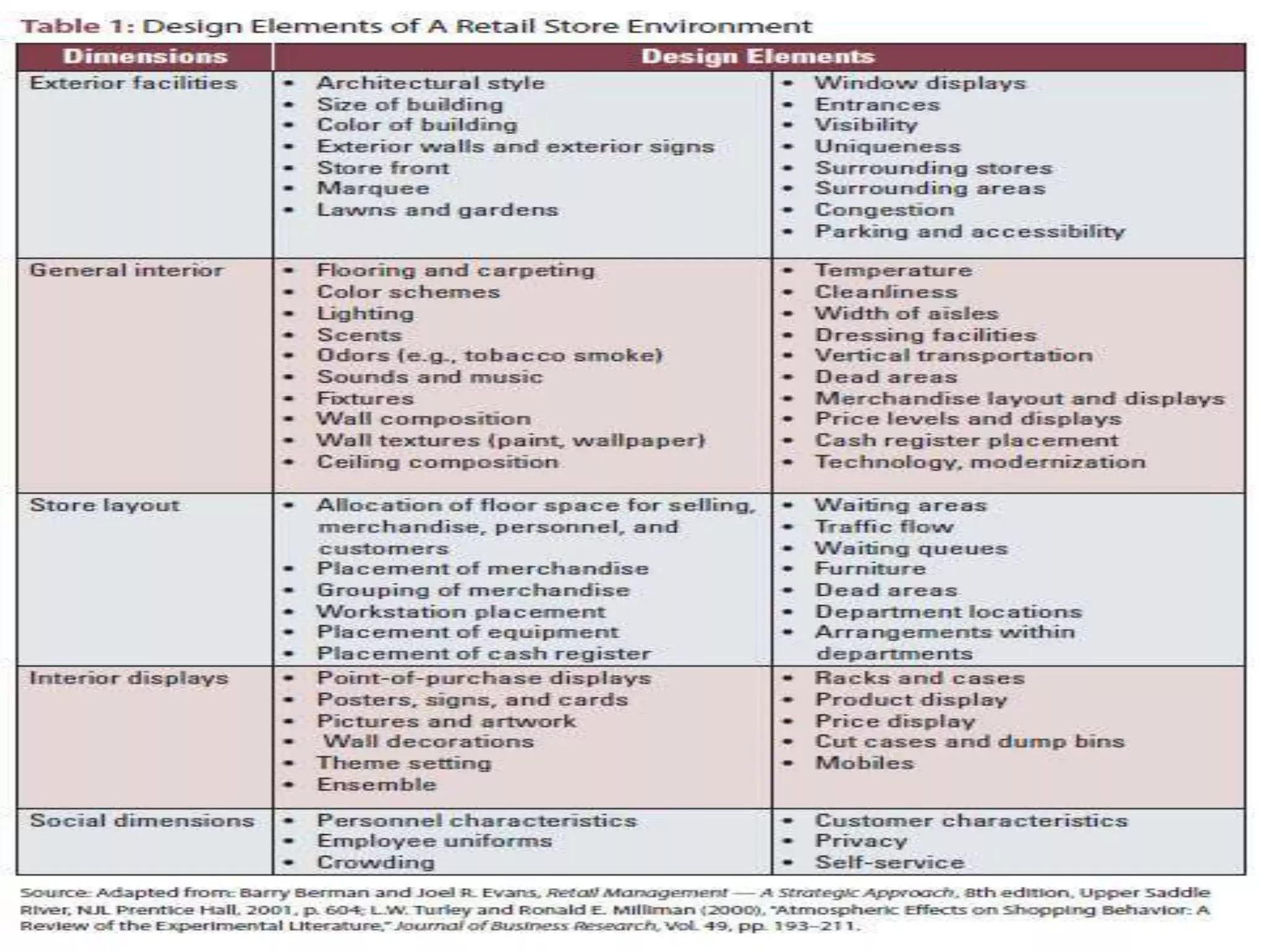
• Physical Environment : Appearance of buildings,
interior furnishings, printed materials, etc; tangible
evidence
• People : Front-line staff
• Productivity and Quality : reduce costs, product
differentiation, customer satisfaction & loyalty
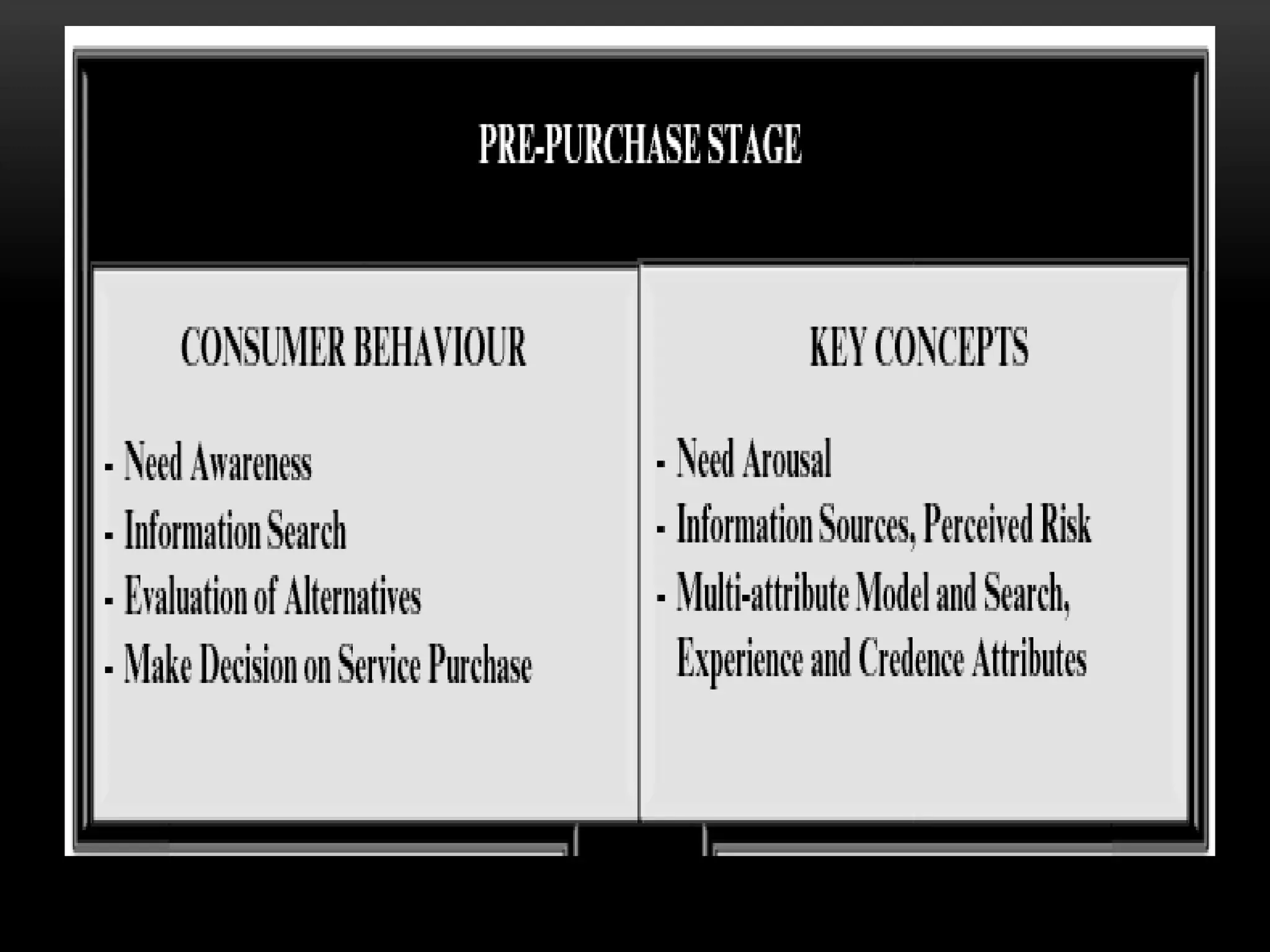
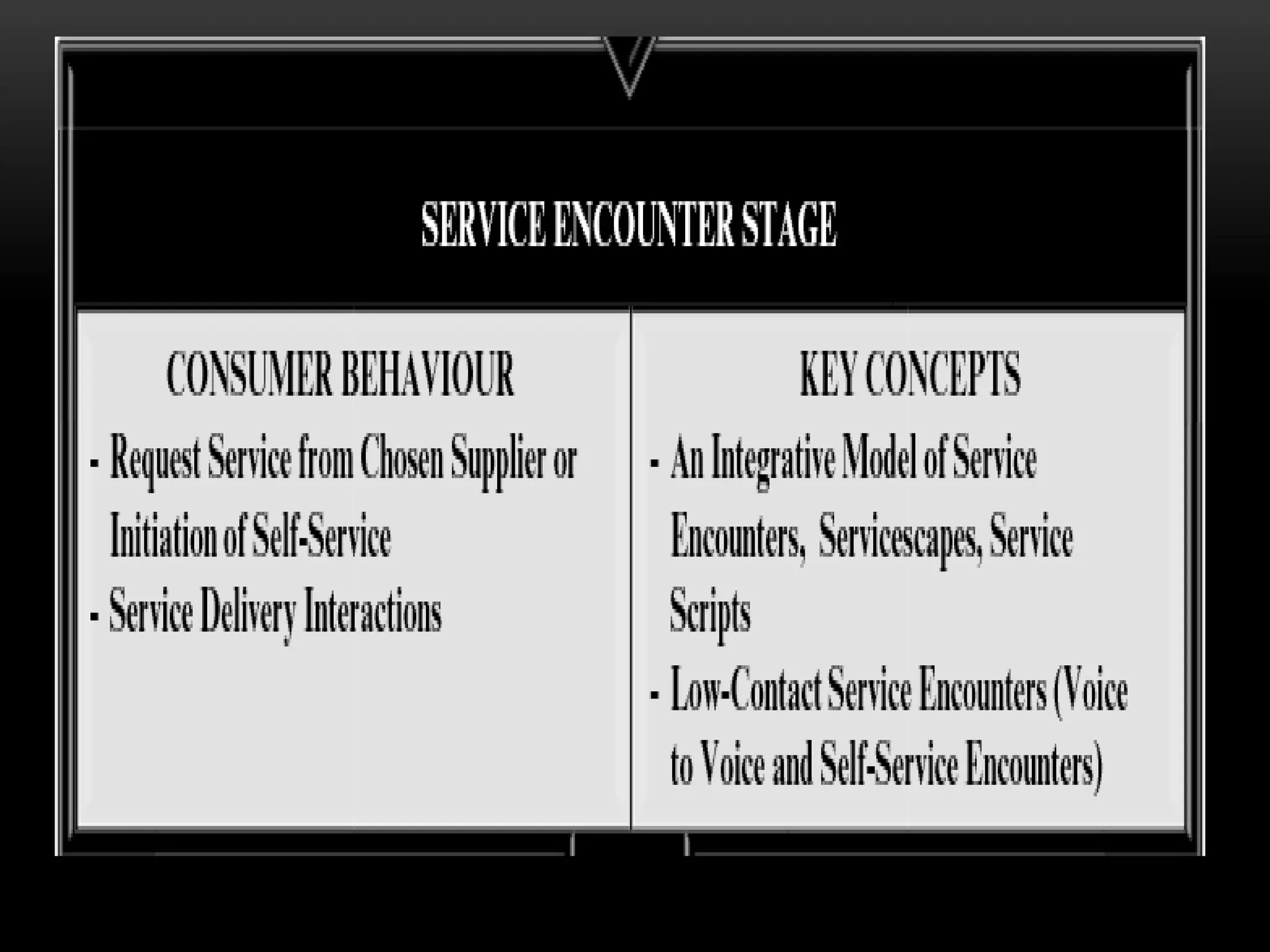
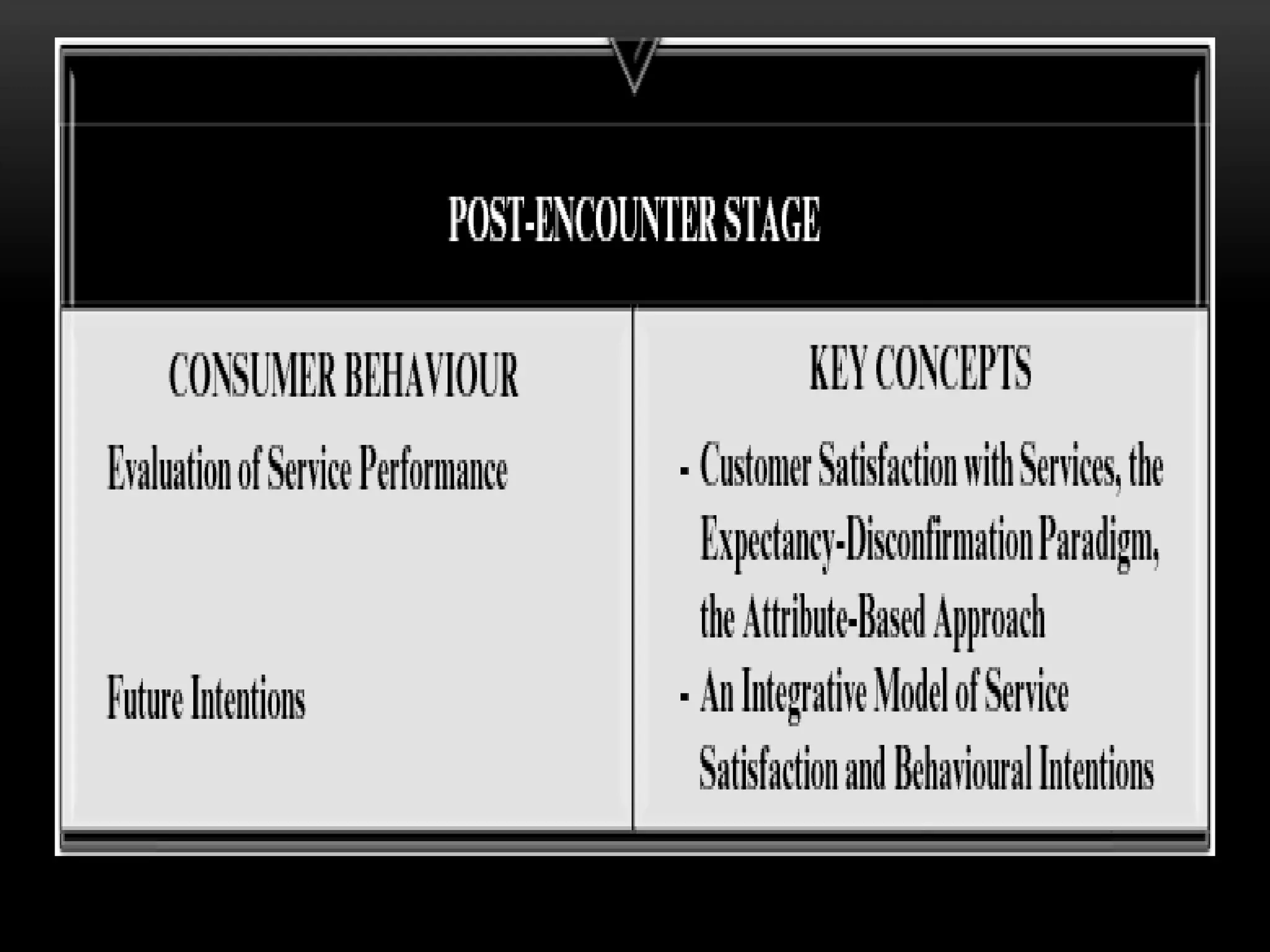
CUSTOMER DECISION MAKING
3 stage model of service consumption
• Pre-Purchase Stage
• Service Encounter Stage
• Post-Encounter Stage
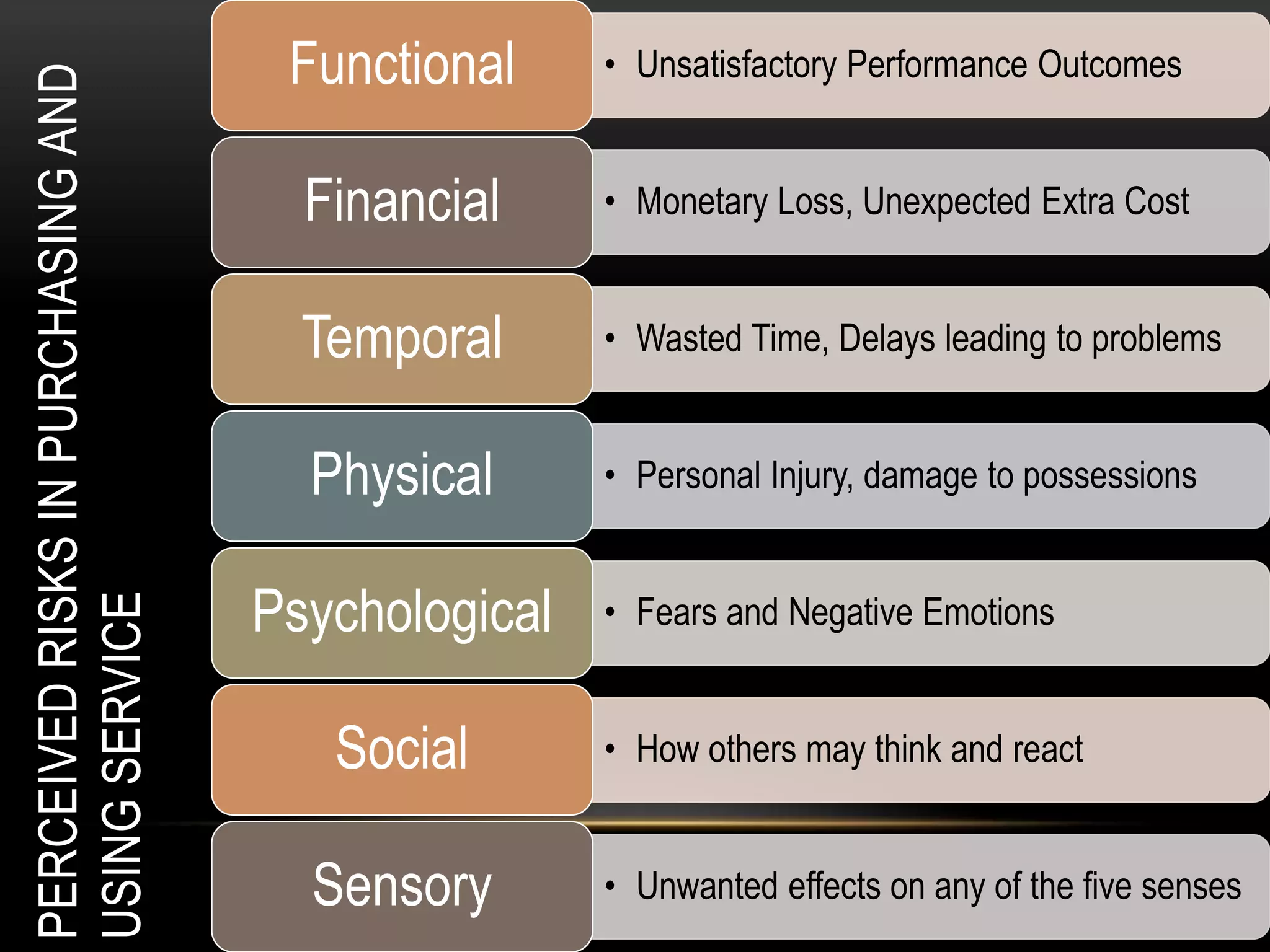
PERCEIVEDRISKSINPURCHASINGAND
USINGSERVICE
• Unsatisfactory Performance OutcomesFunctional
• Monetary Loss, Unexpected Extra CostFinancial
• Wasted Time, Delays leading to problemsTemporal
• Personal Injury, damage to possessionsPhysical
• Fears and Negative EmotionsPsychological
• How others may think and reactSocial
• Unwanted effects on any of the five sensesSensory
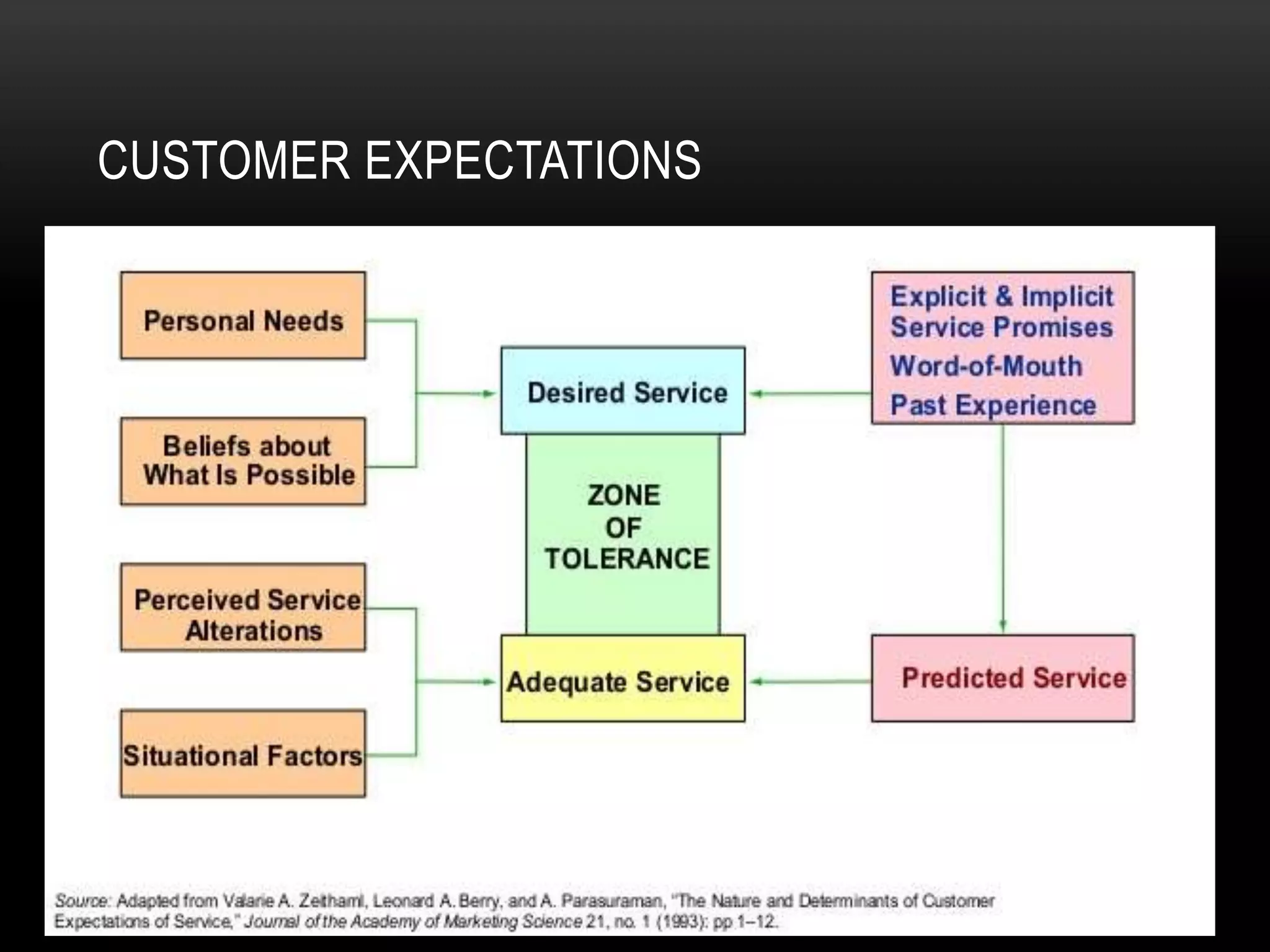
CUSTOMER EXPECTATIONS
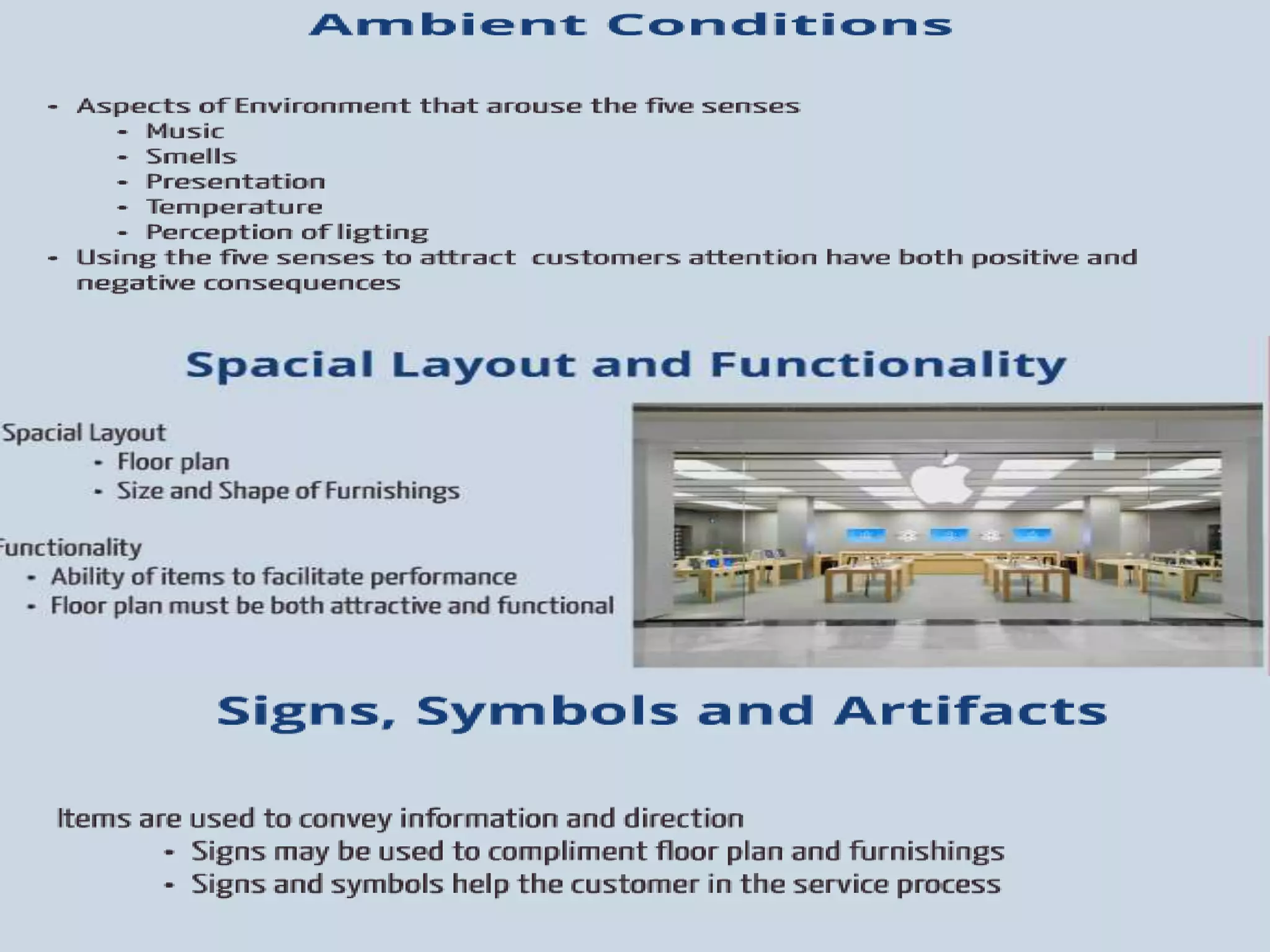
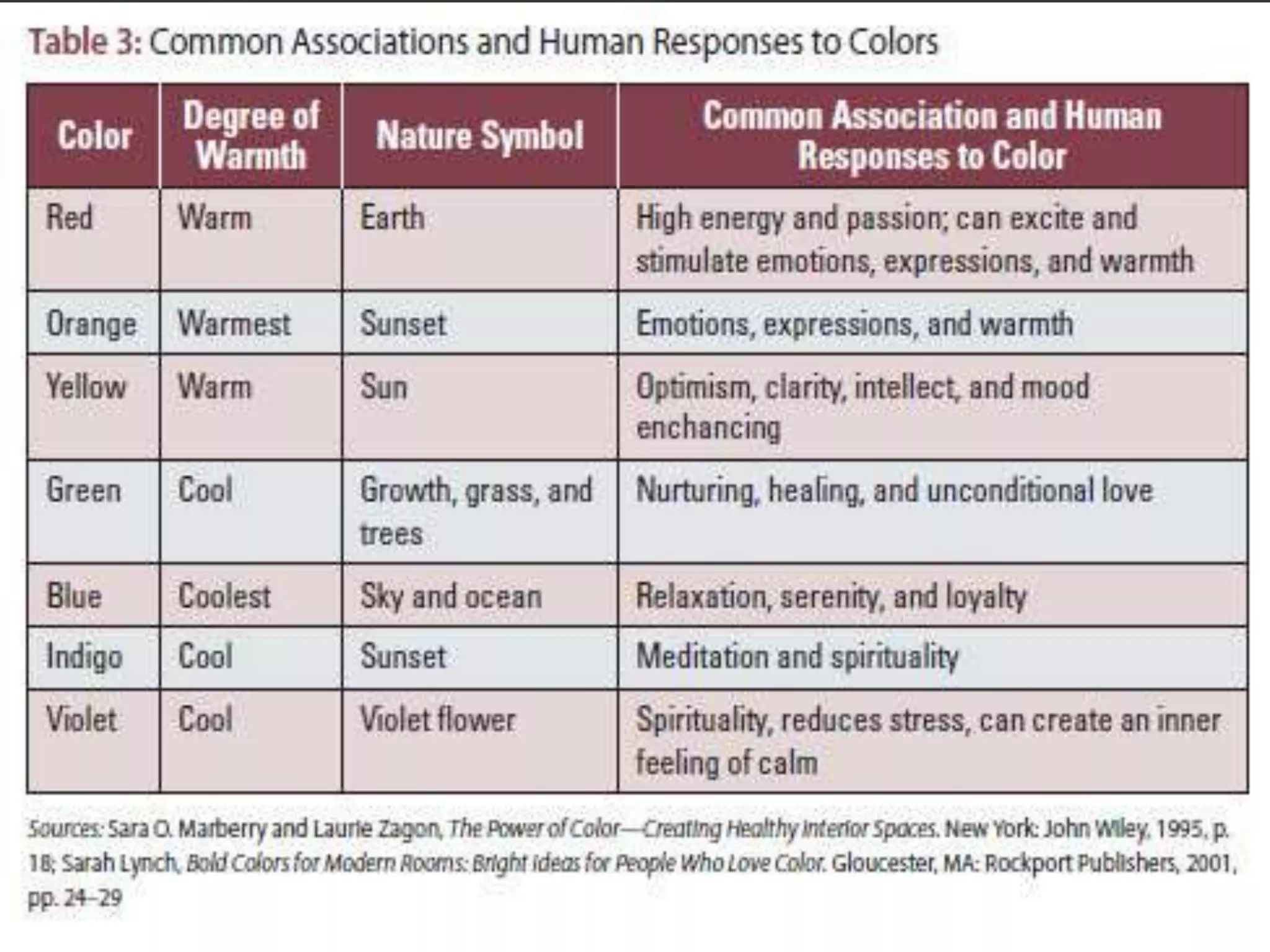
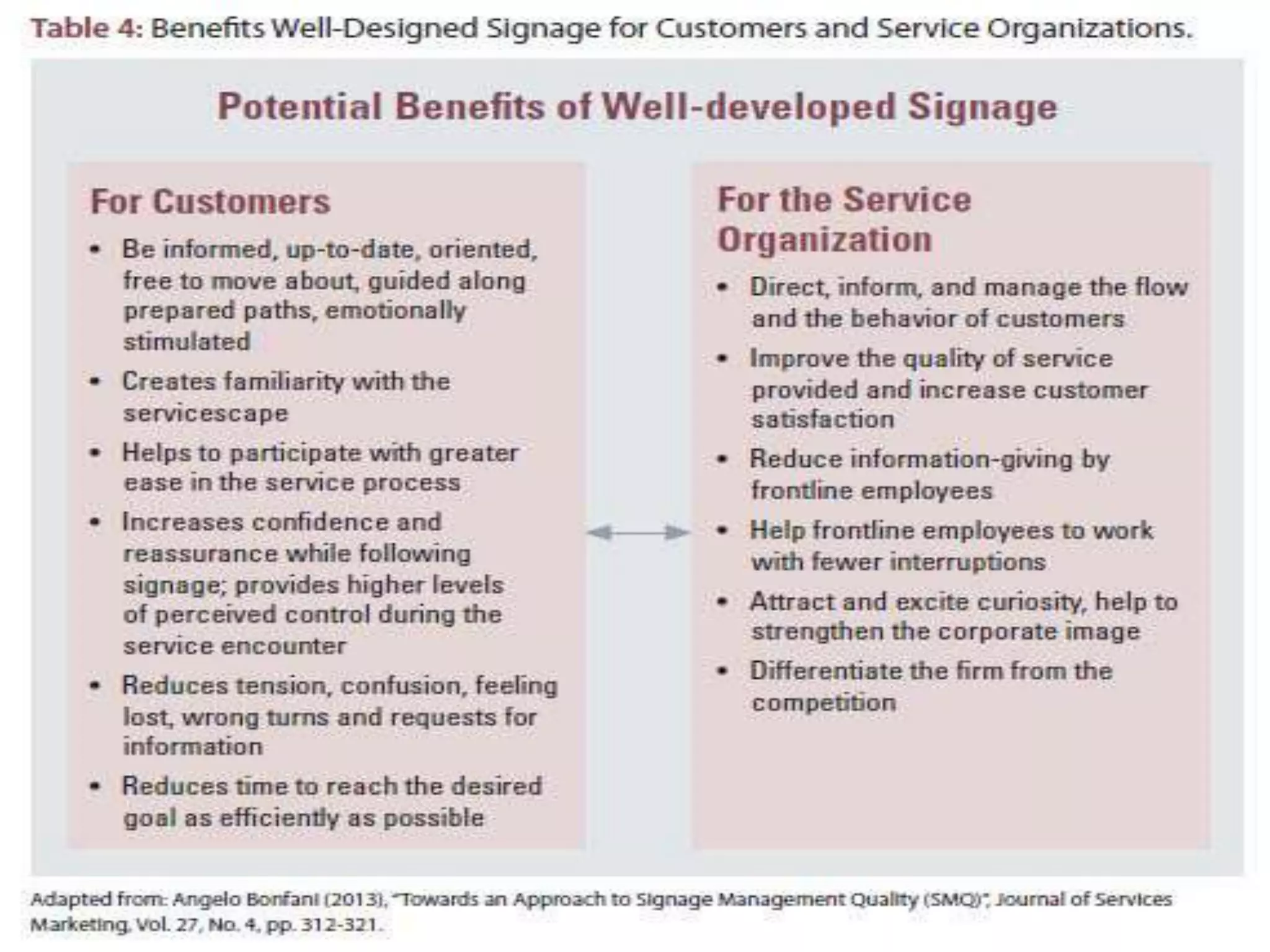
DIMENSIONS OF SERVICES ENVIRONMENT
Three Main Aspects in Servicescape Model:
• Ambient Conditions
• Spacial layout and Functionality
• Signs, Symbols, and Artifacts
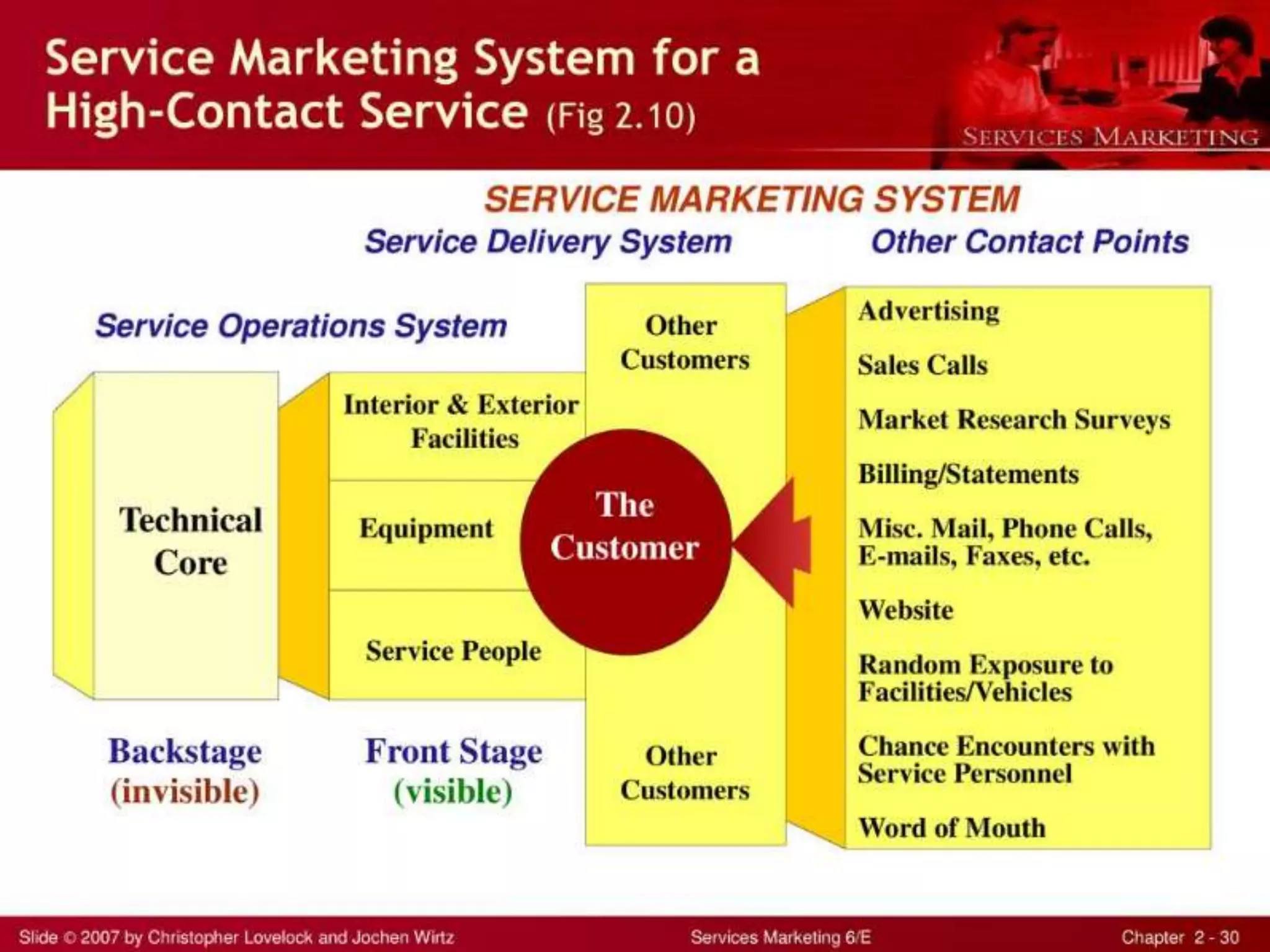
LEVELSOFCUSTOMERCONTACTWITH
SERVICEORGANIZATIONS
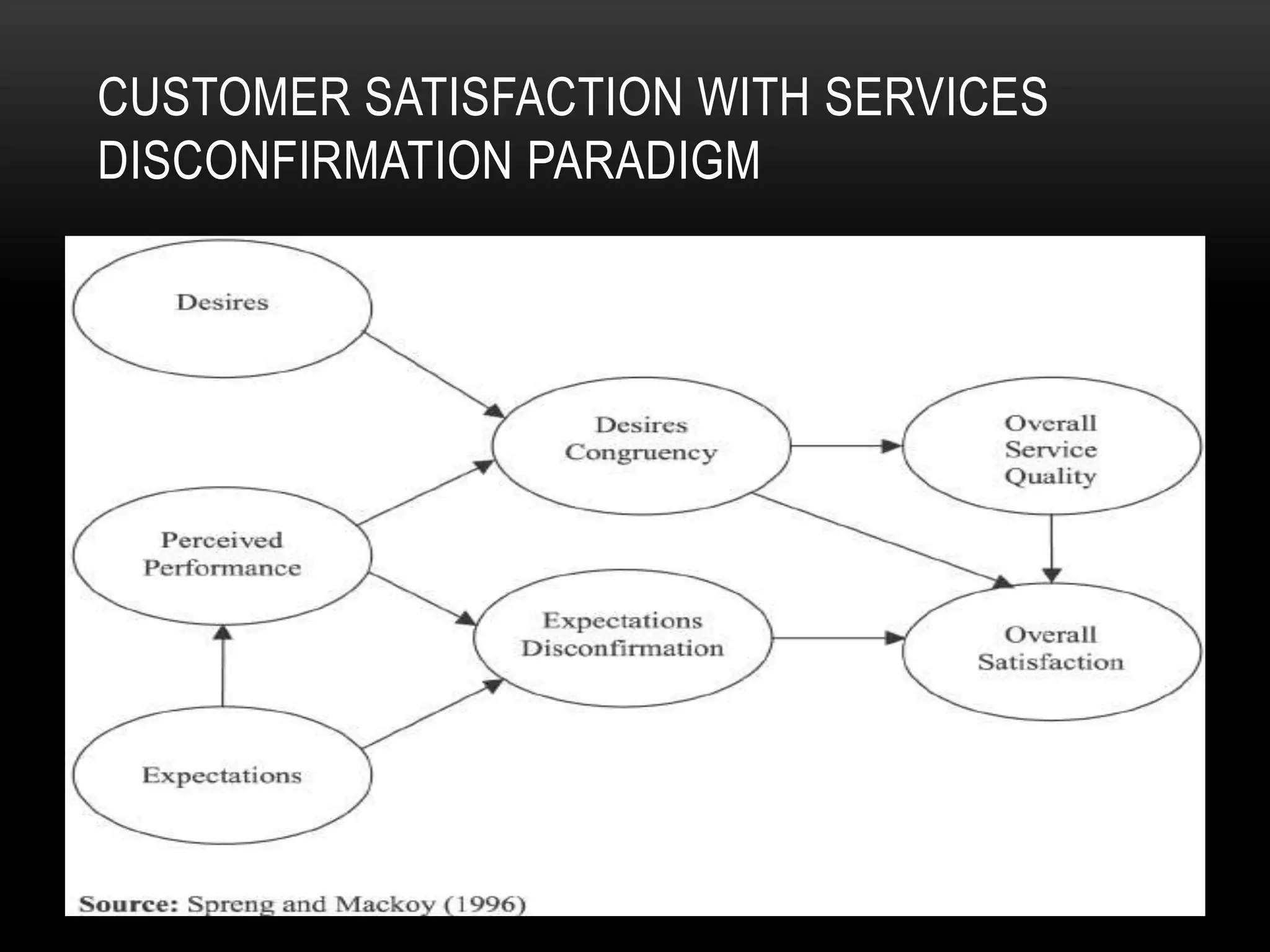
CUSTOMER SATISFACTION WITH SERVICES
DISCONFIRMATION PARADIGM
RUSSELL MODEL OF AFFECT
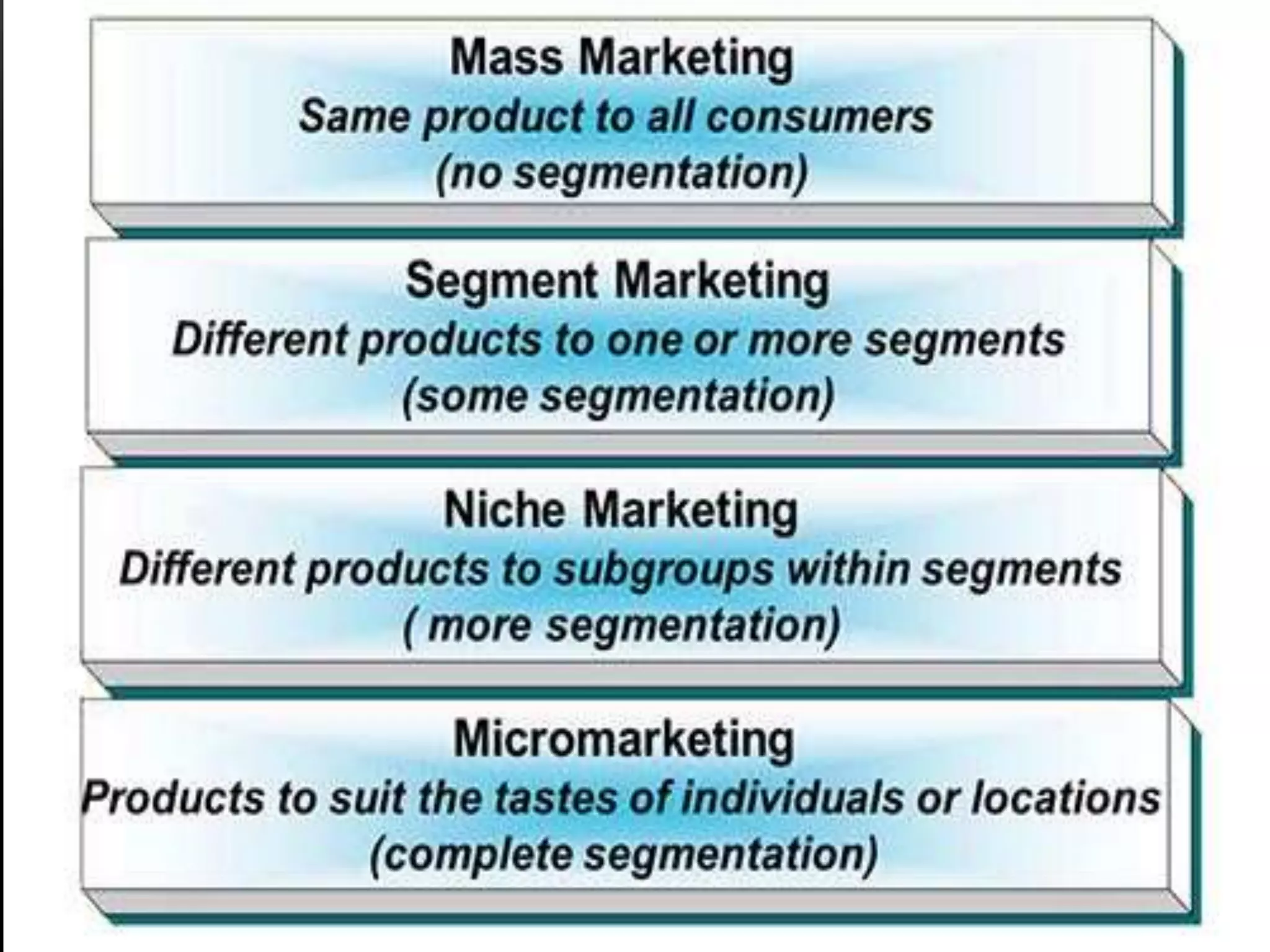
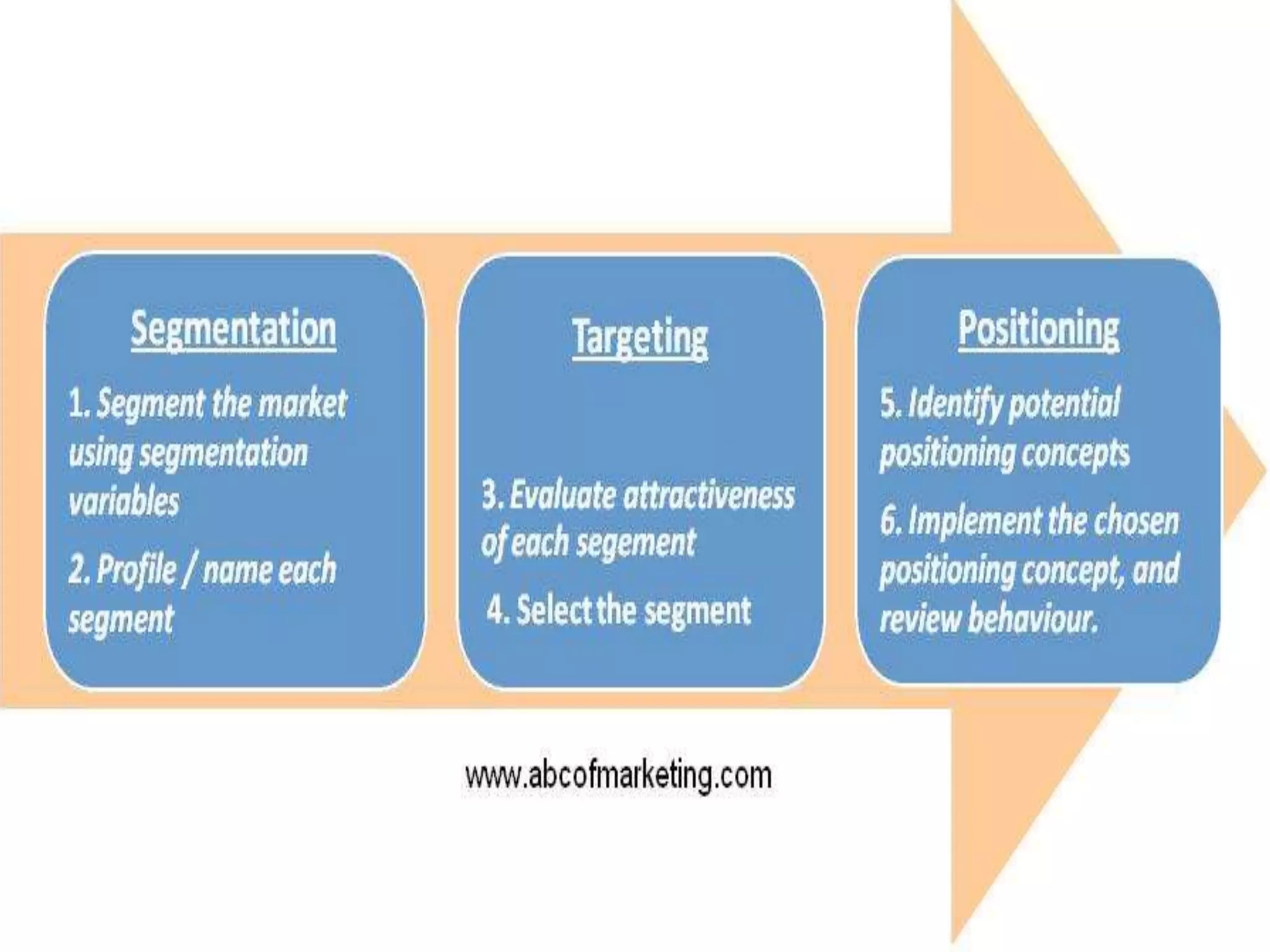
MARKET SEGMENTATION & TARGETING
• Market segmentation is the process of dividing a market
of potential customers into groups, or segments, based
on different characteristics.
• A target market is a group of customers within
a business's serviceable available market that
the business has decided to aim its marketing efforts
towards. Target markets consist of consumers who
exhibit similar characteristics (such as age, location,
income, and lifestyle) and are considered most likely to
buy a business's product or service.
MARKET POSITIONING
• Market position refers to the consumer’s
perception of a brand or product in relation to
competing brands or products.
• Market positioning refers to the process of
establishing the image or identity of a brand or
product so that consumers perceive it in a
certain way.
EFFECTIVE MARKET SEGMENTATION
• Measurability
• Accessibility
• Actionability – effective program formulation
• Large and profitable segments
Unit 2
Unit 2
Unit 2
Unit 2

Unit 2

  • 1.
    Unit 2 SERVICES MARKETING Assessingservice market potential - Classification of services – Expanded marketing mix – Service marketing – Environment and trends – Service market segmentation, targeting and positioning.
  • 2.
    ASSESSING MARKET POTENTIAL •Market potential, quite simply, is the total demand for a product in a given business environment. 5 ELEMENTS TO DETERMINE MARKET POTENTIAL • Market Size • Market Growth • Competition • Profitability • Consumer and Product type
  • 3.
    BENEFITS OF ASSESSINGMARKET POTENTIAL • Understand market potential for a single store, network of stores or a new market • Deploy resources effectively by ranking markets in priority order • Forecast total opportunity in terms of number of customers and revenue potential • Estimate your market share
  • 4.
    I want tolaunch a Chinese cuisine restaurant in my locality. So i determine the market potential as follows. • Market size – I have 2 lakh people living in my locality. They are of different demographies. But with some market research, i find out that many of them are young adults. • Market growth – As my region has even more apartments and buildings coming up, the market is going to grow instead of decreasing. • Profitability – I have an idea of the prices being kept by competitors, and at those prices, i will definitely earn a good margin EXAMPLE OF DETERMINING MARKET POTENTIAL
  • 5.
    EXAMPLE OF DETERMININGMARKET POTENTIAL • Competition – Strong competition from a local chinese restaurant. But i believe my cook and experience is better then him when it comes to serving chinese food. • Customer type – It is going to be a repeat business because customers who like my food are more likely to come again and again. Each customer will be important because i am in the food industry, and a single mistake can lose me a lot of customers as well as my reputation.
  • 6.
    CLASSIFICATION OF SERVICES Basis •Market Segment • Degree of Tangibility • Skills of the Service Provider • Goals of the Service Provider • Degree of Regulation • Degree of Labour Intensiveness • Degree of Customer Contact
  • 7.
    CLASSIFICATION OF SERVICES •Market Segment • B2B • B2C • Degree of Tangibility • Rental Goods (Hotel Room, Car, etc) • Owned Goods (TV Repair, House repair, etc) • Non Goods (Education, Banking, etc)
  • 8.
    CLASSIFICATION OF SERVICES •Skills of the Service Provider • Professional (highly skilled : Legal, Medical, Management, etc) • Non-Professional (unskilled : Taxi, Security, Laundry, etc) • Goals of the Service Provider • Profit (Airlines, Hotels, Insurance) • Non-Profit (Postal services, Public Libraries, NGO)
  • 9.
    CLASSIFICATION OF SERVICES •Degree of Regulation • High Regulation (Airlines, Railways, etc) • Limited Regulation (Hospitality sector) • No Regulation (Personal Services : Barber, Laundry, Beauty Salon) • Degree of Customer Contact • High Contact (Customer spends a long time : Education, Hospital, etc) • Low Contact (Customer spends few minutes to hours : Postal services, Appliances repair)
  • 10.
    CLASSIFICATION OF SERVICES •Degree of Labour Intensiveness • Equipment Based Services • Completely Automated Services (ATM, Coffee Vending Machines) • Unskilled Operators (Dry Cleaning, PoS machines) • Skilled Operators (Cranes, Airlines, Trains) • People Based Services • Unskilled (Security Guards, Housekeeping) • Skilled (Printing, Catering) • Professionals (Lawyer, Doctor, Management Consultant)
  • 11.
  • 12.
    ACTIVITY • The classbreaks into seven groups and each group is assigned one of the service classifications to come up with an example for each of the four quadrants in the matrix.
  • 13.
    CLASSIFICATION OF SERVICES- RECAP Basis • Market Segment • Degree of Tangibility • Skills of the Service Provider • Goals of the Service Provider • Degree of Regulation • Degree of Labour Intensiveness • Degree of Customer Contact
  • 14.
  • 15.
    • Product Elements(core product – primary need; supplementary service elements – help customers to use effectively) • Place and Time (where, when, methods, channels) • Price (service firm – cost + profit; customers – cost to obtain benefits) • Promotion and Education (3 roles : provide information, persuade target customers by specifying merits, encouraging them to buy)
  • 16.
  • 17.
    EXPANDED MARKETING MIX •Process : How a firm does things – underlying processes • Physical Environment : Appearance of buildings, interior furnishings, printed materials, etc; tangible evidence • People : Front-line staff • Productivity and Quality : reduce costs, product differentiation, customer satisfaction & loyalty
  • 18.
    CUSTOMER DECISION MAKING 3stage model of service consumption • Pre-Purchase Stage • Service Encounter Stage • Post-Encounter Stage
  • 20.
    PERCEIVEDRISKSINPURCHASINGAND USINGSERVICE • Unsatisfactory PerformanceOutcomesFunctional • Monetary Loss, Unexpected Extra CostFinancial • Wasted Time, Delays leading to problemsTemporal • Personal Injury, damage to possessionsPhysical • Fears and Negative EmotionsPsychological • How others may think and reactSocial • Unwanted effects on any of the five sensesSensory
  • 21.
  • 23.
    DIMENSIONS OF SERVICESENVIRONMENT Three Main Aspects in Servicescape Model: • Ambient Conditions • Spacial layout and Functionality • Signs, Symbols, and Artifacts
  • 29.
  • 33.
    CUSTOMER SATISFACTION WITHSERVICES DISCONFIRMATION PARADIGM
  • 35.
  • 37.
    MARKET SEGMENTATION &TARGETING • Market segmentation is the process of dividing a market of potential customers into groups, or segments, based on different characteristics. • A target market is a group of customers within a business's serviceable available market that the business has decided to aim its marketing efforts towards. Target markets consist of consumers who exhibit similar characteristics (such as age, location, income, and lifestyle) and are considered most likely to buy a business's product or service.
  • 38.
    MARKET POSITIONING • Marketposition refers to the consumer’s perception of a brand or product in relation to competing brands or products. • Market positioning refers to the process of establishing the image or identity of a brand or product so that consumers perceive it in a certain way.
  • 40.
    EFFECTIVE MARKET SEGMENTATION •Measurability • Accessibility • Actionability – effective program formulation • Large and profitable segments