WHAT IS MARKETING…
AND, HOW DOES PR DIFFER – OR NOT
SEE HOW MUCH OF THE MARKETING FUNCTION IS SIMILAR TO PR…AND
HOW MUCH ISN’T
“Crazy, man. We just went marketing. We didn’t
go PR’ing.
DEFINITION OF MARKETING
• Managing Profitable Customer Relationships…by meeting their needs, wants, demands through better
products, better value
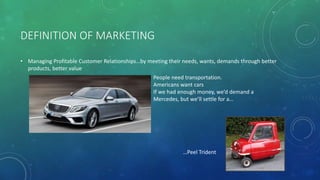
People need transportation.
Americans want cars
If we had enough money, we’d demand a
Mercedes, but we’ll settle for a…
…Peel Trident
MORE BROADLY…
• Marketing is a social and managerial process by which individuals and organizations obtain what they
need and want through creating and exchanging value with others (company and customer)
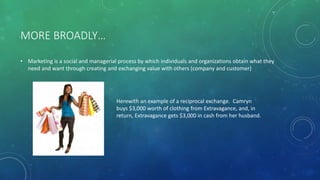
Herewith an example of a reciprocal exchange. Camryn
buys $3,000 worth of clothing from Extravagance, and, in
return, Extravagance gets $3,000 in cash from her husband.
SO, FROM AN ECONOMICS PERSPECTIVE…
• People want stuff, and organizations want money. The organization sells a product, the consumer
“sells” his or her money. A voluntary exchange takes place, everyone lives happily ever after, or until
people decide they want more stuff, and an organization wants more money.
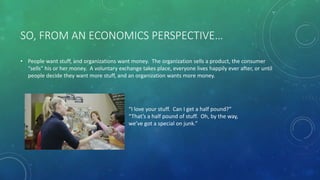
“I love your stuff. Can I get a half pound?”
“That’s a half pound of stuff. Oh, by the way,
we’ve got a special on junk.”
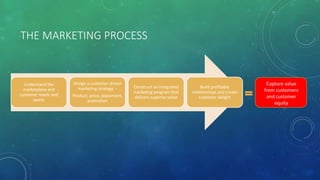
THE MARKETING PROCESS
Understand the
marketplace and
customer needs and
wants
Design a customer-driven
marketing strategy --
Product, price, placement,
promotion
Construct an integrated
marketing program that
delivers superior value
Build profitable
relationships and create
customer delight
Capture value
from customers
and customer
equity
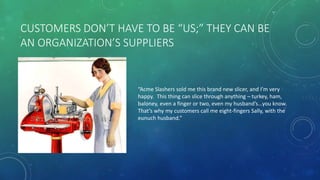
CUSTOMERS DON’T HAVE TO BE “US;” THEY CAN BE
AN ORGANIZATION’S SUPPLIERS
“Acme Slashers sold me this brand new slicer, and I’m very
happy. This thing can slice through anything – turkey, ham,
baloney, even a finger or two, even my husband’s…you know.
That’s why my customers call me eight-fingers Sally, with the
eunuch husband.”
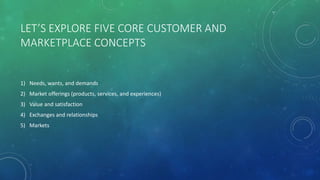
LET’S EXPLORE FIVE CORE CUSTOMER AND
MARKETPLACE CONCEPTS
1) Needs, wants, and demands
2) Market offerings (products, services, and experiences)
3) Value and satisfaction
4) Exchanges and relationships
5) Markets
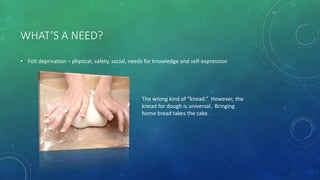
WHAT’S A NEED?
• Felt deprivation – physical, safety, social, needs for knowledge and self-expression
The wrong kind of “knead.” However, the
knead for dough is universal. Bringing
home bread takes the cake.
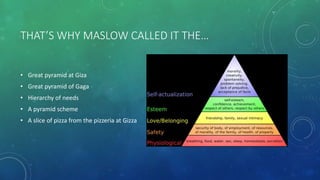
THAT’S WHY MASLOW CALLED IT THE…
• Great pyramid at Giza
• Great pyramid of Gaga
• Hierarchy of needs
• A pyramid scheme
• A slice of pizza from the pizzeria at Gizza
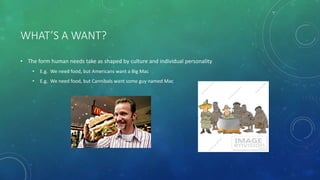
WHAT’S A WANT?
• The form human needs take as shaped by culture and individual personality
• E.g. We need food, but Americans want a Big Mac
• E.g. We need food, but Cannibals want some guy named Mac
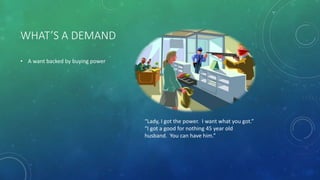
WHAT’S A DEMAND
• A want backed by buying power
“Lady, I got the power. I want what you got.”
“I got a good for nothing 45 year old
husband. You can have him.”
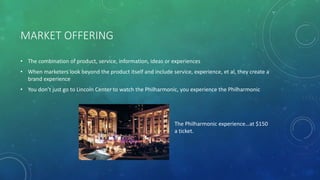
MARKET OFFERING
• The combination of product, service, information, ideas or experiences
• When marketers look beyond the product itself and include service, experience, et al, they create a
brand experience
• You don’t just go to Lincoln Center to watch the Philharmonic, you experience the Philharmonic
The Philharmonic experience…at $150
a ticket.
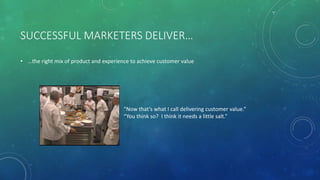
SUCCESSFUL MARKETERS DELIVER…
• …the right mix of product and experience to achieve customer value
“Now that’s what I call delivering customer value.”
“You think so? I think it needs a little salt.”
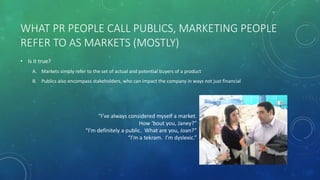
WHAT PR PEOPLE CALL PUBLICS, MARKETING PEOPLE
REFER TO AS MARKETS (MOSTLY)
• Is it true?
A. Markets simply refer to the set of actual and potential buyers of a product
B. Publics also encompass stakeholders, who can impact the company in ways not just financial
“I’ve always considered myself a market.
How ‘bout you, Janey?”
“I’m definitely a public. What are you, Joan?”
“I’m a tekram. I’m dyslexic.”
MARKETING MANAGEMENT
• The art and science of choosing target markets and building profitable relationships
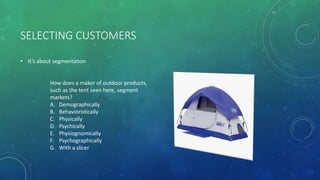
SELECTING CUSTOMERS
• It’s about segmentation
How does a maker of outdoor products,
such as the tent seen here, segment
markets?
A. Demographically
B. Behavioristically
C. Physically
D. Psychically
E. Physiognomically
F. Psychographically
G. With a slicer
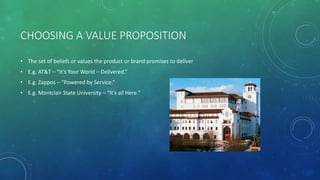
CHOOSING A VALUE PROPOSITION
• The set of beliefs or values the product or brand promises to deliver
• E.g. AT&T – “It’s Your World – Delivered.”
• E.g. Zappos – “Powered by Service.”
• E.g. Montclair State University – “It’s all Here.”
MARKETING ORIENTATIONS
• 1. Production Concept – customers favor products that are available and highly affordable.
• 2. Product Concept – customers favor products that offer the most in quality, performance, and
innovative features.
• 3. Selling Concept – customers will not buy enough of the firm’s products unless it undertakes a large-
scale selling and promotion effort. E.g. flood insurance, donating blood. Doesn’t build relationships.
Focuses on selling.
• 4. Marketing Concept – achieving organizational goals depend on knowing the needs and wants of
target markets and delivering the desired satisfaction better than the competition. Customer centered.
• 5. Societal Marketing Concept – questions whether the pure marketing concept overlooks possible
conflicts between consumer short-run wants and consumer long run welfare. In other words, benefits
both consumer and society.
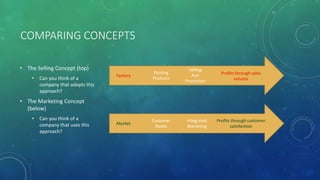
COMPARING CONCEPTS
• The Selling Concept (top)
• Can you think of a
company that adopts this
approach?
• The Marketing Concept
(below)
• Can you think of a
company that uses this
approach?
Factory
Existing
Products
Selling
And
Promotion
Profits through sales
volume
Market
Customer
Needs
Integrated
Marketing
Profits through customer
satisfaction
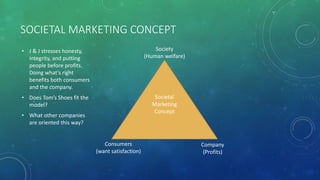
SOCIETAL MARKETING CONCEPT
• J & J stresses honesty,
integrity, and putting
people before profits.
Doing what’s right
benefits both consumers
and the company.
• Does Tom’s Shoes fit the
model?
• What other companies
are oriented this way?
Societal
Marketing
Concept
Consumers
(want satisfaction)
Society
(Human welfare)
Company
(Profits)
CUSTOMER RELATIONSHIP MANAGEMENT
• …is the overall process of building and maintaining profitable customer relationships by deliver superior
customer value and satisfaction
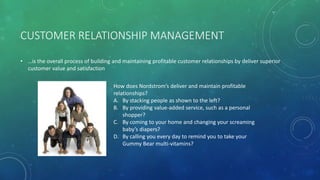
How does Nordstrom’s deliver and maintain profitable
relationships?
A. By stacking people as shown to the left?
B. By providing value-added service, such as a personal
shopper?
C. By coming to your home and changing your screaming
baby’s diapers?
D. By calling you every day to remind you to take your
Gummy Bear multi-vitamins?
CRM BUILDING BLOCKS
• Customer Value – customer evaluation of the difference between benefits and costs of your product
versus the competition (e.g. Do you think spending more for Starbucks coffee is a value to you?)
• Customer Satisfaction – product’s perceived performance matching customer expectation (e.g. “I
expected much more from my Dell computer.)
• What are some ways companies deliver value and/or satisfaction?
BEYOND CUSTOMER RELATIONSHIP MARKETING
• CUSTOMER MANAGED RELATIONSHIPS – Customers, empowered by technology, interact with
companies and with each other to shape their relationships with brands
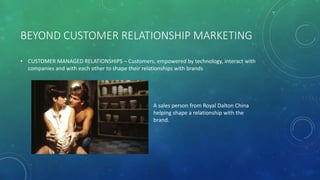
A sales person from Royal Dalton China
helping shape a relationship with the
brand.
CONSUMER GENERATED MARKETING
• Brand exchanges created by consumers themselves – both invited and uninvited – by which consumers
are playing an increasing role in shaping their own brand experiences with other consumers. E.g. User-
generated YouTube content by Tostitos customers.
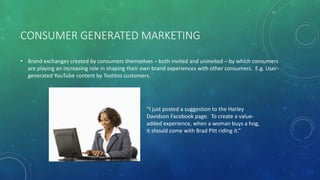
“I just posted a suggestion to the Harley
Davidson Facebook page. To create a value-
added experience, when a woman buys a hog,
it should come with Brad Pitt riding it.”
PARTNER RELATIONSHIP MANAGEMENT
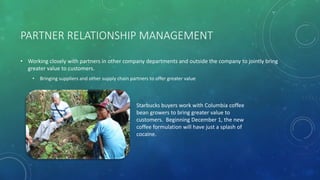
• Working closely with partners in other company departments and outside the company to jointly bring
greater value to customers.
• Bringing suppliers and other supply chain partners to offer greater value
Starbucks buyers work with Columbia coffee
bean growers to bring greater value to
customers. Beginning December 1, the new
coffee formulation will have just a splash of
cocaine.
HOW DO WE GET VALUE FROM OUR CUSTOMERS
• Current and future sales
• Market share
• Profits
“Welcome to our humble home. Our daughter says
you’re the sales guy who sold her her new car?”
“Thanks to you, the Miller family, I was able to make
enough money to get some hair plugs.”
BY CREATING VALUE…
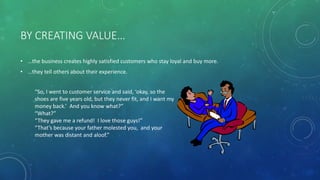
• …the business creates highly satisfied customers who stay loyal and buy more.
• …they tell others about their experience.
“So, I went to customer service and said, ‘okay, so the
shoes are five years old, but they never fit, and I want my
money back.’ And you know what?”
“What?”
“They gave me a refund! I love those guys!”
“That’s because your father molested you, and your
mother was distant and aloof.”
CUSTOMER LIFETIME VALUE
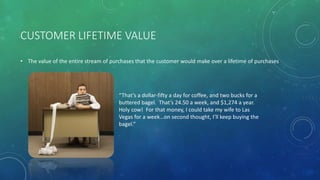
• The value of the entire stream of purchases that the customer would make over a lifetime of purchases
“That’s a dollar-fifty a day for coffee, and two bucks for a
buttered bagel. That’s 24.50 a week, and $1,274 a year.
Holy cow! For that money, I could take my wife to Las
Vegas for a week…on second thought, I’ll keep buying the
bagel.”
CUSTOMER RELATIONSHIP GROUPS
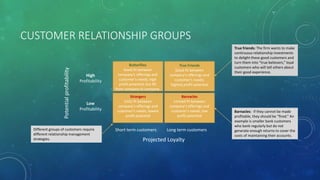
Potentialprofitability Butterflies
Good fit between
company’s offerings and
customer’s needs; high
profit potential; but flit
from company to company.
True Friends
Good fit between
company’s offerings and
customer’s needs;
highest profit potential
Strangers
Little fit between
company’s offerings and
customer’s needs; lowest
profit potential
Barnacles
Limited fit between
company’s offerings and
customer’s needs; low
profit potential
True friends: The firm wants to make
continuous relationship investments
to delight these good customers and
turn them into “true believers,” loyal
customers who will tell others about
their good experience.
Barnacles: If they cannot be made
profitable, they should be “fired.” An
example is smaller bank customers
who bank regularly but do not
generate enough returns to cover the
costs of maintaining their accounts.
Different groups of customers require
different relationship management
strategies.
Short term customers Long term customers
Projected Loyalty
High
Profitability
Low
Profitability
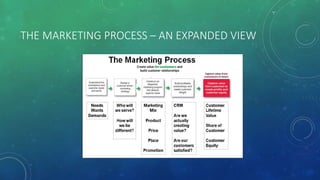
THE MARKETING PROCESS – AN EXPANDED VIEW
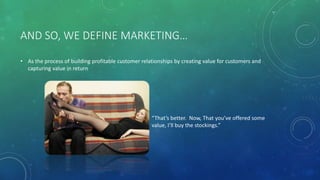
AND SO, WE DEFINE MARKETING…
• As the process of building profitable customer relationships by creating value for customers and
capturing value in return
“That’s better. Now, That you’ve offered some
value, I’ll buy the stockings.”
DEFINITION OF PUBLIC RELATIONS
(PRSA)
• Public relations is a strategic communication process that builds mutually beneficial relationships
between organizations and their publics.”
SO, WHAT’S THE DIFFERENCE?
• Where does marketing end and PR begin, or, is there lots of overlapping going on?
“It’s a real conundrum.”
MARKETING…
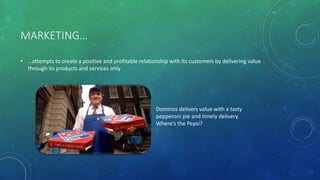
• …attempts to create a positive and profitable relationship with its customers by delivering value
through its products and services only
Dominos delivers value with a tasty
pepperoni pie and timely delivery.
Where’s the Pepsi?
PUBLIC RELATIONS
• …attempts to create a positive relationship with not just customers, but stakeholders as well…people
who can influence a company in either positive or negative ways.
A steakholder
ULTIMATELY, THOSE STAKEHOLDERS…
• Provide us with quality labor
• Can be loyal employees
• Make life easier or more difficult for the company to survive
• Enablers
• Adversaries
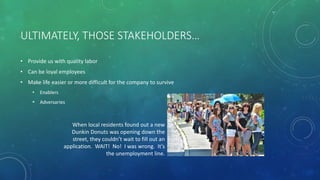
When local residents found out a new
Dunkin Donuts was opening down the
street, they couldn’t wait to fill out an
application. WAIT! No! I was wrong. It’s
the unemployment line.
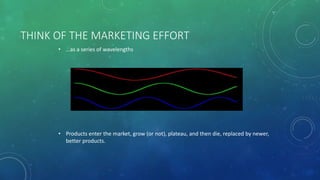
THINK OF THE MARKETING EFFORT
• …as a series of wavelengths
• Products enter the market, grow (or not), plateau, and then die, replaced by newer,
better products.
THE PUBLIC RELATIONS FUNCTION IS…
• Ongoing, constant, eternal vigilance, measuring stakeholder perceptions to make sure the PR/Ph
balance is maintained. Think of a straight line.
Here, a group tests the PR/Ph balance. Shirley, on the left, thinks
it’s a little acidic, while Heather (second from right), thinks it’s too
alkaline. Jennifer (in blue) is hoping there’s a bathroom nearby,
while, Joan (right) just bit into a rusty nail embedded in a pumpkin
muffin.
MARKETING IS…
• Product focused
• Product branding
“Wow, that Lindsay Lohan is one nice product!”
PUBLIC RELATIONS…
• *Focuses (generally) on the company
• Focuses on corporate messaging
* Exception: Marketing PR, which is a marketing tool
“It’s a bird…it’s a plane. No, it’s…a fungal
cream. Must be marketing.”
THE PUBLIC RELATIONS FUNCTION…
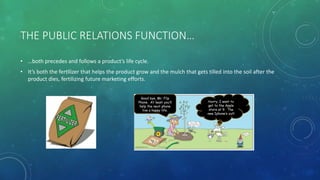
• …both precedes and follows a product’s life cycle.
• It’s both the fertilizer that helps the product grow and the mulch that gets tilled into the soil after the
product dies, fertilizing future marketing efforts.
Good bye, Mr. Flip
Phone. At least you’ll
help the next phone
live a happy life.
Hurry, I want to
get to the Apple
store at 9. The
new Iphone’s out!
PUBLIC RELATIONS GOES ON AFTER A PRODUCT IS
BURIED
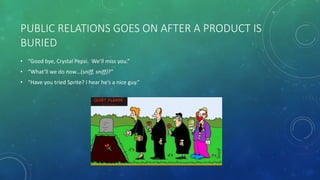
• “Good bye, Crystal Pepsi. We’ll miss you.”
• “What’ll we do now…(sniff, sniff)?”
• “Have you tried Sprite? I hear he’s a nice guy.”
SO, WHEN NEW PRODUCTS ARE INTRODUCED
• The corporate Ethos – one of the three legs of the rhetorical triumvirate – and
the one most important for establishing credibility and “persuasability” –
helps make marketing products easier.
LogosEthos Pathos
AND SO, IT TAKES US BACK TO THE VERY FIRST
CHAPTER WE READ ON…
THAT’S WHAT PUBLIC RELATIONS DELIVERS
• Unfortunately, few practitioners can articulate this.
• And, it’s why most PR people find themselves reporting to marketing mangers.
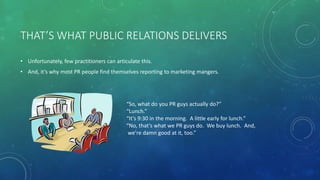
“So, what do you PR guys actually do?”
“Lunch.”
“It’s 9:30 in the morning. A little early for lunch.”
“No, that’s what we PR guys do. We buy lunch. And,
we’re damn good at it, too.”
NEXT WEEK…
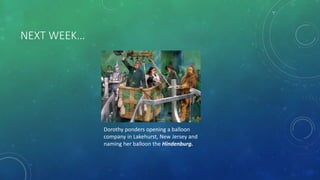
Dorothy ponders opening a balloon
company in Lakehurst, New Jersey and
naming her balloon the Hindenburg.
What is marketing

What is marketing

  • 2.
    WHAT IS MARKETING… AND,HOW DOES PR DIFFER – OR NOT SEE HOW MUCH OF THE MARKETING FUNCTION IS SIMILAR TO PR…AND HOW MUCH ISN’T “Crazy, man. We just went marketing. We didn’t go PR’ing.
  • 3.
    DEFINITION OF MARKETING •Managing Profitable Customer Relationships…by meeting their needs, wants, demands through better products, better value People need transportation. Americans want cars If we had enough money, we’d demand a Mercedes, but we’ll settle for a… …Peel Trident
  • 4.
    MORE BROADLY… • Marketingis a social and managerial process by which individuals and organizations obtain what they need and want through creating and exchanging value with others (company and customer) Herewith an example of a reciprocal exchange. Camryn buys $3,000 worth of clothing from Extravagance, and, in return, Extravagance gets $3,000 in cash from her husband.
  • 5.
    SO, FROM ANECONOMICS PERSPECTIVE… • People want stuff, and organizations want money. The organization sells a product, the consumer “sells” his or her money. A voluntary exchange takes place, everyone lives happily ever after, or until people decide they want more stuff, and an organization wants more money. “I love your stuff. Can I get a half pound?” “That’s a half pound of stuff. Oh, by the way, we’ve got a special on junk.”
  • 6.
    THE MARKETING PROCESS Understandthe marketplace and customer needs and wants Design a customer-driven marketing strategy -- Product, price, placement, promotion Construct an integrated marketing program that delivers superior value Build profitable relationships and create customer delight Capture value from customers and customer equity
  • 7.
    CUSTOMERS DON’T HAVETO BE “US;” THEY CAN BE AN ORGANIZATION’S SUPPLIERS “Acme Slashers sold me this brand new slicer, and I’m very happy. This thing can slice through anything – turkey, ham, baloney, even a finger or two, even my husband’s…you know. That’s why my customers call me eight-fingers Sally, with the eunuch husband.”
  • 8.
    LET’S EXPLORE FIVECORE CUSTOMER AND MARKETPLACE CONCEPTS 1) Needs, wants, and demands 2) Market offerings (products, services, and experiences) 3) Value and satisfaction 4) Exchanges and relationships 5) Markets
  • 9.
    WHAT’S A NEED? •Felt deprivation – physical, safety, social, needs for knowledge and self-expression The wrong kind of “knead.” However, the knead for dough is universal. Bringing home bread takes the cake.
  • 10.
    THAT’S WHY MASLOWCALLED IT THE… • Great pyramid at Giza • Great pyramid of Gaga • Hierarchy of needs • A pyramid scheme • A slice of pizza from the pizzeria at Gizza
  • 11.
    WHAT’S A WANT? •The form human needs take as shaped by culture and individual personality • E.g. We need food, but Americans want a Big Mac • E.g. We need food, but Cannibals want some guy named Mac
  • 12.
    WHAT’S A DEMAND •A want backed by buying power “Lady, I got the power. I want what you got.” “I got a good for nothing 45 year old husband. You can have him.”
  • 13.
    MARKET OFFERING • Thecombination of product, service, information, ideas or experiences • When marketers look beyond the product itself and include service, experience, et al, they create a brand experience • You don’t just go to Lincoln Center to watch the Philharmonic, you experience the Philharmonic The Philharmonic experience…at $150 a ticket.
  • 14.
    SUCCESSFUL MARKETERS DELIVER… •…the right mix of product and experience to achieve customer value “Now that’s what I call delivering customer value.” “You think so? I think it needs a little salt.”
  • 15.
    WHAT PR PEOPLECALL PUBLICS, MARKETING PEOPLE REFER TO AS MARKETS (MOSTLY) • Is it true? A. Markets simply refer to the set of actual and potential buyers of a product B. Publics also encompass stakeholders, who can impact the company in ways not just financial “I’ve always considered myself a market. How ‘bout you, Janey?” “I’m definitely a public. What are you, Joan?” “I’m a tekram. I’m dyslexic.”
  • 16.
    MARKETING MANAGEMENT • Theart and science of choosing target markets and building profitable relationships
  • 17.
    SELECTING CUSTOMERS • It’sabout segmentation How does a maker of outdoor products, such as the tent seen here, segment markets? A. Demographically B. Behavioristically C. Physically D. Psychically E. Physiognomically F. Psychographically G. With a slicer
  • 18.
    CHOOSING A VALUEPROPOSITION • The set of beliefs or values the product or brand promises to deliver • E.g. AT&T – “It’s Your World – Delivered.” • E.g. Zappos – “Powered by Service.” • E.g. Montclair State University – “It’s all Here.”
  • 19.
    MARKETING ORIENTATIONS • 1.Production Concept – customers favor products that are available and highly affordable. • 2. Product Concept – customers favor products that offer the most in quality, performance, and innovative features. • 3. Selling Concept – customers will not buy enough of the firm’s products unless it undertakes a large- scale selling and promotion effort. E.g. flood insurance, donating blood. Doesn’t build relationships. Focuses on selling. • 4. Marketing Concept – achieving organizational goals depend on knowing the needs and wants of target markets and delivering the desired satisfaction better than the competition. Customer centered. • 5. Societal Marketing Concept – questions whether the pure marketing concept overlooks possible conflicts between consumer short-run wants and consumer long run welfare. In other words, benefits both consumer and society.
  • 20.
    COMPARING CONCEPTS • TheSelling Concept (top) • Can you think of a company that adopts this approach? • The Marketing Concept (below) • Can you think of a company that uses this approach? Factory Existing Products Selling And Promotion Profits through sales volume Market Customer Needs Integrated Marketing Profits through customer satisfaction
  • 21.
    SOCIETAL MARKETING CONCEPT •J & J stresses honesty, integrity, and putting people before profits. Doing what’s right benefits both consumers and the company. • Does Tom’s Shoes fit the model? • What other companies are oriented this way? Societal Marketing Concept Consumers (want satisfaction) Society (Human welfare) Company (Profits)
  • 22.
    CUSTOMER RELATIONSHIP MANAGEMENT •…is the overall process of building and maintaining profitable customer relationships by deliver superior customer value and satisfaction How does Nordstrom’s deliver and maintain profitable relationships? A. By stacking people as shown to the left? B. By providing value-added service, such as a personal shopper? C. By coming to your home and changing your screaming baby’s diapers? D. By calling you every day to remind you to take your Gummy Bear multi-vitamins?
  • 23.
    CRM BUILDING BLOCKS •Customer Value – customer evaluation of the difference between benefits and costs of your product versus the competition (e.g. Do you think spending more for Starbucks coffee is a value to you?) • Customer Satisfaction – product’s perceived performance matching customer expectation (e.g. “I expected much more from my Dell computer.) • What are some ways companies deliver value and/or satisfaction?
  • 24.
    BEYOND CUSTOMER RELATIONSHIPMARKETING • CUSTOMER MANAGED RELATIONSHIPS – Customers, empowered by technology, interact with companies and with each other to shape their relationships with brands A sales person from Royal Dalton China helping shape a relationship with the brand.
  • 25.
    CONSUMER GENERATED MARKETING •Brand exchanges created by consumers themselves – both invited and uninvited – by which consumers are playing an increasing role in shaping their own brand experiences with other consumers. E.g. User- generated YouTube content by Tostitos customers. “I just posted a suggestion to the Harley Davidson Facebook page. To create a value- added experience, when a woman buys a hog, it should come with Brad Pitt riding it.”
  • 26.
    PARTNER RELATIONSHIP MANAGEMENT •Working closely with partners in other company departments and outside the company to jointly bring greater value to customers. • Bringing suppliers and other supply chain partners to offer greater value Starbucks buyers work with Columbia coffee bean growers to bring greater value to customers. Beginning December 1, the new coffee formulation will have just a splash of cocaine.
  • 27.
    HOW DO WEGET VALUE FROM OUR CUSTOMERS • Current and future sales • Market share • Profits “Welcome to our humble home. Our daughter says you’re the sales guy who sold her her new car?” “Thanks to you, the Miller family, I was able to make enough money to get some hair plugs.”
  • 28.
    BY CREATING VALUE… •…the business creates highly satisfied customers who stay loyal and buy more. • …they tell others about their experience. “So, I went to customer service and said, ‘okay, so the shoes are five years old, but they never fit, and I want my money back.’ And you know what?” “What?” “They gave me a refund! I love those guys!” “That’s because your father molested you, and your mother was distant and aloof.”
  • 29.
    CUSTOMER LIFETIME VALUE •The value of the entire stream of purchases that the customer would make over a lifetime of purchases “That’s a dollar-fifty a day for coffee, and two bucks for a buttered bagel. That’s 24.50 a week, and $1,274 a year. Holy cow! For that money, I could take my wife to Las Vegas for a week…on second thought, I’ll keep buying the bagel.”
  • 30.
    CUSTOMER RELATIONSHIP GROUPS PotentialprofitabilityButterflies Good fit between company’s offerings and customer’s needs; high profit potential; but flit from company to company. True Friends Good fit between company’s offerings and customer’s needs; highest profit potential Strangers Little fit between company’s offerings and customer’s needs; lowest profit potential Barnacles Limited fit between company’s offerings and customer’s needs; low profit potential True friends: The firm wants to make continuous relationship investments to delight these good customers and turn them into “true believers,” loyal customers who will tell others about their good experience. Barnacles: If they cannot be made profitable, they should be “fired.” An example is smaller bank customers who bank regularly but do not generate enough returns to cover the costs of maintaining their accounts. Different groups of customers require different relationship management strategies. Short term customers Long term customers Projected Loyalty High Profitability Low Profitability
  • 31.
    THE MARKETING PROCESS– AN EXPANDED VIEW
  • 32.
    AND SO, WEDEFINE MARKETING… • As the process of building profitable customer relationships by creating value for customers and capturing value in return “That’s better. Now, That you’ve offered some value, I’ll buy the stockings.”
  • 33.
    DEFINITION OF PUBLICRELATIONS (PRSA) • Public relations is a strategic communication process that builds mutually beneficial relationships between organizations and their publics.”
  • 34.
    SO, WHAT’S THEDIFFERENCE? • Where does marketing end and PR begin, or, is there lots of overlapping going on? “It’s a real conundrum.”
  • 35.
    MARKETING… • …attempts tocreate a positive and profitable relationship with its customers by delivering value through its products and services only Dominos delivers value with a tasty pepperoni pie and timely delivery. Where’s the Pepsi?
  • 36.
    PUBLIC RELATIONS • …attemptsto create a positive relationship with not just customers, but stakeholders as well…people who can influence a company in either positive or negative ways. A steakholder
  • 37.
    ULTIMATELY, THOSE STAKEHOLDERS… •Provide us with quality labor • Can be loyal employees • Make life easier or more difficult for the company to survive • Enablers • Adversaries When local residents found out a new Dunkin Donuts was opening down the street, they couldn’t wait to fill out an application. WAIT! No! I was wrong. It’s the unemployment line.
  • 38.
    THINK OF THEMARKETING EFFORT • …as a series of wavelengths • Products enter the market, grow (or not), plateau, and then die, replaced by newer, better products.
  • 39.
    THE PUBLIC RELATIONSFUNCTION IS… • Ongoing, constant, eternal vigilance, measuring stakeholder perceptions to make sure the PR/Ph balance is maintained. Think of a straight line. Here, a group tests the PR/Ph balance. Shirley, on the left, thinks it’s a little acidic, while Heather (second from right), thinks it’s too alkaline. Jennifer (in blue) is hoping there’s a bathroom nearby, while, Joan (right) just bit into a rusty nail embedded in a pumpkin muffin.
  • 40.
    MARKETING IS… • Productfocused • Product branding “Wow, that Lindsay Lohan is one nice product!”
  • 41.
    PUBLIC RELATIONS… • *Focuses(generally) on the company • Focuses on corporate messaging * Exception: Marketing PR, which is a marketing tool “It’s a bird…it’s a plane. No, it’s…a fungal cream. Must be marketing.”
  • 42.
    THE PUBLIC RELATIONSFUNCTION… • …both precedes and follows a product’s life cycle. • It’s both the fertilizer that helps the product grow and the mulch that gets tilled into the soil after the product dies, fertilizing future marketing efforts. Good bye, Mr. Flip Phone. At least you’ll help the next phone live a happy life. Hurry, I want to get to the Apple store at 9. The new Iphone’s out!
  • 43.
    PUBLIC RELATIONS GOESON AFTER A PRODUCT IS BURIED • “Good bye, Crystal Pepsi. We’ll miss you.” • “What’ll we do now…(sniff, sniff)?” • “Have you tried Sprite? I hear he’s a nice guy.”
  • 44.
    SO, WHEN NEWPRODUCTS ARE INTRODUCED • The corporate Ethos – one of the three legs of the rhetorical triumvirate – and the one most important for establishing credibility and “persuasability” – helps make marketing products easier. LogosEthos Pathos
  • 45.
    AND SO, ITTAKES US BACK TO THE VERY FIRST CHAPTER WE READ ON…
  • 46.
    THAT’S WHAT PUBLICRELATIONS DELIVERS • Unfortunately, few practitioners can articulate this. • And, it’s why most PR people find themselves reporting to marketing mangers. “So, what do you PR guys actually do?” “Lunch.” “It’s 9:30 in the morning. A little early for lunch.” “No, that’s what we PR guys do. We buy lunch. And, we’re damn good at it, too.”
  • 47.
    NEXT WEEK… Dorothy pondersopening a balloon company in Lakehurst, New Jersey and naming her balloon the Hindenburg.