7 Reasons Why
Customer Value is
Your Secret Weapon
And how to start delivering it to your customers
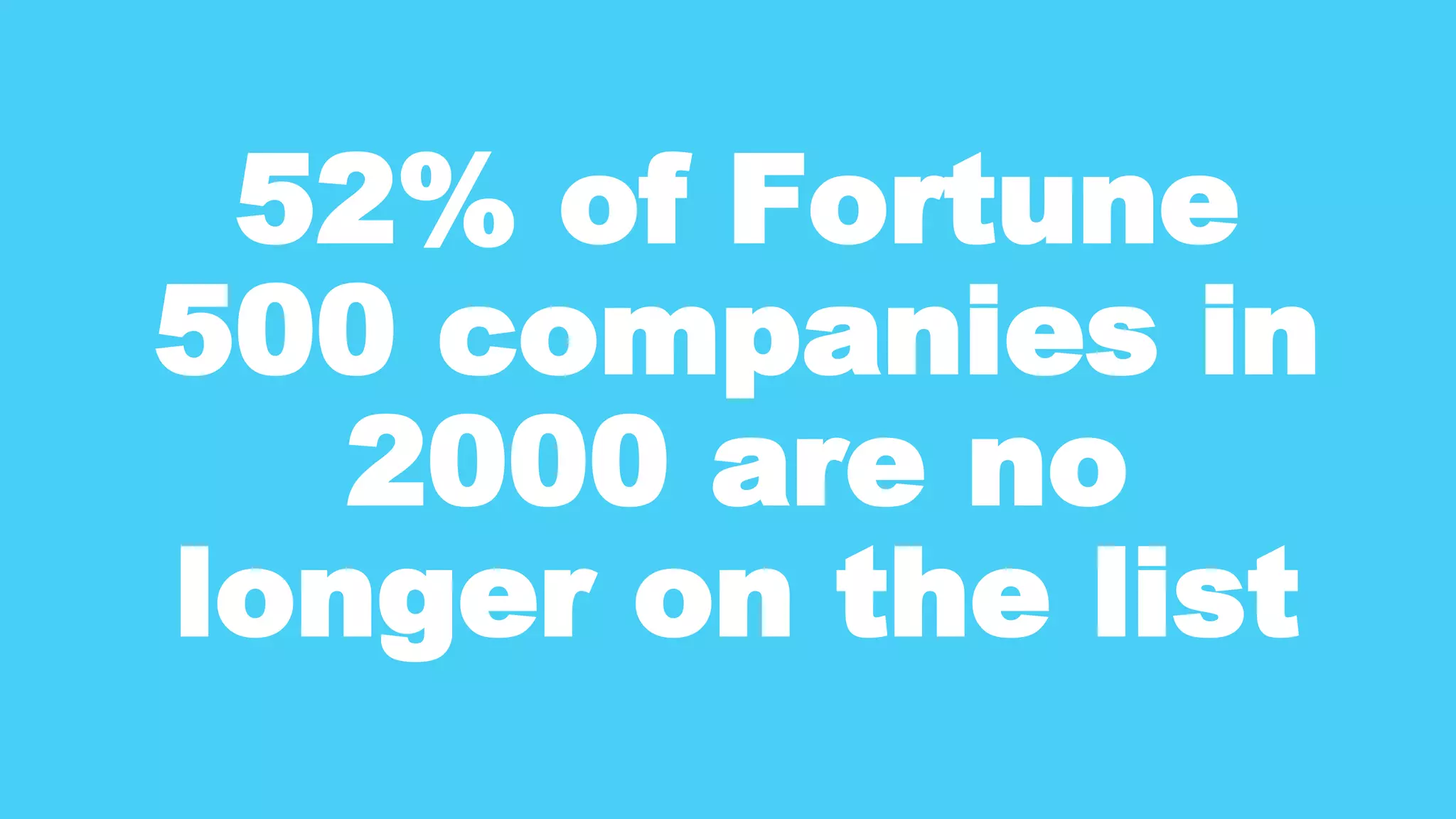
52% of Fortune
500 companies in
2000 are no
longer on the list
What is value?
"Something worth the money it
cost"
Perceived value = benefits –
costs
Total cost of ownership (TCO) =
search + installation+ ancillary +
running + maintenance + insurance
Perceived value = benefits -
TCO
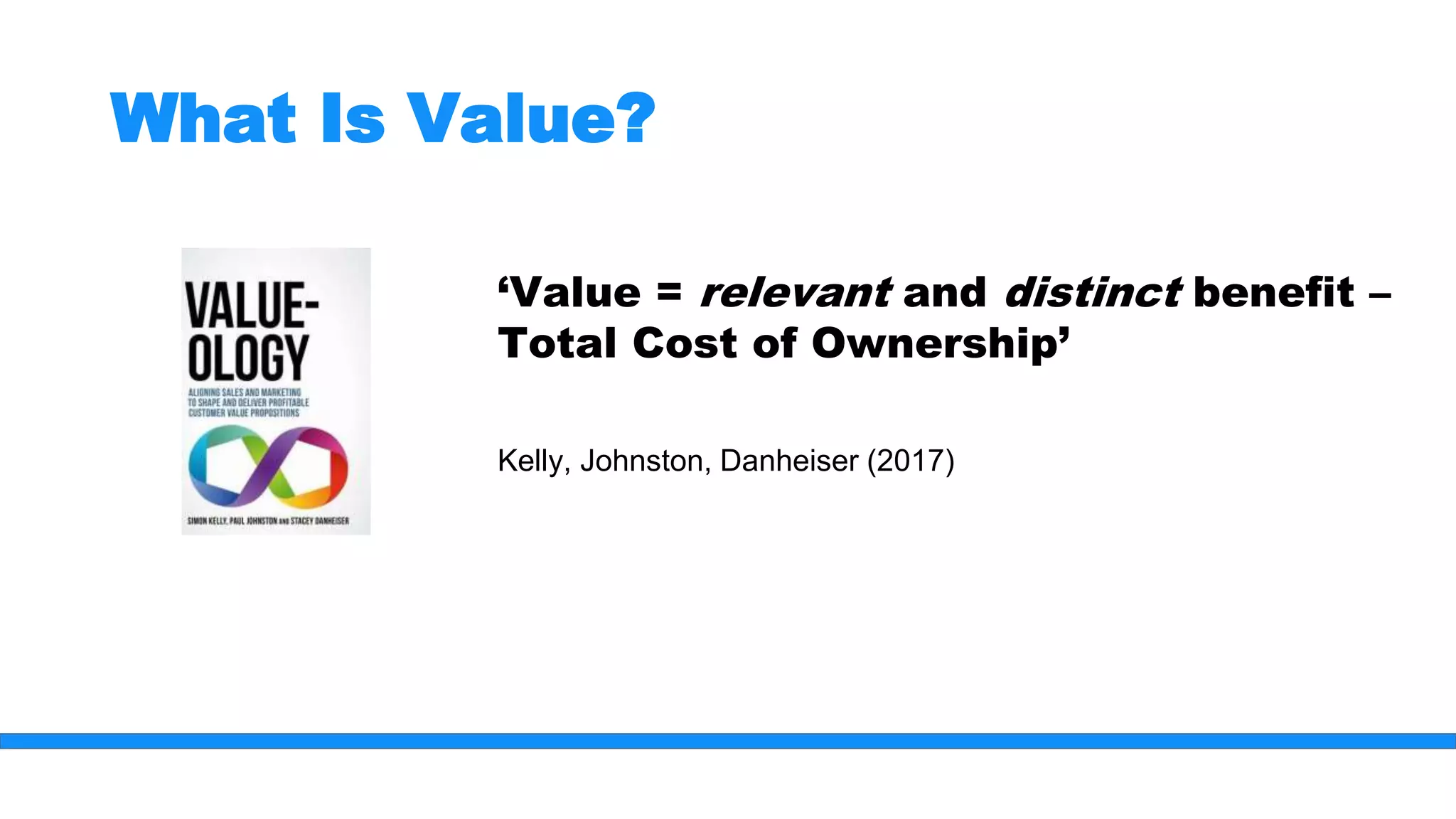
What Is Value?
‘Value = relevant and distinct benefit –
Total Cost of Ownership’
Kelly, Johnston, Danheiser (2017)
Types of value
Economic value -‘the price someone is willing to pay’
Porter 1985
Perceived value - Perceived benefits minus costs/total cost of
ownership (so called ‘give and get’)
Zeithaml 1988
Relational value – core solution plus knowledge sharing, trust, co-
operation and commitment over time
Gronroos 1996
Experiential value – core solution, relational value and positive
subjective feelings such as professionalism
Pine and Gilmore 1998, Helkkula, Kelleher, Philstrom 2012
Co-creation value – supplier and customer get value at the same time
(value appropriation)
Vargo and Lusch 2004
POLL:
Which element of value do
your customers care about
most?
7 reasons
1. Customers want value, not products
2. Organizations that are customer-focused grow faster
3. To resonate with customers – and stop wasting money
4. Customers are moving ahead without you
5. Which means….marketing and sales need to be
aligned
6. To be more relevant, persuasive and sell more
7. It's not just about the sales, it's about service …and
experience
#1
Customers want value,
not products
 Only 16% of C Level customers chose a vendor because of their
product
 Customers want salespeople that understand their business and can
provide a solution
What to do
 83% of marketers don’t have a clear
definition of value proposition.
 Clearly define what “value” and
“value proposition” mean in your
organization.
What Is A Value Proposition?
‘A value proposition is a promise of
expected future value illustrating
future relevant and distinct benefits
that will outweigh total cost of
ownership.’
Kelly, Johnston, Danheiser (2017)
#2
Customer-Focused
Organizations Grow
Faster
 Customer-centric orgs are 60% more profitable compared to those
that aren’t (Deloitte and Touche)
 Aberdeen group research said that organizations who effectively
leverage on-line resources (value-ology approach) grow 21%
What to do
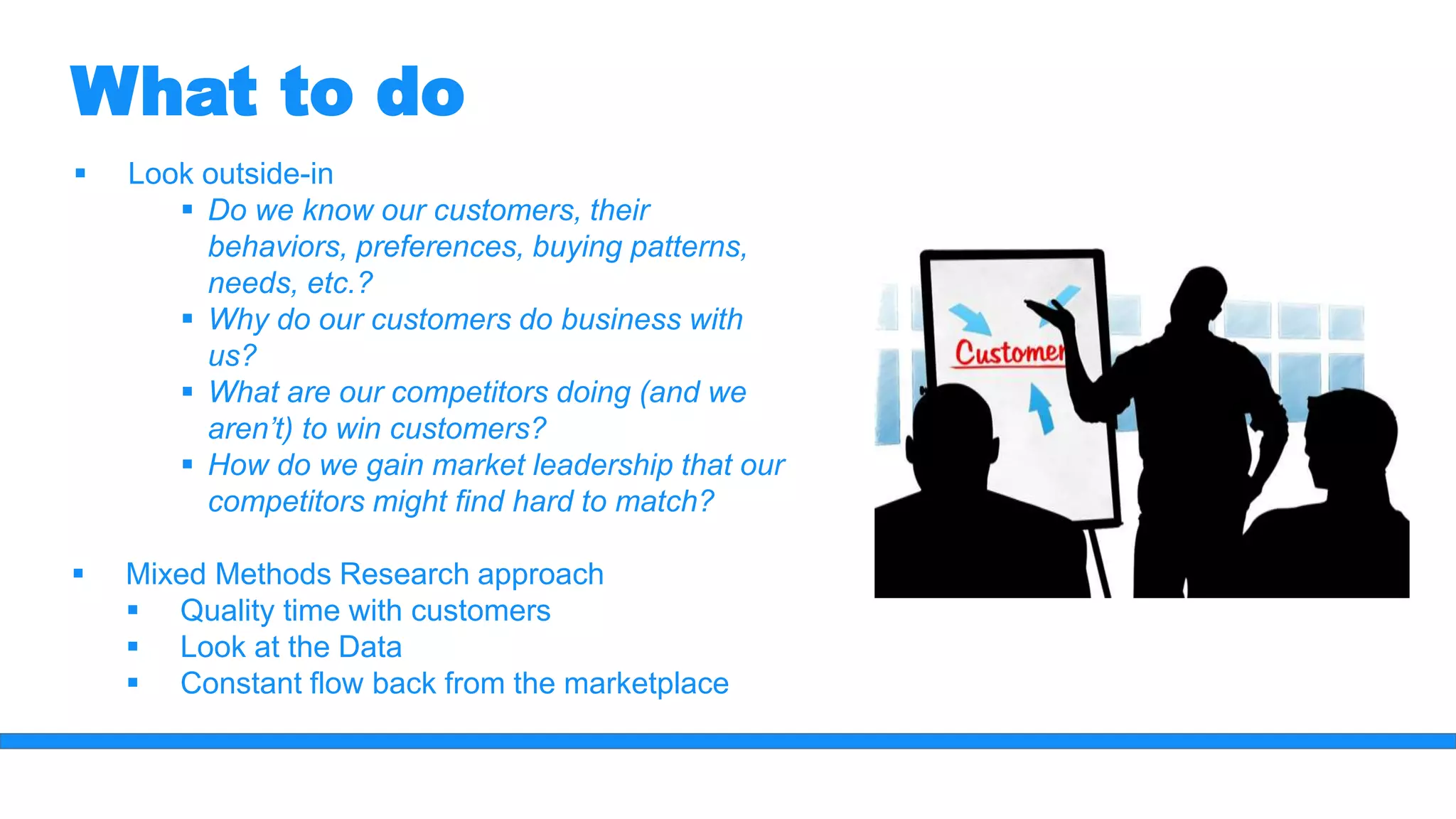
 Look outside-in
 Do we know our customers, their
behaviors, preferences, buying patterns,
needs, etc.?
 Why do our customers do business with
us?
 What are our competitors doing (and we
aren’t) to win customers?
 How do we gain market leadership that our
competitors might find hard to match?
 Mixed Methods Research approach
 Quality time with customers
 Look at the Data
 Constant flow back from the marketplace
#3
Resonate with
customers – and stop
wasting money
 B2B organizations waste $958 million on ineffective marketing every year
 94% of customers have completely disengaged with content because it
fails to resonate (CEB) While 91% say they will pass resonating content
on to peers
What to do
 Look at your website and sales
presentations for meaningless
claims like "world class", "end to
end”, “robust”, “the best”
 Chunk up to value themes
#4
Customers are moving
ahead without you
 Customers are typically 60% of way through buying process before
they contact you
 67% have a clear picture of what they want when they first speak to
you
What to do
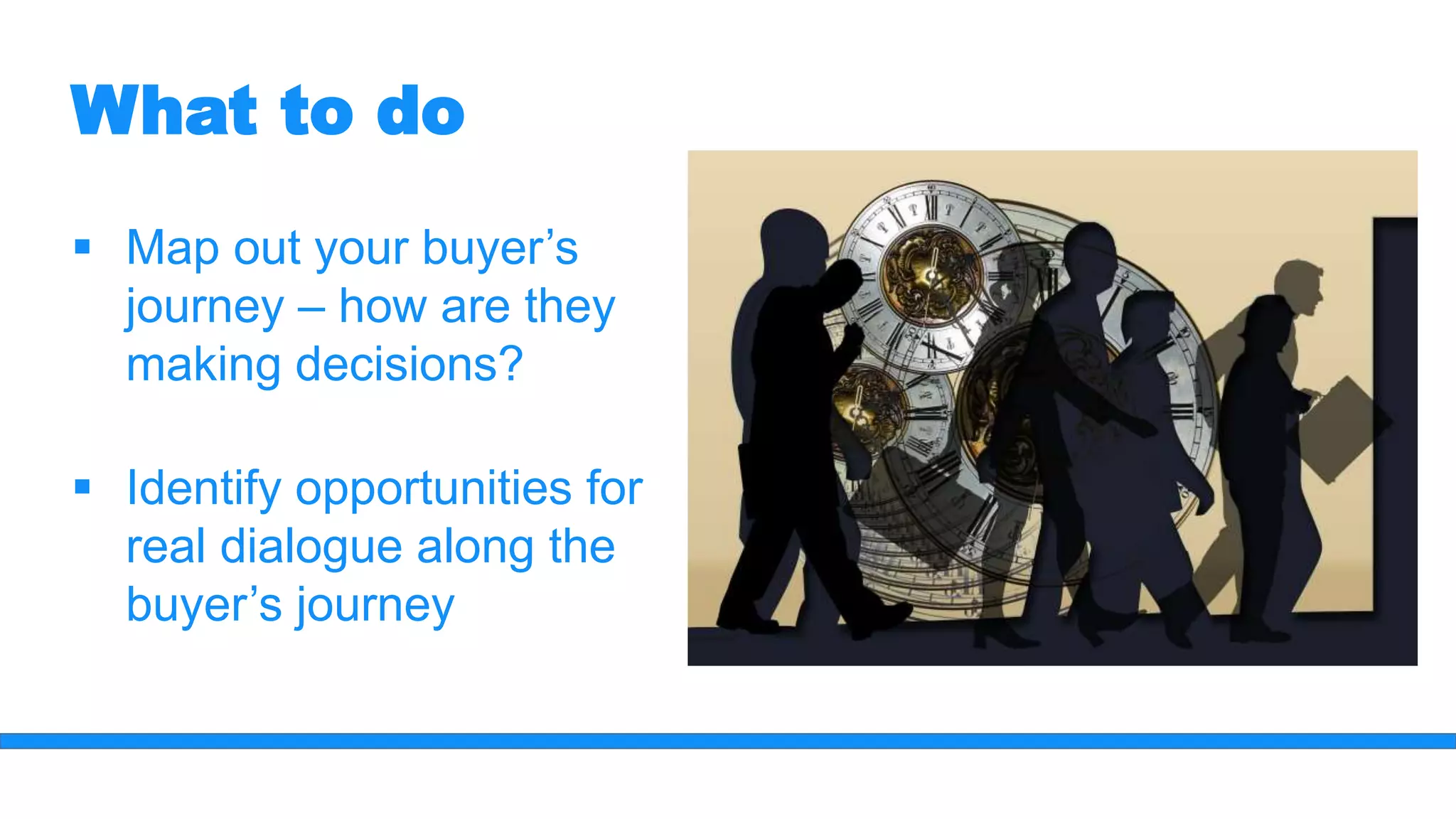
 Map out your buyer’s
journey – how are they
making decisions?
 Identify opportunities for
real dialogue along the
buyer’s journey
Confirm
Did I make
the right
choice?
Awareness
Should I
solve this
problem?
Education
What are my
options to solve
this problem?
Comparison
What is the best
solution out
there?
Purchase
I’ve made
a decision
The Buyer’s
Journey
#5
Marketing and Sales
need to be aligned
• Highly aligned organisations typically experience 32% y-o-y growth
(Aberdeen Group)
• Less than 40% of organisations say they are aligned to what customers want
(Cespedes)
What to do
 Understand where you are at
now - alignment roadmap
 Set common strategic goals
 Make sure roles are clear
 Have more customer value
conversations
 Agree what success looks
like
Customer
Alignment
Roadmap Road to nowhere Highway to Heaven
Road to hell Rocky Road -
Long and
winding road
Sales &
Marketing
Alignment
Aligned
Not Aligned
AlignedNot Aligned
Customer Alignment
POLL:
How well aligned are your
marketing and sales
teams?
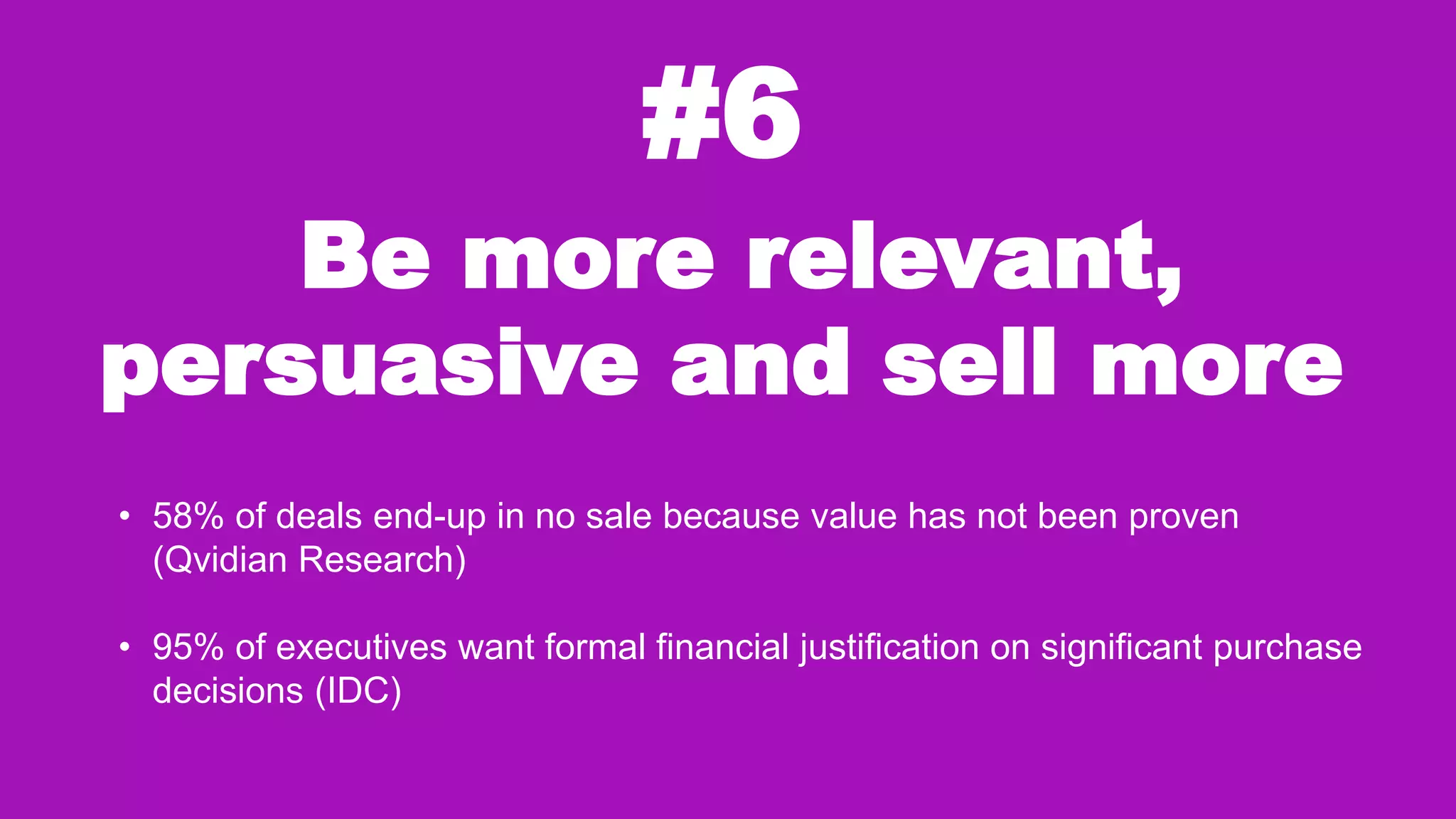
#6
Be more relevant,
persuasive and sell more
• 58% of deals end-up in no sale because value has not been proven
(Qvidian Research)
• 95% of executives want formal financial justification on significant purchase
decisions (IDC)
What to do
 Quantify the value your product or
solution provides
 Use the musicAL approach:
 Monetary calculation
 Unique
 Spend (costs)
 Impact
 Capability
 ALigned to the needs of the
customer
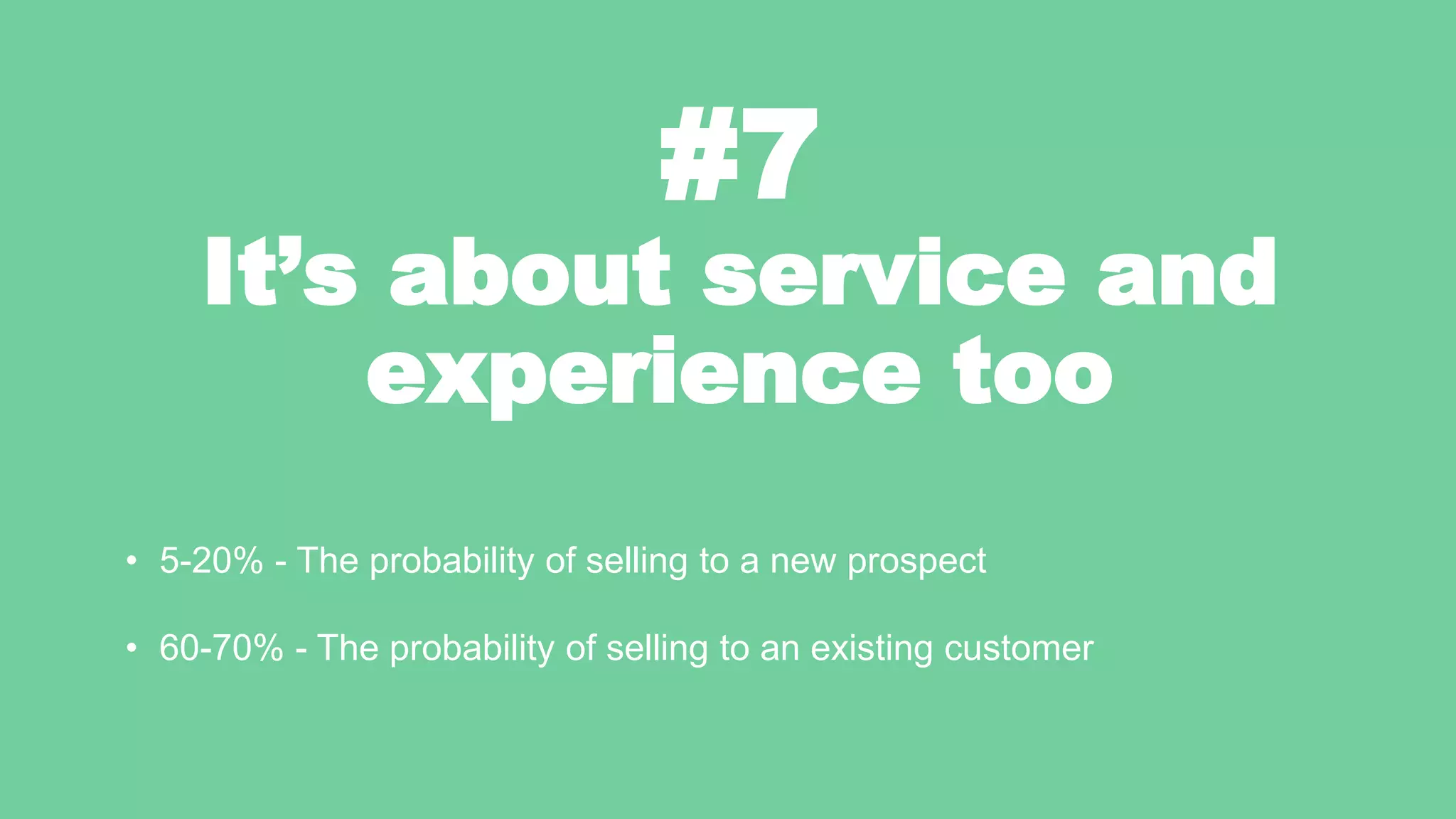
#7
It’s about service and
experience too
• 5-20% - The probability of selling to a new prospect
• 60-70% - The probability of selling to an existing customer
What to do
 Follow-up with your
customers – are they getting
the value you promised?
 Master the integrated
approach – online and
offline
Additional Tools
FREE ebook – Rock your customers’ World
www.customervaluelink.com/free-resources
Value-ology – online course and book to help
you understand how to tune into and deliver
customer value
www.customervaluelink.com

7 reasons why customer value is your secret weapon

  • 1.
    7 Reasons Why CustomerValue is Your Secret Weapon And how to start delivering it to your customers
  • 2.
    52% of Fortune 500companies in 2000 are no longer on the list
  • 3.
    What is value? "Somethingworth the money it cost" Perceived value = benefits – costs Total cost of ownership (TCO) = search + installation+ ancillary + running + maintenance + insurance Perceived value = benefits - TCO
  • 4.
    What Is Value? ‘Value= relevant and distinct benefit – Total Cost of Ownership’ Kelly, Johnston, Danheiser (2017)
  • 5.
    Types of value Economicvalue -‘the price someone is willing to pay’ Porter 1985 Perceived value - Perceived benefits minus costs/total cost of ownership (so called ‘give and get’) Zeithaml 1988 Relational value – core solution plus knowledge sharing, trust, co- operation and commitment over time Gronroos 1996 Experiential value – core solution, relational value and positive subjective feelings such as professionalism Pine and Gilmore 1998, Helkkula, Kelleher, Philstrom 2012 Co-creation value – supplier and customer get value at the same time (value appropriation) Vargo and Lusch 2004
  • 6.
    POLL: Which element ofvalue do your customers care about most?
  • 7.
    7 reasons 1. Customerswant value, not products 2. Organizations that are customer-focused grow faster 3. To resonate with customers – and stop wasting money 4. Customers are moving ahead without you 5. Which means….marketing and sales need to be aligned 6. To be more relevant, persuasive and sell more 7. It's not just about the sales, it's about service …and experience
  • 8.
    #1 Customers want value, notproducts  Only 16% of C Level customers chose a vendor because of their product  Customers want salespeople that understand their business and can provide a solution
  • 9.
    What to do 83% of marketers don’t have a clear definition of value proposition.  Clearly define what “value” and “value proposition” mean in your organization.
  • 10.
    What Is AValue Proposition? ‘A value proposition is a promise of expected future value illustrating future relevant and distinct benefits that will outweigh total cost of ownership.’ Kelly, Johnston, Danheiser (2017)
  • 11.
    #2 Customer-Focused Organizations Grow Faster  Customer-centricorgs are 60% more profitable compared to those that aren’t (Deloitte and Touche)  Aberdeen group research said that organizations who effectively leverage on-line resources (value-ology approach) grow 21%
  • 12.
    What to do Look outside-in  Do we know our customers, their behaviors, preferences, buying patterns, needs, etc.?  Why do our customers do business with us?  What are our competitors doing (and we aren’t) to win customers?  How do we gain market leadership that our competitors might find hard to match?  Mixed Methods Research approach  Quality time with customers  Look at the Data  Constant flow back from the marketplace
  • 13.
    #3 Resonate with customers –and stop wasting money  B2B organizations waste $958 million on ineffective marketing every year  94% of customers have completely disengaged with content because it fails to resonate (CEB) While 91% say they will pass resonating content on to peers
  • 14.
    What to do Look at your website and sales presentations for meaningless claims like "world class", "end to end”, “robust”, “the best”  Chunk up to value themes
  • 15.
    #4 Customers are moving aheadwithout you  Customers are typically 60% of way through buying process before they contact you  67% have a clear picture of what they want when they first speak to you
  • 16.
    What to do Map out your buyer’s journey – how are they making decisions?  Identify opportunities for real dialogue along the buyer’s journey
  • 17.
    Confirm Did I make theright choice? Awareness Should I solve this problem? Education What are my options to solve this problem? Comparison What is the best solution out there? Purchase I’ve made a decision The Buyer’s Journey
  • 18.
    #5 Marketing and Sales needto be aligned • Highly aligned organisations typically experience 32% y-o-y growth (Aberdeen Group) • Less than 40% of organisations say they are aligned to what customers want (Cespedes)
  • 19.
    What to do Understand where you are at now - alignment roadmap  Set common strategic goals  Make sure roles are clear  Have more customer value conversations  Agree what success looks like
  • 20.
    Customer Alignment Roadmap Road tonowhere Highway to Heaven Road to hell Rocky Road - Long and winding road Sales & Marketing Alignment Aligned Not Aligned AlignedNot Aligned Customer Alignment
  • 21.
    POLL: How well alignedare your marketing and sales teams?
  • 22.
    #6 Be more relevant, persuasiveand sell more • 58% of deals end-up in no sale because value has not been proven (Qvidian Research) • 95% of executives want formal financial justification on significant purchase decisions (IDC)
  • 23.
    What to do Quantify the value your product or solution provides  Use the musicAL approach:  Monetary calculation  Unique  Spend (costs)  Impact  Capability  ALigned to the needs of the customer
  • 24.
    #7 It’s about serviceand experience too • 5-20% - The probability of selling to a new prospect • 60-70% - The probability of selling to an existing customer
  • 25.
    What to do Follow-up with your customers – are they getting the value you promised?  Master the integrated approach – online and offline
  • 26.
    Additional Tools FREE ebook– Rock your customers’ World www.customervaluelink.com/free-resources Value-ology – online course and book to help you understand how to tune into and deliver customer value www.customervaluelink.com

Editor's Notes

  • #2 Tee up Value-ology We are passionate about this approach
  • #3 STACEY They fell off due to bankruptcy, mergers, and acquisitions or because they were replaced by better-performing companies. What this means -- In the short period of 17 years, the landscape shifted so dramatically that over half of the companies on the list couldn’t keep up. Customer expectations have risen Competition has heated up Boils down to -- Companies that understand their customers best and what they value, win And for those that aren’t customer focused, Accenture estimates $6 trillion in revenue opportunity in play globally due to customer switching. AT&T, who has been on the list for many years doesn’t sell phone service; they sell the concept of “connecting” with another person We are going to talk about what your organization can do to survive and thrive….
  • #4 SIMON One size does not fit all
  • #5 SIMON
  • #6 SIMON Reference HBR article: define
  • #7 Which element of value do you think your customers care about most? Economic Perceived Relational Experience Individual Inspirational
  • #8 STACEY We will cover each one of these in more depth…
  • #9 SIMON EXAMPLE – Marsha went into NYC camera shop to buy a part…came out with a camera Only 16% of C Level customers chose a vendor because of their product CEB Stat – customers want salespeople that understands their business and can provide a solution STAT - Executives want marketing content that educates them and makes them smarter - LINK
  • #10 A value proposition is a promise of expected future value, illustrating future relevant and distinct benefits that will outweigh the total cost of ownership. In other words, value propositions are promises of the value you hope to deliver to the customer in the future. But this cannot be done unless you are clear about what is valuable to the customer. This requires a level of effort to understand customers and their issues.
  • #11 SIMON
  • #12 Aberdeen group research said that organizations who effectively leverage on-line resources (value-ology approach) grow 21%   Customer-centric orgs are 60% more profitable compared to those that aren’t (Deloitte and Touche) And Microsoft CEO Satya Nadella says that “customer love” is the primary indicator of success (behind revenue and profit) STACEY
  • #13 According to Forrester, only 22% of vendor sales people understand the issues affecting buyers and how they can help Understanding what your customers need isn’t always as easy as it sounds. Common sense would tell you to just ask your customers, but they may not even know they have a problem, let alone the possibilities that exist to solve it. The secret lies in your ability to ask the right questions, read and analyze data, and ultimately connect the dots for your customer. Mixed methods approach Fewer than 40% of CMI respondents said they use the following techniques: Database Analysis (35%), Secondary Data Analysis (35%), Quantitative Primary Research (33%), Qualitative Primary Research (30%), Auditing Existing Buyer Data (27%), Usability Testing (18%), Expert Advisory Boards (12%), and Other (3%). 4% said they do not use techniques. Data-driven results fail to provide the depth of understanding that organisations need to anticipate market needs - •emotional scaling ; •discourse analysis; •consumer ethnography; •social media networks; •narrative and story telling;
  • #14 B2B organizations waste $958 million on ineffective marketing every year   94% of customers have completely disengaged with content because it fails to resonate (CEB) While 91% say they will pass resonating content on to peers (include chart on what type of content resonates with execs)   Themes resonate – stop the product push, develop themes SIMON
  • #15 1. Are you using meaningless claims like “world class”, “end-to-end”, etc.? Unfortunately, these words are so overused now by marketers that they hold little value. We recently analyzed the top 40 global telecom companies … It backs up what Gartner said in a white paper from the year before. Political campaign example – Take back Control; Make America Great again You have to hit this theme ”over and over”; companies get tired of the theme long before the market gets tired of it
  • #16 Customers are typically 60% of way through buying process before they contact you   67% have a clear picture of what they want when they first speak to you STACEY
  • #17 STAT – most marketers ignore middle of funnel content Prioritize based on what your customers need and where you currently have gaps
  • #18 What is the buyer’s journey? This is our model; Not necessarily a linear process - First – realize that all customers go through a basic decision making process. Whether they are buying a jug of milk, or a high tech phone system. Awareness – your goal is to help your buyers see a BIG problem with their existing solution (that is worth fixing). You want to educate them on their problem. Content like educational videos, whitepapers, assessments are all good here Education – you want to help shape their buying criteria (in your favor). Paint the ideal picture for them and address common objections. Content such as Buying guides/ checklists, videos, frameworks/ models, event presentations (virtual/ in person), topical webinars. The earlier you can get in to educate your buyer, the more in favor it will be toward you. 3. Comparison - Present a favorable story of your company and solution Show them how your solution will help them achieve their goals (your value proposition). Enable your buyer to easily address internal/peer questions. Product brochures, demos, comparison guides, webinars with product SME Pass-through materials (for end-clients if applicable) 4. Purchase – Pretty straightforward step – you want your buyer to feel good about their decision 5. Confirm - Reinforce their purchase decision; People have buyer’s remorse pretty quickly. Ensure onboarding process is smooth and questions are addressed Continuous education on how to get the most out of your solution Email campaigns – exclusive customer education, access to webinars and calls, video tutorials on key features, pleasant surprises
  • #19 90% of marketing content is not used by sales (CMI)   Our B2B survey found that 88% of marketers had no idea what content their sales team needs to close more business.   SIMON
  • #22 How well aligned are your marketing and sales teams? Not aligned at all Very poorly aligned Poorly aligned Somewhat aligned Very well aligned Completely aligned
  • #23 58% of deals end-up in no sales because value has not been proven (Qvidian)   McDonald research says value proposition approach drives 10% revenue growth   MHI Global reports that buyers are putting more emphasis on identifying and calculating the benefits of any potential purchase. This means you better be able to demonstrate the ROI of your solution, using real customer testimonials or case studies.  95% of executives require formal financial justification on any significant purchase decision (IDC) Emotional + Rational = art/ science Value can be emotional, relational, financial, STACEY
  • #24 Financially justified value propositions help you increase profitable sales in a number of ways: – You will close typically between 2% and 10% more deals – You will reduce discounting by 20 to 30% – You can get 10-20% uplift in ROI on marketing campaigns – You will reduce the number of “no” responses or delayed decision Some examples – Our solution helped…. * Improve efficiency by x% * Increase revenue by x% * Shave x months of time off new product development * Increase employee productivity by x% Reduce business operating costs by x% Improve customer retention by x% - of financial benefits minus costs Unique - things that set you apart from competitors Spend (costs) - how much the customer is prepared to pay Impact - how it will positively impact the customer / organization Capability - what it is that you can do for the customer to make this impact ALigned - to the key needs of the customer  
  • #25 It's not just about the sales it's about service …and experience SIMON Any business with customers is in the "people" business. The Takeaway Losing even a single customer can be very costly. It’s critical for companies to turn a complaint into a positive for the customer and for the company moving forward. 78% of consumers have bailed on a transaction or not made an intended purchase because of a poor service experience. 96% of customers don’t voice complaints; they just take their business elsewhere Value-in-use   The customer only really gets value from a product or service once they start to use it, why then, do so few organisations follow-up with customers to review whether the value proposition has been delivered.
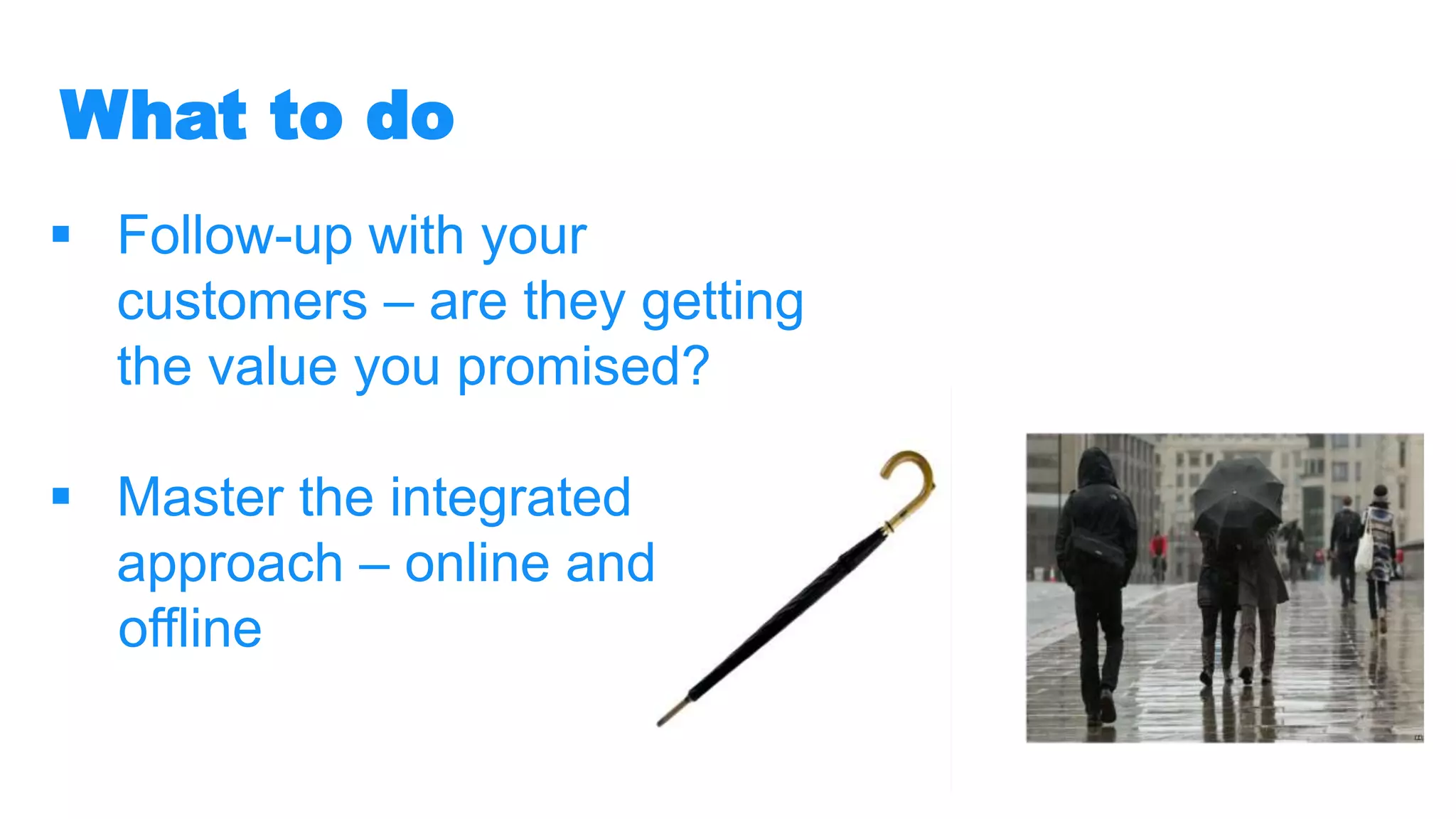
  • #26 Value only starts when you start to use the product or service If the umbrella doesn’t do its job 100% - people aren’t checking with the customers to make sure the umbrella kept them dry If your umbrella doesn’t keep them dry, they won’t come back to buy another one If you’ve promised them something, you better be following up === that can become your differentiator because most companies don’t do this – validated through our own research
  • #27 STACEY Gain access to more templates tools and insights in our book, Value-ology Learn how to craft your own value proposition -- Download our free Ebook