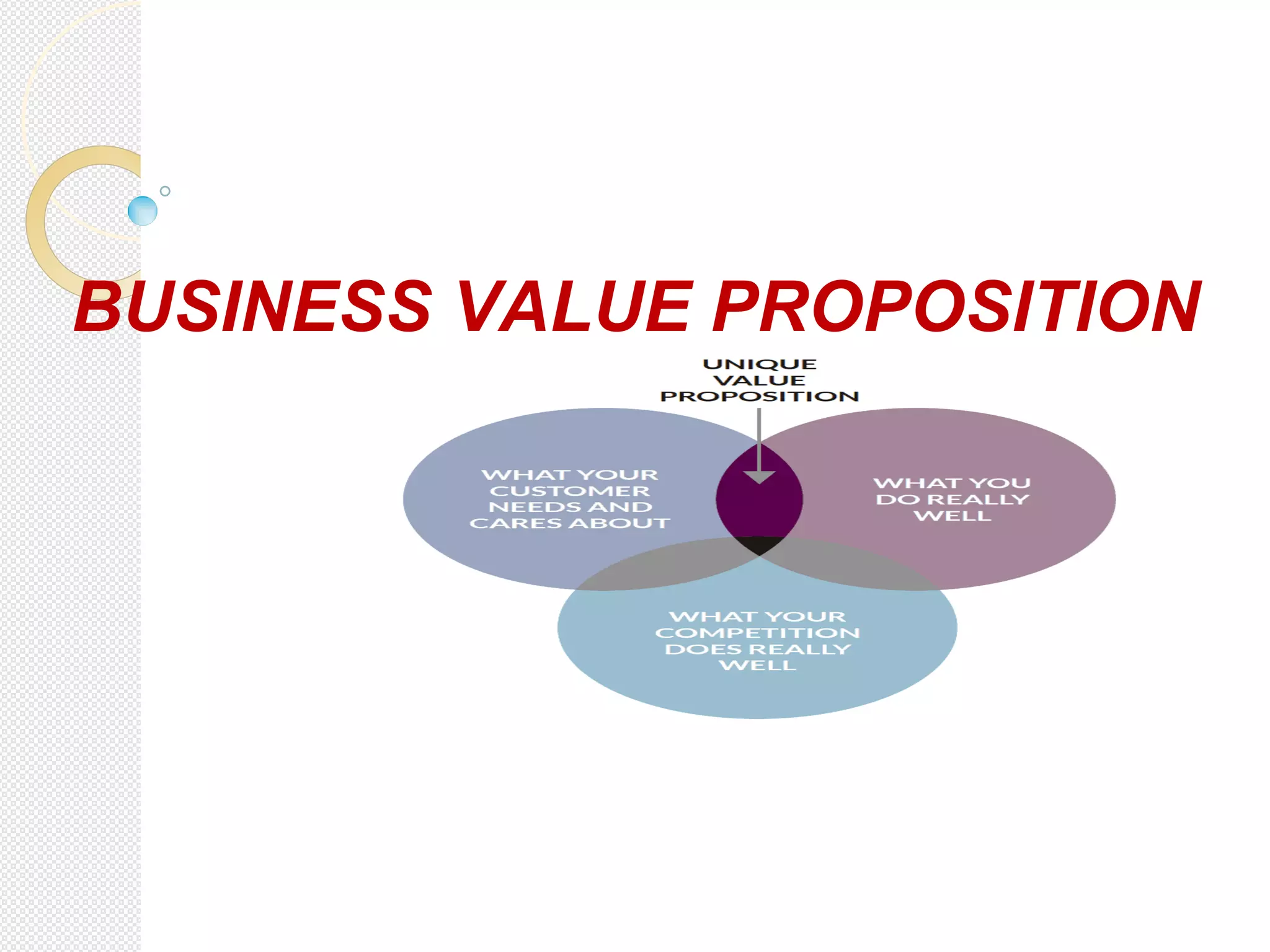
BUSINESS VALUE PROPOSITION
Value Proposition--
A value proposition is a promise of value to
be delivered and acknowledged and a belief
from the customer that value will be
appealed and experienced. A value
proposition can apply to an entire
organization, or parts thereof, or customer
accounts, or products or services.
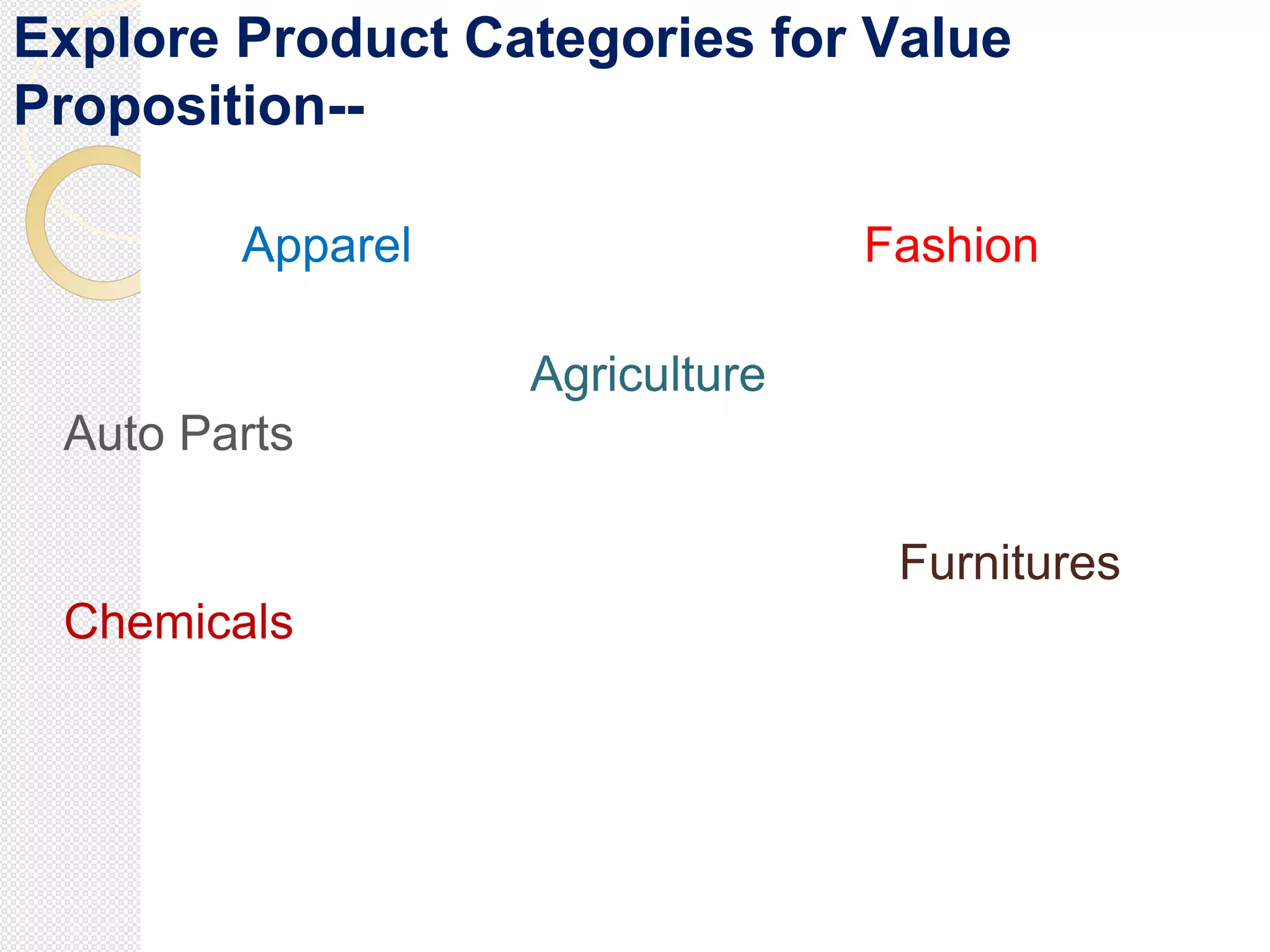
Explore Product Categories for Value
Proposition--
Apparel Fashion
Agriculture
Auto Parts
Furnitures
Chemicals
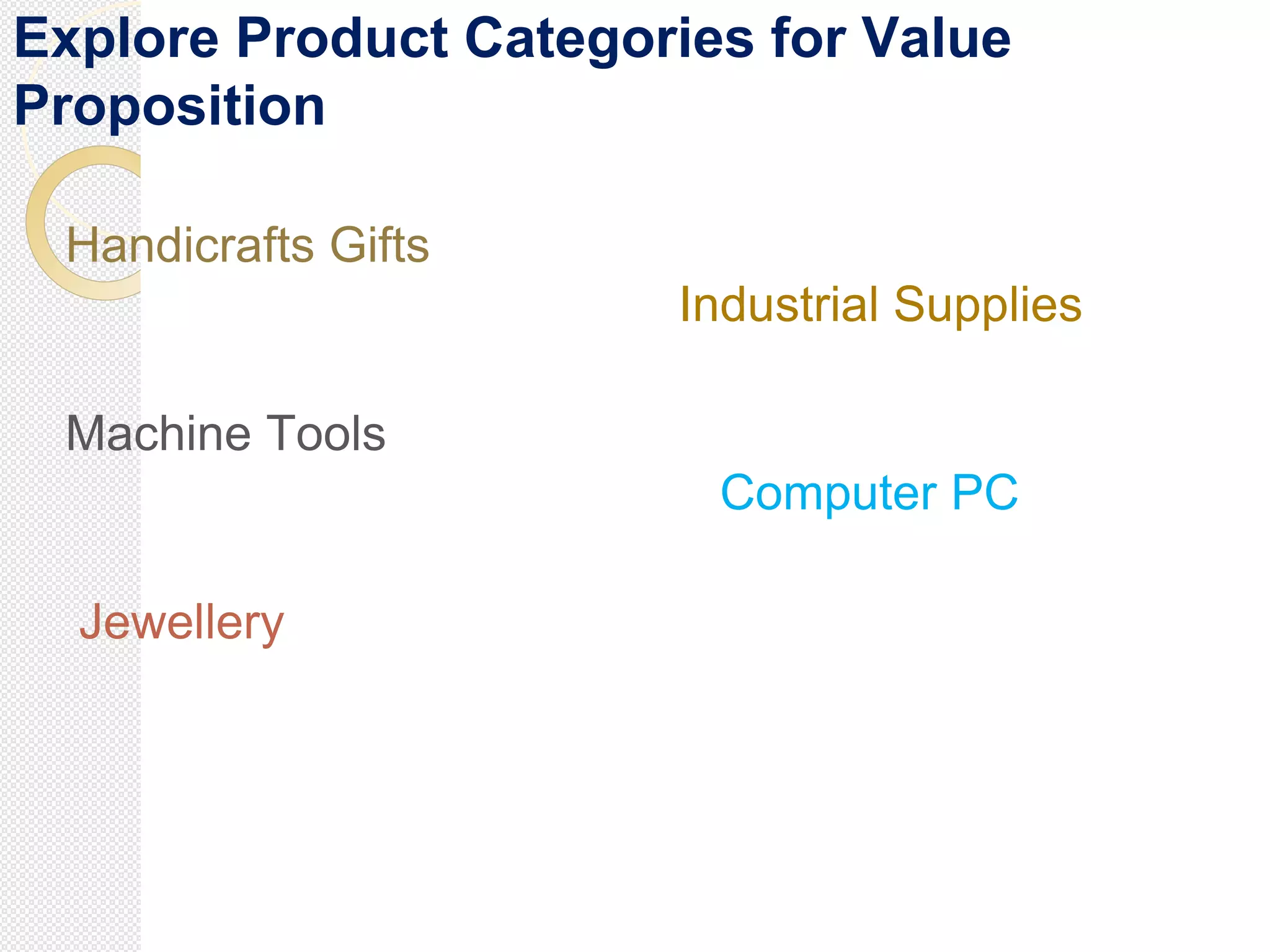
Explore Product Categories for Value
Proposition
Handicrafts Gifts
Industrial Supplies
Machine Tools
Computer PC
Jewellery
Explore Product Categories for Value
Proposition
Ayurvedic Products
Electronics
Consumer Electronics
Packaging Material
Houseware Products
Explore Product Categories for Value
Proposition
Real Estate Tour Travel
Packers Movers
Financial Legal Service
Event Organizer Services
Architecture And Interiors
Value Proposition---
Value Proposition--
FROM “VALUE CUSTOMER PROPOSITION” …
TO “VALUE BUSINESS CHAIN” & “VALUE MARKETING
STRATEGY”
Value Proposition--
VALUE
PROPOSITION
VALUE
COMMUNICATI
ON
(“Promotion/M
edia”)
VALUE
CREATION
(Product/Brand
”)
VALUE
DELIVERY
(“Place/Channe
ls”)
VALUE
COSTING
(“Price”)
OPERATIONS
MANAGEMENT & MARKETING
(“Through-put”)
COMPANY
VALUE-ADDED
OUTBOUND LOGISTICS
(“Output”)
CUSTOMER
VALUE
RECEIVED
INBOUND
LOGISTICS
(“Input”)
SUPPLIER
VALUE
RESOURCES
THE “VALUE
CHAIN”
Value Proposition--
Imagine a world where everyone is in sales. Well, the fact is,
everyone is in sales, in some fashion. It's not just the salesman
at the car lot or computer reseller who qualifies
 Maybe you are trying to sell ideas to your spouse for the next
holiday;
 Maybe you're pitching a new project to your boss;
 Maybe you are headhunting someone to join your firm. It's all
selling, and, whatever your offer (product, idea, project or job)
it's important to have a really strong value proposition.
A value proposition is a short statement that clearly
communicates the benefits that your potential client gets by
using your product, service or idea.
Value Proposition - Features
 It "boils down" all the complexity of your sales pitch into
something that your client can easily grasp and remember.
 It needs to be very specific:
 Simply describing the features or capabilities of your offer is not
enough. Your value proposition must focus closely on what
your customer really wants and values. Your customer wants to
solve problems, to improve on existing solutions, to have a
better life, build a better business or do more, better, faster. and
so on.
Value Proposition - Features
Creating a value proposition is a useful marketing
technique that had wider application than product
marketing. Whatever you are 'selling' and to whom, a
value proposition is useful, if not essential, tool.
Whether your 'customers' are external customers,
employees,co-workers or even your family, the idea is
to help them see the specific value your offer brings to
them. And by doing so, you will grab their attention in
such a way that they know: "Yes, that's right for me".
Creating a great Value Proposition
"Why should I buy this specific product or idea?" asks your
customer: And your value proposition must answer this, in a
compelling way. In creating a good value proposition, the trick is
to know your product or idea well, know how it compares with
those of your competitors and, very importantly, put yourself in
your customer's shoes to find the answers.
Your value proposition can be created step-by-step, by answering
a series of questions. Once you answer these, you have the
ingredients to create a value proposition that answers your
customer's question: "Why should I buy this product or idea?"
Value Proposition - Features
" Creating a Value Proposition
Communicating the Benefits of Your Product, Service or Idea,
Simply and Clearly
Steps in creating Value Proposition
Step 1: Know your customer
Thinking from the perspective of your customer, ask the following:
Who is he or she? What does s/he do and need?
What problems does s/he need to solve?
What improvements does s/he look for?
What does s/he value?
Tip: If you don't know, ask! It's easy to try to second guess what
your customers want. And very easy to get it wrong.
So do some market research: This could be a simple matter of
asking customers directly, or organizing a focus group or surveys.
'Market research' is not just for external customers, it works for
other 'markets' too: Depending on your product or idea, your
'market' could be employees, colleagues, or even your spouse
Steps in creating Value Proposition
Step 2: Know your product, service or idea
From your customer view point:
How does the product, service or idea solve the problem or offer
improvement?
What value and hard results does it offer the customer?
Tip: Include numbers and percentages
To grab your customer's attention even faster in this financially-
oriented world, your value proposition should also speak
percentages and numbers: How much will your customer gain,
save or improve? How much more efficient will he or she
become? How much safer, smarter, faster, brighter will the
solution be? And so on.
Steps in creating Value Proposition
Step 3: Know your Competitors
Keep on thinking from the perspective of your customer, and ask:
How does your product or idea create more value than competing
ones?
Tip: This can be quite difficult. See our articles on USP Analysis,
Core Competence Analysis and SWOT Analysis for useful tools
for doing this.
Steps in creating Value Proposition
Step 4: Distill the customer-oriented proposition
The final step is to pull it all together and answer, in 2 or 3
sentence: "Why should I buy this specific product or idea?"
Try writing from the customer viewpoint by completing the
following, (also include the numbers and percentages that
matter!):
"I want to buy this product or idea because it will..."
"The things I value most about the offer are..."
"It is better than competing products or ideas because..."
Steps in creating Value Proposition
Step 5: Pull it all together
Now, turn around your customers 'answer' from step 4 into a value
proposition statement.
Examples
Example
Here's a simple example. Let's say that you sell lawn mowers, and
your customer is someone with a large back yard.
Step 1: Know your customer
Your customer is a businessman with quite a large house, who
likes the "meditative feeling" of cutting his own lawn, but gets
bored by the job when it takes too long.
He's looking for a good quality of cut, for the job to be done
quickly and enjoyably
Examples
Step 2: Know your product or idea
The product is a ride-on mower with a 25 horsepower (powerful)
engine and 45 inch (wide) cutting blades.
Step 3: Know your competitors
The mower goes faster and cuts wider than the competition.
Step 4: Distill the customer-oriented proposition
"Our mower cuts your grass in 50% of the time of 'big brand'
mowers in its class. And it leaves the lawn looking beautiful too!"
If you haven't already looked at our USP Analysis article, do so
now – it will show you how, with a little research, you can identify
how your product or service is unique. It's also worth
understanding the various strategic positioning options that will
underpin your value statement
Thank You

Value Proposition.ppt

  • 1.
  • 2.
    Value Proposition-- A valueproposition is a promise of value to be delivered and acknowledged and a belief from the customer that value will be appealed and experienced. A value proposition can apply to an entire organization, or parts thereof, or customer accounts, or products or services.
  • 3.
    Explore Product Categoriesfor Value Proposition-- Apparel Fashion Agriculture Auto Parts Furnitures Chemicals
  • 4.
    Explore Product Categoriesfor Value Proposition Handicrafts Gifts Industrial Supplies Machine Tools Computer PC Jewellery
  • 5.
    Explore Product Categoriesfor Value Proposition Ayurvedic Products Electronics Consumer Electronics Packaging Material Houseware Products
  • 6.
    Explore Product Categoriesfor Value Proposition Real Estate Tour Travel Packers Movers Financial Legal Service Event Organizer Services Architecture And Interiors
  • 7.
  • 8.
    Value Proposition-- FROM “VALUECUSTOMER PROPOSITION” … TO “VALUE BUSINESS CHAIN” & “VALUE MARKETING STRATEGY”
  • 9.
    Value Proposition-- VALUE PROPOSITION VALUE COMMUNICATI ON (“Promotion/M edia”) VALUE CREATION (Product/Brand ”) VALUE DELIVERY (“Place/Channe ls”) VALUE COSTING (“Price”) OPERATIONS MANAGEMENT &MARKETING (“Through-put”) COMPANY VALUE-ADDED OUTBOUND LOGISTICS (“Output”) CUSTOMER VALUE RECEIVED INBOUND LOGISTICS (“Input”) SUPPLIER VALUE RESOURCES THE “VALUE CHAIN”
  • 10.
    Value Proposition-- Imagine aworld where everyone is in sales. Well, the fact is, everyone is in sales, in some fashion. It's not just the salesman at the car lot or computer reseller who qualifies  Maybe you are trying to sell ideas to your spouse for the next holiday;  Maybe you're pitching a new project to your boss;  Maybe you are headhunting someone to join your firm. It's all selling, and, whatever your offer (product, idea, project or job) it's important to have a really strong value proposition. A value proposition is a short statement that clearly communicates the benefits that your potential client gets by using your product, service or idea.
  • 11.
    Value Proposition -Features  It "boils down" all the complexity of your sales pitch into something that your client can easily grasp and remember.  It needs to be very specific:  Simply describing the features or capabilities of your offer is not enough. Your value proposition must focus closely on what your customer really wants and values. Your customer wants to solve problems, to improve on existing solutions, to have a better life, build a better business or do more, better, faster. and so on.
  • 12.
    Value Proposition -Features Creating a value proposition is a useful marketing technique that had wider application than product marketing. Whatever you are 'selling' and to whom, a value proposition is useful, if not essential, tool. Whether your 'customers' are external customers, employees,co-workers or even your family, the idea is to help them see the specific value your offer brings to them. And by doing so, you will grab their attention in such a way that they know: "Yes, that's right for me".
  • 13.
    Creating a greatValue Proposition "Why should I buy this specific product or idea?" asks your customer: And your value proposition must answer this, in a compelling way. In creating a good value proposition, the trick is to know your product or idea well, know how it compares with those of your competitors and, very importantly, put yourself in your customer's shoes to find the answers. Your value proposition can be created step-by-step, by answering a series of questions. Once you answer these, you have the ingredients to create a value proposition that answers your customer's question: "Why should I buy this product or idea?"
  • 14.
    Value Proposition -Features " Creating a Value Proposition Communicating the Benefits of Your Product, Service or Idea, Simply and Clearly
  • 15.
    Steps in creatingValue Proposition Step 1: Know your customer Thinking from the perspective of your customer, ask the following: Who is he or she? What does s/he do and need? What problems does s/he need to solve? What improvements does s/he look for? What does s/he value? Tip: If you don't know, ask! It's easy to try to second guess what your customers want. And very easy to get it wrong. So do some market research: This could be a simple matter of asking customers directly, or organizing a focus group or surveys. 'Market research' is not just for external customers, it works for other 'markets' too: Depending on your product or idea, your 'market' could be employees, colleagues, or even your spouse
  • 16.
    Steps in creatingValue Proposition Step 2: Know your product, service or idea From your customer view point: How does the product, service or idea solve the problem or offer improvement? What value and hard results does it offer the customer? Tip: Include numbers and percentages To grab your customer's attention even faster in this financially- oriented world, your value proposition should also speak percentages and numbers: How much will your customer gain, save or improve? How much more efficient will he or she become? How much safer, smarter, faster, brighter will the solution be? And so on.
  • 17.
    Steps in creatingValue Proposition Step 3: Know your Competitors Keep on thinking from the perspective of your customer, and ask: How does your product or idea create more value than competing ones? Tip: This can be quite difficult. See our articles on USP Analysis, Core Competence Analysis and SWOT Analysis for useful tools for doing this.
  • 18.
    Steps in creatingValue Proposition Step 4: Distill the customer-oriented proposition The final step is to pull it all together and answer, in 2 or 3 sentence: "Why should I buy this specific product or idea?" Try writing from the customer viewpoint by completing the following, (also include the numbers and percentages that matter!): "I want to buy this product or idea because it will..." "The things I value most about the offer are..." "It is better than competing products or ideas because..."
  • 19.
    Steps in creatingValue Proposition Step 5: Pull it all together Now, turn around your customers 'answer' from step 4 into a value proposition statement.
  • 20.
    Examples Example Here's a simpleexample. Let's say that you sell lawn mowers, and your customer is someone with a large back yard. Step 1: Know your customer Your customer is a businessman with quite a large house, who likes the "meditative feeling" of cutting his own lawn, but gets bored by the job when it takes too long. He's looking for a good quality of cut, for the job to be done quickly and enjoyably
  • 21.
    Examples Step 2: Knowyour product or idea The product is a ride-on mower with a 25 horsepower (powerful) engine and 45 inch (wide) cutting blades. Step 3: Know your competitors The mower goes faster and cuts wider than the competition. Step 4: Distill the customer-oriented proposition "Our mower cuts your grass in 50% of the time of 'big brand' mowers in its class. And it leaves the lawn looking beautiful too!" If you haven't already looked at our USP Analysis article, do so now – it will show you how, with a little research, you can identify how your product or service is unique. It's also worth understanding the various strategic positioning options that will underpin your value statement
  • 22.