CUSTOMER VALUE & SATISFACTION
1
Course: MBA-I
Subject: MARKETING MANAGEMENT - 1
Unit: I
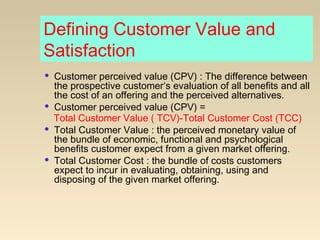
Defining Customer Value and
Satisfaction
 Customer perceived value (CPV) : The difference between
the prospective customer‘s evaluation of all benefits and all
the cost of an offering and the perceived alternatives.
 Customer perceived value (CPV) =
Total Customer Value ( TCV)-Total Customer Cost (TCC)
 Total Customer Value : the perceived monetary value of
the bundle of economic, functional and psychological
benefits customer expect from a given market offering.
 Total Customer Cost : the bundle of costs customers
expect to incur in evaluating, obtaining, using and
disposing of the given market offering.
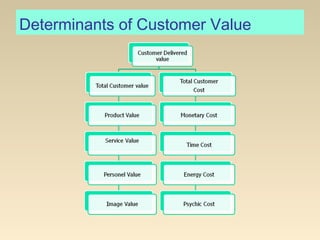
Determinants of Customer Value
 Based on this decision making theory,
there are three (3) ways to making
success in selling to the buyer :
1. Increasing total customer value by improving
product, services, personel, and/or image benefits.
2. Reducing the buyer’s non monetary cost by
reducing the time, energy, and psychic cost.
3. Reducing it’s product monetary cost to the buyer.
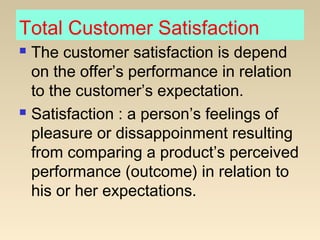
Total Customer Satisfaction
 The customer satisfaction is depend
on the offer’s performance in relation
to the customer’s expectation.
 Satisfaction : a person’s feelings of
pleasure or dissappoinment resulting
from comparing a product’s perceived
performance (outcome) in relation to
his or her expectations.
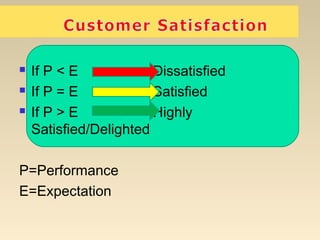
 If P < E Dissatisfied
 If P = E Satisfied
 If P > E Highly
Satisfied/Delighted
P=Performance
E=Expectation
 The important key to generating high customer loyalty is
delivering high customer value.
 A company must design a competitively superior value
proposition aimed at a specific market segment (Michael
Lanning).
 The value proposition : consits of whole cluster of
benefits the company promises to deliver ; it is more
than the core positioning of the offering.
 In a hypercompetitive economy a company can
only win the competition by creating and
delivering superior values.
 This involves 5 capabilities :
1. Understanding customer value
2. Creating customer value
3. Delivering customer value
4. Capturing customer value
5. Sustaining customer value
 To succeed, a company needs to use the
concepts of a value chain and a value
delivery network.
Value Chain
 Value chain: a tool for identifying was to create more customer
value (Porter,M).
 Every firm is a synthesis of activities that are performed to
design, produce, market, delivery and support its products.
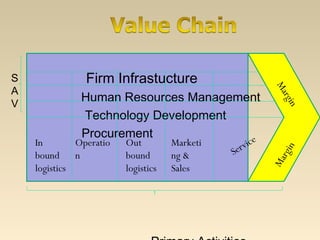
 The value chains identifies nine strategically relevant activities
that create value and cost in a specific business.
 These nine value creating activities consists of five primary
activities and four support activities.
 The primary activities represent the sequence of bringing
materials into the business (inbound logistics), converting them
into final products (operations), shipping out final products
(outbond lohistics), marketing , and servicing them.
 The support activities: procurement, technology, human
resource management, and firm infrastructure are handled in
certain specialized departments, but not only there. For
example: several departments may do some procurements and
hiring of people.
 The firm task is to examine its cost and performance in each
value creating activity and to look for ways to improve it.
 The firm should estimate its competitors cost and performance
as benchmarks against which to compare its owns cost and
performances.
 The firm success depends not only on how well each
departments performs its works, but also on how well the
various departmental activities are coordinated. Too often,
company departments act to maximize their interests. For
example: a credit department may take a long time to check
prospective customers’credit so as not to incur bad debts,
mean while the customer waits and the sales person is
frustrated.
Firm Infrastucture
Human Resources Management
Technology Development
Procurement
In
bound
logistics
Operatio
n
Out
bound
logistics
Marketi
ng &
Sales
Service
Margin
Margin
S
A
V
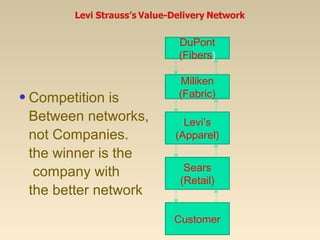
Competition is
Between networks,
not Companies.
the winner is the
company with
the better network
DuPont
(Fibers)
Miliken
(Fabric)
Levi’s
(Apparel)
Sears
(Retail)
Customer
Attracting and Retaining
Customers
 Customer Relationship Management
 The process of managing detailed
information about individual customers and
carefully managing all the customer “touch
points” with the aim of maximizing
customer loyalty.
 The aim of CRM : is to produce high
customer equity ( value equity, brand
equity and relationship equity).
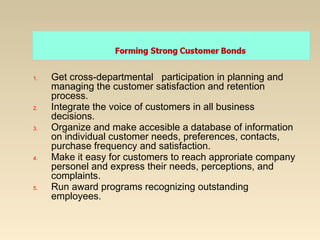
1. Get cross-departmental participation in planning and
managing the customer satisfaction and retention
process.
2. Integrate the voice of customers in all business
decisions.
3. Organize and make accesible a database of information
on individual customer needs, preferences, contacts,
purchase frequency and satisfaction.
4. Make it easy for customers to reach approriate company
personel and express their needs, perceptions, and
complaints.
5. Run award programs recognizing outstanding
employees.
References & Sources
 wps.pearsoncustom.com/wps/media/obj
ects/2426/.../MKT101_Ch04.pdf
 en.wikipedia.org/wiki/Customer_satisf
action
 Philip Kotler (Chapter-16)
16

Mba i mm-1 u-1.2 customer value & satisfaction

  • 1.
    CUSTOMER VALUE &SATISFACTION 1 Course: MBA-I Subject: MARKETING MANAGEMENT - 1 Unit: I
  • 2.
    Defining Customer Valueand Satisfaction  Customer perceived value (CPV) : The difference between the prospective customer‘s evaluation of all benefits and all the cost of an offering and the perceived alternatives.  Customer perceived value (CPV) = Total Customer Value ( TCV)-Total Customer Cost (TCC)  Total Customer Value : the perceived monetary value of the bundle of economic, functional and psychological benefits customer expect from a given market offering.  Total Customer Cost : the bundle of costs customers expect to incur in evaluating, obtaining, using and disposing of the given market offering.
  • 3.
  • 4.
     Based onthis decision making theory, there are three (3) ways to making success in selling to the buyer : 1. Increasing total customer value by improving product, services, personel, and/or image benefits. 2. Reducing the buyer’s non monetary cost by reducing the time, energy, and psychic cost. 3. Reducing it’s product monetary cost to the buyer.
  • 5.
    Total Customer Satisfaction The customer satisfaction is depend on the offer’s performance in relation to the customer’s expectation.  Satisfaction : a person’s feelings of pleasure or dissappoinment resulting from comparing a product’s perceived performance (outcome) in relation to his or her expectations.
  • 6.
     If P< E Dissatisfied  If P = E Satisfied  If P > E Highly Satisfied/Delighted P=Performance E=Expectation
  • 8.
     The importantkey to generating high customer loyalty is delivering high customer value.  A company must design a competitively superior value proposition aimed at a specific market segment (Michael Lanning).  The value proposition : consits of whole cluster of benefits the company promises to deliver ; it is more than the core positioning of the offering.
  • 9.
     In ahypercompetitive economy a company can only win the competition by creating and delivering superior values.  This involves 5 capabilities : 1. Understanding customer value 2. Creating customer value 3. Delivering customer value 4. Capturing customer value 5. Sustaining customer value  To succeed, a company needs to use the concepts of a value chain and a value delivery network.
  • 10.
    Value Chain  Valuechain: a tool for identifying was to create more customer value (Porter,M).  Every firm is a synthesis of activities that are performed to design, produce, market, delivery and support its products.  The value chains identifies nine strategically relevant activities that create value and cost in a specific business.  These nine value creating activities consists of five primary activities and four support activities.  The primary activities represent the sequence of bringing materials into the business (inbound logistics), converting them into final products (operations), shipping out final products (outbond lohistics), marketing , and servicing them.
  • 11.
     The supportactivities: procurement, technology, human resource management, and firm infrastructure are handled in certain specialized departments, but not only there. For example: several departments may do some procurements and hiring of people.  The firm task is to examine its cost and performance in each value creating activity and to look for ways to improve it.  The firm should estimate its competitors cost and performance as benchmarks against which to compare its owns cost and performances.  The firm success depends not only on how well each departments performs its works, but also on how well the various departmental activities are coordinated. Too often, company departments act to maximize their interests. For example: a credit department may take a long time to check prospective customers’credit so as not to incur bad debts, mean while the customer waits and the sales person is frustrated.
  • 12.
    Firm Infrastucture Human ResourcesManagement Technology Development Procurement In bound logistics Operatio n Out bound logistics Marketi ng & Sales Service Margin Margin S A V
  • 13.
    Competition is Between networks, notCompanies. the winner is the company with the better network DuPont (Fibers) Miliken (Fabric) Levi’s (Apparel) Sears (Retail) Customer
  • 14.
    Attracting and Retaining Customers Customer Relationship Management  The process of managing detailed information about individual customers and carefully managing all the customer “touch points” with the aim of maximizing customer loyalty.  The aim of CRM : is to produce high customer equity ( value equity, brand equity and relationship equity).
  • 15.
    1. Get cross-departmentalparticipation in planning and managing the customer satisfaction and retention process. 2. Integrate the voice of customers in all business decisions. 3. Organize and make accesible a database of information on individual customer needs, preferences, contacts, purchase frequency and satisfaction. 4. Make it easy for customers to reach approriate company personel and express their needs, perceptions, and complaints. 5. Run award programs recognizing outstanding employees.
  • 16.
    References & Sources wps.pearsoncustom.com/wps/media/obj ects/2426/.../MKT101_Ch04.pdf  en.wikipedia.org/wiki/Customer_satisf action  Philip Kotler (Chapter-16) 16