Marketing Research DesignOverview
Learning ObjectivesTo understand what research design is and why it is significant.
To learn how exploratory research helps the researcher gain a feel for the problem.
To know the fundamental questions addressed by descriptive research and different types of descriptive research.
To explain what is meant by casual research and to describe four types of experimental research designs.
To know the different types of test marketing and how to select test market cities. Research DesignMarketing research methods vary from focus groups to stimulated test markets to large, nationally representative sample surveys.
Research design is a set of advance decisions that make up the master plan specifying the methods and procedures for collecting and analysing data.
Each research problem is unique. However,
There are similarities among research problems to allow us to use the best plan to solve the problem.
There are basic research designs that can be successfully matched to a given research problem. Three Types of Research DesignResearch designs are classified into three categories: exploratory, descriptive, and causal. refer: Table 1.0
Choice depends largely on objectives of the research.
Research does not necessarily follow the order of exploratory, descriptive and casual designs.
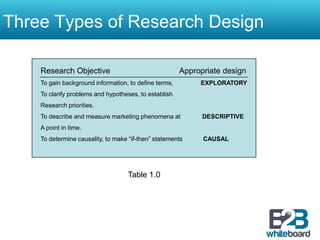
Caution about thinking about research in a step-by-step process. Three Types of Research DesignResearch Objective		     Appropriate designTo gain background information, to define terms,    EXPLORATORYTo clarify problems and hypotheses, to establishResearch priorities.To describe and measure marketing phenomena at	DESCRIPTIVEA point in time.To determine causality, to make “if-then” statements  CAUSALTable 1.0
Three Types of Research DesignExploratory Research: is most commonly unstructured, informal research that is undertaken to gain background information about the general nature of the research problem.
Exploratory research is systematic and flexible and allows the researcher to investigate whatever sources he or she desires.
Such research may consist of going to the library and reading published secondary data; of asking questions, salespersons acquaintances for their opinions about a company, its products and services, and prices; or of simply observing everyday company practices. Three Types of Research DesignExploratory Research is used in a number of situations:1. Gain background information- When very little is known  about the problem or when the problem has not been clearly formulated.Firms having an MIS in which a review of internal information tracked over time can provide useful insights into the background of the company, brand, sales territories etc.Three Types of Research DesignExploratory Research is used in a number of situations:2. Define Terms – Exploratory research helps to             define terms and concepts.What is 3M’s image? The researcher learns that “image” is composed of several components –   innovative products, friendly sales/customer service, good corporate citizen and so on.     Three Types of Research DesignExploratory Research is used in a number of situations:3. Clarify Problems and Hypotheses – Exploratory research allows the researcher to define the problem more precisely and to generate a hypotheses for the upcoming study.i.e.: banks have three types of customers: retail customers, commercial customers and other banks for which services are performed for fees. Define which group bank image should be measured.  Three Types of Research DesignExploratory Research is used in a number of situations:4. Establish Research Priorities – Exploratory research can be used to prioritise research topics in order of importance, especially when it is faced with conducting several research studies.i.e.: customer complaint letters may indicate the product or service that needs attention.
i.e.: Office furniture store owner decided to conduct research on the feasibility of carrying overhead projectors after interviewing his sales people revealed that customers were requesting overhead projectors.Three Types of Research DesignMethods of Conducting Exploratory Research:1. Secondary Data Analysis – refers to the process of searching for and interpreting existing information relevant to the research problem.Sources of secondary data includes: information found in books, journals, magazines, special reports, bulletins, newsletters, and so on.
An analysis of secondary data is often the “core” of exploratory research.  Three Types of Research DesignMethods of Conducting Exploratory Research:2. Experience Surveys – refer to gathering information from those thought to be knowledgeable on the issues relevant to the research problem.3. Case Analysis – we refer to a review of available information about a former situation(s) that has some similarities to the present research problem.4. Focus Groups – bringing small groups of people together and guided by a moderator through an unstructured, spontaneous discussion for the purpose of gaining information relevant to a research problem.
Three Types of Research Design Methods of Conducting Exploratory Research:5. Projective Techniques  – we refer to the process of searching for and interpreting existing information relevant to the research problem.Sources of secondary data includes: information found in books, journals, magazines, special reports, bulletins, newsletters, and so on.
An analysis of secondary data is often the “core” of exploratory research.  Three Types of Research DesignDescriptive Research: which provides answers to questions such as who, what, where, where and how, as they are related to the research problem.
Who- may be defined as a firms (competitors) customers.
What- defined as brands, brands, sizes that are being purchased.
Where- places where customers are purchasing products.
Why- we can not conclusively answer the question of why using descriptive research.Need to use causal research designs.Three Types of Research DesignClassification of Descriptive Research Studies:1.  Cross-sectional studies- are very prevalent in market research, outnumbering longitudinal studies and casual studies. Because cross-sectional studies are one time measurements.
Often described as “snapshots” of the population.
i.e. used to describe the readership of a magazine in terms of demographics. Three Types of Research DesignClassification of Descriptive Research Studies:2.  Longitudinal studies- repeatedly measure the same population  over a period of time.Often described as “movies” of the population.

Marketing Research Design

  • 1.
  • 2.
    Learning ObjectivesTo understandwhat research design is and why it is significant.
  • 3.
    To learn howexploratory research helps the researcher gain a feel for the problem.
  • 4.
    To know thefundamental questions addressed by descriptive research and different types of descriptive research.
  • 5.
    To explain whatis meant by casual research and to describe four types of experimental research designs.
  • 6.
    To know thedifferent types of test marketing and how to select test market cities. Research DesignMarketing research methods vary from focus groups to stimulated test markets to large, nationally representative sample surveys.
  • 7.
    Research design isa set of advance decisions that make up the master plan specifying the methods and procedures for collecting and analysing data.
  • 8.
    Each research problemis unique. However,
  • 9.
    There are similaritiesamong research problems to allow us to use the best plan to solve the problem.
  • 10.
    There are basicresearch designs that can be successfully matched to a given research problem. Three Types of Research DesignResearch designs are classified into three categories: exploratory, descriptive, and causal. refer: Table 1.0
  • 11.
    Choice depends largelyon objectives of the research.
  • 12.
    Research does notnecessarily follow the order of exploratory, descriptive and casual designs.
  • 13.
    Caution about thinkingabout research in a step-by-step process. Three Types of Research DesignResearch Objective Appropriate designTo gain background information, to define terms, EXPLORATORYTo clarify problems and hypotheses, to establishResearch priorities.To describe and measure marketing phenomena at DESCRIPTIVEA point in time.To determine causality, to make “if-then” statements CAUSALTable 1.0
  • 14.
    Three Types ofResearch DesignExploratory Research: is most commonly unstructured, informal research that is undertaken to gain background information about the general nature of the research problem.
  • 15.
    Exploratory research issystematic and flexible and allows the researcher to investigate whatever sources he or she desires.
  • 16.
    Such research mayconsist of going to the library and reading published secondary data; of asking questions, salespersons acquaintances for their opinions about a company, its products and services, and prices; or of simply observing everyday company practices. Three Types of Research DesignExploratory Research is used in a number of situations:1. Gain background information- When very little is known about the problem or when the problem has not been clearly formulated.Firms having an MIS in which a review of internal information tracked over time can provide useful insights into the background of the company, brand, sales territories etc.Three Types of Research DesignExploratory Research is used in a number of situations:2. Define Terms – Exploratory research helps to define terms and concepts.What is 3M’s image? The researcher learns that “image” is composed of several components – innovative products, friendly sales/customer service, good corporate citizen and so on. Three Types of Research DesignExploratory Research is used in a number of situations:3. Clarify Problems and Hypotheses – Exploratory research allows the researcher to define the problem more precisely and to generate a hypotheses for the upcoming study.i.e.: banks have three types of customers: retail customers, commercial customers and other banks for which services are performed for fees. Define which group bank image should be measured. Three Types of Research DesignExploratory Research is used in a number of situations:4. Establish Research Priorities – Exploratory research can be used to prioritise research topics in order of importance, especially when it is faced with conducting several research studies.i.e.: customer complaint letters may indicate the product or service that needs attention.
  • 17.
    i.e.: Office furniturestore owner decided to conduct research on the feasibility of carrying overhead projectors after interviewing his sales people revealed that customers were requesting overhead projectors.Three Types of Research DesignMethods of Conducting Exploratory Research:1. Secondary Data Analysis – refers to the process of searching for and interpreting existing information relevant to the research problem.Sources of secondary data includes: information found in books, journals, magazines, special reports, bulletins, newsletters, and so on.
  • 18.
    An analysis ofsecondary data is often the “core” of exploratory research. Three Types of Research DesignMethods of Conducting Exploratory Research:2. Experience Surveys – refer to gathering information from those thought to be knowledgeable on the issues relevant to the research problem.3. Case Analysis – we refer to a review of available information about a former situation(s) that has some similarities to the present research problem.4. Focus Groups – bringing small groups of people together and guided by a moderator through an unstructured, spontaneous discussion for the purpose of gaining information relevant to a research problem.
  • 19.
    Three Types ofResearch Design Methods of Conducting Exploratory Research:5. Projective Techniques – we refer to the process of searching for and interpreting existing information relevant to the research problem.Sources of secondary data includes: information found in books, journals, magazines, special reports, bulletins, newsletters, and so on.
  • 20.
    An analysis ofsecondary data is often the “core” of exploratory research. Three Types of Research DesignDescriptive Research: which provides answers to questions such as who, what, where, where and how, as they are related to the research problem.
  • 21.
    Who- may bedefined as a firms (competitors) customers.
  • 22.
    What- defined asbrands, brands, sizes that are being purchased.
  • 23.
    Where- places wherecustomers are purchasing products.
  • 24.
    Why- we cannot conclusively answer the question of why using descriptive research.Need to use causal research designs.Three Types of Research DesignClassification of Descriptive Research Studies:1. Cross-sectional studies- are very prevalent in market research, outnumbering longitudinal studies and casual studies. Because cross-sectional studies are one time measurements.
  • 25.
    Often described as“snapshots” of the population.
  • 26.
    i.e. used todescribe the readership of a magazine in terms of demographics. Three Types of Research DesignClassification of Descriptive Research Studies:2. Longitudinal studies- repeatedly measure the same population over a period of time.Often described as “movies” of the population.