

ASSIGNMENT ON SEMISOLID
PREPRATIONS
SCHOOL OF PHARMACEUTICAL SCIENCES
ASHUTOSH
KASHYAP
M.PHARM
(DEPARTMENT OF
PHARMACEUTICS)
CONTENTS
• Introduction 3
• Ideal properties of semisolid
4
• Advantage of semisolid dosage form
6
• Disadvantage of semisolid dosage form
7
• Types of semisolid dosage form 8
• Ingredients used in semisolid preparation
9
• Evaluations of ointment, cream and pastes
12
• Equipments used in formulation of semisolid
16
INTRODUCTION
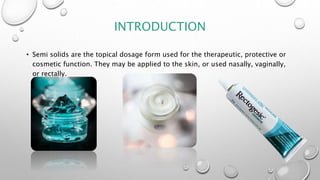
• Semi solids are the topical dosage form used for the therapeutic, protective or
cosmetic function. They may be applied to the skin, or used nasally, vaginally,
or rectally.
IDEAL PROPERTIES OF SEMISOLIDS
PHYSICAL PROPERTIES:
• Smooth texture
• Elegant in appearance
• Non dehydrating
• Non gritty
• Non greasy and non staining
• Non hygroscopic
PHYSIOLOGICAL PROPERTIES
• Non irritating
• Do not alter membrane / skin functioning
• Miscible with skin secretion
• Have low sensitization index
APPLICATION PROPERTIES
• Easily applicable with efficient drug release.
• High aqueous wash ability.
ADVANTAGE OF SEMI-SOLID DOSAGE FORM
• It is used externally.
• Probability of side effect can be reduce.
• First pass gut and hepatic metabolism is avoided.
• Local action and site specific action of drug on affected area.
• Convenient for unconscious patient or patient having difficulty on oral
administration.
• Suitable dosage form for bitter drugs.
• More stable than liquid dosage form.
DISADVANTAGES OF SEMI-SOLID DOSAGE
FORM
• There is no dosage accuracy in this type of dosage form.
• The base which is used in the semi-solid dosage form can be easily oxidized.
• May cause staining.
• They are bulky to handle.
• Application with finger may cause contamination.
• Physico-chemically less stable than solid dosage form.
• May cause irritation or allergy to some patients.
TYPES OF SEMISOLID DOSAGE FORM
• OINTMENTS
Ointments are homogeneous, semi-solid preparations intended for external application to the skin or mucous
membranes. They are used as emollients or for the application of active ingredients to the skin for protective,
therapeutic, or prophylactic purposes.
• PASTES
Pastes are homogeneous, semi-solid preparations containing high concentrations of insoluble powdered
substances (usually not less than 20%) dispersed in a suitable base. The pastes are usually less greasy, more
absorptive, and stiffer in consistency than ointments because of the large quantity of powdered ingredients present.
• CREAM
Creams are homogeneous, semi-solid preparations. Creams are intended for application to the skin or certain
mucous membranes for protective, therapeutic, purposes. The term "cream" is most frequently used to describe soft,
cosmetically acceptable types of preparations.
• GELS
Gels are usually homogeneous, clear, semi-solid preparations. Gels are applied to the skin or certain mucous
membranes for protective, therapeutic, purposes.
INGREDIENTS USED IN SEMISOLID
PREPARATION
• BASES
It is one of the most important ingredient used in formulation of semisolid dosage form.
Ointment bases do not merely act as the carriers of the medicaments, but they also control the
extent of absorption of medicaments incorporated in them.
Types of ointment bases used
a- hydrocarbon bases (oleaginous bases) (petrolatum , paraffin, lanolin)
b- absorption bases (cold cream, anhydrous lanolin …)
c- water-removable bases ( oil in water)
d- water-soluble bases (polyethylene glycol)
ANTIOXIDANTS:
Free radicals are capable of attacking the healthy cells of the body,
causing them to lose their structure and function. To prevent this an
antioxidants are added.
E.G. Butylated hydroxy anisole, butylated hydroxy toluene
• HUMECTANTS:
A humectant is a hygroscopic substance, humectants are used to :
increase the solubility of the active ingredient ,to elevate its skin penetration.
Elevate the hydration of the skin.
• EMULSIFIER:
An emulsifier (emulgent) is a substance that stabilizes an emulsion by increasing its
kinetic stability.
- Must reduce surface tension for proper emulsification.
- Prevents coalescence (ability to increase the viscosity at low concentration.)
• BUFFERS:
Buffers are added for various purpose such as : - compatibility with skin. - Drug
solubility. - Drug stability. - Influence ionization of drug. Skin, due to its weak acidic nature,
tolerates weak acidic preparations. • E.G. Sodium acetate, sodium citrate, potassium
EVALUATION OF CREAMS, OINTMENT, PASTE
• RHEOLOGY:
The rheology or viscosity should remain constant. Rheologic measurements
are utilized to characterize the ease of pouring from a bottle, squeezing from a tube
or container. The viscosity can be measured using viscometers used for such liquids.
• PENETRATION:
Weighed quantities of the ointments are rubbed over definite areas of the skin
for a given length of time. Thereafter the unabsorbed ointment is collected from the
skin and weighed. The difference between the two weights roughly represents the
amount absorbed.
• RATE OF RELEASE OF MEDICAMENT:
To assess rate of release of medicament, small amount of the ointment
can be placed on the surface of nutrient agar contained in a petri dish.
If the medicament is bactericidal the agar plate is previously seeded with a
suitable organism like s.Aureus. After a suitable period of incubation, the zone
of inhibition is measured and correlated with the rate of release.
• IRRITANT EFFECT:
The irritant effect can also be judged to a certain extent by injecting the
ointment into thigh muscles and under the abdominal skin of rats. Reaction are
noted at intervals of 24,48,72 and 96 hours. Presence of patches on the skin
within 2 weeks indicate irritancy to pressing skin
• DRUG CONTENT UNIFORMITY:
1gm of gel was accurately weighed in a 50ml of volumetric flask to which
20ml purified water was added with continuous shaking. Volume was adjusted with
a mixture of 10% methanol in water. Absorbance of the solution with the blank was
measured at 360nm using uv-spectrophotometer.
• MEASUREMENT OF pH:
The pH of gels were determined by digital ph meter. One gram of gel was
dissolved in 100ml of distilled water and stored at 4°C for two hours.
• SPREADABILITY:
A modified apparatus consisting of two glass slides containing gel in
between with the lower slide fixed to a wooden plate and the upper one
attached to a balance by a hook was used to determine spreadability.
• EXTRUDABILITY:
A simple method was adopted for determination of extrudability in terms
of weight in grams required to extrude a 0.5cm ribbon of gel in 10 seconds
from the collapsible tube
EQUIPMENTS USED IN FORMULATION OF
SEMISOLID
• Mixing and blending of semisolid equipment: blade mixture
• Dispersing equipment: homogenizers, colloid mill.
• Size reduction of solid and semisolid equipment: end-runner mill, hammer mill,
ball mill, colloid mill, micronizer
TROUBLE SHOOTING IN SEMISOLID
PREPARATION
• TEMPERATURE:
Processing at the right temperature is critical for successful manufacturing.
Too much heating during processing can result in chemical degradation. Insufficient
heat can lead to batch failures, and excess cooling can result in the precipitation of
solubilized ingredients.
• HEATING AND COOLING RATES.
Heating too slowly can result in poor yields from evaporative loss. Heating too
rapidly may burn areas of the batch in contact with the heating surface, which raises
the potential for burnt material in the batch. Rapid cooling can result in
precipitation/crystallization or increased viscosity.
• MIXING METHODS AND SPEEDS:
It is essential to determine the required amount of shear and the optimal
mixing methods and speeds. Emulsification typically requires high shear or
homogenization to obtain the optimal droplet size and dispersion, while the
mixing of a gel may require low shear in order to preserve certain physical
characteristics, such as viscosity.
Proper mixing speeds must be obtained for each phase at every batch
scale. Optimal hydration depends on the amount of shear imparted to initially
disperse the polymer into the medium. If the process involves only very low
shear mixing, a polymer may never be completely dispersed and hydrated,
which may result in an out-of-specification viscosity.
• FLOW RATES:
Optimizing flow rate involves determining the amount of shear or throughput needed.
For example, a water-in-oil emulsion may require a slower addition speed than a traditional,
oil-in-water emulsion, and the flow rate must be modified appropriately. Care must be taken
for any product using a pump. Over heating can occur if the formulation is pumped too
quickly.
MIXING TIMES.
Optimizing mixing time requires identifying the minimum time required for ingredients
to dissolve and the maximum mixing time before product failure (e.G., When viscosity begins
to drop). For polymeric gels, particularly acrylic acid-based types, over-mixing, especially
high shear, can break down the polymer's structure.
REFERANCES
• file:///c:/users/hp/downloads/semisolidlaith-161103111902.pdf
• https://www.researchgate.net/publication/322925854_semisolid_dosage_forms
_manufacturing_tools_critical_process_parameters_strategies_optimization_and_
recent_advances
• http://www.pharmtech.com/troubleshooting-guide-topical-drug-
manufacturing
• https://www.emdmillipore.com/us/en/products/small-molecule-
pharmaceuticals/formulation/semi-solid-dosage-
form/o26b.qb.qq0aaafanndkiqpx,nav
• http://www.ijpsonline.com/articles/dermal-and-transdermal-delivery-of-
active-substances-from-semisolid-bases-3353.html?view=mobile

Assignment on semisolid preprations

  • 1.
    ASSIGNMENT ON SEMISOLID PREPRATIONS SCHOOLOF PHARMACEUTICAL SCIENCES ASHUTOSH KASHYAP M.PHARM (DEPARTMENT OF PHARMACEUTICS)
  • 2.
    CONTENTS • Introduction 3 •Ideal properties of semisolid 4 • Advantage of semisolid dosage form 6 • Disadvantage of semisolid dosage form 7 • Types of semisolid dosage form 8 • Ingredients used in semisolid preparation 9 • Evaluations of ointment, cream and pastes 12 • Equipments used in formulation of semisolid 16
  • 3.
    INTRODUCTION • Semi solidsare the topical dosage form used for the therapeutic, protective or cosmetic function. They may be applied to the skin, or used nasally, vaginally, or rectally.
  • 4.
    IDEAL PROPERTIES OFSEMISOLIDS PHYSICAL PROPERTIES: • Smooth texture • Elegant in appearance • Non dehydrating • Non gritty • Non greasy and non staining • Non hygroscopic
  • 5.
    PHYSIOLOGICAL PROPERTIES • Nonirritating • Do not alter membrane / skin functioning • Miscible with skin secretion • Have low sensitization index APPLICATION PROPERTIES • Easily applicable with efficient drug release. • High aqueous wash ability.
  • 6.
    ADVANTAGE OF SEMI-SOLIDDOSAGE FORM • It is used externally. • Probability of side effect can be reduce. • First pass gut and hepatic metabolism is avoided. • Local action and site specific action of drug on affected area. • Convenient for unconscious patient or patient having difficulty on oral administration. • Suitable dosage form for bitter drugs. • More stable than liquid dosage form.
  • 7.
    DISADVANTAGES OF SEMI-SOLIDDOSAGE FORM • There is no dosage accuracy in this type of dosage form. • The base which is used in the semi-solid dosage form can be easily oxidized. • May cause staining. • They are bulky to handle. • Application with finger may cause contamination. • Physico-chemically less stable than solid dosage form. • May cause irritation or allergy to some patients.
  • 8.
    TYPES OF SEMISOLIDDOSAGE FORM • OINTMENTS Ointments are homogeneous, semi-solid preparations intended for external application to the skin or mucous membranes. They are used as emollients or for the application of active ingredients to the skin for protective, therapeutic, or prophylactic purposes. • PASTES Pastes are homogeneous, semi-solid preparations containing high concentrations of insoluble powdered substances (usually not less than 20%) dispersed in a suitable base. The pastes are usually less greasy, more absorptive, and stiffer in consistency than ointments because of the large quantity of powdered ingredients present. • CREAM Creams are homogeneous, semi-solid preparations. Creams are intended for application to the skin or certain mucous membranes for protective, therapeutic, purposes. The term "cream" is most frequently used to describe soft, cosmetically acceptable types of preparations. • GELS Gels are usually homogeneous, clear, semi-solid preparations. Gels are applied to the skin or certain mucous membranes for protective, therapeutic, purposes.
  • 9.
    INGREDIENTS USED INSEMISOLID PREPARATION • BASES It is one of the most important ingredient used in formulation of semisolid dosage form. Ointment bases do not merely act as the carriers of the medicaments, but they also control the extent of absorption of medicaments incorporated in them. Types of ointment bases used a- hydrocarbon bases (oleaginous bases) (petrolatum , paraffin, lanolin) b- absorption bases (cold cream, anhydrous lanolin …) c- water-removable bases ( oil in water) d- water-soluble bases (polyethylene glycol)
  • 10.
    ANTIOXIDANTS: Free radicals arecapable of attacking the healthy cells of the body, causing them to lose their structure and function. To prevent this an antioxidants are added. E.G. Butylated hydroxy anisole, butylated hydroxy toluene • HUMECTANTS: A humectant is a hygroscopic substance, humectants are used to : increase the solubility of the active ingredient ,to elevate its skin penetration. Elevate the hydration of the skin.
  • 11.
    • EMULSIFIER: An emulsifier(emulgent) is a substance that stabilizes an emulsion by increasing its kinetic stability. - Must reduce surface tension for proper emulsification. - Prevents coalescence (ability to increase the viscosity at low concentration.) • BUFFERS: Buffers are added for various purpose such as : - compatibility with skin. - Drug solubility. - Drug stability. - Influence ionization of drug. Skin, due to its weak acidic nature, tolerates weak acidic preparations. • E.G. Sodium acetate, sodium citrate, potassium
  • 12.
    EVALUATION OF CREAMS,OINTMENT, PASTE • RHEOLOGY: The rheology or viscosity should remain constant. Rheologic measurements are utilized to characterize the ease of pouring from a bottle, squeezing from a tube or container. The viscosity can be measured using viscometers used for such liquids. • PENETRATION: Weighed quantities of the ointments are rubbed over definite areas of the skin for a given length of time. Thereafter the unabsorbed ointment is collected from the skin and weighed. The difference between the two weights roughly represents the amount absorbed.
  • 13.
    • RATE OFRELEASE OF MEDICAMENT: To assess rate of release of medicament, small amount of the ointment can be placed on the surface of nutrient agar contained in a petri dish. If the medicament is bactericidal the agar plate is previously seeded with a suitable organism like s.Aureus. After a suitable period of incubation, the zone of inhibition is measured and correlated with the rate of release. • IRRITANT EFFECT: The irritant effect can also be judged to a certain extent by injecting the ointment into thigh muscles and under the abdominal skin of rats. Reaction are noted at intervals of 24,48,72 and 96 hours. Presence of patches on the skin within 2 weeks indicate irritancy to pressing skin
  • 14.
    • DRUG CONTENTUNIFORMITY: 1gm of gel was accurately weighed in a 50ml of volumetric flask to which 20ml purified water was added with continuous shaking. Volume was adjusted with a mixture of 10% methanol in water. Absorbance of the solution with the blank was measured at 360nm using uv-spectrophotometer. • MEASUREMENT OF pH: The pH of gels were determined by digital ph meter. One gram of gel was dissolved in 100ml of distilled water and stored at 4°C for two hours.
  • 15.
    • SPREADABILITY: A modifiedapparatus consisting of two glass slides containing gel in between with the lower slide fixed to a wooden plate and the upper one attached to a balance by a hook was used to determine spreadability. • EXTRUDABILITY: A simple method was adopted for determination of extrudability in terms of weight in grams required to extrude a 0.5cm ribbon of gel in 10 seconds from the collapsible tube
  • 16.
    EQUIPMENTS USED INFORMULATION OF SEMISOLID • Mixing and blending of semisolid equipment: blade mixture
  • 17.
    • Dispersing equipment:homogenizers, colloid mill.
  • 18.
    • Size reductionof solid and semisolid equipment: end-runner mill, hammer mill, ball mill, colloid mill, micronizer
  • 19.
    TROUBLE SHOOTING INSEMISOLID PREPARATION • TEMPERATURE: Processing at the right temperature is critical for successful manufacturing. Too much heating during processing can result in chemical degradation. Insufficient heat can lead to batch failures, and excess cooling can result in the precipitation of solubilized ingredients. • HEATING AND COOLING RATES. Heating too slowly can result in poor yields from evaporative loss. Heating too rapidly may burn areas of the batch in contact with the heating surface, which raises the potential for burnt material in the batch. Rapid cooling can result in precipitation/crystallization or increased viscosity.
  • 20.
    • MIXING METHODSAND SPEEDS: It is essential to determine the required amount of shear and the optimal mixing methods and speeds. Emulsification typically requires high shear or homogenization to obtain the optimal droplet size and dispersion, while the mixing of a gel may require low shear in order to preserve certain physical characteristics, such as viscosity. Proper mixing speeds must be obtained for each phase at every batch scale. Optimal hydration depends on the amount of shear imparted to initially disperse the polymer into the medium. If the process involves only very low shear mixing, a polymer may never be completely dispersed and hydrated, which may result in an out-of-specification viscosity.
  • 21.
    • FLOW RATES: Optimizingflow rate involves determining the amount of shear or throughput needed. For example, a water-in-oil emulsion may require a slower addition speed than a traditional, oil-in-water emulsion, and the flow rate must be modified appropriately. Care must be taken for any product using a pump. Over heating can occur if the formulation is pumped too quickly. MIXING TIMES. Optimizing mixing time requires identifying the minimum time required for ingredients to dissolve and the maximum mixing time before product failure (e.G., When viscosity begins to drop). For polymeric gels, particularly acrylic acid-based types, over-mixing, especially high shear, can break down the polymer's structure.
  • 22.
    REFERANCES • file:///c:/users/hp/downloads/semisolidlaith-161103111902.pdf • https://www.researchgate.net/publication/322925854_semisolid_dosage_forms _manufacturing_tools_critical_process_parameters_strategies_optimization_and_ recent_advances •http://www.pharmtech.com/troubleshooting-guide-topical-drug- manufacturing • https://www.emdmillipore.com/us/en/products/small-molecule- pharmaceuticals/formulation/semi-solid-dosage- form/o26b.qb.qq0aaafanndkiqpx,nav • http://www.ijpsonline.com/articles/dermal-and-transdermal-delivery-of- active-substances-from-semisolid-bases-3353.html?view=mobile