Mr. Ravikumar R Patil
Dr. Shivajirao Kadam College of Pharmacy,
Kasabe digraj, Sangli
 Posology: (Derived from the greek words Posos-
how much, and logos means science).
 Posology is a branch of medical science which
deals with dose or quantity of drugs which can
be administered to a patient to get the desired
pharmacological action.
 The dose of a drug cannot be fixed rigidly bec.
Various factors are responsible i.e age, sex,
severity of the disease etc.
 The official doses in pharmacopoeia represent
the average range of quty. Suitable for adults
which is administered orally within 24 hrs.
 When other routes of administration are followed
the relevant appropriate dose is given.
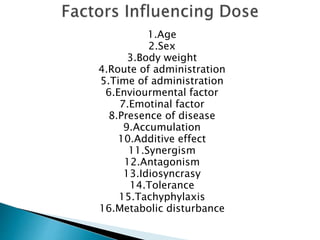
1.Age
2.Sex
3.Body weight
4.Route of administration
5.Time of administration
6.Enviourmental factor
7.Emotinal factor
8.Presence of disease
9.Accumulation
10.Additive effect
11.Synergism
12.Antagonism
13.Idiosyncrasy
14.Tolerance
15.Tachyphylaxis
16.Metabolic disturbance
 Age:
- The pharmacokinetics of many drugs changes with
age.
- Newborn infants (pediatric) are abnormally
sensitive to certain drugs because of the immature
state of their hepatic and renal function by which
drugs are inactivated and eliminated from the
body. Failure to detoxify and eliminate drugs
results in their accumulation in the tissues to a
toxic level.
- Whereas, elderly patients are more sensitive to
some drug effect e.g. hypnotics which may
produce confusion state in them.
 Sex:
- Women do not always respond to the action of
drug in the same manner as it done in men.
- Special care should be taken when drugs are
administered during menstruation, pregnancy &
lactation.
- The strong purgative eg. Aloes should be avoided
during menstruation.
- Similarly the drugs which may stimulate the
uterine smooth muscles e.g. drastic purgative,
antimalarial drugs, ergot alkaloids are contra
indicated during pregnancy.
- Alcohol, barbiturate, narcotic drugs acts on foetus
through placenta.
- During lactation, morphine, tetracycline avoided
because its affect on babies.
 Body weight:
- The average dose is mentioned either in terms
of mg per kg body weight.
- Another technique used as a total single for an
adult weighing between 50-100kg.
- However, the dose expressed in this fashion
may not apply in case of obese patients,
children & malnourished patients. It should be
calculated according to body weight.
 Route of administration:
- I.V doses of drug are usually smaller than the
oral doses, bec…
- Intravenous route this might enhance the
chances of drug toxicity.
- The effectiveness of drug formulation is
generally controlled by the route of
administration.
 Time of administration:
- The presence of food in the stomach delay the
absorption of drug & rapidly absorbed from the
empty stomach.
- But it does not mean that much effective when
taken during or after meal.
- Iron, arsenic & cod-liver oil should be given after
meal & antacid drugs taken before meal.
 Environmental factors:
- The personality & behavior of a physician may
influence the effect of drug especially the drugs
which are intended for use in a psychosomatic
disorders.
- The females are more emotional than male &
required less dose of certain drugs.
- Inert dosage forms called placebos which
resemble the actual medicament in the physical
properties are known to produce therapeutic
benefit in disease like angina pectoris &
bronchial asthma.
 Presence of disease:
- Drugs like barbiturates & chlorpromazine may
produce unusually prolonged effect in patient
having liver cirrhosis.
- Such as, streptomycin produce toxic effect on
these patient their kidney function is not working
properly because streptomycin excreted through
kidney.
 Accumulation:
- Some drugs produces the toxic effect if it is
repeatedly administered for long time e.g.
digitalis, emetine, heavy metals because these
drugs excreted slowly.
- This occurs due to accumulative effect of the
drug.
 Additive effect:
- When two or more drugs administered together is
equivalent to sum of their individual pharmacological
action, the phenomenon is called as additive effect.
- E.g ephedrine & aminophylline in the treatment of
bronchial ashtma.
 Synergism:
- When desired therapeutic result needed is difficult to
achieve with single drug at that time two or more drugs
are used in the combination form for increasing their
action this phenomenon is called synergism.
- E.g. procaine & adrenaline combination, increase the
duration of action of procaine.
 Antagonism:
- When the action of one drug is opposed by the
other drug on the same physiological system is
known as drug antagonism.
- The use of antagonistic response to drugs is
valuable in the treatment of poisoning.
- E.g. milk of magnesia is given in acid poisoning
where alkaline effect of milk of magnesia neutralise
the effect of acid poisoning.
- When adrenaline & acetylcholine are given together,
they neutralise the effect of each other due to
antagonism because adrenaline is vasoconstrictor &
acetylcholine is vasodilator.
 Idiosyncrasy:
- Idiosyncrasy is also called as allergy.
- An extraordinary response to a drug which is
different from its characteristic pharmacological
action is called idiosyncrasy.
- E.g. small quty. of aspirin may cause gastric
hemorrhage.
- E.g some persons are sensitive to penicillin &
sulphonamide because they produce severe
toxic effect.
 Tolerance:
- When an unusually large dose of a drug is
required to elicit an affect ordinarily produced
by the normal therapeutic dose of the drug, the
phenomenon is called as drug tolerance.
- E.g. smokers can tolerate nicotine, alcoholic can
tolerate large quantity of alcohol.
- The drug tolerance is of two types:
- True tolerance, which is produced by oral &
parenteral administration of the drug.
- Pseudo tolerance, which is produced only to the
oral route of administration.
 Tachyphylaxis:
- When some drugs administered repeatedly at
short intervals, the cell receptors get blocked up
& pharmacological response to that drug
decreased.
- The decreased response cannot be reversed by
increasing the dose this phenomenon is called
tachyphylaxis or acute tolerance.
- E.g. ephedrine given repeated dose at short
intervals in the treatment of bronchial asthma
may produce very less response due to
tachyphylaxis.
 Metabolic disturbance:
- Changes in water electrolyte balance & acid
base balance, body temperature & other
physiological factor may modify the effect of
drug.
- E.g. salicylates reduce body temperature in
only in case an individual has rise in body
temperature. They have no antipyretic effect
if the body temperature is normal.
 The dose of a drug given in the
pharmacopoeia represents the average
max.quty of drugs which can be administered
to an adult orally within 24 hrs.
 The doses are also calculated in
proportionate to age, body weight & surface
area of the patient.
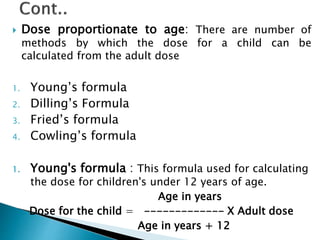
 Dose proportionate to age: There are number of
methods by which the dose for a child can be
calculated from the adult dose
1. Young’s formula
2. Dilling’s Formula
3. Fried’s formula
4. Cowling’s formula
1. Young's formula : This formula used for calculating
the dose for children's under 12 years of age.
Age in years
Dose for the child = ------------- X Adult dose
Age in years + 12
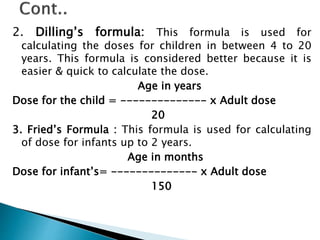
2. Dilling’s formula: This formula is used for
calculating the doses for children in between 4 to 20
years. This formula is considered better because it is
easier & quick to calculate the dose.
Age in years
Dose for the child = -------------- x Adult dose
20
3. Fried’s Formula : This formula is used for calculating
of dose for infants up to 2 years.
Age in months
Dose for infant’s= -------------- x Adult dose
150
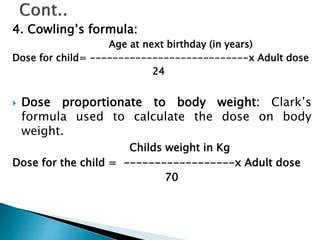
4. Cowling’s formula:
Age at next birthday (in years)
Dose for child= ----------------------------x Adult dose
24
 Dose proportionate to body weight: Clark’s
formula used to calculate the dose on body
weight.
Childs weight in Kg
Dose for the child = ------------------x Adult dose
70
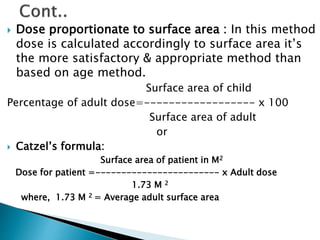
 Dose proportionate to surface area : In this method
dose is calculated accordingly to surface area it’s
the more satisfactory & appropriate method than
based on age method.
Surface area of child
Percentage of adult dose=------------------ x 100
Surface area of adult
or
 Catzel’s formula:
Surface area of patient in M2
Dose for patient =------------------------ x Adult dose
1.73 M 2
where, 1.73 M 2 = Average adult surface area
Posology

Posology

  • 1.
    Mr. Ravikumar RPatil Dr. Shivajirao Kadam College of Pharmacy, Kasabe digraj, Sangli
  • 2.
     Posology: (Derivedfrom the greek words Posos- how much, and logos means science).  Posology is a branch of medical science which deals with dose or quantity of drugs which can be administered to a patient to get the desired pharmacological action.  The dose of a drug cannot be fixed rigidly bec. Various factors are responsible i.e age, sex, severity of the disease etc.  The official doses in pharmacopoeia represent the average range of quty. Suitable for adults which is administered orally within 24 hrs.  When other routes of administration are followed the relevant appropriate dose is given.
  • 3.
    1.Age 2.Sex 3.Body weight 4.Route ofadministration 5.Time of administration 6.Enviourmental factor 7.Emotinal factor 8.Presence of disease 9.Accumulation 10.Additive effect 11.Synergism 12.Antagonism 13.Idiosyncrasy 14.Tolerance 15.Tachyphylaxis 16.Metabolic disturbance
  • 4.
     Age: - Thepharmacokinetics of many drugs changes with age. - Newborn infants (pediatric) are abnormally sensitive to certain drugs because of the immature state of their hepatic and renal function by which drugs are inactivated and eliminated from the body. Failure to detoxify and eliminate drugs results in their accumulation in the tissues to a toxic level. - Whereas, elderly patients are more sensitive to some drug effect e.g. hypnotics which may produce confusion state in them.
  • 5.
     Sex: - Womendo not always respond to the action of drug in the same manner as it done in men. - Special care should be taken when drugs are administered during menstruation, pregnancy & lactation. - The strong purgative eg. Aloes should be avoided during menstruation. - Similarly the drugs which may stimulate the uterine smooth muscles e.g. drastic purgative, antimalarial drugs, ergot alkaloids are contra indicated during pregnancy. - Alcohol, barbiturate, narcotic drugs acts on foetus through placenta. - During lactation, morphine, tetracycline avoided because its affect on babies.
  • 6.
     Body weight: -The average dose is mentioned either in terms of mg per kg body weight. - Another technique used as a total single for an adult weighing between 50-100kg. - However, the dose expressed in this fashion may not apply in case of obese patients, children & malnourished patients. It should be calculated according to body weight.
  • 7.
     Route ofadministration: - I.V doses of drug are usually smaller than the oral doses, bec… - Intravenous route this might enhance the chances of drug toxicity. - The effectiveness of drug formulation is generally controlled by the route of administration.
  • 8.
     Time ofadministration: - The presence of food in the stomach delay the absorption of drug & rapidly absorbed from the empty stomach. - But it does not mean that much effective when taken during or after meal. - Iron, arsenic & cod-liver oil should be given after meal & antacid drugs taken before meal.
  • 9.
     Environmental factors: -The personality & behavior of a physician may influence the effect of drug especially the drugs which are intended for use in a psychosomatic disorders. - The females are more emotional than male & required less dose of certain drugs. - Inert dosage forms called placebos which resemble the actual medicament in the physical properties are known to produce therapeutic benefit in disease like angina pectoris & bronchial asthma.
  • 10.
     Presence ofdisease: - Drugs like barbiturates & chlorpromazine may produce unusually prolonged effect in patient having liver cirrhosis. - Such as, streptomycin produce toxic effect on these patient their kidney function is not working properly because streptomycin excreted through kidney.
  • 11.
     Accumulation: - Somedrugs produces the toxic effect if it is repeatedly administered for long time e.g. digitalis, emetine, heavy metals because these drugs excreted slowly. - This occurs due to accumulative effect of the drug.
  • 12.
     Additive effect: -When two or more drugs administered together is equivalent to sum of their individual pharmacological action, the phenomenon is called as additive effect. - E.g ephedrine & aminophylline in the treatment of bronchial ashtma.  Synergism: - When desired therapeutic result needed is difficult to achieve with single drug at that time two or more drugs are used in the combination form for increasing their action this phenomenon is called synergism. - E.g. procaine & adrenaline combination, increase the duration of action of procaine.
  • 13.
     Antagonism: - Whenthe action of one drug is opposed by the other drug on the same physiological system is known as drug antagonism. - The use of antagonistic response to drugs is valuable in the treatment of poisoning. - E.g. milk of magnesia is given in acid poisoning where alkaline effect of milk of magnesia neutralise the effect of acid poisoning. - When adrenaline & acetylcholine are given together, they neutralise the effect of each other due to antagonism because adrenaline is vasoconstrictor & acetylcholine is vasodilator.
  • 14.
     Idiosyncrasy: - Idiosyncrasyis also called as allergy. - An extraordinary response to a drug which is different from its characteristic pharmacological action is called idiosyncrasy. - E.g. small quty. of aspirin may cause gastric hemorrhage. - E.g some persons are sensitive to penicillin & sulphonamide because they produce severe toxic effect.
  • 15.
     Tolerance: - Whenan unusually large dose of a drug is required to elicit an affect ordinarily produced by the normal therapeutic dose of the drug, the phenomenon is called as drug tolerance. - E.g. smokers can tolerate nicotine, alcoholic can tolerate large quantity of alcohol. - The drug tolerance is of two types: - True tolerance, which is produced by oral & parenteral administration of the drug. - Pseudo tolerance, which is produced only to the oral route of administration.
  • 16.
     Tachyphylaxis: - Whensome drugs administered repeatedly at short intervals, the cell receptors get blocked up & pharmacological response to that drug decreased. - The decreased response cannot be reversed by increasing the dose this phenomenon is called tachyphylaxis or acute tolerance. - E.g. ephedrine given repeated dose at short intervals in the treatment of bronchial asthma may produce very less response due to tachyphylaxis.
  • 17.
     Metabolic disturbance: -Changes in water electrolyte balance & acid base balance, body temperature & other physiological factor may modify the effect of drug. - E.g. salicylates reduce body temperature in only in case an individual has rise in body temperature. They have no antipyretic effect if the body temperature is normal.
  • 18.
     The doseof a drug given in the pharmacopoeia represents the average max.quty of drugs which can be administered to an adult orally within 24 hrs.  The doses are also calculated in proportionate to age, body weight & surface area of the patient.
  • 19.
     Dose proportionateto age: There are number of methods by which the dose for a child can be calculated from the adult dose 1. Young’s formula 2. Dilling’s Formula 3. Fried’s formula 4. Cowling’s formula 1. Young's formula : This formula used for calculating the dose for children's under 12 years of age. Age in years Dose for the child = ------------- X Adult dose Age in years + 12
  • 20.
    2. Dilling’s formula:This formula is used for calculating the doses for children in between 4 to 20 years. This formula is considered better because it is easier & quick to calculate the dose. Age in years Dose for the child = -------------- x Adult dose 20 3. Fried’s Formula : This formula is used for calculating of dose for infants up to 2 years. Age in months Dose for infant’s= -------------- x Adult dose 150
  • 21.
    4. Cowling’s formula: Ageat next birthday (in years) Dose for child= ----------------------------x Adult dose 24  Dose proportionate to body weight: Clark’s formula used to calculate the dose on body weight. Childs weight in Kg Dose for the child = ------------------x Adult dose 70
  • 22.
     Dose proportionateto surface area : In this method dose is calculated accordingly to surface area it’s the more satisfactory & appropriate method than based on age method. Surface area of child Percentage of adult dose=------------------ x 100 Surface area of adult or  Catzel’s formula: Surface area of patient in M2 Dose for patient =------------------------ x Adult dose 1.73 M 2 where, 1.73 M 2 = Average adult surface area