CRANIAL NERVES
PRESENTED BY : DR CHITRANSHA
INTRODUCTION
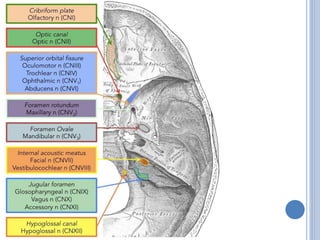
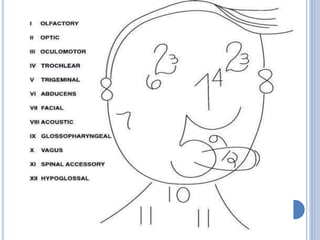
1. Olfactory nerve
2. Optic nerve
3. Oculomotor nerve
4. Trochlear nerve
5. Trigeminal nerve
6. Abducens nerve
7. Facial nerve
8. Vestibulocochlear nerve
9. Glossopharangial nerve
10. Vagus nerve
11. Accessory nerve
12. Hypoglossal nerve
There are 12 pairs of cranial nerves in our body.
These are called as cranial nerve because the originated directly from
the brain or inside the cranium.
There names are:
ORIGIN OF THE CRANIAL NERVES
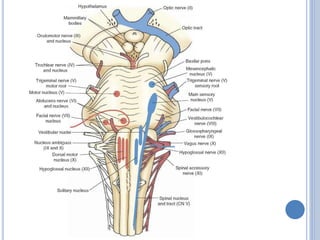
 The olfactory nerve (CN I) and optic nerve (CN II) originate
from the cerebrum (forebrain).
 Cranial nerves III – XII arise from the brain stem.
 1, 2 - Forebrain
 3,4 – Midbrain
 5,6,7,8 – Pons
 9,10,11,12 – Medulla oblogata
 All cranial nerves arise from ventral surface except 4th
(trochlear nerve) which arises dorsaally.
ORIGIN
 1, 2 - Forebrain
 3,4 – Midbrain
 5,6,7,8 – Pons
 9,10,11,12 – Medulla oblogata
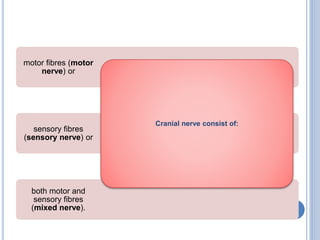
both motor and
sensory fibres
(mixed nerve).
sensory fibres
(sensory nerve) or
motor fibres (motor
nerve) or
Cranial nerve consist of:
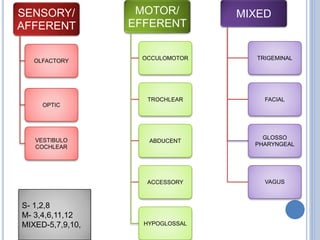
SENSORY/
AFFERENT
OLFACTORY
OPTIC
VESTIBULO
COCHLEAR
MOTOR/
EFFERENT
OCCULOMOTOR
TROCHLEAR
ABDUCENT
ACCESSORY
HYPOGLOSSAL
MIXED
TRIGEMINAL
FACIAL
GLOSSO
PHARYNGEAL
VAGUS
S- 1,2,8
M- 3,4,6,11,12
MIXED-5,7,9,10,
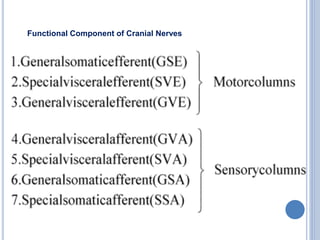
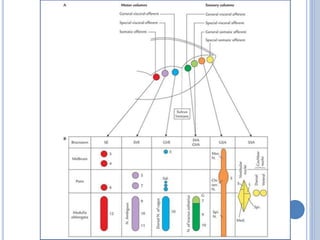
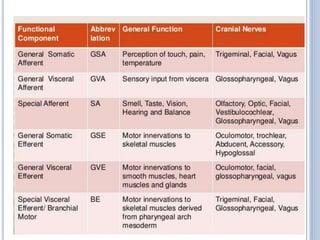
Functional Component of Cranial Nerves
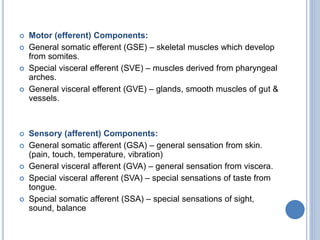
 Motor (efferent) Components:
 General somatic efferent (GSE) – skeletal muscles which develop
from somites.
 Special visceral efferent (SVE) – muscles derived from pharyngeal
arches.
 General visceral efferent (GVE) – glands, smooth muscles of gut &
vessels.
 Sensory (afferent) Components:
 General somatic afferent (GSA) – general sensation from skin.
(pain, touch, temperature, vibration)
 General visceral afferent (GVA) – general sensation from viscera.
 Special visceral afferent (SVA) – special sensations of taste from
tongue.
 Special somatic afferent (SSA) – special sensations of sight,
sound, balance
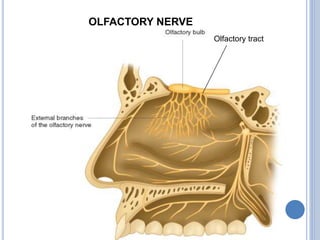
OLFACTORY NERVE
Olfactory tract
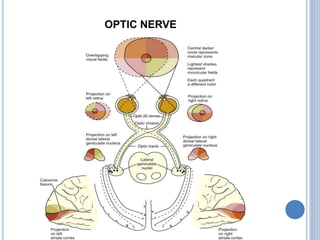
OPTIC NERVE

Cranial nerves

  • 1.
  • 2.
    INTRODUCTION 1. Olfactory nerve 2.Optic nerve 3. Oculomotor nerve 4. Trochlear nerve 5. Trigeminal nerve 6. Abducens nerve 7. Facial nerve 8. Vestibulocochlear nerve 9. Glossopharangial nerve 10. Vagus nerve 11. Accessory nerve 12. Hypoglossal nerve There are 12 pairs of cranial nerves in our body. These are called as cranial nerve because the originated directly from the brain or inside the cranium. There names are:
  • 3.
    ORIGIN OF THECRANIAL NERVES  The olfactory nerve (CN I) and optic nerve (CN II) originate from the cerebrum (forebrain).  Cranial nerves III – XII arise from the brain stem.  1, 2 - Forebrain  3,4 – Midbrain  5,6,7,8 – Pons  9,10,11,12 – Medulla oblogata  All cranial nerves arise from ventral surface except 4th (trochlear nerve) which arises dorsaally.
  • 4.
    ORIGIN  1, 2- Forebrain  3,4 – Midbrain  5,6,7,8 – Pons  9,10,11,12 – Medulla oblogata
  • 7.
    both motor and sensoryfibres (mixed nerve). sensory fibres (sensory nerve) or motor fibres (motor nerve) or Cranial nerve consist of:
  • 8.
  • 9.
  • 11.
     Motor (efferent)Components:  General somatic efferent (GSE) – skeletal muscles which develop from somites.  Special visceral efferent (SVE) – muscles derived from pharyngeal arches.  General visceral efferent (GVE) – glands, smooth muscles of gut & vessels.  Sensory (afferent) Components:  General somatic afferent (GSA) – general sensation from skin. (pain, touch, temperature, vibration)  General visceral afferent (GVA) – general sensation from viscera.  Special visceral afferent (SVA) – special sensations of taste from tongue.  Special somatic afferent (SSA) – special sensations of sight, sound, balance
  • 14.
  • 15.