VESTIBULAR APPRATUS
BY :
HARSHITA
YADAV
INTRODUCTION
• Two important functions of the ear
• Enables us to hear
• Sensory organ of balance or equilibrium
• Location of one ear on each side of head produces
binaural hearing
• Hearing from both sides
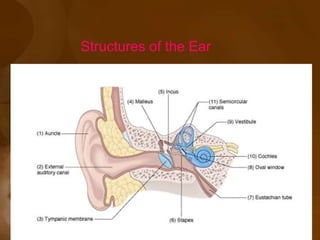
• External ear
• Visible portion, not contained within the head
• Auricle or pinna
• Cartilaginous flap or ear lobe
• External auditory canal
• Tube leading from auricle to the middle ear
• Lined with tiny hairs called cilia to aid in
transmitting sound waves inward
• Tympanic membrane (eardrum)
• Separates external ear from middle ear
Structures of the Ear
• Middle ear
• Three tiny bones known as auditory ossicles
• Malleus
• Resembles shape of a hammer
• Connected to tympanic membrane and transmits
sound vibrations to second auditory ossicle
• Incus
• Resembles shape of an anvil
• Transmits sound vibrations from malleus to third
auditory ossicle
Structures of the Ear
• Middle ear
• Stapes
• Shaped like a tiny stirrup
• Transmits sound vibrations from incus to inner ear
• Eustachian tube
• Connects middle ear to pharynx
• Auditory tube
• Oval window
• Separates middle ear from inner ear
• Base of stapes fits into oval window
Structures of the Ear
• Inner ear
• Vestibule
• Central portion of inner ear
• Located next to stapes and between cochlea and
semicircular canals
• Contains utricle and saccule-membranous
pouches or sacs that aid in maintaining balance
• Cochlea
• Snail-shaped bony structure
• Contains endolymph and perilymph
• Auditory fluids that aid in transmission of sound
vibrations
Structures of the Ear
Introduction to vestibular appratus
 It is part of inner ear or labyrinth
 It is a sensory organ that detects sensation of
equilibrium
 Vestibular apparatus plays an important role in
maintaining posture and equilibrium
 The other part of labyrinth is the cochlea, which
is concerned with sensation of hearing
LABYRINTH
Labyrinth or inner ear consists of two structure:
 BONY LABYRINTH
MEMBRANOUS LABYRINTH
BONY LABRINGTH
 It is composed of a system of bony tubes and
chambers located in the petrous portion of the
temporal bone, called the bony labyrinth,
 And within this, is a system of membranous
tubes and chambers called the membranous
labyrinth.
 The space between bony and membranous
labyrinth filled with a fluid called perilymph or
periotic fluid. This fluid is similar ECF in
composition with large amount of sodium ions.
MEMBRANEOUS LABYRINTH
 It is formed by membraneous tubules and sacs.
 Tubules are semicicular canals & sacs are
vestibular and cochlear duct.
 The vestibular duct consists of otolith organ.
 Otolith organ is formed is formed by utricle and
saccule. The membranous labyrinth is filled with
a fluid called endolymph or otic fluid. The
endolymph is similar to ICF in composition.This
has more quantity of potassium ions.
STRUCTURE OF SEMICIRCULAR CANAL
 Vestibular apparatus is formed by three
semicircular ducts and otolith organ
SEMICIRCULAR CANALS
 The three semi-circular canals in each vestibular
apparatus, are placed at right angles to each
other.
 Because of this type of arrangement, the
semicircular canals represent the three axes of
rotation: vertical, anteroposterior and transverse
axes
The semicircular canals are named according to
the situation as follows:
1.Anterior or superior canal
2.Posterior canal
3.Lateral or horizontal or external canal
The anterior and posterior canals are situated
vertically and the lateral canal is situated in
horizontal plane.
The lateral canal of vestibular apparatus on both
sides are placed horizontally in the same plane
with the convexities directed outwards and a little
backward
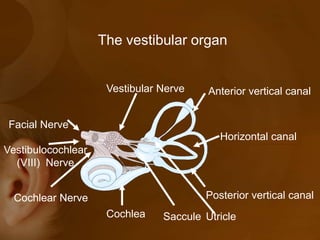
The vestibular organ
Horizontal canal
Anterior vertical canal
Posterior vertical canal
Vestibular Nerve
Facial Nerve
Vestibulocochlear
(VIII) Nerve
Cochlea
Cochlear NerveCochlear Nerve
UtricleSaccule
 When the head is bent forward about 30 degrees,
the lateral semicircular canals are then
approximately horizontal with respect to the
surface of the earth
 The anterior canals are in vertical planes that
project forward and 45 degrees outward, whereas
the posterior canals are also in vertical planes but
project backward and 45 degrees outward.
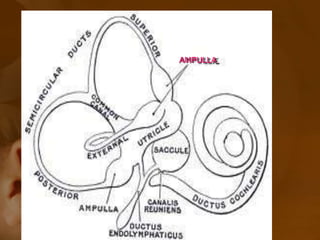
AMPULLA
 Among the two ends of semicircular canal , one
and is narrow and other end is enlarged.
 The enlarged end is called ampulla.
 The ampulla contains the receptor organ known as
crista ampullaries.
 The ampulla of all the 3 canals & narrow end of
horizontal canal open directly into the utricle .
 The narrow end of anterior & posterior canals
open into the utricle jointly , by forming a common
crus .
 Thus, semicircular canals open into the utricle by
means of five openings.
AMPULLA
The vestibular organ
Horizontal canal
Anterior vertical canal
Posterior vertical canal
Vestibular Nerve
Facial Nerve
Vestibulocochlear
(VIII) Nerve
Cochlea
Cochlear NerveCochlear Nerve
UtricleSaccule
OTOLITH ORGAN OR VESTIBULE
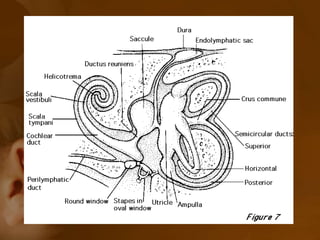
 Otolith organ or vestibule is formed by utricle and
saccule.
 Often utricle and saccule are together called
otoliths.
 Utricle communicates with saccule through
utriculo-saccular duct.
 Saccule communicates with cochlear duct through
ductus reuniens.
 Another duct called endolymphatic duct arises
from utriculosaccular duct.
 It ends in a bag like structure called
endolymphatic sac, which lies on the cranial
surface of petrous bone.
RECEPTOR ORGAN IN SEMICIRCULAR
CANAL CRISTA AMPULLARIS
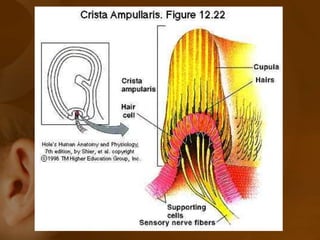
It is a crest like structure situated inside the ampulla
of semicircular canals
The crest is formed by a receptor epithelium
(neuroepithelium) which consists if hair cells,
supporting cells and secreting epithelial cells
The secreting cells secrete the ground substance,
proteoglycan
These cells are arranged in planum semilunatum
(group of epithelial cells) around hair cells
HAIR CELLS
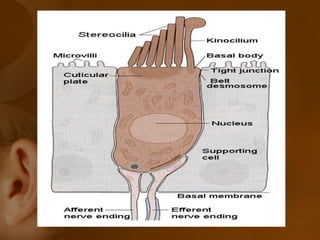
• Hair cells are the receptor cells of crista ampullaris. There are
2 types of hair cells, type I and type II hair cells. Hair cells of
semicircular canals, utricle and saccule receive both afferent
and efferent nerve terminals.
 TYPE I HAIR CELLS
Type I hair cells are flask shaped. The afferent nerve
terminates in the form of calyx that surrounds the cell body.
The efferent nerve terminal ends on the surface of the calyx.
 TYPE II HAIR CELLS
These cells have a cylindrical or test tube shape. Both
afferent and efferent nerve fibres terminate on the surface cell
without forming calyx.
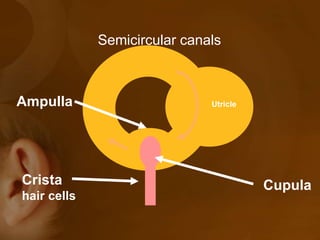
CUPULA
From crista ampullaris, a dome-shaped
gelatinous structure extends up to the roof of
the ampulla. It is known as cupula. The
cupula encloses the cilia of hair cells. The
cilia of hair cells are projected in the cupula.
Semicircular canals
UtricleAmpulla
Crista
hair cells
Cupula
MACULA
 The receptor organs in utricle and saccule are
called maculae.
 Like crista ampullaris it is also formed by
neuroepithelium and supporting cells
 The neuroepithelial of this also has two types of
hair cells, the type 1 and 2 hair cells.
 Situation of macula is different in utricle and
saccule .
 In utricle , the macula is situated in horizontal
plane, so that the cilia from hair cells are in
verticle plane .
 In saccule , the macula is in verticle plane and
the cilia are in horizontal.
BLOOD SUPPLY TO THE VESTIBULAR END
ORGAN
 The main blood supply is through the internal auditory
(labyrinthine artery), which usually arises from the anterior
cerebellar artery, superior cerebellar artery, or basilar artery
 The labyrinthine artery divides into two branches- anterior
vestibular artery and the common cochlear artery
 Anterior vestibular artery provides the blood supply to most
of the utricle, to superior and horizontal ampullae’ and to
small portion of the saccule
 The common carotid artery supply posterior ampulla, the
major part of the saccule, parts of the body of the utricle and
the horizontal and superior ampullae
NERVE SUPPLY TO VESTIBULAR APPARATUS
 The impulses from the hair cells of crista ampullaris and
maculae are transmitted to medulla oblongata and other
parts of CNS through the fibres of vestibular division of
vestibulocochlear (VIII cranial) nerve.
FIRST ORDER NEURON
 The first order neurons of the sensory pathway are bipolar in
nature. The soma of the bipolar cells is situated in vestibular
or Scarpa’s ganglion ( situated in internal auditory meatus) .
 The dendrites of the bipolar cells reach the receptor organs,
i.e. crista ampullaris and maculae in vestibular apparatus.
 The axon form the vestibular division of
vestibulo cochlear nerve.
 The fibres from bipolar reach medulla oblongata
and terminate in the vestibular nuclei.The nerve
fibres are called primary vestibular fibres.
VESTIBULAR NUCLEI
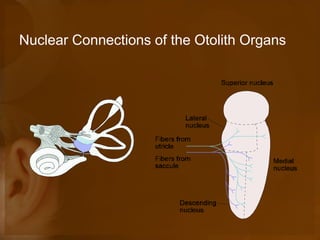
 There are four vestibular nuclei in the medulla oblongata,
viz. superior, inferior, lateral and medial nuclei.
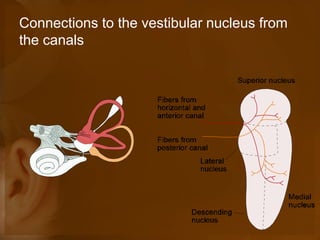
 Most of the primary vestibular fibres reaching superior and
medial nuclei come from crista ampullaris of semicircular
canals.
 Lateral vestibular nucleus receives the fibres mostly from
maculae of otolith organ, and, the inferior vestibular nucleus
receives fibres from both crista ampullaris and maculae.
 It is believed that the efferent fibres to hair cells provide tonic
inhibition of hair cells.
 The fibres from some bipolar cells reach cerebellum directly
and terminate in the flocculonodular lobe or the fastigial
nucleus in the cerebellum.
Connections to the vestibular nucleus from
the canals
Nuclear Connections of the Otolith Organs
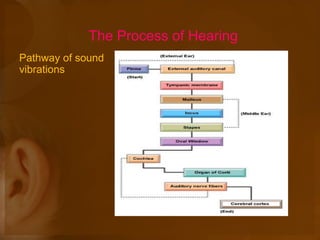
The Process of Hearing
Pathway of sound
vibrations
SECOND ORDER NEURON
 The second order neurons of this pathway are located in the
four vestibular nuclei which forms secondary vestibular fibres
which further forms four tracts :
1. Vestibulo-ocular tract
This tract is concerned with movements of eyeballs in
relation to the position of the head.
2. Vestibulo-spinal tract
The fibres of this tract are involved in reflex movements
of head and body during postural changes.
3. Vestibulo-recticular tract
These fibres are concerned with facilitation of muscle
tone.
4. Vestibulo-cerebellar tract
Involved in coordination of movement acc. to body position.
FUNCTIONS OF VESTIBULAR APPRATUS
It is responsible for dectecting the position of
head during different movements.
It causes the reflex adjustments in the position of
eyeball, head and body during postural changes.
FUNCTION OF SEMICIRCULAR CANALS
Semicircular canals sense angular acceleration
FUNCTION OF OTOLITH ORGAN
 The otolith organs sense linear acceleration
 The saccule senses acceleration in the sagittal
vertical plane: up and down (so it senses
gravity) and forward and backward.
 The utricle senses acceleration in the horizontal
plane
APPLIED PHYSIOLOGY – EFFECT OF
LABYRINTHECTOMY
 BILATERAL LABYRINTHECTOMY-
Removal of labyrinthine apparatus on both sides leads to
complete loss of equilibrium
The equilibrium could be maintained only by visual
sensation.
The postural reflexes are severely affected.
There is loss of hearing sensation .
UNILATERAL LABYRINTHECTOMY
• Removal of labyrinthine apparatus on one side causes
less effects on postural reflexes.
• Severe autonomic symtoms occur like nausea , vomiting
and diarrhea.
MOTION SICKNESS
o It is defined as syndrome of physiological response
during movement to which the person is not adapted .
o Motion sickness is due to excessive and repeated
stimulation of vestibular apparatus.
 Symtoms
o Nausea Discomfort
o Vomiting Headache
o Sweating Disorientation
o Diarrhoea
o Pallor
o Salivation
PREVENTION
o It can be done by avioding greasy and bulky
food before travel and by taking antiemic drugs
THANK YOU

Vestibular system

  • 1.
  • 2.
    INTRODUCTION • Two importantfunctions of the ear • Enables us to hear • Sensory organ of balance or equilibrium • Location of one ear on each side of head produces binaural hearing • Hearing from both sides
  • 3.
    • External ear •Visible portion, not contained within the head • Auricle or pinna • Cartilaginous flap or ear lobe • External auditory canal • Tube leading from auricle to the middle ear • Lined with tiny hairs called cilia to aid in transmitting sound waves inward • Tympanic membrane (eardrum) • Separates external ear from middle ear Structures of the Ear
  • 4.
    • Middle ear •Three tiny bones known as auditory ossicles • Malleus • Resembles shape of a hammer • Connected to tympanic membrane and transmits sound vibrations to second auditory ossicle • Incus • Resembles shape of an anvil • Transmits sound vibrations from malleus to third auditory ossicle Structures of the Ear
  • 5.
    • Middle ear •Stapes • Shaped like a tiny stirrup • Transmits sound vibrations from incus to inner ear • Eustachian tube • Connects middle ear to pharynx • Auditory tube • Oval window • Separates middle ear from inner ear • Base of stapes fits into oval window Structures of the Ear
  • 6.
    • Inner ear •Vestibule • Central portion of inner ear • Located next to stapes and between cochlea and semicircular canals • Contains utricle and saccule-membranous pouches or sacs that aid in maintaining balance • Cochlea • Snail-shaped bony structure • Contains endolymph and perilymph • Auditory fluids that aid in transmission of sound vibrations Structures of the Ear
  • 8.
  • 9.
    Introduction to vestibularappratus  It is part of inner ear or labyrinth  It is a sensory organ that detects sensation of equilibrium  Vestibular apparatus plays an important role in maintaining posture and equilibrium  The other part of labyrinth is the cochlea, which is concerned with sensation of hearing
  • 10.
    LABYRINTH Labyrinth or innerear consists of two structure:  BONY LABYRINTH MEMBRANOUS LABYRINTH
  • 11.
    BONY LABRINGTH  Itis composed of a system of bony tubes and chambers located in the petrous portion of the temporal bone, called the bony labyrinth,  And within this, is a system of membranous tubes and chambers called the membranous labyrinth.  The space between bony and membranous labyrinth filled with a fluid called perilymph or periotic fluid. This fluid is similar ECF in composition with large amount of sodium ions.
  • 13.
    MEMBRANEOUS LABYRINTH  Itis formed by membraneous tubules and sacs.  Tubules are semicicular canals & sacs are vestibular and cochlear duct.  The vestibular duct consists of otolith organ.  Otolith organ is formed is formed by utricle and saccule. The membranous labyrinth is filled with a fluid called endolymph or otic fluid. The endolymph is similar to ICF in composition.This has more quantity of potassium ions.
  • 15.
    STRUCTURE OF SEMICIRCULARCANAL  Vestibular apparatus is formed by three semicircular ducts and otolith organ SEMICIRCULAR CANALS  The three semi-circular canals in each vestibular apparatus, are placed at right angles to each other.  Because of this type of arrangement, the semicircular canals represent the three axes of rotation: vertical, anteroposterior and transverse axes
  • 16.
    The semicircular canalsare named according to the situation as follows: 1.Anterior or superior canal 2.Posterior canal 3.Lateral or horizontal or external canal The anterior and posterior canals are situated vertically and the lateral canal is situated in horizontal plane. The lateral canal of vestibular apparatus on both sides are placed horizontally in the same plane with the convexities directed outwards and a little backward
  • 17.
    The vestibular organ Horizontalcanal Anterior vertical canal Posterior vertical canal Vestibular Nerve Facial Nerve Vestibulocochlear (VIII) Nerve Cochlea Cochlear NerveCochlear Nerve UtricleSaccule
  • 18.
     When thehead is bent forward about 30 degrees, the lateral semicircular canals are then approximately horizontal with respect to the surface of the earth  The anterior canals are in vertical planes that project forward and 45 degrees outward, whereas the posterior canals are also in vertical planes but project backward and 45 degrees outward.
  • 20.
    AMPULLA  Among thetwo ends of semicircular canal , one and is narrow and other end is enlarged.  The enlarged end is called ampulla.  The ampulla contains the receptor organ known as crista ampullaries.  The ampulla of all the 3 canals & narrow end of horizontal canal open directly into the utricle .  The narrow end of anterior & posterior canals open into the utricle jointly , by forming a common crus .  Thus, semicircular canals open into the utricle by means of five openings.
  • 21.
  • 22.
    The vestibular organ Horizontalcanal Anterior vertical canal Posterior vertical canal Vestibular Nerve Facial Nerve Vestibulocochlear (VIII) Nerve Cochlea Cochlear NerveCochlear Nerve UtricleSaccule
  • 23.
    OTOLITH ORGAN ORVESTIBULE  Otolith organ or vestibule is formed by utricle and saccule.  Often utricle and saccule are together called otoliths.  Utricle communicates with saccule through utriculo-saccular duct.  Saccule communicates with cochlear duct through ductus reuniens.  Another duct called endolymphatic duct arises from utriculosaccular duct.  It ends in a bag like structure called endolymphatic sac, which lies on the cranial surface of petrous bone.
  • 26.
    RECEPTOR ORGAN INSEMICIRCULAR CANAL CRISTA AMPULLARIS It is a crest like structure situated inside the ampulla of semicircular canals The crest is formed by a receptor epithelium (neuroepithelium) which consists if hair cells, supporting cells and secreting epithelial cells The secreting cells secrete the ground substance, proteoglycan These cells are arranged in planum semilunatum (group of epithelial cells) around hair cells
  • 28.
    HAIR CELLS • Haircells are the receptor cells of crista ampullaris. There are 2 types of hair cells, type I and type II hair cells. Hair cells of semicircular canals, utricle and saccule receive both afferent and efferent nerve terminals.  TYPE I HAIR CELLS Type I hair cells are flask shaped. The afferent nerve terminates in the form of calyx that surrounds the cell body. The efferent nerve terminal ends on the surface of the calyx.  TYPE II HAIR CELLS These cells have a cylindrical or test tube shape. Both afferent and efferent nerve fibres terminate on the surface cell without forming calyx.
  • 30.
    CUPULA From crista ampullaris,a dome-shaped gelatinous structure extends up to the roof of the ampulla. It is known as cupula. The cupula encloses the cilia of hair cells. The cilia of hair cells are projected in the cupula.
  • 32.
  • 33.
    MACULA  The receptororgans in utricle and saccule are called maculae.  Like crista ampullaris it is also formed by neuroepithelium and supporting cells  The neuroepithelial of this also has two types of hair cells, the type 1 and 2 hair cells.  Situation of macula is different in utricle and saccule .  In utricle , the macula is situated in horizontal plane, so that the cilia from hair cells are in verticle plane .  In saccule , the macula is in verticle plane and the cilia are in horizontal.
  • 34.
    BLOOD SUPPLY TOTHE VESTIBULAR END ORGAN  The main blood supply is through the internal auditory (labyrinthine artery), which usually arises from the anterior cerebellar artery, superior cerebellar artery, or basilar artery  The labyrinthine artery divides into two branches- anterior vestibular artery and the common cochlear artery  Anterior vestibular artery provides the blood supply to most of the utricle, to superior and horizontal ampullae’ and to small portion of the saccule  The common carotid artery supply posterior ampulla, the major part of the saccule, parts of the body of the utricle and the horizontal and superior ampullae
  • 36.
    NERVE SUPPLY TOVESTIBULAR APPARATUS  The impulses from the hair cells of crista ampullaris and maculae are transmitted to medulla oblongata and other parts of CNS through the fibres of vestibular division of vestibulocochlear (VIII cranial) nerve. FIRST ORDER NEURON  The first order neurons of the sensory pathway are bipolar in nature. The soma of the bipolar cells is situated in vestibular or Scarpa’s ganglion ( situated in internal auditory meatus) .  The dendrites of the bipolar cells reach the receptor organs, i.e. crista ampullaris and maculae in vestibular apparatus.
  • 37.
     The axonform the vestibular division of vestibulo cochlear nerve.  The fibres from bipolar reach medulla oblongata and terminate in the vestibular nuclei.The nerve fibres are called primary vestibular fibres.
  • 38.
    VESTIBULAR NUCLEI  Thereare four vestibular nuclei in the medulla oblongata, viz. superior, inferior, lateral and medial nuclei.  Most of the primary vestibular fibres reaching superior and medial nuclei come from crista ampullaris of semicircular canals.  Lateral vestibular nucleus receives the fibres mostly from maculae of otolith organ, and, the inferior vestibular nucleus receives fibres from both crista ampullaris and maculae.  It is believed that the efferent fibres to hair cells provide tonic inhibition of hair cells.  The fibres from some bipolar cells reach cerebellum directly and terminate in the flocculonodular lobe or the fastigial nucleus in the cerebellum.
  • 39.
    Connections to thevestibular nucleus from the canals
  • 40.
    Nuclear Connections ofthe Otolith Organs
  • 41.
    The Process ofHearing Pathway of sound vibrations
  • 42.
    SECOND ORDER NEURON The second order neurons of this pathway are located in the four vestibular nuclei which forms secondary vestibular fibres which further forms four tracts : 1. Vestibulo-ocular tract This tract is concerned with movements of eyeballs in relation to the position of the head. 2. Vestibulo-spinal tract The fibres of this tract are involved in reflex movements of head and body during postural changes. 3. Vestibulo-recticular tract These fibres are concerned with facilitation of muscle tone. 4. Vestibulo-cerebellar tract Involved in coordination of movement acc. to body position.
  • 43.
    FUNCTIONS OF VESTIBULARAPPRATUS It is responsible for dectecting the position of head during different movements. It causes the reflex adjustments in the position of eyeball, head and body during postural changes. FUNCTION OF SEMICIRCULAR CANALS Semicircular canals sense angular acceleration
  • 44.
    FUNCTION OF OTOLITHORGAN  The otolith organs sense linear acceleration  The saccule senses acceleration in the sagittal vertical plane: up and down (so it senses gravity) and forward and backward.  The utricle senses acceleration in the horizontal plane
  • 45.
    APPLIED PHYSIOLOGY –EFFECT OF LABYRINTHECTOMY  BILATERAL LABYRINTHECTOMY- Removal of labyrinthine apparatus on both sides leads to complete loss of equilibrium The equilibrium could be maintained only by visual sensation. The postural reflexes are severely affected. There is loss of hearing sensation .
  • 46.
    UNILATERAL LABYRINTHECTOMY • Removalof labyrinthine apparatus on one side causes less effects on postural reflexes. • Severe autonomic symtoms occur like nausea , vomiting and diarrhea.
  • 47.
    MOTION SICKNESS o Itis defined as syndrome of physiological response during movement to which the person is not adapted . o Motion sickness is due to excessive and repeated stimulation of vestibular apparatus.  Symtoms o Nausea Discomfort o Vomiting Headache o Sweating Disorientation o Diarrhoea o Pallor o Salivation
  • 48.
    PREVENTION o It canbe done by avioding greasy and bulky food before travel and by taking antiemic drugs
  • 49.