ACCESSORY NERVE (XI)
DR. SAMIA SHAHBAZ
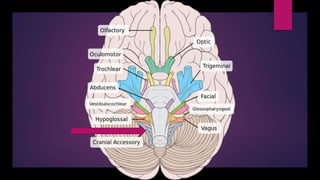
The spinal accessory nerve is a motor nerve.
It is the 11th pair out of the total 12 pairs of cranial nerves.
Two components:
 Cranial part
 Spinal part
It is a unique cranial nerve as it originates extracranially i.e.
arises from motor neurons of the
upper five segments [c1-c5] of the
cervical spinal cord.
CRANIAL ROOT
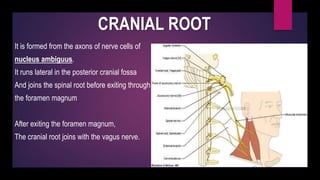
It is formed from the axons of nerve cells of
nucleus ambiguus.
It runs lateral in the posterior cranial fossa
And joins the spinal root before exiting through
the foramen magnum
After exiting the foramen magnum,
The cranial root joins with the vagus nerve.
SPINAL PART
The spinal part is formed from axons of nerve cells in the spinal nucleus.
The spinal portion arises from neurons of the upper spinal cord, specifically C1-C5 spinal nerve
roots. These fibres coalesce to form the spinal part of the accessory nerve, which then runs
superiorly to enter the cranial cavity via the foramen magnum.
The nerve traverses the posterior cranial fossa to reach the jugular foramen. It briefly meets the
cranial portion of the accessory nerve, before exiting the skull (along with the glossopharyngeal and
vagus nerves).
After a short distance, the spinal root separates from the cranial root and descends along
the internal carotid artery to reach the sternocleidomastoid muscle, which it innervates.
It then moves across the posterior triangle of the neck to supply motor fibres to the trapezius.
So,
It supplies
STERNOCLEIDOMASTOID MUSCLE
TRAPEZIUS MUSCLE
ACCESSORY NERVE PALSY
STERNOCLEIDOMASTOID MUSCLE:
the sternocleidomastoid muscle is tested by asking the patient to turn their head to the left or right
against resistance. weakness in head-turning suggests injury to the contralateral spinal accessory
nerve: a weak leftward turn is indicative of a weak right sternocleidomastoid muscle (and thus right
spinal accessory nerve injury) and vice versa.
TRAPEZIUS MUSCLE
The trapezius muscle is tested by asking the patient to shrug their shoulders with and without
resistance. A one-sided weakness is indicative of an injury to the spinal accessory nerve on the
same side (ipsilateral) of the body being assessed.
DROOPED shoulders will be indicative of injury.

Accessory nerve xi

  • 1.
  • 3.
    The spinal accessorynerve is a motor nerve. It is the 11th pair out of the total 12 pairs of cranial nerves. Two components:  Cranial part  Spinal part
  • 4.
    It is aunique cranial nerve as it originates extracranially i.e. arises from motor neurons of the upper five segments [c1-c5] of the cervical spinal cord.
  • 5.
    CRANIAL ROOT It isformed from the axons of nerve cells of nucleus ambiguus. It runs lateral in the posterior cranial fossa And joins the spinal root before exiting through the foramen magnum After exiting the foramen magnum, The cranial root joins with the vagus nerve.
  • 6.
    SPINAL PART The spinalpart is formed from axons of nerve cells in the spinal nucleus. The spinal portion arises from neurons of the upper spinal cord, specifically C1-C5 spinal nerve roots. These fibres coalesce to form the spinal part of the accessory nerve, which then runs superiorly to enter the cranial cavity via the foramen magnum.
  • 7.
    The nerve traversesthe posterior cranial fossa to reach the jugular foramen. It briefly meets the cranial portion of the accessory nerve, before exiting the skull (along with the glossopharyngeal and vagus nerves).
  • 10.
    After a shortdistance, the spinal root separates from the cranial root and descends along the internal carotid artery to reach the sternocleidomastoid muscle, which it innervates. It then moves across the posterior triangle of the neck to supply motor fibres to the trapezius. So, It supplies STERNOCLEIDOMASTOID MUSCLE TRAPEZIUS MUSCLE
  • 12.
    ACCESSORY NERVE PALSY STERNOCLEIDOMASTOIDMUSCLE: the sternocleidomastoid muscle is tested by asking the patient to turn their head to the left or right against resistance. weakness in head-turning suggests injury to the contralateral spinal accessory nerve: a weak leftward turn is indicative of a weak right sternocleidomastoid muscle (and thus right spinal accessory nerve injury) and vice versa.
  • 13.
    TRAPEZIUS MUSCLE The trapeziusmuscle is tested by asking the patient to shrug their shoulders with and without resistance. A one-sided weakness is indicative of an injury to the spinal accessory nerve on the same side (ipsilateral) of the body being assessed. DROOPED shoulders will be indicative of injury.