ANTERIOR
TRIANGLE OF
NECK
Lecture By:
Dr. Chitransha
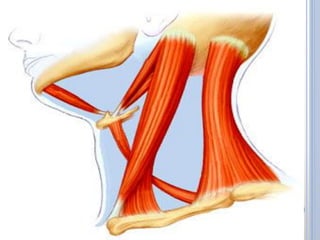
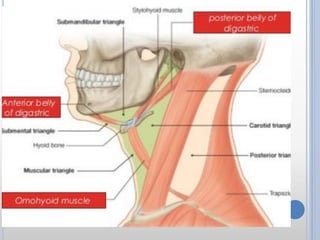
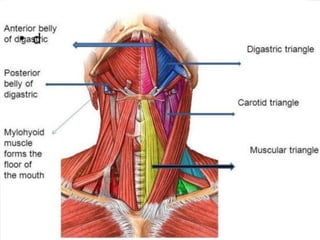
DIGASTRIC MUSCLE
2 bellies –anterior & posterior.
The anterior belly arises from digastric fossa
on the base of the mandible and runs
downwards and backwards, towards the
hyoid bone.
The posterior belly arises from the digastric
notch on the medial surface of the base of
the mastoid process, and runs downwards
and forwards, towards the hyoid bone.
Above the hyoid bone the two bellies
are connected by an intermediate
tendon, which is anchored to the
hyoid bone by a fascial sling of
investing layer of deep cervical fascia.
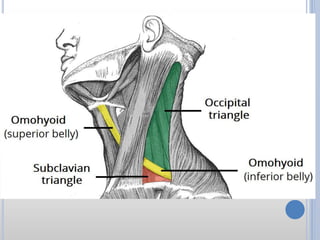
OMOHYOID MUSCLE
Superior and inferior bellies joined by an
intermediate tendon.
The inferior belly arises from upper border of
scapula, near the suprascapular notch, it then
passes behind the SCM and ends there in an
intermediate tendon.
The superior belly begins at the intermediate
tendon and passes almost vertically upwards
to be attached to the lower border of the
hyoid bone.
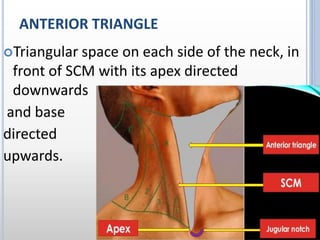
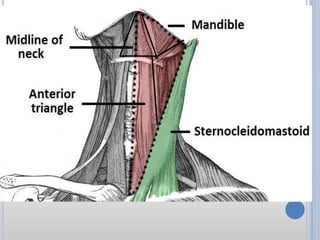
ANTERIOR TRIANGLE
Triangular space on each side of the neck, in
front of SCM with its apex directed
downwards
and base
directed
upwards.
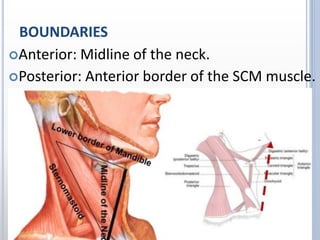
BOUNDARIES
Anterior: Midline of the neck.
Posterior: Anterior border of the SCM muscle.
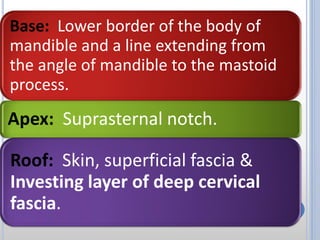
Base: Lower border of the body of
mandible and a line extending from
the angle of mandible to the mastoid
process.
Apex: Suprasternal notch.
Roof: Skin, superficial fascia &
Investing layer of deep cervical
fascia.
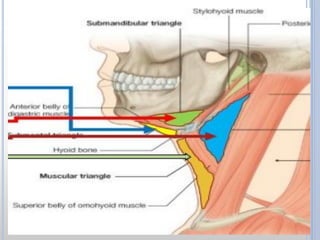
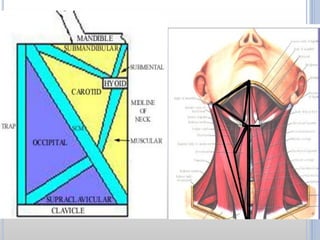
1. Submental triangle
2. Digastric (submandibular) triangle.
3. Carotid triangle.
4. Muscular triangle.
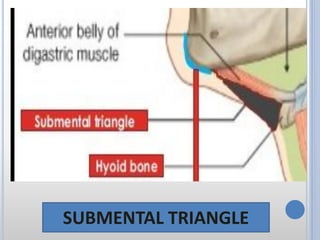
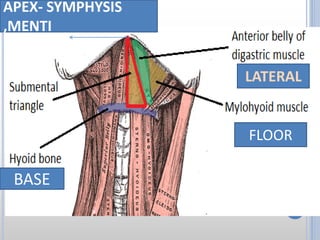
SUBMENTAL TRIANGLE
FLOOR
LATERAL
BASE
APEX- SYMPHYSIS
,MENTI
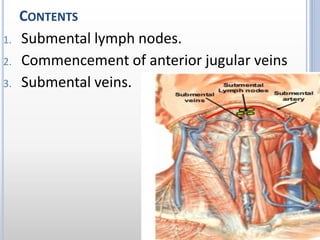
CONTENTS
1. Submental lymph nodes.
2. Commencement of anterior jugular veins
3. Submental veins.
APPLIED
Infections of floor of mouth, tip of
tongue, and incisor teeth cause
painful enlargement of submental
lymph nodes because lymph from
these structures is drained into these
nodes.
DIGASTRIC TRIANGLE
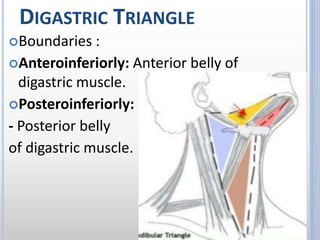
Boundaries :
Anteroinferiorly: Anterior belly of
digastric muscle.
Posteroinferiorly:
- Posterior belly
of digastric muscle.
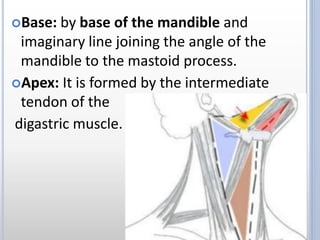
Base: by base of the mandible and
imaginary line joining the angle of the
mandible to the mastoid process.
Apex: It is formed by the intermediate
tendon of the
digastric muscle.
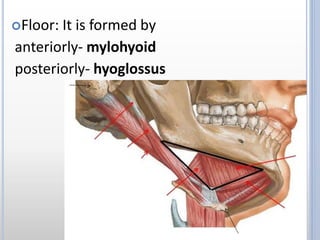
Floor: It is formed by
anteriorly- mylohyoid
posteriorly- hyoglossus
CONTENTS
The digastric triangle is subdivided into
anterior and posterior parts by the
stylomandibular ligament.
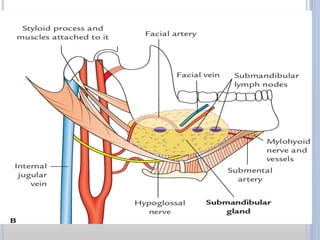
CONTENTS IN THE ANTERIOR PART OF
THE TRIANGLE:
1. Submandibular salivary gland
2. Submandibular lymph nodes
3. Hypoglossal nerve
4. Facial vein
5. Facial artery
6. Submental artery
7. Mylohyoid nerve and vessels
CONTENTS IN THE POSTERIOR PART
OF THE TRIANGLE:
External carotid artery.
Carotid sheath and its contents.
Lower part of parotid gland.
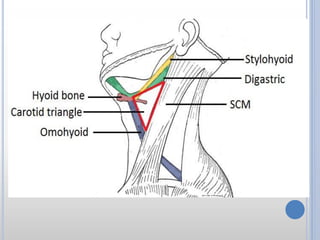
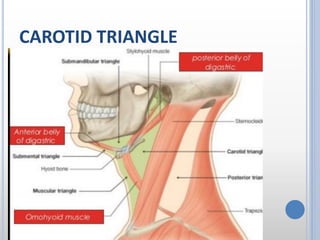
CAROTID TRIANGLE
CAROTID TRIANGLE
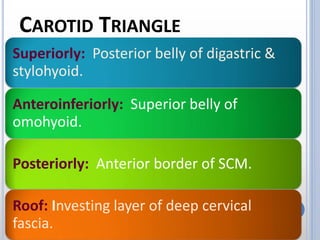
Superiorly: Posterior belly of digastric &
stylohyoid.
Anteroinferiorly: Superior belly of
omohyoid.
Posteriorly: Anterior border of SCM.
Roof: Investing layer of deep cervical
fascia.
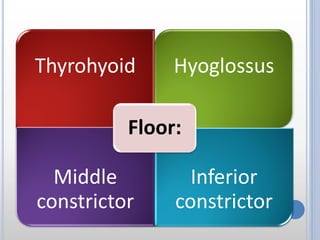
Thyrohyoid Hyoglossus
Middle
constrictor
Inferior
constrictor
Floor:
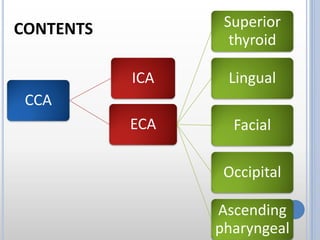
CCA
ICA
ECA
Superior
thyroid
Lingual
Facial
Occipital
Ascending
pharyngeal
CONTENTS
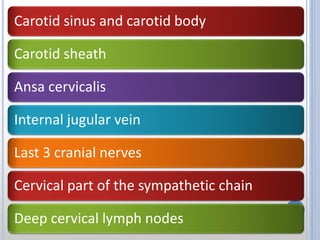
Carotid sinus and carotid body
Carotid sheath
Ansa cervicalis
Internal jugular vein
Last 3 cranial nerves
Cervical part of the sympathetic chain
Deep cervical lymph nodes
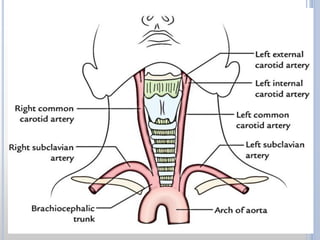
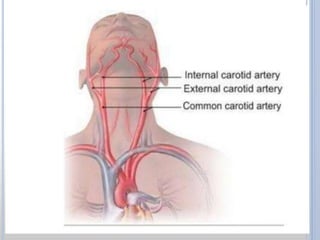
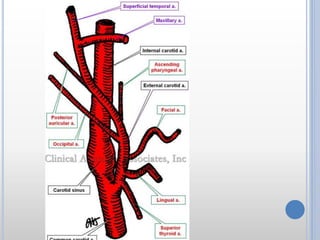
INTERNAL CAROTID ARTERIES
After its origin the internal carotid
artery ascends towards base of skull.
It gives off no branches in the neck.
It supplies the cerebral hemisphere,
the eyes and the contents of the orbit
and the forehead.
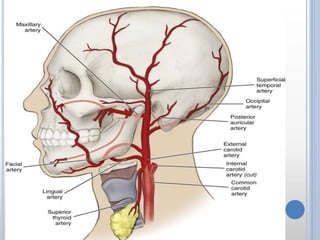
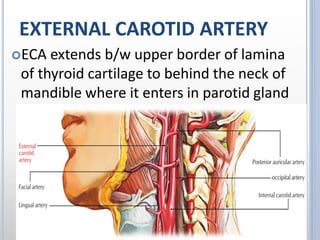
EXTERNAL CAROTID ARTERY
ECA extends b/w upper border of lamina
of thyroid cartilage to behind the neck of
mandible where it enters in parotid gland
& behind the neck of mandible divides in
into 2 terminal branches.
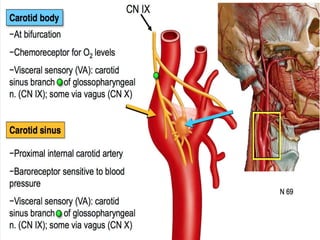
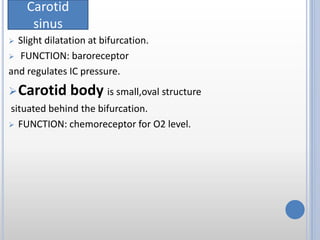
 Slight dilatation at bifurcation.
 FUNCTION: baroreceptor
and regulates IC pressure.
Carotid body is small,oval structure
situated behind the bifurcation.
 FUNCTION: chemoreceptor for O2 level.
Carotid
sinus
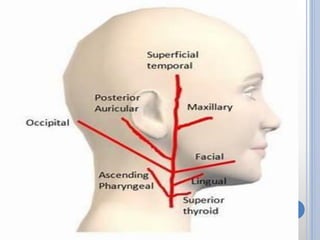
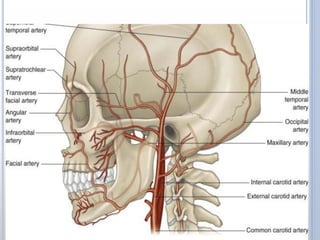
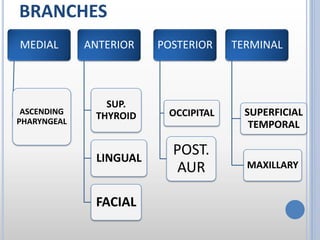
BRANCHES
MEDIAL
ASCENDING
PHARYNGEAL
ANTERIOR
SUP.
THYROID
LINGUAL
FACIAL
TERMINAL
SUPERFICIAL
TEMPORAL
MAXILLARY
POSTERIOR
OCCIPITAL
POST.
AUR
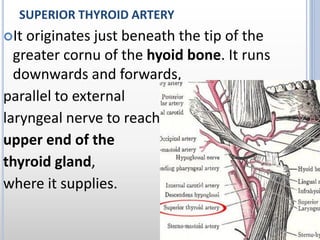
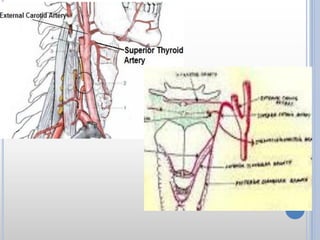
SUPERIOR THYROID ARTERY
It originates just beneath the tip of the
greater cornu of the hyoid bone. It runs
downwards and forwards,
parallel to external
laryngeal nerve to reach
upper end of the
thyroid gland,
where it supplies.
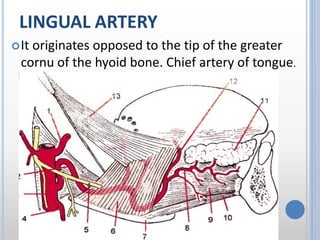
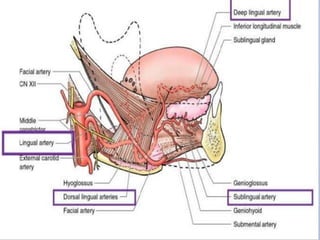
LINGUAL ARTERY
It originates opposed to the tip of the greater
cornu of the hyoid bone. Chief artery of tongue.
Divded into 3 parts by hyoglossus
muscle.
Characteristic loop in first part to
facilitate free movements to hyoid
bone.
FACIAL ARTERY
 It arises just above the tip of the
greater cornu of the hyoid bone.
two parts—
1. Cervical
2. Facial
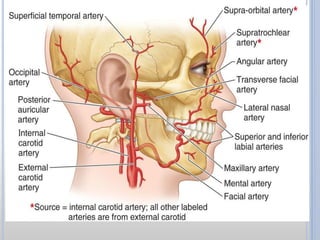
COURSE :
tortuous course ~
extending obliquely upward, downward &
forward and appear at lower border of
mandible then goes upwards across the
cheek to the angle of mouth, side of nose
to medial angle of eye.
At the medial angle of eye, it anastomoses
with the dorsal nasal artery branches of
ophthalmic artery, a branch of internal
carotid artery.
BRANCHES IN THE FACE:
1. Inferior labial artery, to supply the
lower lip.
2. Superior labial artery, to supply the
upper lip.
3. Lateral nasal artery, to supply the
ala and dorsum of the nose.
4. Muscular branches, are small,
unnamed.
SLIM
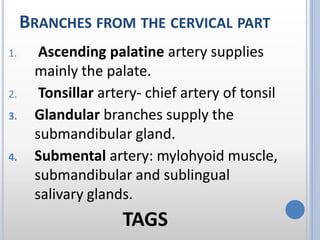
BRANCHES FROM THE CERVICAL PART
1. Ascending palatine artery supplies
mainly the palate.
2. Tonsillar artery- chief artery of tonsil
3. Glandular branches supply the
submandibular gland.
4. Submental artery: mylohyoid muscle,
submandibular and sublingual
salivary glands.
TAGS
OCCIPITAL ARTERY
It arises from the posterior aspect of
the external carotid artery at the same
level as the facial artery.
It travels backwards and upwards,
then it runs deep to the mastoid
process grooving the lower surface of
the temporal bone medial to the
mastoid notch.
It supplies most of the back of the
scalp.
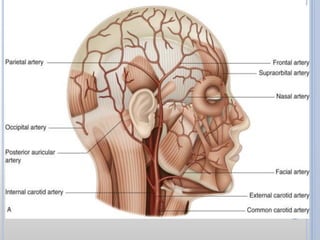
POSTERIOR AURICULAR ARTERY
Arises posteriorly a little above the
occipital artery.
It runs upwards and backwards parallel
to the occipital artery along the upper
border of the posterior belly of digastric
muscle and deep to the parotid gland.
Then it becomes superficial and lies on
the base of mastoid process behind the
ear where it supplies.
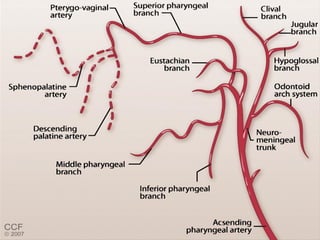
ASCENDING PHARYNGEAL ARTERY
It originates from the medial part of the
external carotid artery near its lower
end.
 It runs in the middle of the side wall of
the pharynx and tonsil.
Pharyngeal branches supply pharynx.
Its meningeal branches enters in
cranial cavity through foramen lacerum,
jugular foramen, hypoglossal canal.
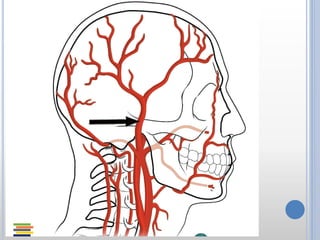
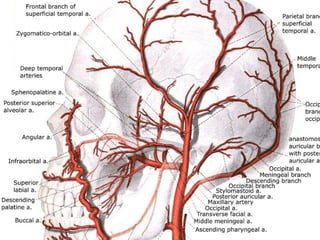
SUPERFICIAL TEMPORAL ARTERY
It is smaller terminal branch of the ECA.
It arises within the parotid gland behind
the neck of the mandible.
It travels vertically upwards, cross the
zygomztic arch, temporal fascia.
5cm above the zygomatic arch, it divides
into anterior and posterior branches
that circulate the temple and scalp.
MAXILLARY ARTERY
The maxillary artery larger terminal
branch originates in parotid gland
behind the neck of and enter
the infratemporal fossa to
the pterygopalatine fossa.
Lateral pterygoid muscle divide it into
3 parts.
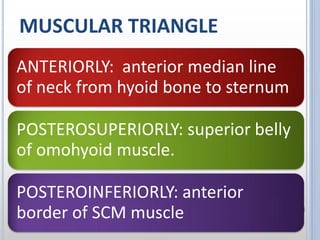
MUSCULAR TRIANGLE
ANTERIORLY: anterior median line
of neck from hyoid bone to sternum
POSTEROSUPERIORLY: superior belly
of omohyoid muscle.
POSTEROINFERIORLY: anterior
border of SCM muscle
Floor: formed by
sternothyroid,
sternohyoid
muscles.
Roof: Investing
layer of deep
cervical fascia.
CONTENTS
 The infrahyoid muscle are the chief
contents and the muscles are:
1. Sternohyoid
2. Sternothyroid
3. Thyrohyoid
4. Omohyoid
All are supplied by ventral rami of 1,2,3rd
cervical spinal nerves.
Other important structures below the
floor are thyroid gland, trachea, and
esophagus.

Anterior triangle of neck

  • 1.
  • 3.
    DIGASTRIC MUSCLE 2 bellies–anterior & posterior. The anterior belly arises from digastric fossa on the base of the mandible and runs downwards and backwards, towards the hyoid bone. The posterior belly arises from the digastric notch on the medial surface of the base of the mastoid process, and runs downwards and forwards, towards the hyoid bone.
  • 4.
    Above the hyoidbone the two bellies are connected by an intermediate tendon, which is anchored to the hyoid bone by a fascial sling of investing layer of deep cervical fascia.
  • 5.
    OMOHYOID MUSCLE Superior andinferior bellies joined by an intermediate tendon. The inferior belly arises from upper border of scapula, near the suprascapular notch, it then passes behind the SCM and ends there in an intermediate tendon. The superior belly begins at the intermediate tendon and passes almost vertically upwards to be attached to the lower border of the hyoid bone.
  • 9.
    ANTERIOR TRIANGLE Triangular spaceon each side of the neck, in front of SCM with its apex directed downwards and base directed upwards.
  • 10.
    BOUNDARIES Anterior: Midline ofthe neck. Posterior: Anterior border of the SCM muscle.
  • 11.
    Base: Lower borderof the body of mandible and a line extending from the angle of mandible to the mastoid process. Apex: Suprasternal notch. Roof: Skin, superficial fascia & Investing layer of deep cervical fascia.
  • 13.
    1. Submental triangle 2.Digastric (submandibular) triangle. 3. Carotid triangle. 4. Muscular triangle.
  • 17.
  • 18.
  • 19.
    CONTENTS 1. Submental lymphnodes. 2. Commencement of anterior jugular veins 3. Submental veins.
  • 20.
    APPLIED Infections of floorof mouth, tip of tongue, and incisor teeth cause painful enlargement of submental lymph nodes because lymph from these structures is drained into these nodes.
  • 21.
    DIGASTRIC TRIANGLE Boundaries : Anteroinferiorly:Anterior belly of digastric muscle. Posteroinferiorly: - Posterior belly of digastric muscle.
  • 22.
    Base: by baseof the mandible and imaginary line joining the angle of the mandible to the mastoid process. Apex: It is formed by the intermediate tendon of the digastric muscle.
  • 23.
    Floor: It isformed by anteriorly- mylohyoid posteriorly- hyoglossus
  • 24.
    CONTENTS The digastric triangleis subdivided into anterior and posterior parts by the stylomandibular ligament.
  • 25.
    CONTENTS IN THEANTERIOR PART OF THE TRIANGLE: 1. Submandibular salivary gland 2. Submandibular lymph nodes 3. Hypoglossal nerve 4. Facial vein 5. Facial artery 6. Submental artery 7. Mylohyoid nerve and vessels
  • 27.
    CONTENTS IN THEPOSTERIOR PART OF THE TRIANGLE: External carotid artery. Carotid sheath and its contents. Lower part of parotid gland.
  • 28.
  • 29.
    CAROTID TRIANGLE Superiorly: Posteriorbelly of digastric & stylohyoid. Anteroinferiorly: Superior belly of omohyoid. Posteriorly: Anterior border of SCM. Roof: Investing layer of deep cervical fascia.
  • 30.
  • 31.
  • 32.
    Carotid sinus andcarotid body Carotid sheath Ansa cervicalis Internal jugular vein Last 3 cranial nerves Cervical part of the sympathetic chain Deep cervical lymph nodes
  • 35.
    INTERNAL CAROTID ARTERIES Afterits origin the internal carotid artery ascends towards base of skull. It gives off no branches in the neck. It supplies the cerebral hemisphere, the eyes and the contents of the orbit and the forehead.
  • 36.
    EXTERNAL CAROTID ARTERY ECAextends b/w upper border of lamina of thyroid cartilage to behind the neck of mandible where it enters in parotid gland & behind the neck of mandible divides in into 2 terminal branches.
  • 38.
     Slight dilatationat bifurcation.  FUNCTION: baroreceptor and regulates IC pressure. Carotid body is small,oval structure situated behind the bifurcation.  FUNCTION: chemoreceptor for O2 level. Carotid sinus
  • 39.
  • 41.
    SUPERIOR THYROID ARTERY Itoriginates just beneath the tip of the greater cornu of the hyoid bone. It runs downwards and forwards, parallel to external laryngeal nerve to reach upper end of the thyroid gland, where it supplies.
  • 43.
    LINGUAL ARTERY It originatesopposed to the tip of the greater cornu of the hyoid bone. Chief artery of tongue.
  • 44.
    Divded into 3parts by hyoglossus muscle. Characteristic loop in first part to facilitate free movements to hyoid bone.
  • 45.
    FACIAL ARTERY  Itarises just above the tip of the greater cornu of the hyoid bone. two parts— 1. Cervical 2. Facial
  • 46.
    COURSE : tortuous course~ extending obliquely upward, downward & forward and appear at lower border of mandible then goes upwards across the cheek to the angle of mouth, side of nose to medial angle of eye. At the medial angle of eye, it anastomoses with the dorsal nasal artery branches of ophthalmic artery, a branch of internal carotid artery.
  • 48.
    BRANCHES IN THEFACE: 1. Inferior labial artery, to supply the lower lip. 2. Superior labial artery, to supply the upper lip. 3. Lateral nasal artery, to supply the ala and dorsum of the nose. 4. Muscular branches, are small, unnamed. SLIM
  • 49.
    BRANCHES FROM THECERVICAL PART 1. Ascending palatine artery supplies mainly the palate. 2. Tonsillar artery- chief artery of tonsil 3. Glandular branches supply the submandibular gland. 4. Submental artery: mylohyoid muscle, submandibular and sublingual salivary glands. TAGS
  • 51.
    OCCIPITAL ARTERY It arisesfrom the posterior aspect of the external carotid artery at the same level as the facial artery. It travels backwards and upwards, then it runs deep to the mastoid process grooving the lower surface of the temporal bone medial to the mastoid notch. It supplies most of the back of the scalp.
  • 53.
    POSTERIOR AURICULAR ARTERY Arisesposteriorly a little above the occipital artery. It runs upwards and backwards parallel to the occipital artery along the upper border of the posterior belly of digastric muscle and deep to the parotid gland. Then it becomes superficial and lies on the base of mastoid process behind the ear where it supplies.
  • 55.
    ASCENDING PHARYNGEAL ARTERY Itoriginates from the medial part of the external carotid artery near its lower end.  It runs in the middle of the side wall of the pharynx and tonsil. Pharyngeal branches supply pharynx. Its meningeal branches enters in cranial cavity through foramen lacerum, jugular foramen, hypoglossal canal.
  • 57.
    SUPERFICIAL TEMPORAL ARTERY Itis smaller terminal branch of the ECA. It arises within the parotid gland behind the neck of the mandible. It travels vertically upwards, cross the zygomztic arch, temporal fascia. 5cm above the zygomatic arch, it divides into anterior and posterior branches that circulate the temple and scalp.
  • 59.
    MAXILLARY ARTERY The maxillaryartery larger terminal branch originates in parotid gland behind the neck of and enter the infratemporal fossa to the pterygopalatine fossa. Lateral pterygoid muscle divide it into 3 parts.
  • 63.
    MUSCULAR TRIANGLE ANTERIORLY: anteriormedian line of neck from hyoid bone to sternum POSTEROSUPERIORLY: superior belly of omohyoid muscle. POSTEROINFERIORLY: anterior border of SCM muscle
  • 65.
    Floor: formed by sternothyroid, sternohyoid muscles. Roof:Investing layer of deep cervical fascia.
  • 66.
    CONTENTS  The infrahyoidmuscle are the chief contents and the muscles are: 1. Sternohyoid 2. Sternothyroid 3. Thyrohyoid 4. Omohyoid All are supplied by ventral rami of 1,2,3rd cervical spinal nerves.
  • 67.
    Other important structuresbelow the floor are thyroid gland, trachea, and esophagus.