POSTERIOR
TRIANGLE
Lecture By:
Dr. Chitransha
• Neck is divided into large anterior
and posterior triangles by the
sternocleidomastoid muscle
which runs across this area
diagonally from upper end of the
sternum & clavicle to the mastoid
process.
Sternocleidomastoid
• key muscle.
• Origin: The muscle arises by two heads:
sternal and clavicular.
• Sternal head: is arises from the superolateral
part of the front of the manubrium sterni.
• Clavicular head: It arises from the superior
border & anterior surface of medial 1/3rd of
the clavicle. It passes vertically upwards deep
to the sternal head with which it unites to
form a fusiform belly.
Insertion
On mastoid process extending from its
tip to its base, and
By a thin aponeurosis into the lateral half
of the superior nuchal line of the
occipital bone.
Arterial Supply
• The sternocleidomastoid is supplied by
following arteries:
1. Upper part, by occipital and posterior
auricular arteries.
2. Middle part, by superior thyroid
artery.
3. Lower part, by suprascapular artery.
Nerve Supply
• The sternocleidomastoid muscle is
supplied by the spinal accessory nerve.
• It is also supplied by the ventral rami of
C2 and C3, which are mostly sensory and
carry proprioceptive sensations from the
muscle.
Actions
• When muscle contracts unilaterally, it
pulls the head towards the shoulder on
the same side and rotates the head so
that chin turns to the opposite side.
• When muscles of both sides contract
together, flex the cervical part of V.C.
they draw the head forwards as in lifting
the head from the pillow or bending the
head during eating food.
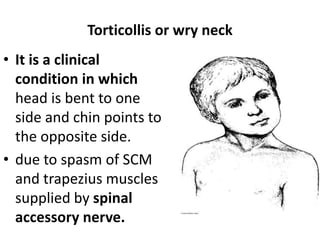
Torticollis or wry neck
• It is a clinical
condition in which
head is bent to one
side and chin points to
the opposite side.
• due to spasm of SCM
and trapezius muscles
supplied by spinal
accessory nerve.
1. Spasmodic
2. Reflex
3. Congenital
• The spasmodic torticollis is characterized
by repeated painful contractions of the
trapezius and SCM muscles on one side.
• It is usually caused by exposure to cold
and maladjustment of pillow during
sleep.
• The reflex torticollis occurs due to
irritation of spinal accessory nerve
caused by inflamed or suppurating lymph
nodes.
• The congenital torticollis occurs due to
birth injury to muscle.
• Sternomastoid tumor: It is the swelling
in the middle third of the SCM muscle
due to edema and ischemic necrosis
caused by birth trauma.
ORIGIN
• Medial third of the superior nuchal line,
• External occipital protuberance,
• ligamentum nuchae,
• Spinous processes of 7th cervical
vertebrae
• Spinous processes of all thoracic
vertebrae
INSERTION
•Upper surface of lateral third of clavicle,
superior crest of spine of scapula, Med.
Border of Acromion process, Tubercle of
Spine of Scapula.
NERVE SUPPLY
• Motor: Accessory nerve (CN XI)
• Sensory: Anterior rami of spinal nerves
C3-C4 (via cervical plexus)
POSTERIOR TRIANGLE
• It is the triangular space on the side of neck
behind the sternocleidomastoid muscle.
• Anterior
• Posterior
• Apex
• Base
• Roof
• Floor
• Anterior: Posterior border of SCM
muscle.
• Posterior: Anterior border of trapezius
muscle.
• Inferior (base): Superior aspect of middle
third of the clavicle.
• Superior (apex): Meeting point of
sternocleidomastoid and trapezius
muscles at the superior nuchal line of the
occipital bone.
• Floor :
 Splenius capitis
 Levator scapulae muscles
 Anterior, medius, posterior scalenus
muscles.
Splenius capitis
Levator scapulae
Post, M, Ant
Scalene
• Roof :
Skin, sup.
Fascia,
Platysma,
Investing layer
of deep cervical
fascia
stretching b/t
SCM &
trapezius
muscles.
Investing
layer
Platysma
Subdivisions
• The posterior triangle is subdivided into two
parts by the inferior belly of the omohyoid,
which crosses the lower part of the triangle
obliquely upwards and forwards (a) a larger
upper part called occipital triangle,
• (b) a small lower part called subclavian
(supraclavicular) triangle.
• These parts are so named because they
contain occipital and subclavian arteries
respectively.
CONTENTS
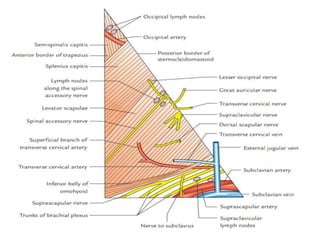
In the occipital triangle (i.e., above the omohyoid)
1. Spinal accessory nerve
2. 3rd and 4th cervical nerves providing branches to
levator scapulae and trapezius muscles
3. Dorsal scapular nerve (C5)
4. Four cutaneous branches of cervical plexus
5. Superficial transverse cervical artery
6. Occipital artery.
In the subclavian/supraclavicular triangle (i.e.,
below the omohyoid)
1. 3rd part of the subclavian artery
2. Subclavian vein
3. Terminal part of EJV
4. Trunks of brachial plexus
5. Superficial (transverse) cervical,
suprascapular, and dorsal scapular arteries
6. Supraclavicular Lymph nodes.
Spinal accessory nerve
• This nerve emerges in the posterior triangle
by piercing the posterior border of the SCM.
• In this situation, it is related to lymph nodes of
the upper deep cervical group.
• The nerve then crosses the posterior triangle
by running downwards and laterally over and
parallel to the fibres of levator scapulae
muscle to disappear underneath to the
anterior border of trapezius and supplies
trapezius muscle.
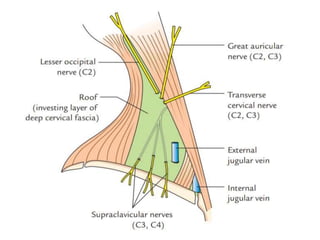
Four cutaneous branches of cervical
plexus
• Although cervical plexus is located deep
to the SCM but its cutaneous branches
emerge at the midpoint or just above the
midpoint of the posterior border of the
sternocleidomastoid by piercing the deep
cervical fascia.
OCCIPITAL ARTERY
• It is a branch of the external carotid artery.
• It enters the posterior triangle at its superior
angle, appearing between the SCM &
trapezius muscles. Then, it ascends in a
tortuous course over the back of the scalp,
accompanied by the greater occipital nerve.
Subclavian Artery
• The third part of
the subclavian
artery enters the
anteroinferior
angle of the
posterior triangle
and disappears
behind the middle
of the clavicle.
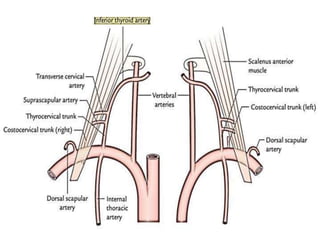
SUPERFICIAL CERVICAL ARTERY
• TRANSVERSE CERVICAL ARTERY
• It is a branch of the thyrocervical trunk, of the
first part of the subclavian artery.
• It runs across the lower part of the posterior
triangle and disappears deep to the trapezius
muscle.
Suprascapular Artery
• The suprascapular artery is also a branch
of the thyrocervical trunk.
• It runs across the lower part of the
posterior triangle.
• It follows the suprascapular nerve into
the supraspinous fossa and takes part in
the anastomosis around the scapula.
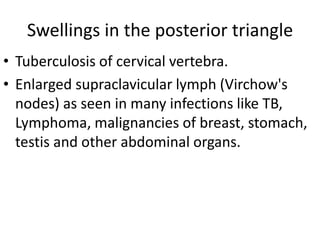
Swellings in the posterior triangle
• Tuberculosis of cervical vertebra.
• Enlarged supraclavicular lymph (Virchow's
nodes) as seen in many infections like TB,
Lymphoma, malignancies of breast, stomach,
testis and other abdominal organs.
CERVICAL RIB
• Enlarged costal element of the
transverse process of the 7th cervical
vertebra.
External jugular vein
• Injury to EJV in
the
supraclavicular
space cause air
embolism and
sudden death.
• JVP Raised in right
sided heart
failures.

Posterior triangle

  • 1.
  • 2.
    • Neck isdivided into large anterior and posterior triangles by the sternocleidomastoid muscle which runs across this area diagonally from upper end of the sternum & clavicle to the mastoid process.
  • 4.
    Sternocleidomastoid • key muscle. •Origin: The muscle arises by two heads: sternal and clavicular. • Sternal head: is arises from the superolateral part of the front of the manubrium sterni. • Clavicular head: It arises from the superior border & anterior surface of medial 1/3rd of the clavicle. It passes vertically upwards deep to the sternal head with which it unites to form a fusiform belly.
  • 7.
    Insertion On mastoid processextending from its tip to its base, and By a thin aponeurosis into the lateral half of the superior nuchal line of the occipital bone.
  • 8.
    Arterial Supply • Thesternocleidomastoid is supplied by following arteries: 1. Upper part, by occipital and posterior auricular arteries. 2. Middle part, by superior thyroid artery. 3. Lower part, by suprascapular artery.
  • 9.
    Nerve Supply • Thesternocleidomastoid muscle is supplied by the spinal accessory nerve. • It is also supplied by the ventral rami of C2 and C3, which are mostly sensory and carry proprioceptive sensations from the muscle.
  • 10.
    Actions • When musclecontracts unilaterally, it pulls the head towards the shoulder on the same side and rotates the head so that chin turns to the opposite side. • When muscles of both sides contract together, flex the cervical part of V.C. they draw the head forwards as in lifting the head from the pillow or bending the head during eating food.
  • 11.
    Torticollis or wryneck • It is a clinical condition in which head is bent to one side and chin points to the opposite side. • due to spasm of SCM and trapezius muscles supplied by spinal accessory nerve.
  • 12.
    1. Spasmodic 2. Reflex 3.Congenital • The spasmodic torticollis is characterized by repeated painful contractions of the trapezius and SCM muscles on one side. • It is usually caused by exposure to cold and maladjustment of pillow during sleep.
  • 13.
    • The reflextorticollis occurs due to irritation of spinal accessory nerve caused by inflamed or suppurating lymph nodes. • The congenital torticollis occurs due to birth injury to muscle.
  • 14.
    • Sternomastoid tumor:It is the swelling in the middle third of the SCM muscle due to edema and ischemic necrosis caused by birth trauma.
  • 16.
    ORIGIN • Medial thirdof the superior nuchal line, • External occipital protuberance, • ligamentum nuchae, • Spinous processes of 7th cervical vertebrae • Spinous processes of all thoracic vertebrae
  • 18.
    INSERTION •Upper surface oflateral third of clavicle, superior crest of spine of scapula, Med. Border of Acromion process, Tubercle of Spine of Scapula.
  • 19.
    NERVE SUPPLY • Motor:Accessory nerve (CN XI) • Sensory: Anterior rami of spinal nerves C3-C4 (via cervical plexus)
  • 20.
    POSTERIOR TRIANGLE • Itis the triangular space on the side of neck behind the sternocleidomastoid muscle. • Anterior • Posterior • Apex • Base • Roof • Floor
  • 22.
    • Anterior: Posteriorborder of SCM muscle. • Posterior: Anterior border of trapezius muscle. • Inferior (base): Superior aspect of middle third of the clavicle. • Superior (apex): Meeting point of sternocleidomastoid and trapezius muscles at the superior nuchal line of the occipital bone.
  • 23.
    • Floor : Splenius capitis  Levator scapulae muscles  Anterior, medius, posterior scalenus muscles.
  • 24.
  • 25.
    • Roof : Skin,sup. Fascia, Platysma, Investing layer of deep cervical fascia stretching b/t SCM & trapezius muscles. Investing layer Platysma
  • 27.
    Subdivisions • The posteriortriangle is subdivided into two parts by the inferior belly of the omohyoid, which crosses the lower part of the triangle obliquely upwards and forwards (a) a larger upper part called occipital triangle, • (b) a small lower part called subclavian (supraclavicular) triangle. • These parts are so named because they contain occipital and subclavian arteries respectively.
  • 28.
    CONTENTS In the occipitaltriangle (i.e., above the omohyoid) 1. Spinal accessory nerve 2. 3rd and 4th cervical nerves providing branches to levator scapulae and trapezius muscles 3. Dorsal scapular nerve (C5) 4. Four cutaneous branches of cervical plexus 5. Superficial transverse cervical artery 6. Occipital artery.
  • 30.
    In the subclavian/supraclaviculartriangle (i.e., below the omohyoid) 1. 3rd part of the subclavian artery 2. Subclavian vein 3. Terminal part of EJV 4. Trunks of brachial plexus 5. Superficial (transverse) cervical, suprascapular, and dorsal scapular arteries 6. Supraclavicular Lymph nodes.
  • 32.
    Spinal accessory nerve •This nerve emerges in the posterior triangle by piercing the posterior border of the SCM. • In this situation, it is related to lymph nodes of the upper deep cervical group. • The nerve then crosses the posterior triangle by running downwards and laterally over and parallel to the fibres of levator scapulae muscle to disappear underneath to the anterior border of trapezius and supplies trapezius muscle.
  • 33.
    Four cutaneous branchesof cervical plexus • Although cervical plexus is located deep to the SCM but its cutaneous branches emerge at the midpoint or just above the midpoint of the posterior border of the sternocleidomastoid by piercing the deep cervical fascia.
  • 35.
    OCCIPITAL ARTERY • Itis a branch of the external carotid artery. • It enters the posterior triangle at its superior angle, appearing between the SCM & trapezius muscles. Then, it ascends in a tortuous course over the back of the scalp, accompanied by the greater occipital nerve.
  • 37.
    Subclavian Artery • Thethird part of the subclavian artery enters the anteroinferior angle of the posterior triangle and disappears behind the middle of the clavicle.
  • 40.
    SUPERFICIAL CERVICAL ARTERY •TRANSVERSE CERVICAL ARTERY • It is a branch of the thyrocervical trunk, of the first part of the subclavian artery. • It runs across the lower part of the posterior triangle and disappears deep to the trapezius muscle.
  • 41.
    Suprascapular Artery • Thesuprascapular artery is also a branch of the thyrocervical trunk. • It runs across the lower part of the posterior triangle. • It follows the suprascapular nerve into the supraspinous fossa and takes part in the anastomosis around the scapula.
  • 44.
    Swellings in theposterior triangle • Tuberculosis of cervical vertebra. • Enlarged supraclavicular lymph (Virchow's nodes) as seen in many infections like TB, Lymphoma, malignancies of breast, stomach, testis and other abdominal organs.
  • 45.
    CERVICAL RIB • Enlargedcostal element of the transverse process of the 7th cervical vertebra.
  • 48.
    External jugular vein •Injury to EJV in the supraclavicular space cause air embolism and sudden death. • JVP Raised in right sided heart failures.