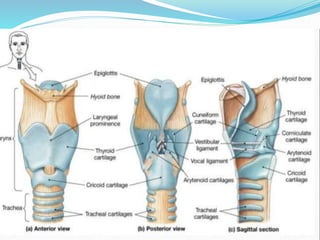
It extends from the root of the
tongue→ trachea.
Location: in front of the 3rd to
6th cervical vertebrae.
higher in children and
females.
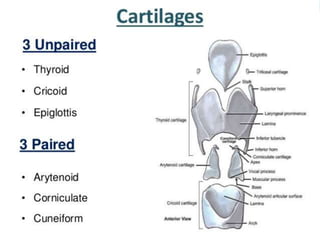
Paired Unpaired
Thyroid
Cricoid
Epiglottis
Arytenoid
Cuneiform
Corniculate
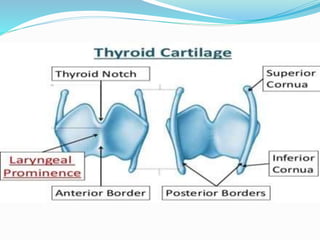
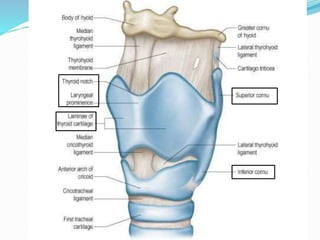
THYROID CARTILAGE
Hyaline cartilage
 Largest cartilage.
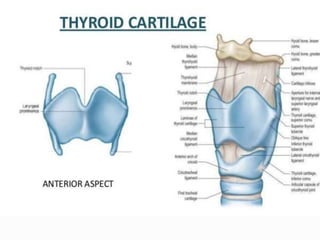
Consist of 2 quadrilateral
laminae, which are fused
anteriorly an angle called Thyroid
Angle.
The angle measures 90° (acute) in
males and 120° (obtuse) in females.
The thyroid angle is prominent in
males and it is responsible for
prominence on the front of the
neck called ADAM’S APPLE.
(laryngeal prominence)
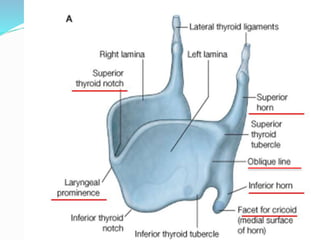
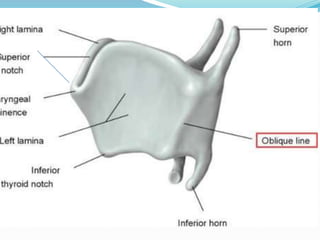
The posterior border of each lamina
extends superiorly and inferiorly to
form the superior and inferior
horns (also known as cornu).
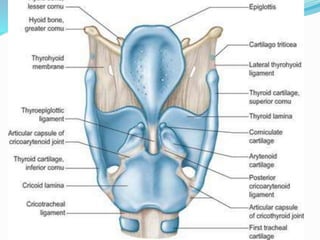
The superior horns are connected to
the hyoid bone via the lateral
thyrohyoid ligament, while the
inferior horns articulate with the
cricoid cartilage.
The posterior border of each lamina is
free and prolonged upwards and
downwards as superior and inferior
horns.
It provides conjoined insertion to 3
muscles:
1) Palatopharyngeus.
2) Salpingopharyngeus.
3) Stylopharyngeus.
Ant.
arch
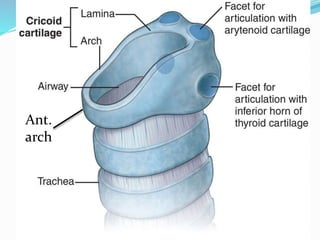
CRICOID CARTILAGE
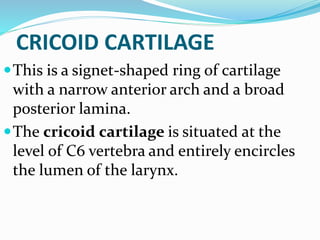
This is a signet-shaped ring of cartilage
with a narrow anterior arch and a broad
posterior lamina.
The cricoid cartilage is situated at the
level of C6 vertebra and entirely encircles
the lumen of the larynx.
EPIGLOTTIS
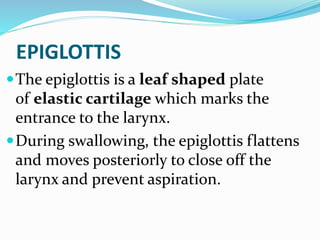
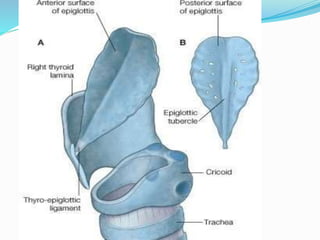
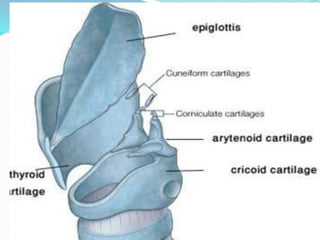
The epiglottis is a leaf shaped plate
of elastic cartilage which marks the
entrance to the larynx.
During swallowing, the epiglottis flattens
and moves posteriorly to close off the
larynx and prevent aspiration.
Epiglottis
Its broad upper end is free while the
lower end (stalk) is pointed and
joined to the posterior part of
thyroid angle by thyroepiglottic
ligament.
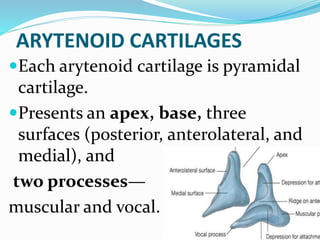
ARYTENOID CARTILAGES
Each arytenoid cartilage is pyramidal
cartilage.
Presents an apex, base, three
surfaces (posterior, anterolateral, and
medial), and
two processes—
muscular and vocal.
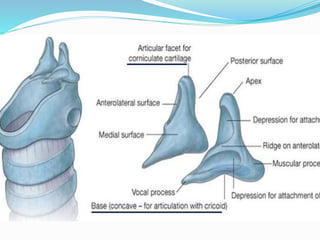
Apex – articulates with the corniculate
cartilage.
Base – articulates with the superior
border of the cricoid cartilage.
The base is prolonged anteriorly to
form the vocal process and laterally
to form the muscular process.
Vocal process – provides attachment
for the vocal ligament.
Muscular process – provides
attachment for the cricoarytenoid
muscle.
CORNICULATE CARTILAGE
The corniculate cartilages are
minor cartilaginous structures.
 They articulate with the apices of
the arytenoid cartilages.
CUNEIFORM CARTILAGES
The cuneiform cartilages are
located folds just above the
corniculate cartilages.
 They have no direct attachment,
but act to strengthen the folds.

Larynx

  • 2.
    It extends fromthe root of the tongue→ trachea. Location: in front of the 3rd to 6th cervical vertebrae. higher in children and females.
  • 4.
  • 6.
  • 9.
    Consist of 2quadrilateral laminae, which are fused anteriorly an angle called Thyroid Angle. The angle measures 90° (acute) in males and 120° (obtuse) in females.
  • 10.
    The thyroid angleis prominent in males and it is responsible for prominence on the front of the neck called ADAM’S APPLE. (laryngeal prominence)
  • 12.
    The posterior borderof each lamina extends superiorly and inferiorly to form the superior and inferior horns (also known as cornu). The superior horns are connected to the hyoid bone via the lateral thyrohyoid ligament, while the inferior horns articulate with the cricoid cartilage.
  • 14.
    The posterior borderof each lamina is free and prolonged upwards and downwards as superior and inferior horns. It provides conjoined insertion to 3 muscles: 1) Palatopharyngeus. 2) Salpingopharyngeus. 3) Stylopharyngeus.
  • 16.
  • 17.
    CRICOID CARTILAGE This isa signet-shaped ring of cartilage with a narrow anterior arch and a broad posterior lamina. The cricoid cartilage is situated at the level of C6 vertebra and entirely encircles the lumen of the larynx.
  • 18.
    EPIGLOTTIS The epiglottis isa leaf shaped plate of elastic cartilage which marks the entrance to the larynx. During swallowing, the epiglottis flattens and moves posteriorly to close off the larynx and prevent aspiration.
  • 21.
    Epiglottis Its broad upperend is free while the lower end (stalk) is pointed and joined to the posterior part of thyroid angle by thyroepiglottic ligament.
  • 22.
    ARYTENOID CARTILAGES Each arytenoidcartilage is pyramidal cartilage. Presents an apex, base, three surfaces (posterior, anterolateral, and medial), and two processes— muscular and vocal.
  • 23.
    Apex – articulateswith the corniculate cartilage. Base – articulates with the superior border of the cricoid cartilage.
  • 25.
    The base isprolonged anteriorly to form the vocal process and laterally to form the muscular process. Vocal process – provides attachment for the vocal ligament. Muscular process – provides attachment for the cricoarytenoid muscle.
  • 26.
    CORNICULATE CARTILAGE The corniculatecartilages are minor cartilaginous structures.  They articulate with the apices of the arytenoid cartilages.
  • 29.
    CUNEIFORM CARTILAGES The cuneiformcartilages are located folds just above the corniculate cartilages.  They have no direct attachment, but act to strengthen the folds.