CRACK DEFORMATION MODES
Melwin D’mello
M.E (Welding Engineering)
Department of Manufacturing Engineering,
ANNAMALAI UNIVERSITY
By,
CONTENTS
 Crack
 Failure
 Fracture
 Modes of crack deformation
 Liberty ships failure
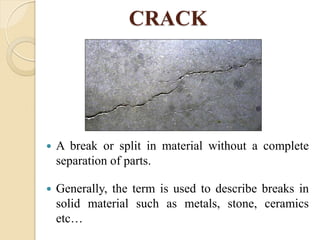
CRACK
 A break or split in material without a complete
separation of parts.
 Generally, the term is used to describe breaks in
solid material such as metals, stone, ceramics
etc…
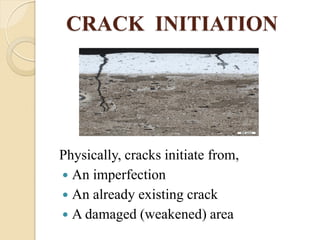
CRACK INITIATION
Physically, cracks initiate from,
 An imperfection
 An already existing crack
 A damaged (weakened) area
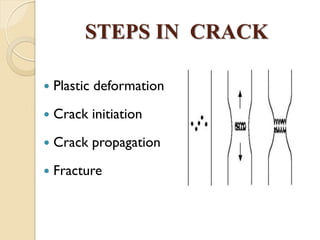
STEPS IN CRACK
 Plastic deformation
 Crack initiation
 Crack propagation
 Fracture
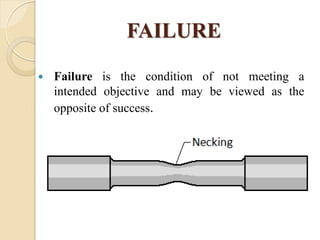
FAILURE
 Failure is the condition of not meeting a
intended objective and may be viewed as the
opposite of success.
REASONS FOR FAILURE ?
 Fatigue
 Creep
 Corrosion
 Wear
 And many more..
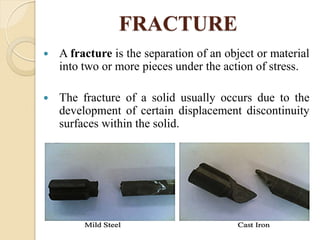
FRACTURE
 A fracture is the separation of an object or material
into two or more pieces under the action of stress.
 The fracture of a solid usually occurs due to the
development of certain displacement discontinuity
surfaces within the solid.
TYPES OF FRACTURE
 Classification is based on the ability of a material to
experience plastic deformation.
 Ductile fracture
◦ Accompanied by significant plastic deformation
 Brittle fracture
◦ Little or no plastic deformation
◦ Sudden, catastrophic
MODES OF CRACK
DEFORMATION
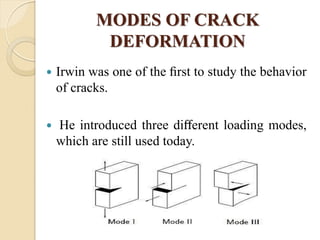
 Irwin was one of the first to study the behavior
of cracks.
 He introduced three different loading modes,
which are still used today.
MODES OF CRACK
DEFORMATION
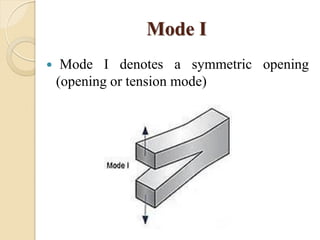
Mode I
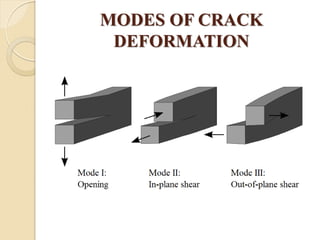
 Mode I denotes a symmetric opening
(opening or tension mode)
Mode II
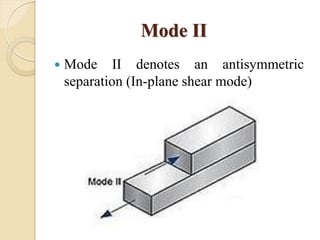
 Mode II denotes an antisymmetric
separation (In-plane shear mode)
Mode III
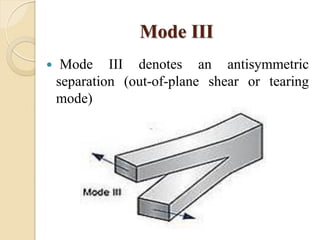
 Mode III denotes an antisymmetric
separation (out-of-plane shear or tearing
mode)
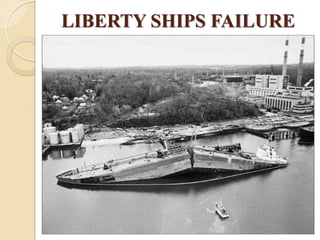
LIBERTY SHIPS FAILURE
References
 A text book of “ Mechanical Metallurgy”
by Gorge E. Dieter : Third edition (Indian
edition )
THANK YOU

Crack Deformation Modes

  • 1.
    CRACK DEFORMATION MODES MelwinD’mello M.E (Welding Engineering) Department of Manufacturing Engineering, ANNAMALAI UNIVERSITY By,
  • 2.
    CONTENTS  Crack  Failure Fracture  Modes of crack deformation  Liberty ships failure
  • 3.
    CRACK  A breakor split in material without a complete separation of parts.  Generally, the term is used to describe breaks in solid material such as metals, stone, ceramics etc…
  • 4.
    CRACK INITIATION Physically, cracksinitiate from,  An imperfection  An already existing crack  A damaged (weakened) area
  • 5.
    STEPS IN CRACK Plastic deformation  Crack initiation  Crack propagation  Fracture
  • 6.
    FAILURE  Failure isthe condition of not meeting a intended objective and may be viewed as the opposite of success.
  • 7.
    REASONS FOR FAILURE?  Fatigue  Creep  Corrosion  Wear  And many more..
  • 8.
    FRACTURE  A fractureis the separation of an object or material into two or more pieces under the action of stress.  The fracture of a solid usually occurs due to the development of certain displacement discontinuity surfaces within the solid.
  • 9.
    TYPES OF FRACTURE Classification is based on the ability of a material to experience plastic deformation.  Ductile fracture ◦ Accompanied by significant plastic deformation  Brittle fracture ◦ Little or no plastic deformation ◦ Sudden, catastrophic
  • 10.
    MODES OF CRACK DEFORMATION Irwin was one of the first to study the behavior of cracks.  He introduced three different loading modes, which are still used today.
  • 11.
  • 12.
    Mode I  ModeI denotes a symmetric opening (opening or tension mode)
  • 13.
    Mode II  ModeII denotes an antisymmetric separation (In-plane shear mode)
  • 14.
    Mode III  ModeIII denotes an antisymmetric separation (out-of-plane shear or tearing mode)
  • 15.
  • 16.
    References  A textbook of “ Mechanical Metallurgy” by Gorge E. Dieter : Third edition (Indian edition )
  • 17.