THE FOLDING AND
FAULTING OF ROCKS
LEARNING COMPETENCY:
Explain how the movement of plates
leads to the formation of folds and
faults.
LEARNING OBJECTIVES:
At the end of the lesson, you should be able to:
1. define folds, faults, stress and strain:
2. explain how the movement of plates leads
to the formation of folds and faults.
PLATE TECTONICS
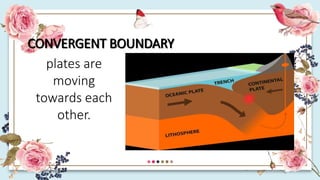
CONVERGENT BOUNDARY
plates are
moving
towards each
other.
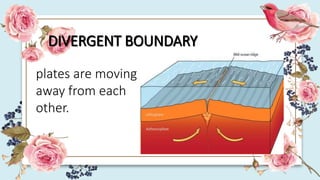
DIVERGENT BOUNDARY
plates are moving
away from each
other.
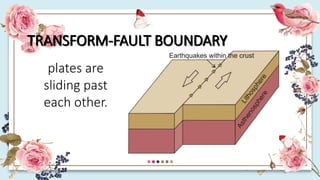
TRANSFORM-FAULT BOUNDARY
plates are
sliding past
each other.
FOLDS AND FAULTS
IN ROCKS
What is a Geologic Fold?
FOLD
defined as a bend in rock due
to compressional forces.
10%
9%
23%
TYPES OF FOLDS
1.Monocline
2. Anticline
3. Syncline
40%
30%
20%
10%
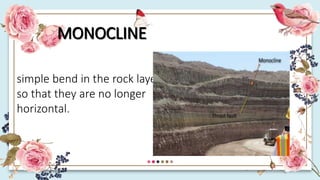
MONOCLINE
simple bend in the rock layers
so that they are no longer
horizontal.
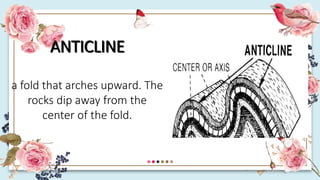
ANTICLINE
a fold that arches upward. The
rocks dip away from the
center of the fold.
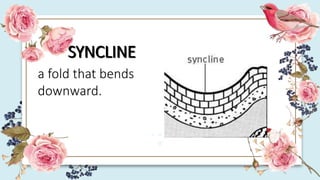
SYNCLINE
a fold that bends
downward.
WHAT IS FAULT?
FAULT
a fracture or zone of fractures
between two blocks of rock.
Types of Faults
1. Normal Fault
2. Reverse Fault
3. STRIKE-SLIP
FAULT
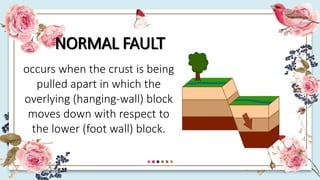
NORMAL FAULT
occurs when the crust is being
pulled apart in which the
overlying (hanging-wall) block
moves down with respect to
the lower (foot wall) block.
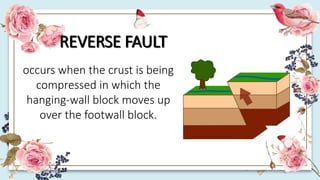
REVERSE FAULT
occurs when the crust is being
compressed in which the
hanging-wall block moves up
over the footwall block.
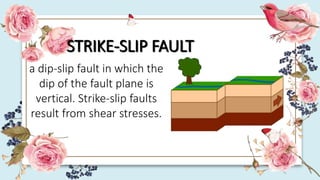
STRIKE-SLIP FAULT
a dip-slip fault in which the
dip of the fault plane is
vertical. Strike-slip faults
result from shear stresses.
STRESS AND STRAIN
STRESS
the force applied to an object.
TYPES OF STRESS
1. Compression
2. Tension
3. Shearing
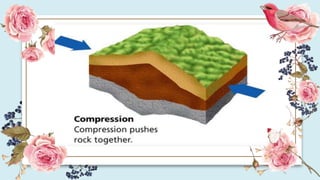
COMPRESSION
force acting perpendicular to and towards a surface.
It happens when rocks squeezes together,
causing rocks to fold or fracture or break.
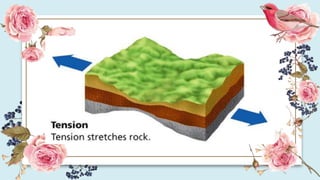
TENSION
a force acting perpendicular to and away
from a surface.
When rocks that are pulled apart, they
are under tension. Rocks under tension
lengthen or break apart.
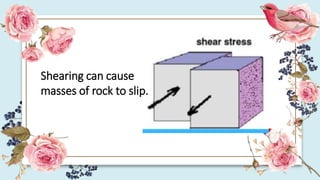
SHEAR
a force acting parallel to a surface.
When forces are parallel but moving in
opposite directions.
Shearing can cause
masses of rock to slip.
STRAIN
the change in a solid's shape caused
by the application of a stress.
KINDS OF ROCK DEFORMATION
1. Elastic Deformation
the rock returns to its original shape
when the stress is removed.
2. Plastic Deformation
takes place when the rock does not return
to its original shape when the stress is
removed.
3. Fracture
happens when the rock breaks.
Thank you for listening

EARTH AND LIFE-WPS Office.pptx