CENTRAL PROCESSING UNIT
(CPU)
P R E PA R E D B Y
P R A B I N M A H A R J A N
B I M 1 S T S E M E S T E R
S E C T I O N “ B ”3/24/2015 1
CONTENTS:
 I N T R O D U C T I O N O F C P U
 F U N C T I O N O F C P U
 C O M P O N E N T S O F T H E C P U
 FA C TO R S A F F E C T I N G P R O C E S S I N G S P E E D
 C P U C Y C L E
 C O N C L U S I O N
3/24/2015 2
INTRODUCTION
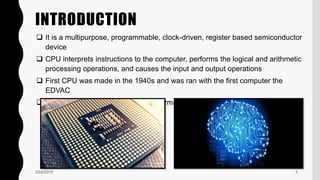
 It is a multipurpose, programmable, clock-driven, register based semiconductor
device
 CPU interprets instructions to the computer, performs the logical and arithmetic
processing operations, and causes the input and output operations
 First CPU was made in the 1940s and was ran with the first computer the
EDVAC
 It is made up of silicon chip which normally contains millions of transistors.
3/24/2015 3
3/24/2015 4
FUNCTION OF CPU
 To carry out processing.
 To perform arithmetic calculation such as addition, subtraction.
 To read instruction & data from memory.
 To communicate with peripherals using system bus.
 To give commands to all parts of the computer system.
 To control the timing of information flow.
 To control the storage of data or instruction.
3/24/2015 5
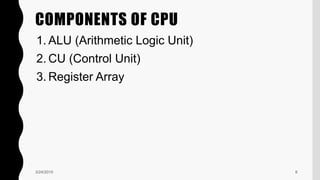
COMPONENTS OF CPU
1. ALU (Arithmetic Logic Unit)
2. CU (Control Unit)
3. Register Array
3/24/2015 6
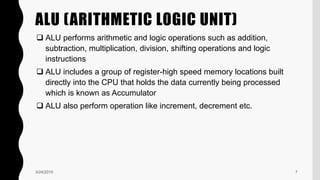
ALU (ARITHMETIC LOGIC UNIT)
 ALU performs arithmetic and logic operations such as addition,
subtraction, multiplication, division, shifting operations and logic
instructions
 ALU includes a group of register-high speed memory locations built
directly into the CPU that holds the data currently being processed
which is known as Accumulator
 ALU also perform operation like increment, decrement etc.
3/24/2015 7
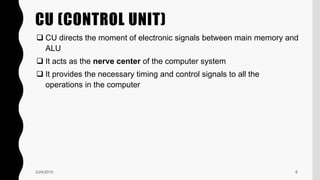
CU (CONTROL UNIT)
 CU directs the moment of electronic signals between main memory and
ALU
 It acts as the nerve center of the computer system
 It provides the necessary timing and control signals to all the
operations in the computer
3/24/2015 8
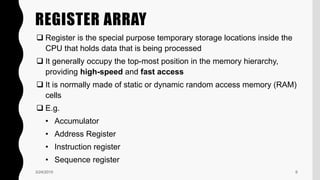
REGISTER ARRAY
 Register is the special purpose temporary storage locations inside the
CPU that holds data that is being processed
 It generally occupy the top-most position in the memory hierarchy,
providing high-speed and fast access
 It is normally made of static or dynamic random access memory (RAM)
cells
 E.g.
• Accumulator
• Address Register
• Instruction register
• Sequence register
3/24/2015 9
FACTORS AFFECTING PROCESSING SPEED
 Clock rate of the CPU
 Computer word size
 Bus speed
 Main memory size
 Cache memory size
 Instruction set complexity
 Number of processing units
3/24/2015 10
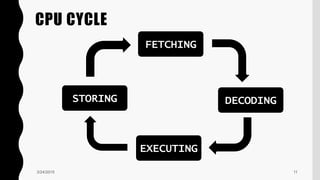
CPU CYCLE
3/24/2015 11
FETCHING
EXECUTING
STORING DECODING
CONCLUSION
 Thus CPU is the main part (brain) of the computer system
 It controls the operation of all other components such as memory, input and
output device
 It interprets instructions to the computer, performs the logical and arithmetic
operations
3/24/2015 12
THANK YOU
3/24/2015 13

CPU (Central Processing Units)

  • 1.
    CENTRAL PROCESSING UNIT (CPU) PR E PA R E D B Y P R A B I N M A H A R J A N B I M 1 S T S E M E S T E R S E C T I O N “ B ”3/24/2015 1
  • 2.
    CONTENTS:  I NT R O D U C T I O N O F C P U  F U N C T I O N O F C P U  C O M P O N E N T S O F T H E C P U  FA C TO R S A F F E C T I N G P R O C E S S I N G S P E E D  C P U C Y C L E  C O N C L U S I O N 3/24/2015 2
  • 3.
    INTRODUCTION  It isa multipurpose, programmable, clock-driven, register based semiconductor device  CPU interprets instructions to the computer, performs the logical and arithmetic processing operations, and causes the input and output operations  First CPU was made in the 1940s and was ran with the first computer the EDVAC  It is made up of silicon chip which normally contains millions of transistors. 3/24/2015 3
  • 4.
  • 5.
    FUNCTION OF CPU To carry out processing.  To perform arithmetic calculation such as addition, subtraction.  To read instruction & data from memory.  To communicate with peripherals using system bus.  To give commands to all parts of the computer system.  To control the timing of information flow.  To control the storage of data or instruction. 3/24/2015 5
  • 6.
    COMPONENTS OF CPU 1.ALU (Arithmetic Logic Unit) 2. CU (Control Unit) 3. Register Array 3/24/2015 6
  • 7.
    ALU (ARITHMETIC LOGICUNIT)  ALU performs arithmetic and logic operations such as addition, subtraction, multiplication, division, shifting operations and logic instructions  ALU includes a group of register-high speed memory locations built directly into the CPU that holds the data currently being processed which is known as Accumulator  ALU also perform operation like increment, decrement etc. 3/24/2015 7
  • 8.
    CU (CONTROL UNIT) CU directs the moment of electronic signals between main memory and ALU  It acts as the nerve center of the computer system  It provides the necessary timing and control signals to all the operations in the computer 3/24/2015 8
  • 9.
    REGISTER ARRAY  Registeris the special purpose temporary storage locations inside the CPU that holds data that is being processed  It generally occupy the top-most position in the memory hierarchy, providing high-speed and fast access  It is normally made of static or dynamic random access memory (RAM) cells  E.g. • Accumulator • Address Register • Instruction register • Sequence register 3/24/2015 9
  • 10.
    FACTORS AFFECTING PROCESSINGSPEED  Clock rate of the CPU  Computer word size  Bus speed  Main memory size  Cache memory size  Instruction set complexity  Number of processing units 3/24/2015 10
  • 11.
  • 12.
    CONCLUSION  Thus CPUis the main part (brain) of the computer system  It controls the operation of all other components such as memory, input and output device  It interprets instructions to the computer, performs the logical and arithmetic operations 3/24/2015 12
  • 13.