Welcome
Our presentation
Presentation name : Introduction to Microprocessor
Presented by
1.Ashraful Islam 191-15-2356
2.
3.
4.
5.
Microprocessor ?
A microprocessor is an integrated circuit (IC) which
incorporates core functions of a computer’s central
processing unit (CPU).
It is a programmable multipurpose silicon chip, clock
driven, register based, accepts binary data as input and
provides output after processing it as per the
instructions stored in the memory
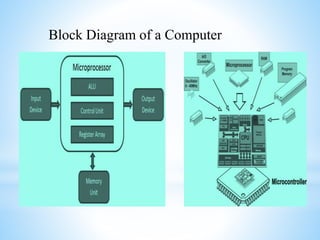
Block Diagram of a Computer
How does a Microprocessor work ?
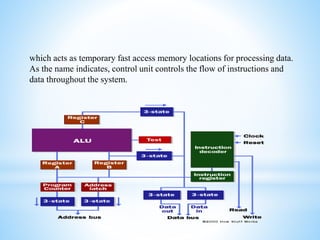
A processor is the brain of a computer which basically consists
of Arithmetical and Logical Unit (ALU), Control Unit and
Register Array
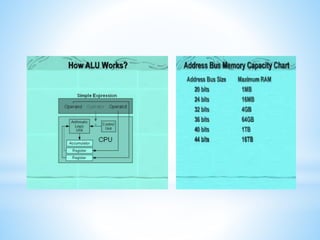
As the name indicates ALU performs all arithmetic and logical
operations on the data received from input devices or memory.
Register array consists of a series of registers like
accumulator (A), B, C, D etc
which acts as temporary fast access memory locations for processing data.
As the name indicates, control unit controls the flow of instructions and
data throughout the system.
Advantages of a Microprocessor
o Low Cost
o High Speed
o Small Size
o Versatile
o Low Power Consumption
o Reliable
o Portable
Necessary tools for microprocessor
CPU : central processing unite
I/O : input , output
Buss : address buss,& data Buss
CU : trimming and control unite
Special and General purpose resister
L1 & L2 cache memory
Buss interface
Examples
Intel 4004 – The First 4 bit microprocessor
Intel 8085 The most successful 8-bit, general-purpose microprocessor is 
Intel 8086 A small 4-or 6-byte instruction
Intel Pentium The Pentium , introduced in1993
Intel Core i7
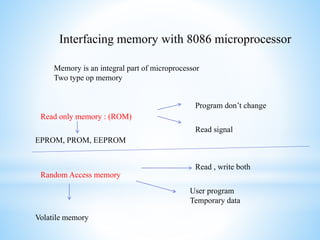
Interfacing memory with 8086 microprocessor
Memory is an integral part of microprocessor
Two type op memory
Read only memory : (ROM)
Read signal
Program don’t change
EPROM, PROM, EEPROM
Random Access memory
Read , write both
User program
Temporary data
Volatile memory
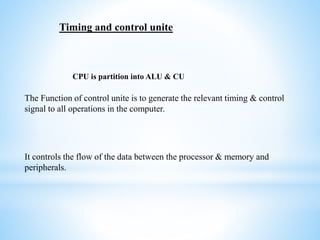
Timing and control unite
CPU is partition into ALU & CU
The Function of control unite is to generate the relevant timing & control
signal to all operations in the computer.
It controls the flow of the data between the processor & memory and
peripherals.
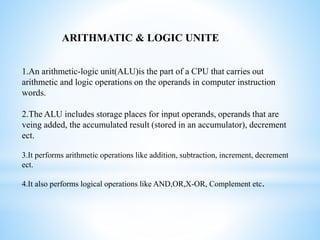
1.An arithmetic-logic unit(ALU)is the part of a CPU that carries out
arithmetic and logic operations on the operands in computer instruction
words.
2.The ALU includes storage places for input operands, operands that are
veing added, the accumulated result (stored in an accumulator), decrement
ect.
3.It performs arithmetic operations like addition, subtraction, increment, decrement
ect.
4.It also performs logical operations like AND,OR,X-OR, Complement etc.
ARITHMATIC & LOGIC UNITE
THANKS
Presentation Introduction to microprocessor

Presentation Introduction to microprocessor

  • 1.
    Welcome Our presentation Presentation name: Introduction to Microprocessor Presented by 1.Ashraful Islam 191-15-2356 2. 3. 4. 5.
  • 2.
    Microprocessor ? A microprocessoris an integrated circuit (IC) which incorporates core functions of a computer’s central processing unit (CPU). It is a programmable multipurpose silicon chip, clock driven, register based, accepts binary data as input and provides output after processing it as per the instructions stored in the memory
  • 3.
    Block Diagram ofa Computer
  • 4.
    How does aMicroprocessor work ? A processor is the brain of a computer which basically consists of Arithmetical and Logical Unit (ALU), Control Unit and Register Array As the name indicates ALU performs all arithmetic and logical operations on the data received from input devices or memory. Register array consists of a series of registers like accumulator (A), B, C, D etc
  • 5.
    which acts astemporary fast access memory locations for processing data. As the name indicates, control unit controls the flow of instructions and data throughout the system.
  • 6.
    Advantages of aMicroprocessor o Low Cost o High Speed o Small Size o Versatile o Low Power Consumption o Reliable o Portable Necessary tools for microprocessor CPU : central processing unite I/O : input , output Buss : address buss,& data Buss CU : trimming and control unite Special and General purpose resister L1 & L2 cache memory Buss interface
  • 7.
    Examples Intel 4004 –The First 4 bit microprocessor Intel 8085 The most successful 8-bit, general-purpose microprocessor is Intel 8086 A small 4-or 6-byte instruction Intel Pentium The Pentium , introduced in1993 Intel Core i7
  • 8.
    Interfacing memory with8086 microprocessor Memory is an integral part of microprocessor Two type op memory Read only memory : (ROM) Read signal Program don’t change EPROM, PROM, EEPROM Random Access memory Read , write both User program Temporary data Volatile memory
  • 9.
    Timing and controlunite CPU is partition into ALU & CU The Function of control unite is to generate the relevant timing & control signal to all operations in the computer. It controls the flow of the data between the processor & memory and peripherals.
  • 10.
    1.An arithmetic-logic unit(ALU)isthe part of a CPU that carries out arithmetic and logic operations on the operands in computer instruction words. 2.The ALU includes storage places for input operands, operands that are veing added, the accumulated result (stored in an accumulator), decrement ect. 3.It performs arithmetic operations like addition, subtraction, increment, decrement ect. 4.It also performs logical operations like AND,OR,X-OR, Complement etc. ARITHMATIC & LOGIC UNITE
  • 12.