The Central processing Unit  Machine Cycle Information processing cycle
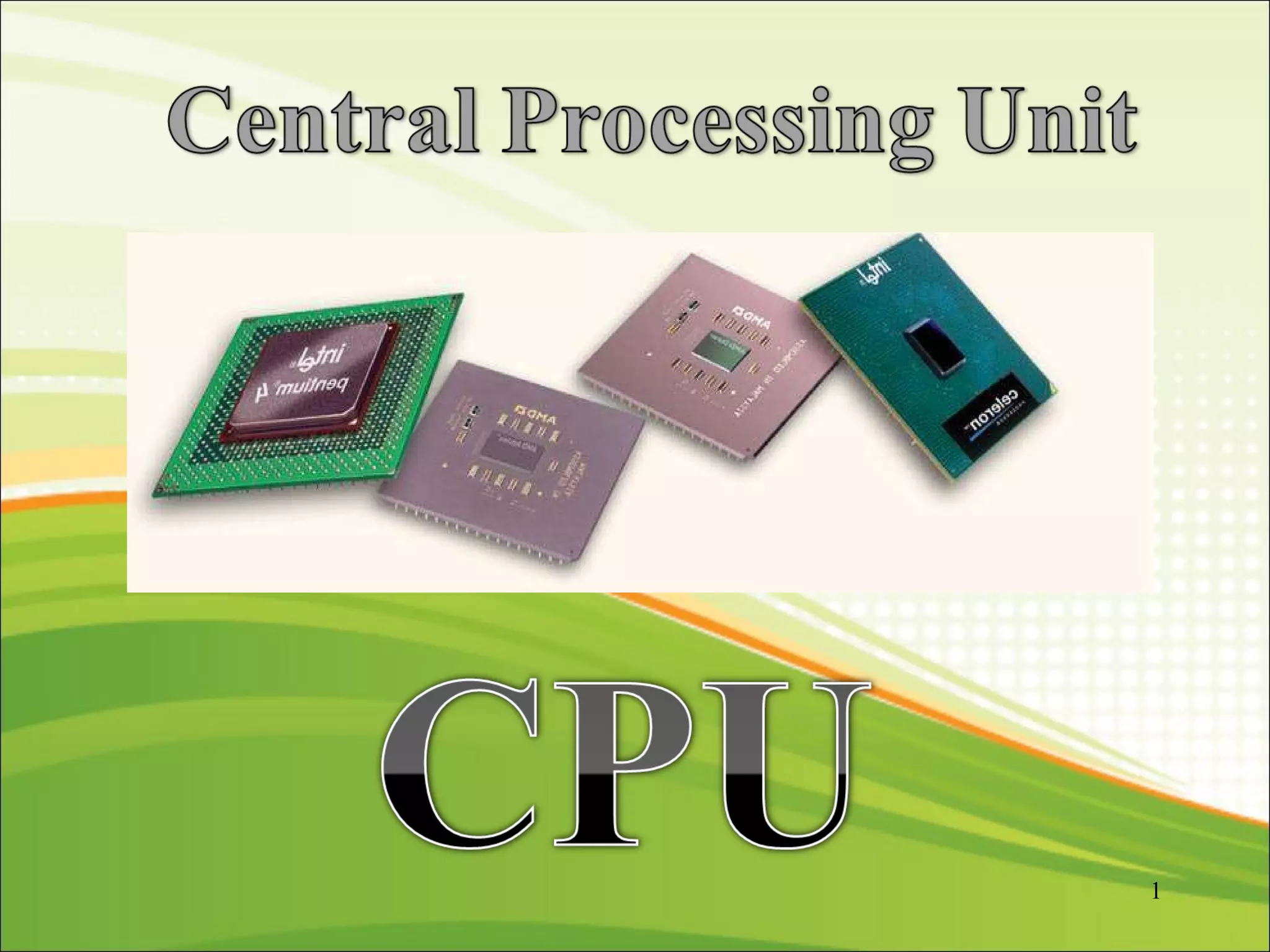
The Central processing Unit The CPU interprets instructions to the computer, performs the logical and arithmetic processing operations, and causes the input and output operations to occur.  consists of hundreds of thousands or millions of electronic circuits. In today's PCs the CPU is contained in a single silicon chip called a microprocessor chip It is considered the “brain” of the computer. Also called the  CPU as  PROCESSOR & MICROPROCCESSOR
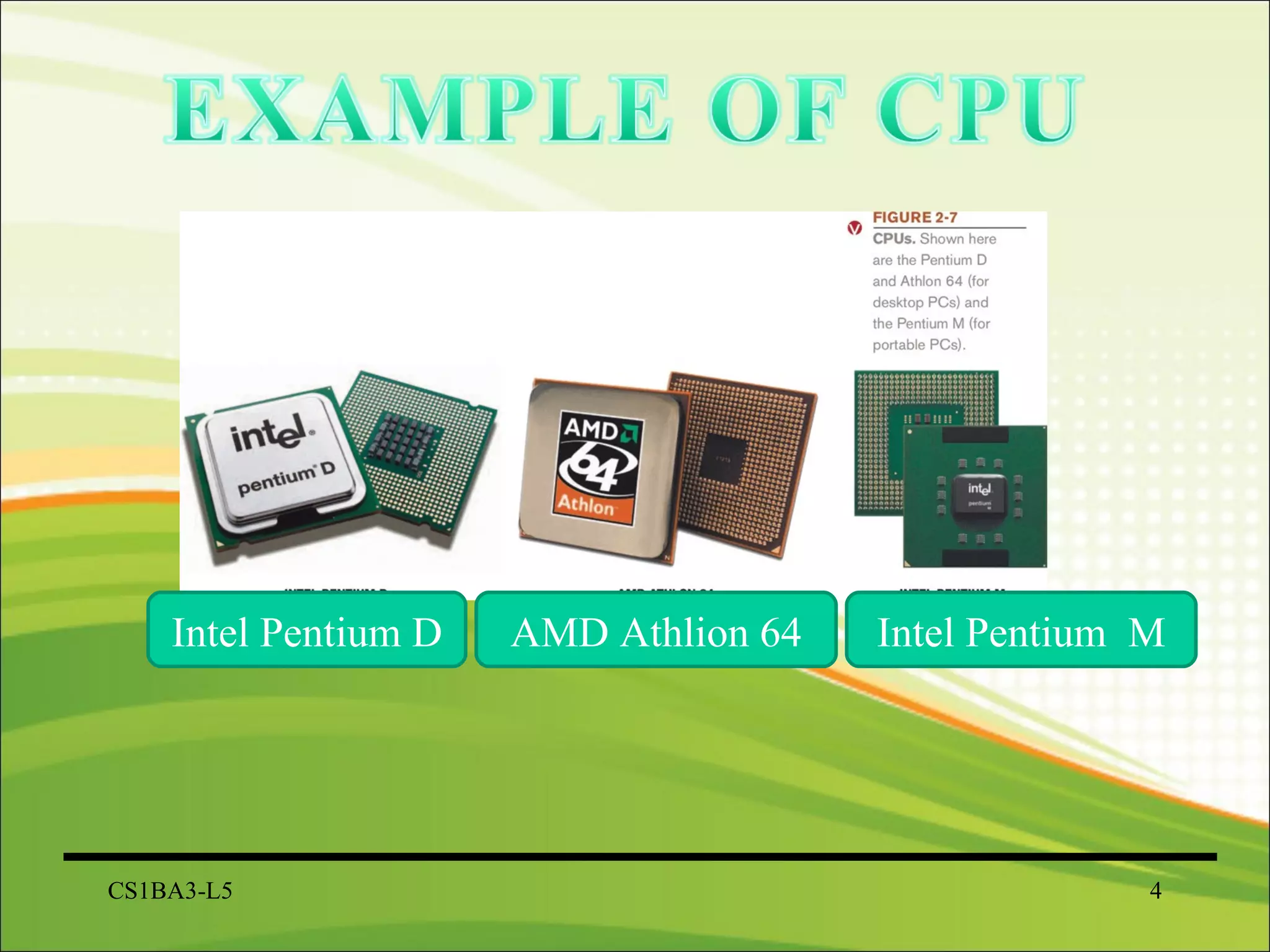
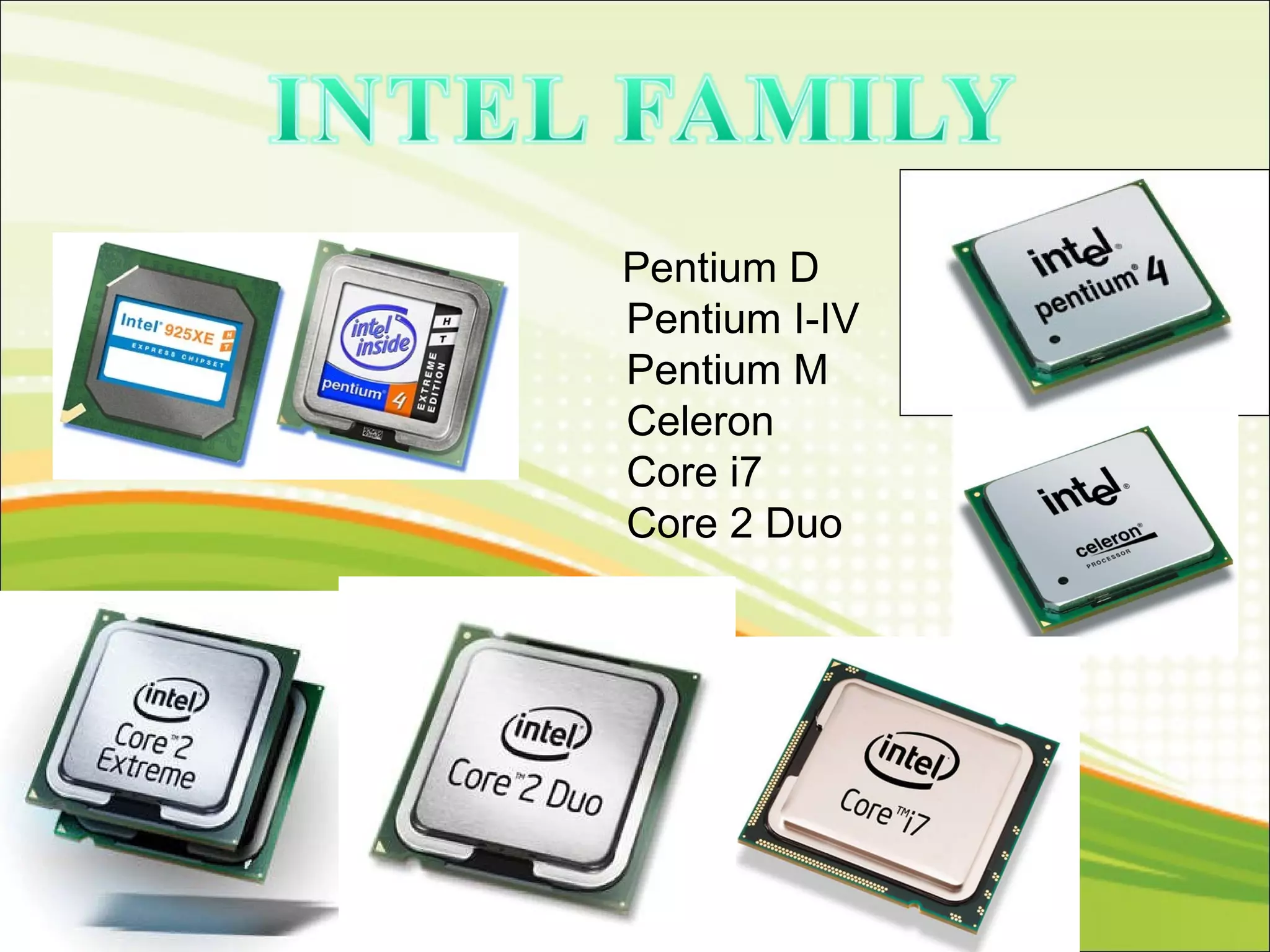
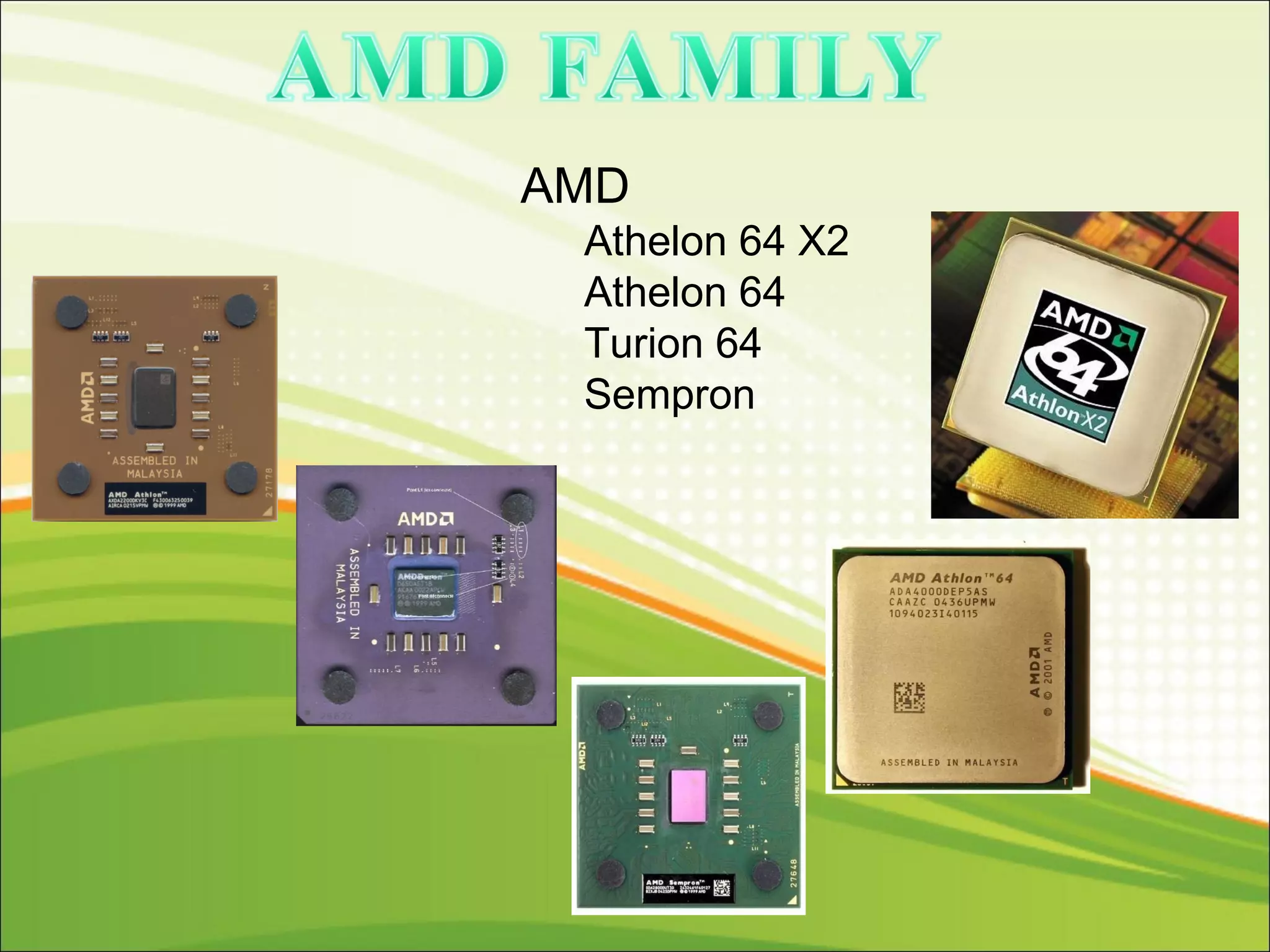
CS1BA3-L5 Intel Pentium D AMD Athlion 64 Intel Pentium  M
Pentium D Pentium I-IV Pentium M Celeron Core i7 Core 2 Duo
AMD Athelon 64 X2 Athelon 64 Turion 64 Sempron
 
 
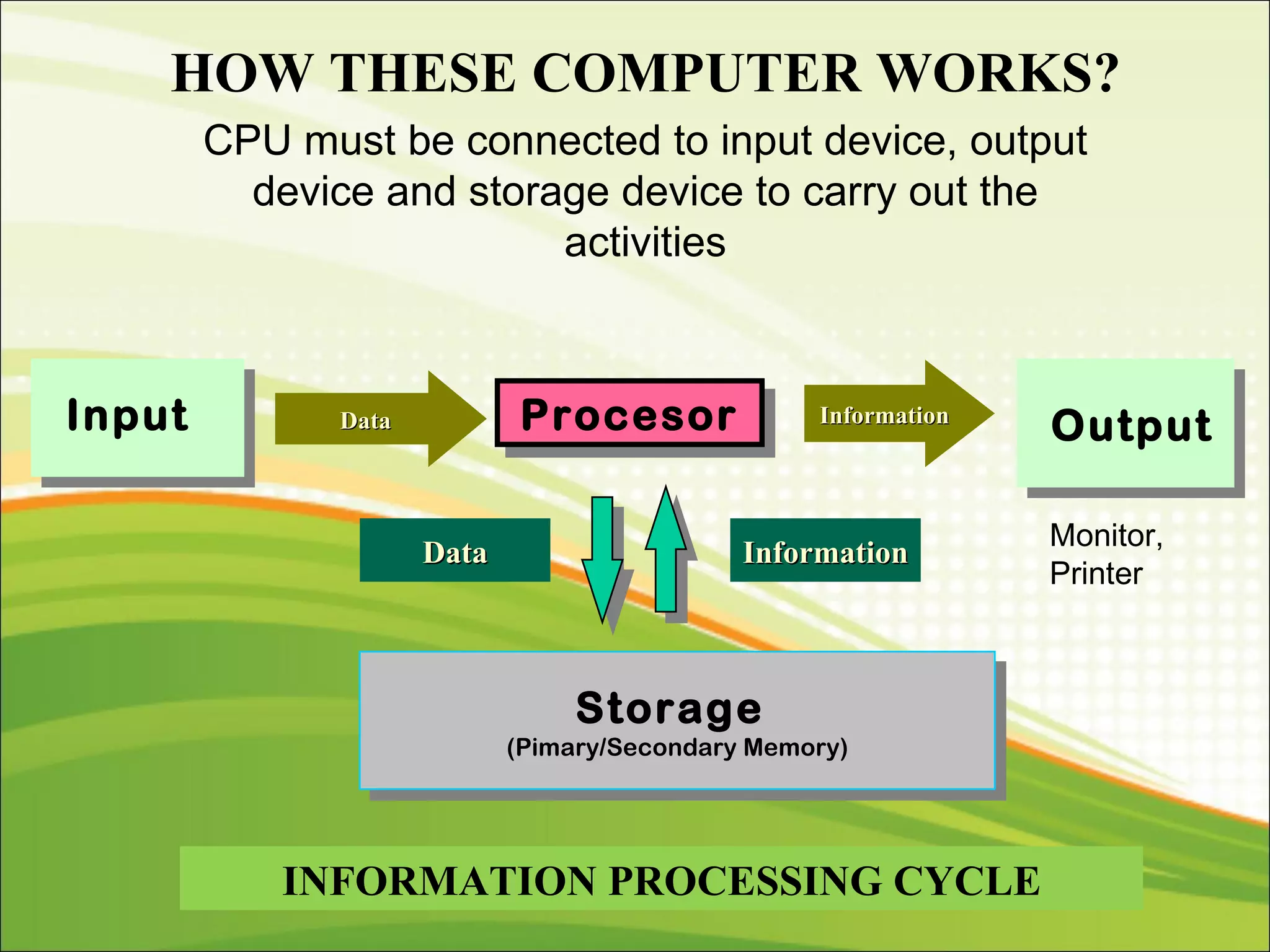
HOW THESE COMPUTER WORKS? Storage  (Pimary/Secondary Memory) Input Procesor Monitor, Printer CPU must be connected to input device, output device and storage device to carry out the activities Data Information INFORMATION PROCESSING CYCLE Data Information Output
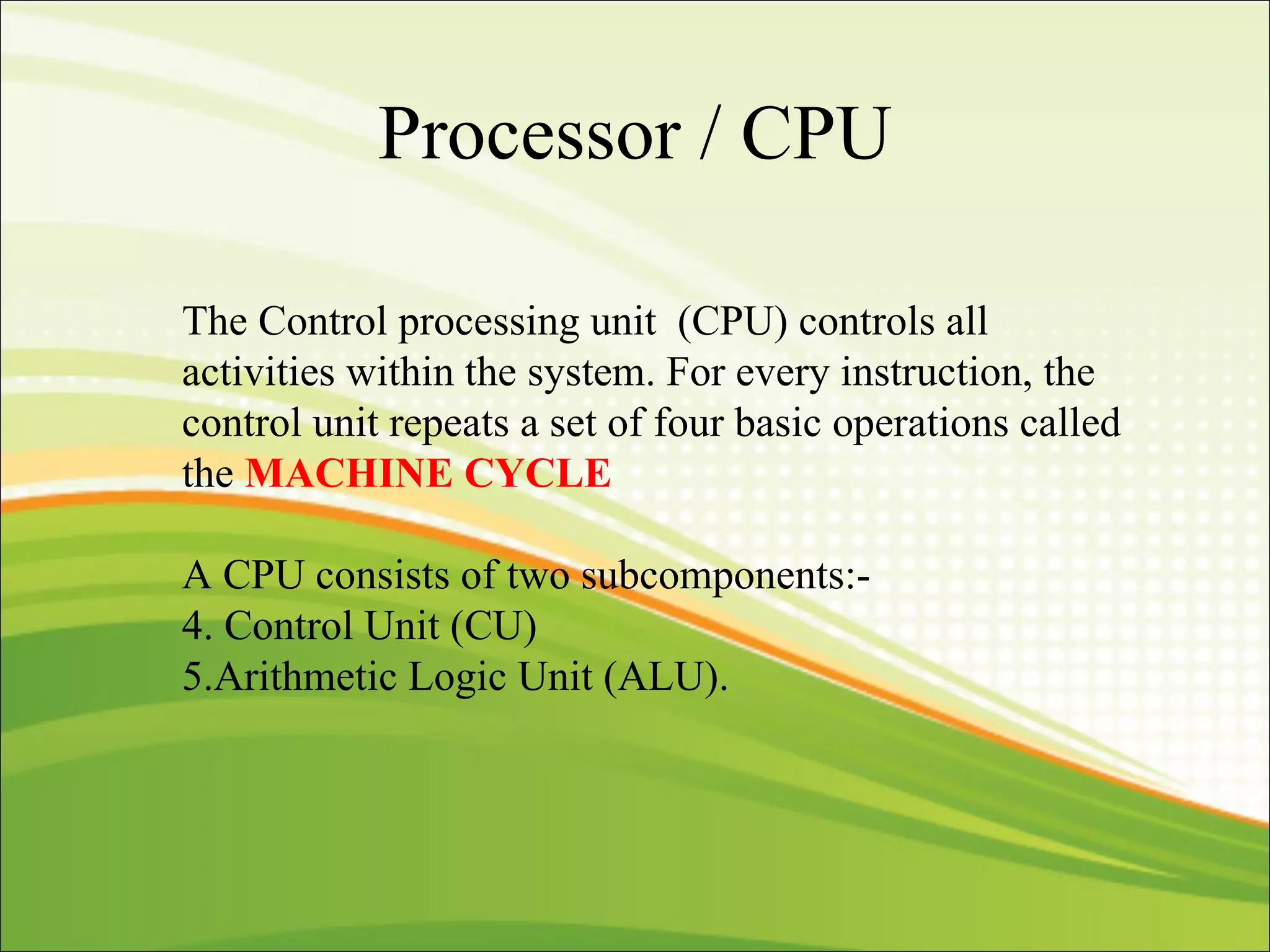
Processor / CPU The Control processing unit  (CPU) controls all activities within the system. For every instruction, the control unit repeats a set of four basic operations called the  MACHINE CYCLE A CPU consists of two subcomponents:- Control Unit (CU) Arithmetic Logic Unit (ALU).
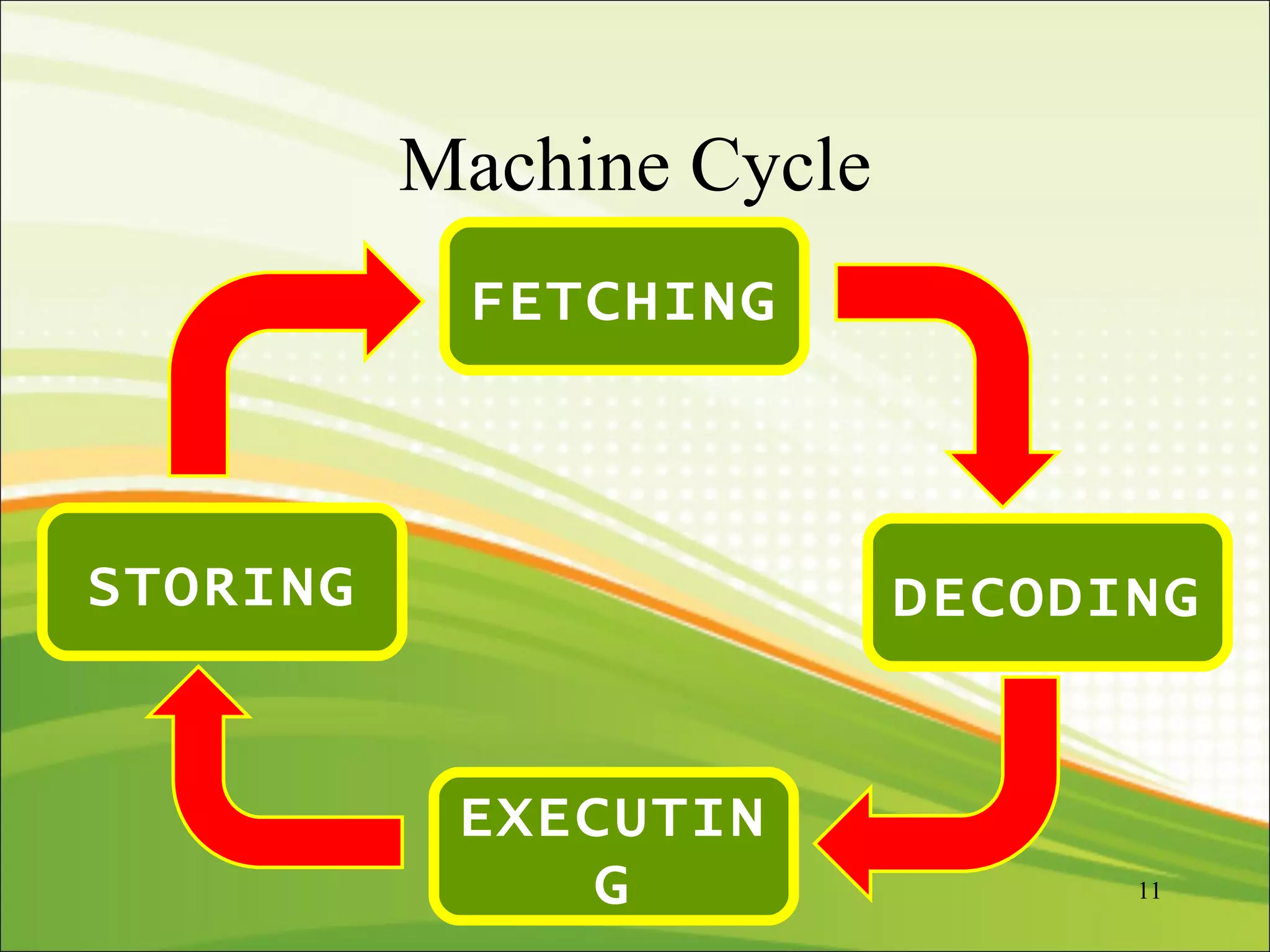
Machine Cycle FETCHING EXECUTING STORING DECODING
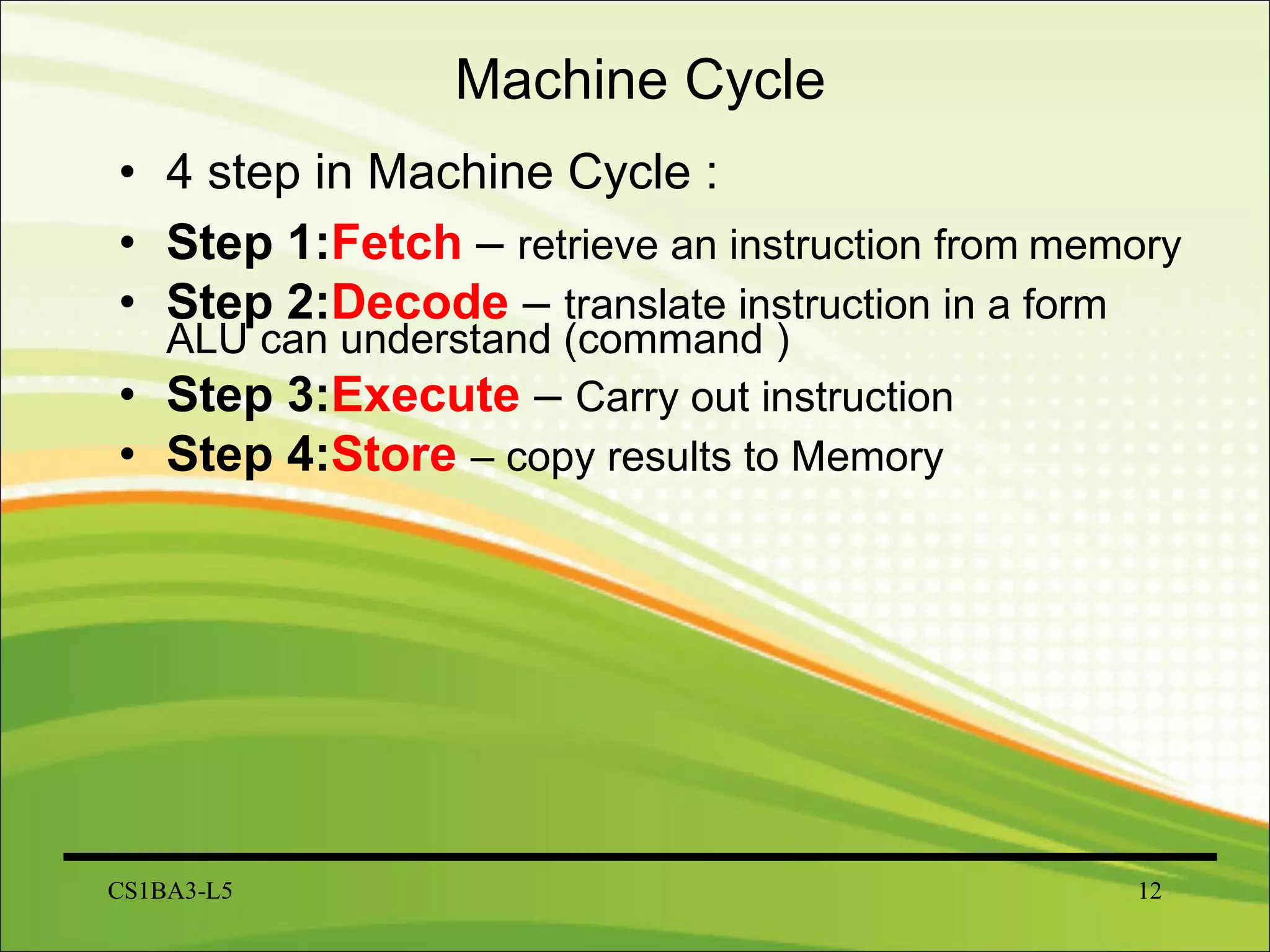
Machine   Cycle 4 step in Machine Cycle : Step 1: Fetch   –  retrieve an instruction from   memory Step 2: Decode   –  translate instruction in a form ALU can understand (command ) Step 3: Execute   –  Carry out instruction Step 4: Store  – copy results to Memory CS1BA3-L5
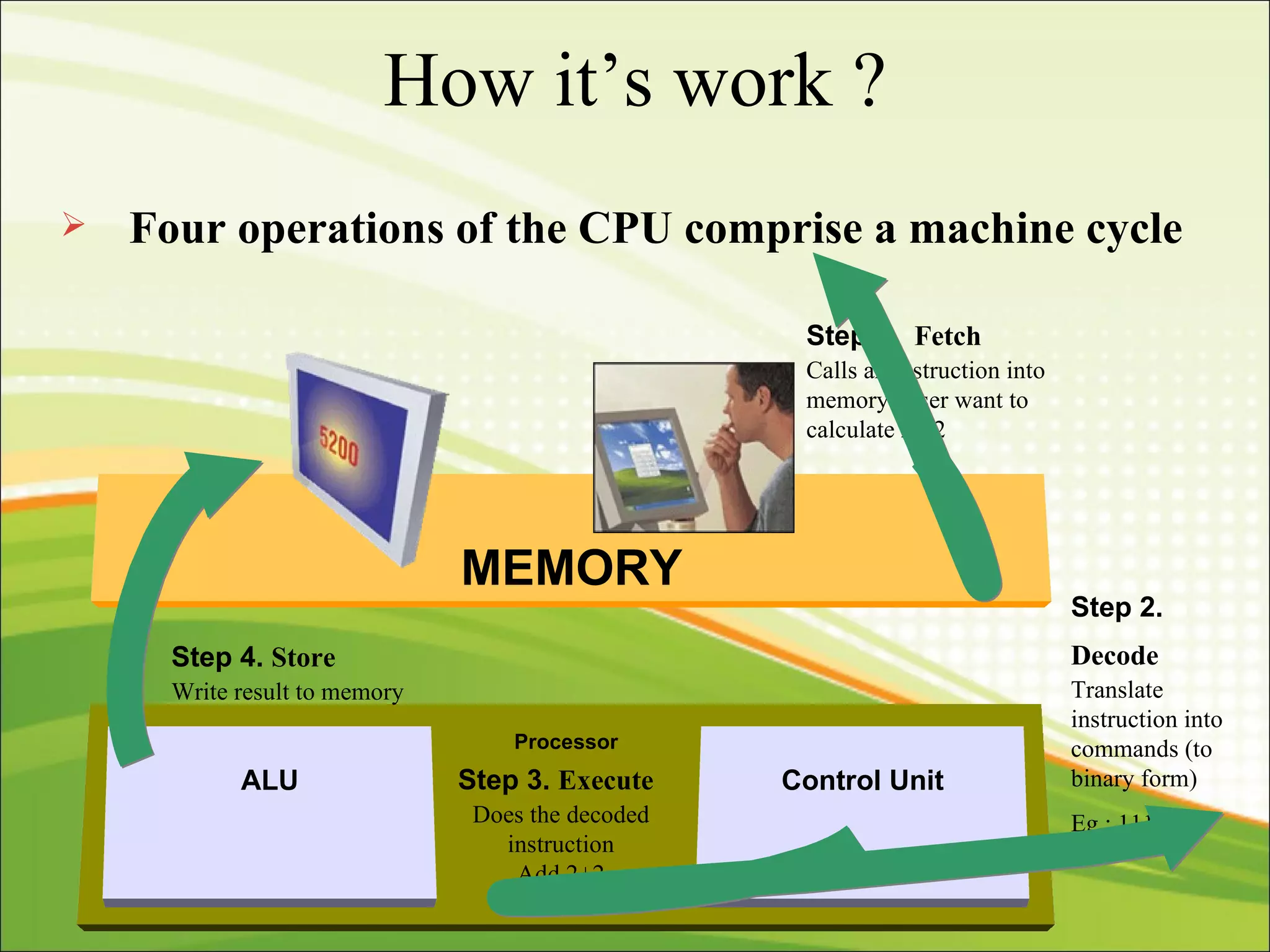
How it’s work ? Step 1.  Fetch   Calls an instruction into memory. User want to calculate 2 +2 Step 2.  Decode   Translate instruction into commands (to binary form) Eg : 1110000 Step 4.  Store   Write result to memory Step 3.  Execute   Does the decoded instruction Add 2+2 Four operations of the CPU comprise a machine cycle Processor Control Unit MEMORY ALU
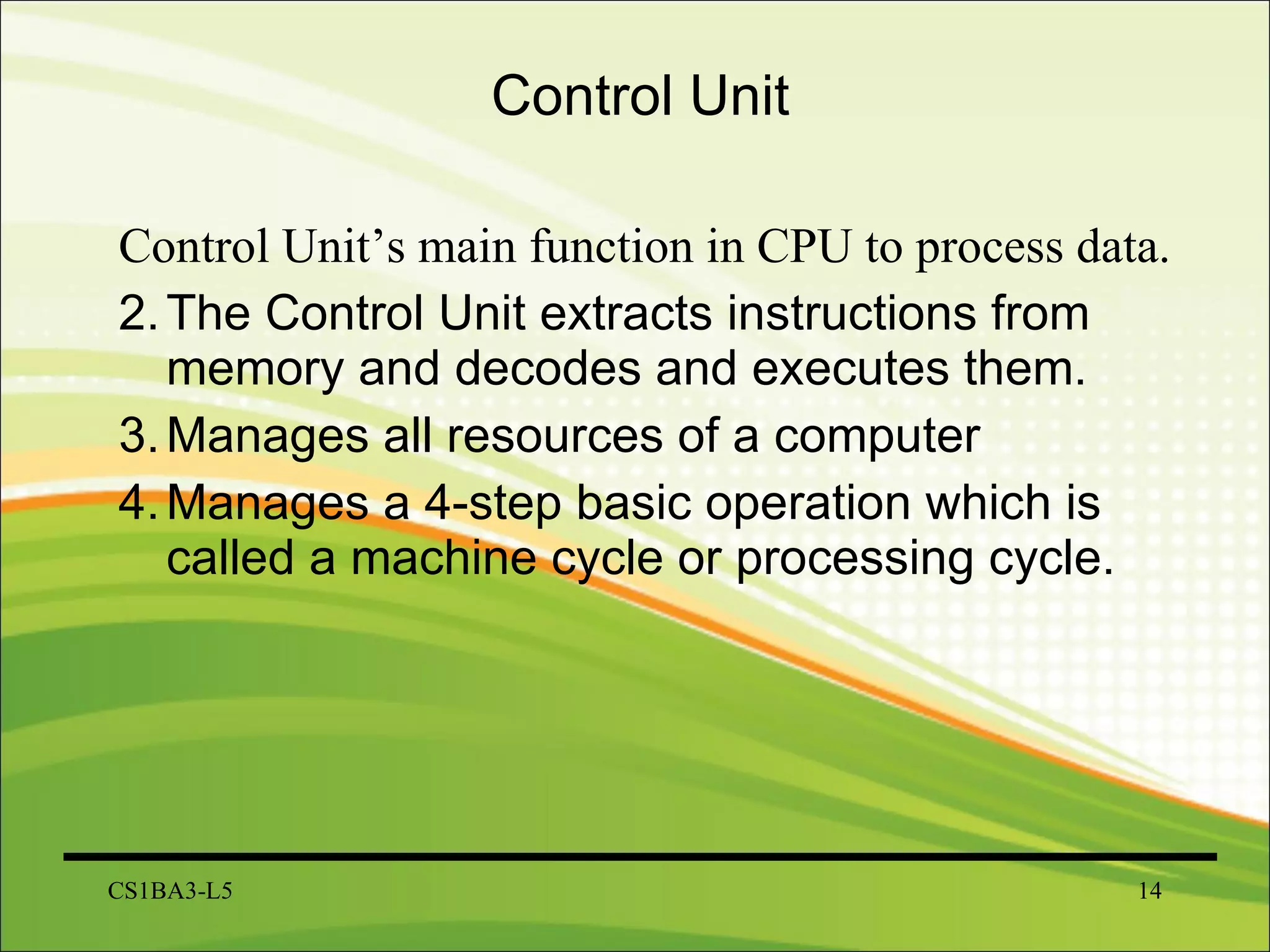
Control Unit Control Unit’s main function in CPU to process data. The Control Unit extracts instructions from memory and decodes and executes  them. Manages all resources of a computer Manages a 4-step  basic operation which is called a machine cycle or processing cycle. CS1BA3-L5
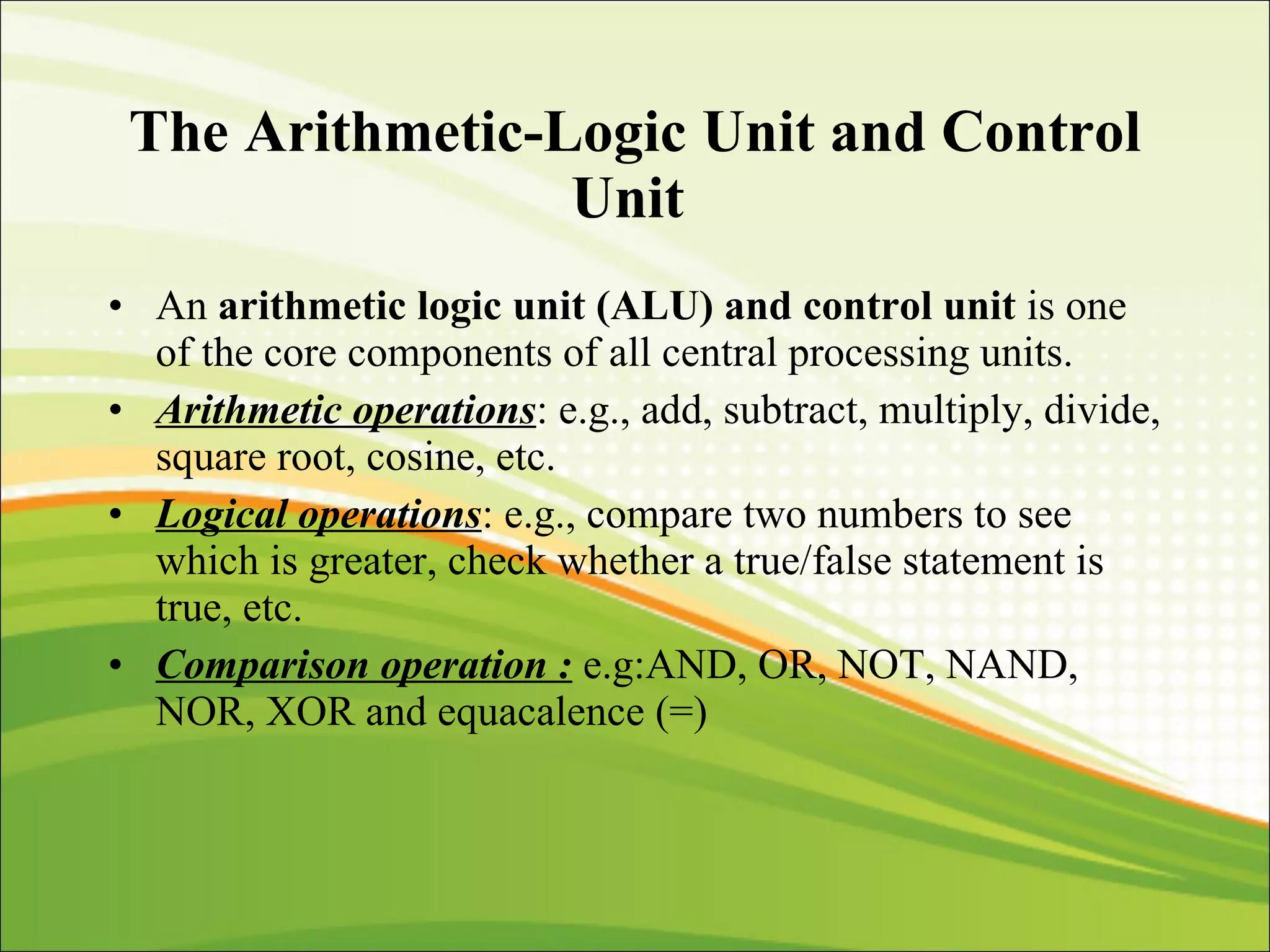
The Arithmetic-Logic Unit and Control Unit   An  arithmetic logic unit (ALU) and control unit  is one of the core components of all central processing units. Arithmetic operations : e.g., add, subtract, multiply, divide, square root, cosine, etc. Logical operations : e.g., compare two numbers to see which is greater, check whether a true/false statement is true, etc. Comparison operation :   e.g:AND, OR, NOT, NAND, NOR, XOR and equacalence (=)
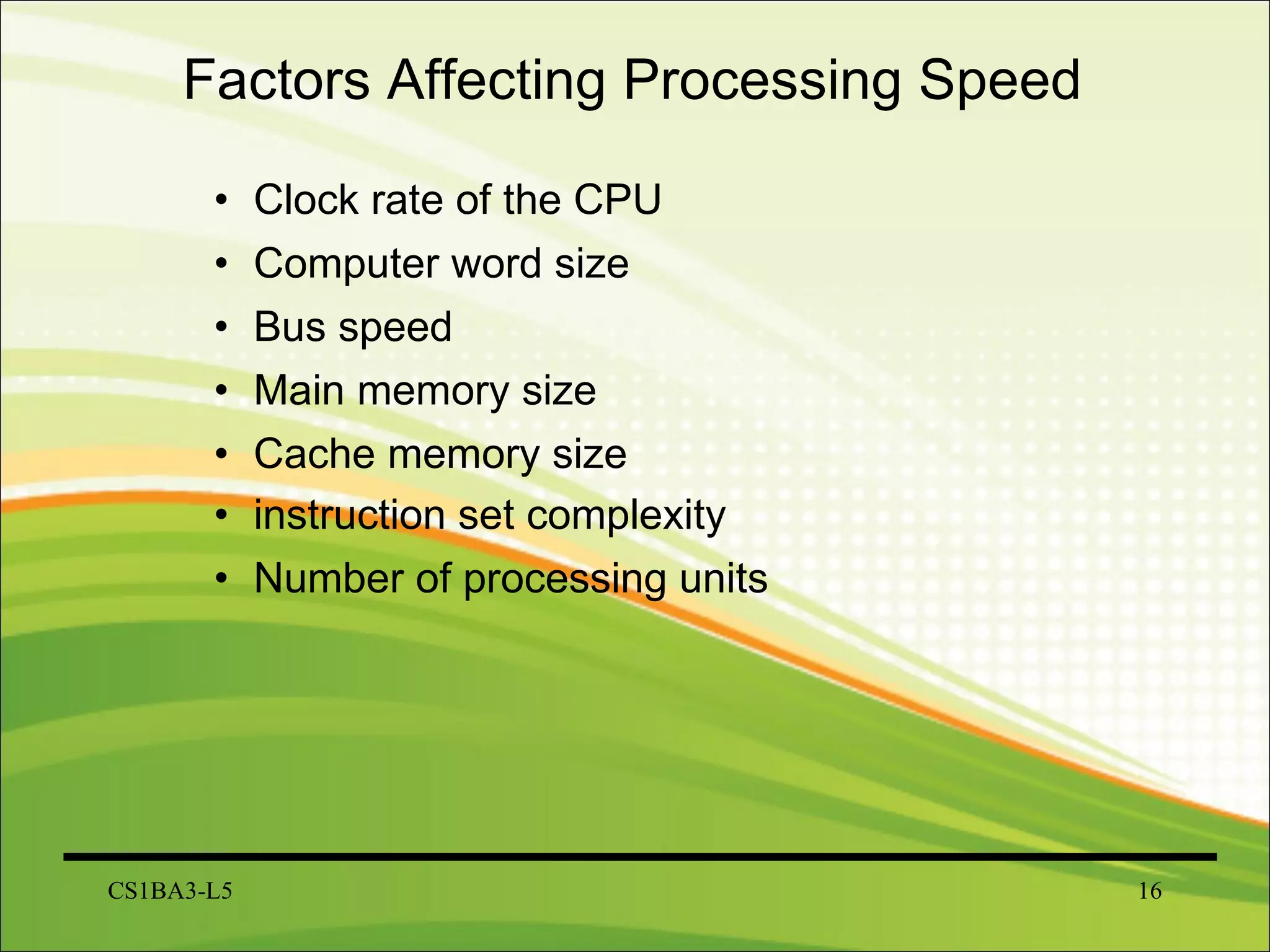
Factors Affecting Processing Speed   Clock rate of the CPU Computer word size Bus speed Main memory size Cache memory size instruction set complexity   Number of processing units CS1BA3-L5
Which computer should I buy?  Desktop
Cpu

Cpu

  • 2.
    The Central processingUnit Machine Cycle Information processing cycle
  • 3.
    The Central processingUnit The CPU interprets instructions to the computer, performs the logical and arithmetic processing operations, and causes the input and output operations to occur. consists of hundreds of thousands or millions of electronic circuits. In today's PCs the CPU is contained in a single silicon chip called a microprocessor chip It is considered the “brain” of the computer. Also called the CPU as PROCESSOR & MICROPROCCESSOR
  • 4.
    CS1BA3-L5 Intel PentiumD AMD Athlion 64 Intel Pentium M
  • 5.
    Pentium D PentiumI-IV Pentium M Celeron Core i7 Core 2 Duo
  • 6.
    AMD Athelon 64X2 Athelon 64 Turion 64 Sempron
  • 7.
  • 8.
  • 9.
    HOW THESE COMPUTERWORKS? Storage (Pimary/Secondary Memory) Input Procesor Monitor, Printer CPU must be connected to input device, output device and storage device to carry out the activities Data Information INFORMATION PROCESSING CYCLE Data Information Output
  • 10.
    Processor / CPUThe Control processing unit (CPU) controls all activities within the system. For every instruction, the control unit repeats a set of four basic operations called the MACHINE CYCLE A CPU consists of two subcomponents:- Control Unit (CU) Arithmetic Logic Unit (ALU).
  • 11.
    Machine Cycle FETCHINGEXECUTING STORING DECODING
  • 12.
    Machine Cycle 4 step in Machine Cycle : Step 1: Fetch – retrieve an instruction from memory Step 2: Decode – translate instruction in a form ALU can understand (command ) Step 3: Execute – Carry out instruction Step 4: Store – copy results to Memory CS1BA3-L5
  • 13.
    How it’s work? Step 1. Fetch Calls an instruction into memory. User want to calculate 2 +2 Step 2. Decode Translate instruction into commands (to binary form) Eg : 1110000 Step 4. Store Write result to memory Step 3. Execute Does the decoded instruction Add 2+2 Four operations of the CPU comprise a machine cycle Processor Control Unit MEMORY ALU
  • 14.
    Control Unit ControlUnit’s main function in CPU to process data. The Control Unit extracts instructions from memory and decodes and executes them. Manages all resources of a computer Manages a 4-step basic operation which is called a machine cycle or processing cycle. CS1BA3-L5
  • 15.
    The Arithmetic-Logic Unitand Control Unit An arithmetic logic unit (ALU) and control unit is one of the core components of all central processing units. Arithmetic operations : e.g., add, subtract, multiply, divide, square root, cosine, etc. Logical operations : e.g., compare two numbers to see which is greater, check whether a true/false statement is true, etc. Comparison operation : e.g:AND, OR, NOT, NAND, NOR, XOR and equacalence (=)
  • 16.
    Factors Affecting ProcessingSpeed Clock rate of the CPU Computer word size Bus speed Main memory size Cache memory size instruction set complexity Number of processing units CS1BA3-L5
  • 17.
    Which computer shouldI buy? Desktop

Editor's Notes

  • #5 Storage Devices
  • #10 Good website for what each component is and how it works. http://www.pcguide.com/ref/index.htm
  • #17 How fast a cpu can execute instructions depends on its internal clock called system clock and measured in number of ticks or cycles per second, usually MHz or GHz Clock speeds of 2 GHz and more are now available Word size depends on the size of registers, 8bit, 16 bits, 32 and now 64 bits