S.N.B.P COLLEGE OFARTS,COMMERCE,SCIENCE
AND
MANAGEMENT STUDIES
Fundamental of computer
on
THE BLOCK DIAGRAM OF COMPUTER
PRESENTED BY :
V
ARSHA.A. CHOUDHARY
Roll NO: BB231092
FY BBASNBPCollege OfACS and Management Studies
INTRODUCTION
 A Computer consists of primarily three different types they are
central processing unit commonly called as processor [CPU],
Input Devices and Output Devices.
 Further Central Processing Unit contains ALU [Arithmetic Logic
Unit] and Control Unit. The set of instruction or information or
data submitted to computer is in a raw form which is entered with
the help of input devices like keyboard and mouse
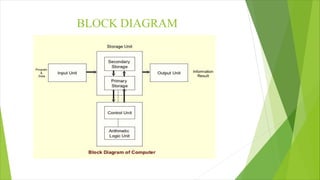
 The block diagram of a computer provides a visual representation
of its internal components and their interconnections.
 Memory stores data and instructions temporarily for the CPU to
access quickly. Input/output devices allow users to interact with
the computer, while storage devices retain data for long-term use.
BLOCK DIAGRAM
Input unit
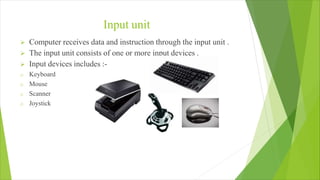
 Computer receives data and instruction through the input unit .
 The input unit consists of one or more input devices .
 Input devices includes :-
o Keyboard
o Mouse
o Scanner
o Joystick
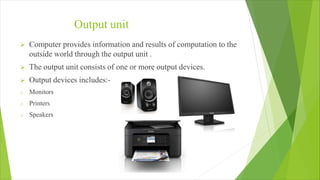
Output unit
 Computer provides information and results of computation to the
outside world through the output unit .
 The output unit consists of one or more output devices.
 Output devices includes:-
o Monitors
o Printers
o Speakers
Storage unit
 The storage unit of the computer holds data and instructions that
are entered through the input unit , before they are processed .
 Storage devices are divided into two categories :
o Primary memory
o Secondary memory
 Primary memory :- Primary memory, also known as RAM (Random Access
Memory), is the main memory in a computer that stores data and instructions
currently being used by the CPU.
 Secondary memory :-Secondary memory, such as hard drives and SSDs,
provides non-volatile storage for data and programs, retaining information
even when the power is turned off.
Central Processing Unit (CPU)
 It is the brain of the computer .
 The arithmetic logic unit (ALU) and the control unit (CU) of a
computer system are jointly known as the central processing unit
(CPU).
 CPU performs actual processing of data , according to
instructions from programs.
 CPU includes :-
o Control unit
o Arithmetic Logic Unit
Control unit
 It controls all other units in the computer .
 It is the central nervous system of the computer that
controls and synchronizes its working
 It is also responsible for controlling
input/output ,memory ,and other devices connected th the
CPU.
Arithmetic Logic Unit
 All calculations are performed in the arithmetic logic unit
(ALU) of the computer
 The data inputted through input devices is stored in the primary
storage unit . The arithmetic logic unit performs arithmetic and
logical operations .
Pdf for a computer presentation ppt presentation..

Pdf for a computer presentation ppt presentation..

  • 1.
    S.N.B.P COLLEGE OFARTS,COMMERCE,SCIENCE AND MANAGEMENTSTUDIES Fundamental of computer on THE BLOCK DIAGRAM OF COMPUTER PRESENTED BY : V ARSHA.A. CHOUDHARY Roll NO: BB231092 FY BBASNBPCollege OfACS and Management Studies
  • 2.
    INTRODUCTION  A Computerconsists of primarily three different types they are central processing unit commonly called as processor [CPU], Input Devices and Output Devices.  Further Central Processing Unit contains ALU [Arithmetic Logic Unit] and Control Unit. The set of instruction or information or data submitted to computer is in a raw form which is entered with the help of input devices like keyboard and mouse  The block diagram of a computer provides a visual representation of its internal components and their interconnections.  Memory stores data and instructions temporarily for the CPU to access quickly. Input/output devices allow users to interact with the computer, while storage devices retain data for long-term use.
  • 3.
  • 4.
    Input unit  Computerreceives data and instruction through the input unit .  The input unit consists of one or more input devices .  Input devices includes :- o Keyboard o Mouse o Scanner o Joystick
  • 5.
    Output unit  Computerprovides information and results of computation to the outside world through the output unit .  The output unit consists of one or more output devices.  Output devices includes:- o Monitors o Printers o Speakers
  • 6.
    Storage unit  Thestorage unit of the computer holds data and instructions that are entered through the input unit , before they are processed .  Storage devices are divided into two categories : o Primary memory o Secondary memory  Primary memory :- Primary memory, also known as RAM (Random Access Memory), is the main memory in a computer that stores data and instructions currently being used by the CPU.  Secondary memory :-Secondary memory, such as hard drives and SSDs, provides non-volatile storage for data and programs, retaining information even when the power is turned off.
  • 7.
    Central Processing Unit(CPU)  It is the brain of the computer .  The arithmetic logic unit (ALU) and the control unit (CU) of a computer system are jointly known as the central processing unit (CPU).  CPU performs actual processing of data , according to instructions from programs.  CPU includes :- o Control unit o Arithmetic Logic Unit
  • 8.
    Control unit  Itcontrols all other units in the computer .  It is the central nervous system of the computer that controls and synchronizes its working  It is also responsible for controlling input/output ,memory ,and other devices connected th the CPU. Arithmetic Logic Unit  All calculations are performed in the arithmetic logic unit (ALU) of the computer  The data inputted through input devices is stored in the primary storage unit . The arithmetic logic unit performs arithmetic and logical operations .