CPU
Central Processing Unit
CONTENTS
o What is CPU?
o Parts of System Unit.
o History of Central Processing Unit.
o Components of CPU.
o Function of the CPU.
What is CPU?
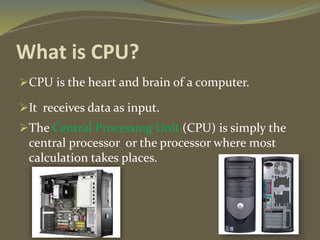
CPU is the heart and brain of a computer.
It receives data as input.
The Central Processing Unit (CPU) is simply the
central processor or the processor where most
calculation takes places.
History of Central
Processing Unit
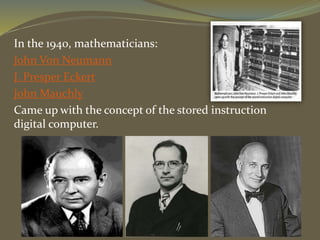
In the 1940, mathematicians:
John Von Neumann
J. Presper Eckert
John Mauchly
Came up with the concept of the stored instruction
digital computer.
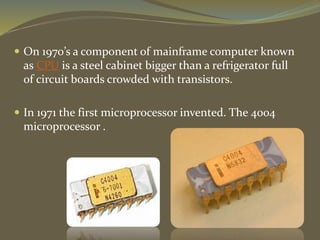
 On 1970’s a component of mainframe computer known
as CPU is a steel cabinet bigger than a refrigerator full
of circuit boards crowded with transistors.
 In 1971 the first microprocessor invented. The 4004
microprocessor .
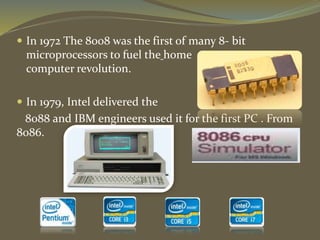
 In 1972 The 8008 was the first of many 8- bit
microprocessors to fuel the home
computer revolution.
 In 1979, Intel delivered the
8088 and IBM engineers used it for the first PC . From
8086.
Parts of System Units:
 Motherboard
 Memory
 Bus
 Expansion Slot
 Ports and Connector
 Bays
 Power Supply
 Sound Components
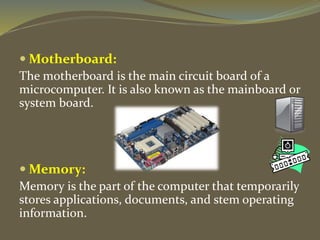
 Motherboard:
The motherboard is the main circuit board of a
microcomputer. It is also known as the mainboard or
system board.
 Memory:
Memory is the part of the computer that temporarily
stores applications, documents, and stem operating
information.
 Bus:
A bus is an electronic line that allows 1s and 0s to move
from one place to another.
 Expansion Slots:
Expansions slots appear on the motherboard. They are
sockets into which adapters are connected.
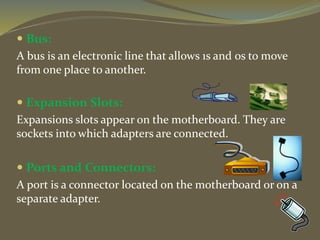
 Ports and Connectors:
A port is a connector located on the motherboard or on a
separate adapter.
 Bays:
A bay is a space inside the computer case where a hard
drive, floppy drive or CD-ROM drive sits
 Power Supply:
A power supply changes normal household electricity
into electricity that a computer can use.
 Sound Components :
A sound card lets a computer play and record high
quality sound.
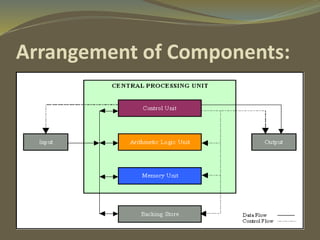
Components of CPU:
 Control Unit
 Arithmetic Logic Unit
 Memory Unit/Register
Arrangement of Components:
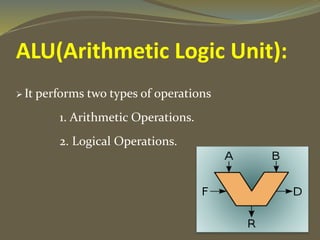
ALU(Arithmetic Logic Unit):
 It performs two types of operations
1. Arithmetic Operations.
2. Logical Operations.
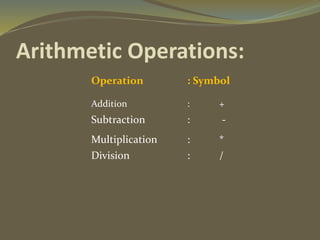
Arithmetic Operations:
Operation : Symbol
Addition : +
Subtraction : -
Multiplication : *
Division : /
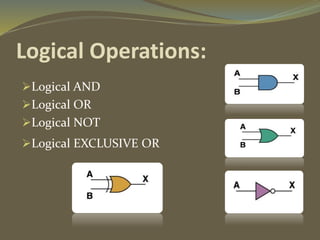
Logical Operations:
Logical AND
Logical OR
Logical NOT
Logical EXCLUSIVE OR
CU (Control Unit):
 It reads and instructions from memory and transforms
them into a series of signals to activate other parts of
the computer.
 Controls the operations that takes place in various parts of
a computer by sending electronic signals.
MU/Register(Memory Unit):
 Is the part of the computer that holds data and
instructions for processing.
Functions of the
CPU
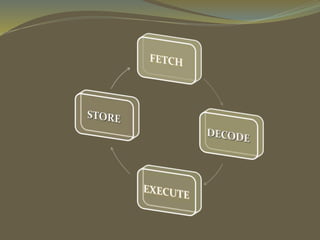
Fetch:
Taking the instruction from the memory.
Decode:
Translating and decoding Assembly code binary instructions
which are understandable to your CPU.
Execute:
Execute calculation, move data and jump to different address.
Store:
CPU dive some data after executing the instruction and store
data being instructed.
CPU AND HISTOTY.pdf
CPU AND HISTOTY.pdf

CPU AND HISTOTY.pdf

  • 1.
  • 2.
    CONTENTS o What isCPU? o Parts of System Unit. o History of Central Processing Unit. o Components of CPU. o Function of the CPU.
  • 3.
    What is CPU? CPUis the heart and brain of a computer. It receives data as input. The Central Processing Unit (CPU) is simply the central processor or the processor where most calculation takes places.
  • 4.
  • 5.
    In the 1940,mathematicians: John Von Neumann J. Presper Eckert John Mauchly Came up with the concept of the stored instruction digital computer.
  • 6.
     On 1970’sa component of mainframe computer known as CPU is a steel cabinet bigger than a refrigerator full of circuit boards crowded with transistors.  In 1971 the first microprocessor invented. The 4004 microprocessor .
  • 7.
     In 1972The 8008 was the first of many 8- bit microprocessors to fuel the home computer revolution.  In 1979, Intel delivered the 8088 and IBM engineers used it for the first PC . From 8086.
  • 8.
    Parts of SystemUnits:  Motherboard  Memory  Bus  Expansion Slot  Ports and Connector  Bays  Power Supply  Sound Components
  • 9.
     Motherboard: The motherboardis the main circuit board of a microcomputer. It is also known as the mainboard or system board.  Memory: Memory is the part of the computer that temporarily stores applications, documents, and stem operating information.
  • 10.
     Bus: A busis an electronic line that allows 1s and 0s to move from one place to another.  Expansion Slots: Expansions slots appear on the motherboard. They are sockets into which adapters are connected.  Ports and Connectors: A port is a connector located on the motherboard or on a separate adapter.
  • 11.
     Bays: A bayis a space inside the computer case where a hard drive, floppy drive or CD-ROM drive sits  Power Supply: A power supply changes normal household electricity into electricity that a computer can use.  Sound Components : A sound card lets a computer play and record high quality sound.
  • 12.
    Components of CPU: Control Unit  Arithmetic Logic Unit  Memory Unit/Register
  • 13.
  • 14.
    ALU(Arithmetic Logic Unit): It performs two types of operations 1. Arithmetic Operations. 2. Logical Operations.
  • 15.
    Arithmetic Operations: Operation :Symbol Addition : + Subtraction : - Multiplication : * Division : /
  • 16.
    Logical Operations: Logical AND LogicalOR Logical NOT Logical EXCLUSIVE OR
  • 17.
    CU (Control Unit): It reads and instructions from memory and transforms them into a series of signals to activate other parts of the computer.  Controls the operations that takes place in various parts of a computer by sending electronic signals.
  • 18.
    MU/Register(Memory Unit):  Isthe part of the computer that holds data and instructions for processing.
  • 19.
  • 21.
    Fetch: Taking the instructionfrom the memory. Decode: Translating and decoding Assembly code binary instructions which are understandable to your CPU. Execute: Execute calculation, move data and jump to different address. Store: CPU dive some data after executing the instruction and store data being instructed.