Introduction
• Play is universal for all children.
• It is work for the and ways of their living.
• It pleasurable and enjoyable aspect of child’s
life and essential to promote growth and
development.
• Play is the activity that has no serious motive
and from which there is no material gain.
1R Dhaker, Lecturer, PCNMS
• Play is the work and language of children.– Lev
Vygotsky
• DEFINITION "PlayTherapy is based upon the
fact that play is the childs natural medium of
self- expression.
Importance of play
• Physical development
• Intellectual and educational development
• Emotional development
• Moral development
3R Dhaker, Lecturer, PCNMS
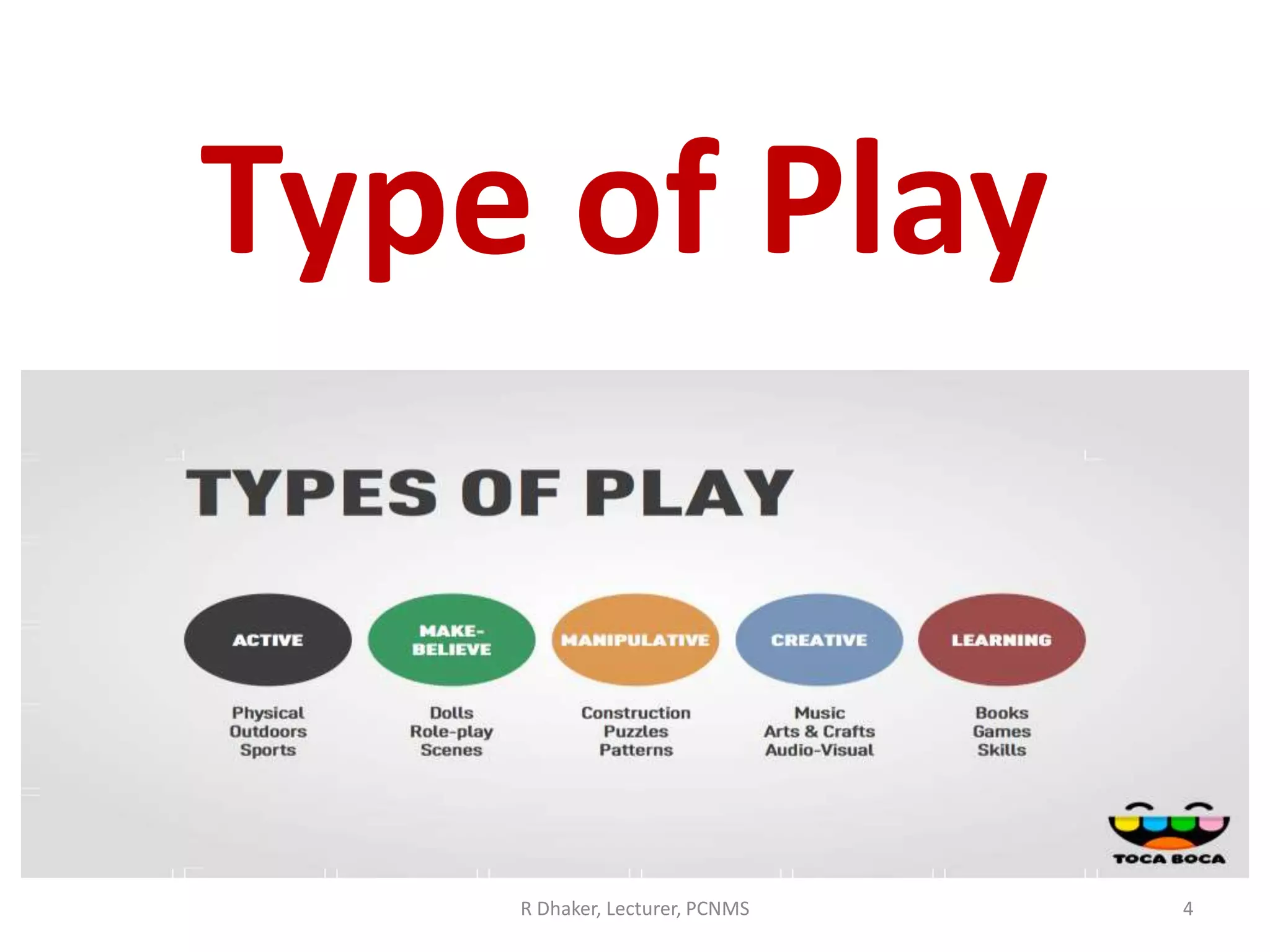
Type of Play
R Dhaker, Lecturer, PCNMS 4
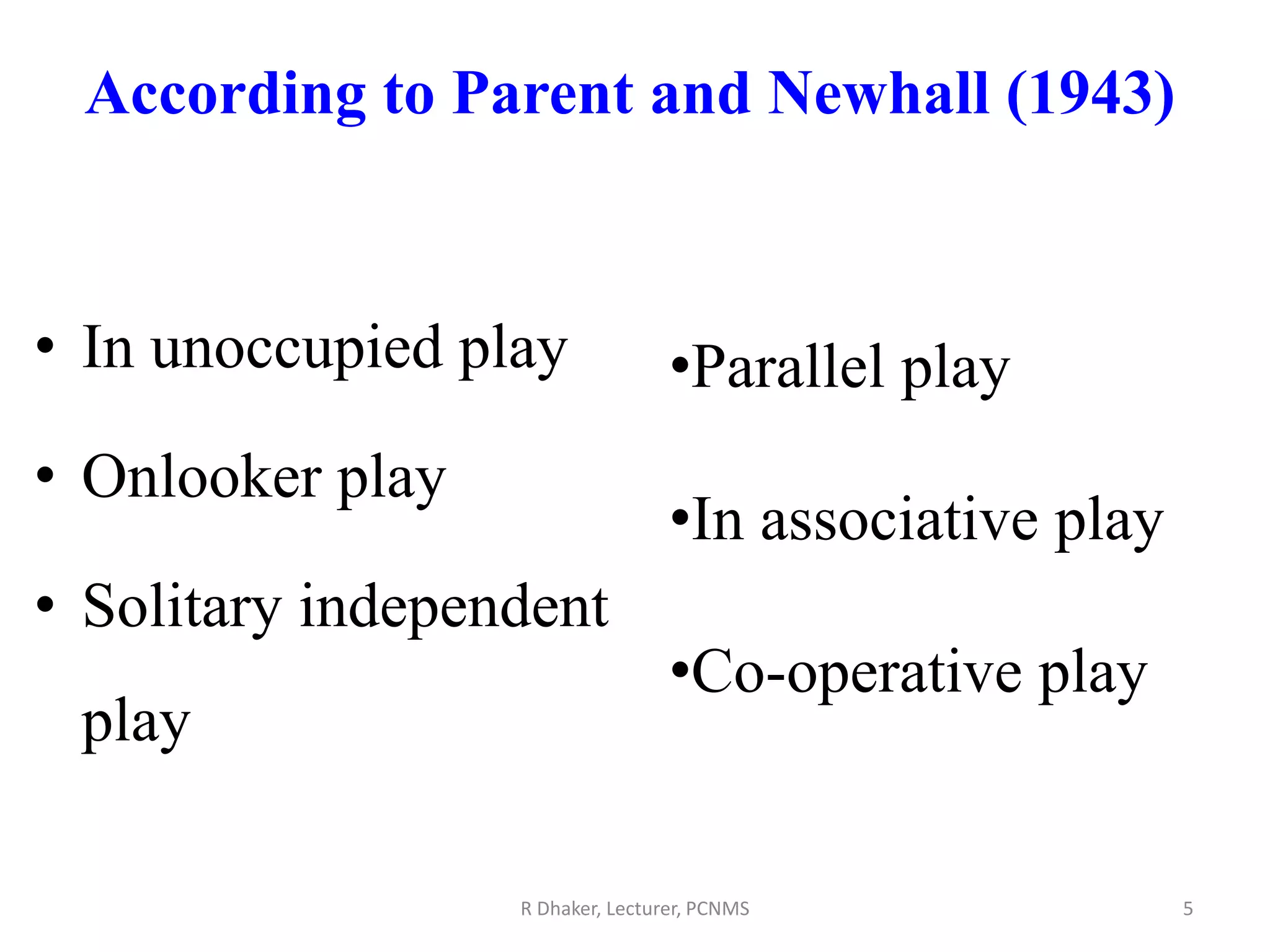
According to Parent and Newhall (1943)
R Dhaker, Lecturer, PCNMS 5
• In unoccupied play
• Onlooker play
• Solitary independent
play
•Parallel play
•In associative play
•Co-operative play
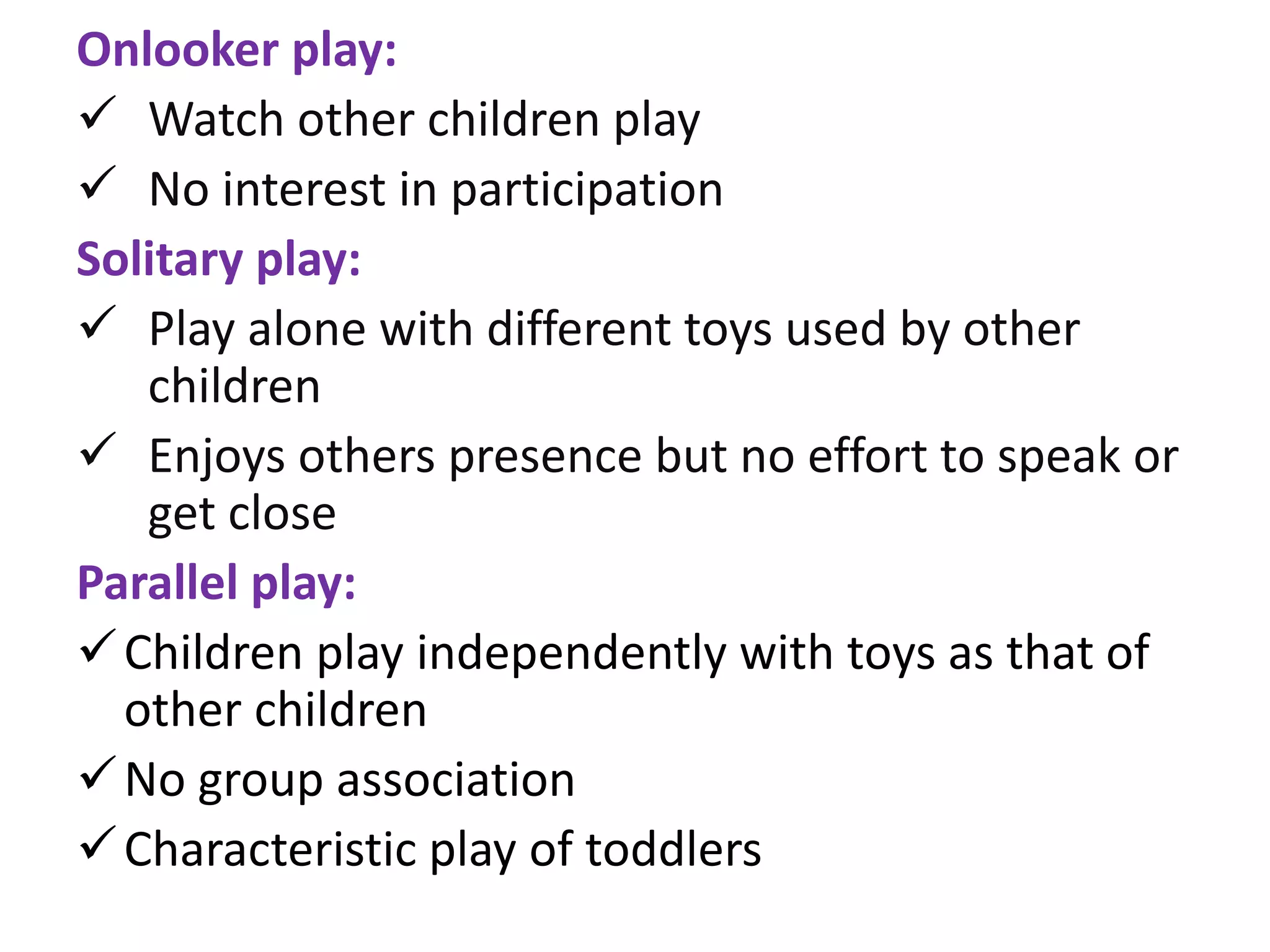
Onlooker play:
 Watch other children play
 No interest in participation
Solitary play:
 Play alone with different toys used by other
children
 Enjoys others presence but no effort to speak or
get close
Parallel play:
Children play independently with toys as that of
other children
No group association
Characteristic play of toddlers
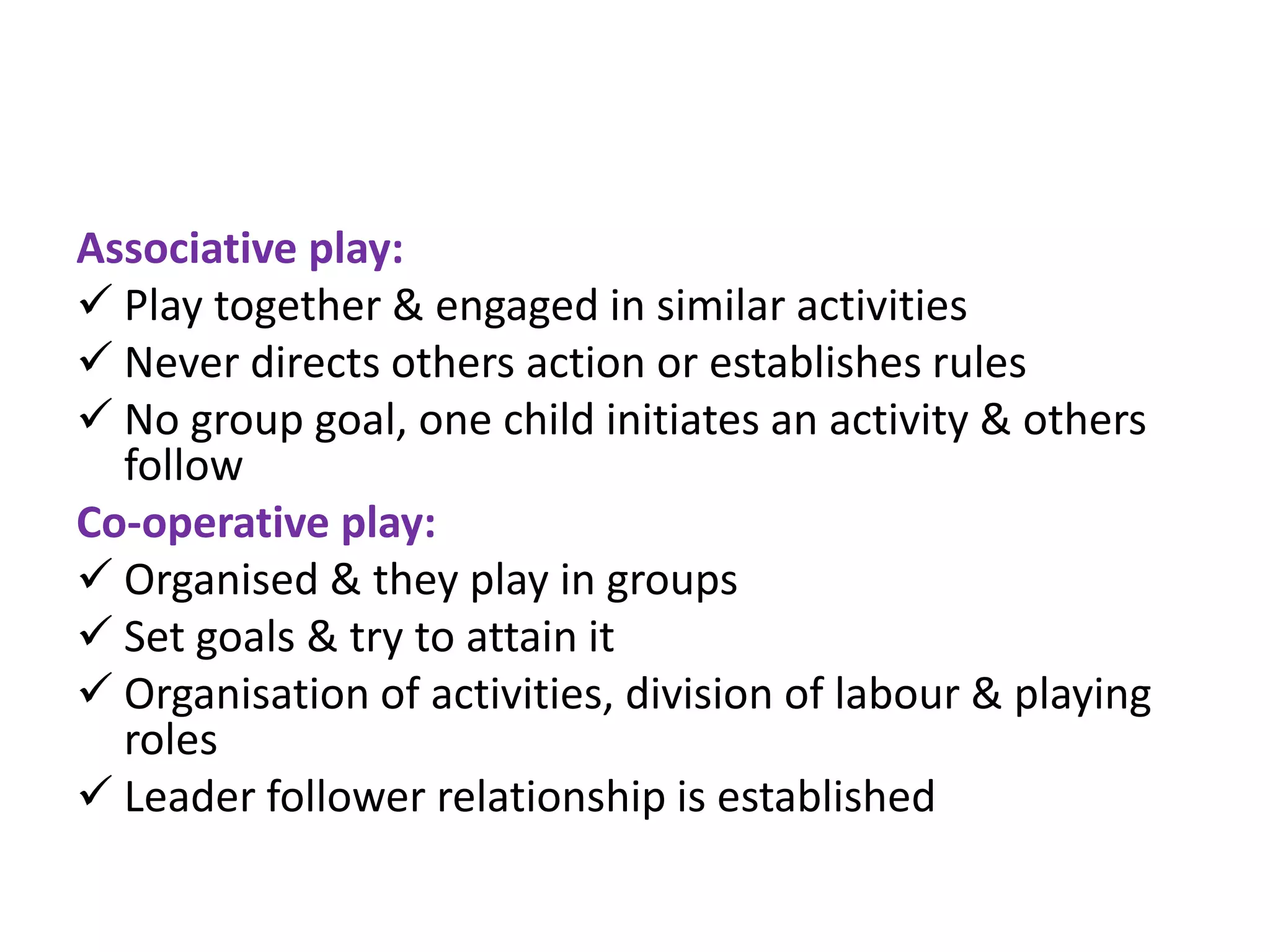
Associative play:
 Play together & engaged in similar activities
 Never directs others action or establishes rules
 No group goal, one child initiates an activity & others
follow
Co-operative play:
 Organised & they play in groups
 Set goals & try to attain it
 Organisation of activities, division of labour & playing
roles
 Leader follower relationship is established
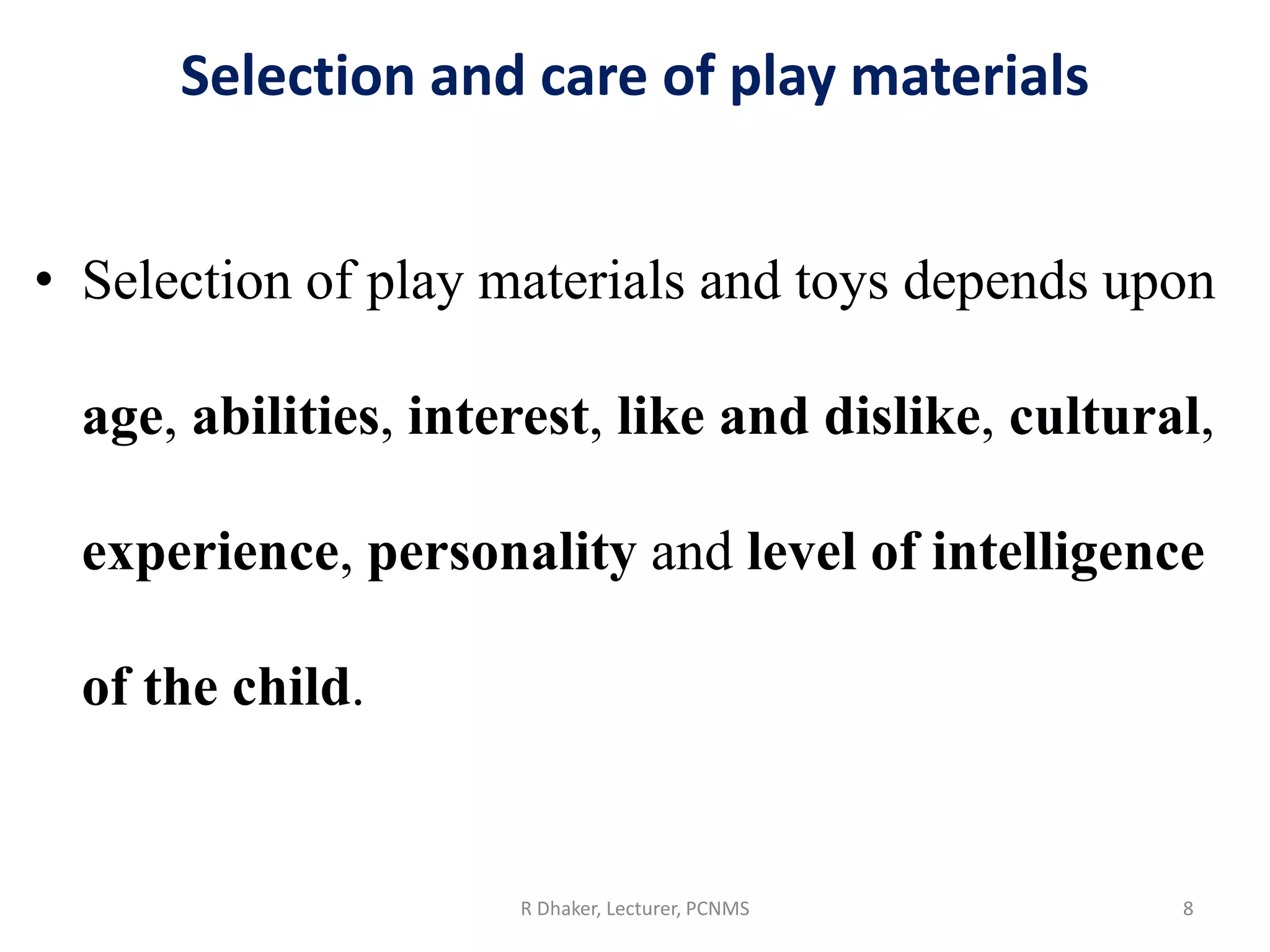
Selection and care of play materials
R Dhaker, Lecturer, PCNMS 8
• Selection of play materials and toys depends upon
age, abilities, interest, like and dislike, cultural,
experience, personality and level of intelligence
of the child.
Play Therapy Room
University of North Texas. (2010, April 23). Center for play therapy. website: http://cpt.unt.edu/about-play-therapy/playrooms/
Guidelines for Selecting Toys
Toys should:
• Allow for exploration of real life experiences including cultural values, traditions
and roles.
• Facilitate contact with the child by gaining the child's interest and attention
• Permit reality testing/limit setting
• Provide the opportunity for development of self-control
• Facilitate exploration of the self and others
• Allow children to express their needs symbolically (without any need for
verbalization)
• Provide for expression of a wide range of feelings
• Provide opportunities for insight/self-understanding
• Allow for creative expression
• Toys should also be durable, simple, and easy to operate, allow for success & are
fun
Reminder: Toys should be selected, not collected
University of North Texas. (2010, April 23). Center for play therapy. website: http://cpt.unt.edu/about-play-therapy/playrooms/
Suggested Toys
Doll furniture (sturdy wood)
• Gumby (bendable nondescript
figure)
• Doll bed, clothes, etc.
• Bendable doll family
• Dolls
• Pacifier
• Nursing bottle (plastic)
• Chalkboard, chalk
• Refrigerator (wood)
• Dishes (plastic or tin)
• Pitcher
• Plastic food
• Egg cartons
• Broom, dustpan
• Crayons, pencils, paper
• Toy watch
• Paints, easel, newsprint, brushes
• Lone Ranger type mask
• Tongue depressors, popsicle
sticks
• Truck, car, airplane, tractor, boat
• Pounding bench and hammer
• Cymbals
• Toy soldiers and army equipment
• Sandbox, large spoon, funnel,
sieve, pail
• Rubber snake, alligator
• Multicolored chalk, eraser
• Stove (wood)
• Pans, silverware
• Dishpan
• Empty fruit and vegetable cans,
etc.
• Band-aids
• Sponge, towel
• Soap, brush, comb
• Transparent tape
• Building blocks (diff. shapes and
sizes)
• Play-Doh or clay
• Pipe cleaners
• ATV (multi-wheel vehicle for
riding on)
• School bus (Fisher Price type)
• Xylophone
• Drum
• Fireman's hat, other hats
• Zoo animals, farm animals
• Bop bag (Bobo)
• Handcuffs
• Toy noise making gun
• Telephone (two)
• Construction paper (several
colors)
• Rags or old towels
• Tinker toys
• Tissue
• Rubber Knife
• Dart gun
• Balls (large and small)
• Medical kit
• Blunt scissors
• Play money and cash register
• Hand puppets (doctor, nurse,
etc.)
• Rope
• Purse and jewelry
Landreth, Garry. (2002). Play therapy the art of the relationship. Bristol, PA: Routledge.
The play materials should have
the following characteristics-
R Dhaker, Lecturer, PCNMS 12
• Safe, washable, light weight, simple, durable,
easy to handle and non- breakable.
• Realistic, attractive, constructive and offer
problem- solving opportunities.
• No sharp edges and no small removable parts
which may be swallowed or inhaled.
Cont…The play materials should have the following characteristics-
R Dhaker, Lecturer, PCNMS13
• Not over stimulating and frustrating
• No toxic paints, not costly, not inflammable and
not excessive noisy.
• Play things with electrical plugs should be
avoided, only children over 8 years of age should
be permitted to use them.
Children must be taught the following-
R Dhaker, Lecturer, PCNMS14
• Correct use of toys. Parents should explain the
directions for use and the causation labels.
• Safe storing of toys in a space with easy reach and
away from busy areas.
• Keeping the playthings in good conditions. Parents
should repair or discard damaged and broken toys.

Value and selection of play

  • 1.
    Introduction • Play isuniversal for all children. • It is work for the and ways of their living. • It pleasurable and enjoyable aspect of child’s life and essential to promote growth and development. • Play is the activity that has no serious motive and from which there is no material gain. 1R Dhaker, Lecturer, PCNMS
  • 2.
    • Play isthe work and language of children.– Lev Vygotsky • DEFINITION "PlayTherapy is based upon the fact that play is the childs natural medium of self- expression.
  • 3.
    Importance of play •Physical development • Intellectual and educational development • Emotional development • Moral development 3R Dhaker, Lecturer, PCNMS
  • 4.
    Type of Play RDhaker, Lecturer, PCNMS 4
  • 5.
    According to Parentand Newhall (1943) R Dhaker, Lecturer, PCNMS 5 • In unoccupied play • Onlooker play • Solitary independent play •Parallel play •In associative play •Co-operative play
  • 6.
    Onlooker play:  Watchother children play  No interest in participation Solitary play:  Play alone with different toys used by other children  Enjoys others presence but no effort to speak or get close Parallel play: Children play independently with toys as that of other children No group association Characteristic play of toddlers
  • 7.
    Associative play:  Playtogether & engaged in similar activities  Never directs others action or establishes rules  No group goal, one child initiates an activity & others follow Co-operative play:  Organised & they play in groups  Set goals & try to attain it  Organisation of activities, division of labour & playing roles  Leader follower relationship is established
  • 8.
    Selection and careof play materials R Dhaker, Lecturer, PCNMS 8 • Selection of play materials and toys depends upon age, abilities, interest, like and dislike, cultural, experience, personality and level of intelligence of the child.
  • 9.
    Play Therapy Room Universityof North Texas. (2010, April 23). Center for play therapy. website: http://cpt.unt.edu/about-play-therapy/playrooms/
  • 10.
    Guidelines for SelectingToys Toys should: • Allow for exploration of real life experiences including cultural values, traditions and roles. • Facilitate contact with the child by gaining the child's interest and attention • Permit reality testing/limit setting • Provide the opportunity for development of self-control • Facilitate exploration of the self and others • Allow children to express their needs symbolically (without any need for verbalization) • Provide for expression of a wide range of feelings • Provide opportunities for insight/self-understanding • Allow for creative expression • Toys should also be durable, simple, and easy to operate, allow for success & are fun Reminder: Toys should be selected, not collected University of North Texas. (2010, April 23). Center for play therapy. website: http://cpt.unt.edu/about-play-therapy/playrooms/
  • 11.
    Suggested Toys Doll furniture(sturdy wood) • Gumby (bendable nondescript figure) • Doll bed, clothes, etc. • Bendable doll family • Dolls • Pacifier • Nursing bottle (plastic) • Chalkboard, chalk • Refrigerator (wood) • Dishes (plastic or tin) • Pitcher • Plastic food • Egg cartons • Broom, dustpan • Crayons, pencils, paper • Toy watch • Paints, easel, newsprint, brushes • Lone Ranger type mask • Tongue depressors, popsicle sticks • Truck, car, airplane, tractor, boat • Pounding bench and hammer • Cymbals • Toy soldiers and army equipment • Sandbox, large spoon, funnel, sieve, pail • Rubber snake, alligator • Multicolored chalk, eraser • Stove (wood) • Pans, silverware • Dishpan • Empty fruit and vegetable cans, etc. • Band-aids • Sponge, towel • Soap, brush, comb • Transparent tape • Building blocks (diff. shapes and sizes) • Play-Doh or clay • Pipe cleaners • ATV (multi-wheel vehicle for riding on) • School bus (Fisher Price type) • Xylophone • Drum • Fireman's hat, other hats • Zoo animals, farm animals • Bop bag (Bobo) • Handcuffs • Toy noise making gun • Telephone (two) • Construction paper (several colors) • Rags or old towels • Tinker toys • Tissue • Rubber Knife • Dart gun • Balls (large and small) • Medical kit • Blunt scissors • Play money and cash register • Hand puppets (doctor, nurse, etc.) • Rope • Purse and jewelry Landreth, Garry. (2002). Play therapy the art of the relationship. Bristol, PA: Routledge.
  • 12.
    The play materialsshould have the following characteristics- R Dhaker, Lecturer, PCNMS 12 • Safe, washable, light weight, simple, durable, easy to handle and non- breakable. • Realistic, attractive, constructive and offer problem- solving opportunities. • No sharp edges and no small removable parts which may be swallowed or inhaled.
  • 13.
    Cont…The play materialsshould have the following characteristics- R Dhaker, Lecturer, PCNMS13 • Not over stimulating and frustrating • No toxic paints, not costly, not inflammable and not excessive noisy. • Play things with electrical plugs should be avoided, only children over 8 years of age should be permitted to use them.
  • 14.
    Children must betaught the following- R Dhaker, Lecturer, PCNMS14 • Correct use of toys. Parents should explain the directions for use and the causation labels. • Safe storing of toys in a space with easy reach and away from busy areas. • Keeping the playthings in good conditions. Parents should repair or discard damaged and broken toys.