

COUNSELLING
Counselling is a scientific process of
assistance extended by an expert in an
individual situation to a needy person.
Counselling involves relationship between
two persons in which one of them
(counsellor) attempts to assists the other
(counselee or client) in so organising
himself as to attain a particular form of
happiness, adjusting to a life situation , or in
short ,self actualisation.
Shostorm: counselling as a self
adjustive process, which helps the client
become more self directive and self
responsible.
• Shortly, it is a personal and dynamic
relationship between two individuals in
which the more experienced person
helps the less experienced person to find
self determined solution for his problem.
Objectives
• To understand once own problems clearly.
• To realise what he is able to do and what he
should do that means to accept abilities and
weaknesses.
• Develop insight and understanding in relation
to self and environment, opportunities open
to improve in respect to his potentials and
goals he has chosen.
• Decide a course of action by making his
own decision .
Features Counselling
• Counselling is a professional service,which is
imparted by a professional counsellor who is
properly trained to handle various kind of
situations
• Counselling helps the client make his own
decision during the process of counselling. The
counsellor is not supposed to make decision for
the client. Counsellor may provide various types
of information so that the client could get insight
to take a decision.
• It is more focused on one to one relationship
even when the participants are involved with
group counselling programmes. They are
generally some or the other time approach
for individual counselling because it is
personal and more confidential.
• Problems and needs of the individual are
important.
• The individual counselling is more
about personal problems
Elements of Counselling
 The counsellor
• a person who is professionally capable to
extend help.
 The counselee
• the person who seeks help and lets
himself/herselfbe subjective for
counselling.
 Thecounselling environment
• a place to facilitate counselling.
Types of Counselling
•Directive Counselling
•Non –Directive
Counselling
•Eclectic Counselling
Directive Counselling.
• E.G WILLIAMSON is the chief
exponent in this viewpoint.
• Counsellor –centred: the counsellor
direct the client to take steps in order to
resolve his conflicts.
• It is based on assumption that the client
cannot solve his own problems for lack of
information.
• The counsellor plays an important
role; he tries to direct the thinking of
counselee by informing , explaining,
interpreting and advising.
• It gives more importance to
intellectual aspect than emotional
aspects.
Steps of Directive Counselling
Williamson hasgiven six
steps directive counselling:
• Analysis
• Diagnosis
• Prognosis
• Counselling
• Follow up
Steps of Directive Counselling
• Analysis – collecting, summarizing, and
organizing data.
• Diagnosis – formulating hypothesis as to the
cause or causes of the problem.
• Prognosis – predicting the development of the
problem.
• Counselling – the heart of the process
wherein the counsellor and the counselee
talk and discuss the problem, and, by means
of leading questions, enables the counselee
to develop insight.
• Follow-up – helping the pupils with recurring
or new problems.
Merits
• It is less time consuming; hence this method
can be adopted when an early solution is
required.
• This method is best; less matured and less
intelligent client interact with an experienced
counsellor.
• This is best method at lower levels where the
client is not in a position to analyse his own
problem
• In this method, the counsellor becomes
readily available to help the client which
makes the client very happy.
Demerits
• In directive counselling, the client never becomes
independent of the counsellor. So it is not an
effective or best guidance.
• The personal autonomy and integrity of the client
is not respected, it leads to new adjustment
problems.
• It will not help the individual to develop any
attitudes through his own experiences.
• The counsellor fails in saving the client to commit
the mistakes in future.
Non-directive Counselling
• CARL R. ROGER is the chief exponent in
this viewpoint.
• This school of thought is just reverse to
that of directive counseling.
• It is a client-centred process.
• In this, the counselee is the pivot of the whole
counselling process.
• The main function of the counsellor is to
create an atmosphere in which the client can
work out his problem.
Steps in Client Centred Counselling
Carl Rogers has given the following steps
of this non-directive counselling:
1.Defining the Problematic Situation :
First of all the counsellor should define
the problematic situation.
2.Free Expression of Feelings : After the
first step, the client is made aware of the
fact that he can express his feelings freely
and the counselor approves this.
• It is also known as
permissive counselling.
• In this type of counselling,
emotional elements rather
than intellectual element
are stressed.
3. Development of Insight: The
counsellor goes on thinking regarding
the client's new feelings along with the
development of client's insight and he
goes on classifying all those new
feelings.
4. Classification of Positive and
Negative Feelings:After the free
expression of feelings by the client, the
counsellor identifies his negative and
positive feelings and he classifies
them.
5. Termination of Counselling
Situation: The counsellor looks for a
point where he can terminate the
counselling situation after all the
above steps. According to this school
of thought, either the client or the
counsellor can suggest for such
termination of counselling situation.
Merits
• It helps the counselee to become
independent and self-reliant and to attain
the ability for self-direction.
• It helps the client to attain emotional
integrity; and helps to reach his full growth.
• It helps to attain more sustainable
adjustment to his situation.
• This type of counselling leaves it’s
impressions for a longer period.
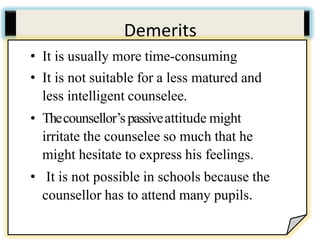
Demerits
• It is usually more time-consuming
• It is not suitable for a less matured and less
intelligent counselee.
• Thecounsellor’s passiveattitude might irritate the
counselee so much that he might hesitate to
express his feelings.
• It is not possible in schools because the
counsellor has to attend many pupils.
• It is usually more time-consuming
• It is not suitable for a less matured and
less intelligent counselee.
• Thecounsellor’s passiveattitude might
irritate the counselee so much that he
might hesitate to express his feelings.
• It is not possible in schools because the
counsellor has to attend many pupils.
Comparative
Analysis Of
Directive And
Non-directive
Counselling
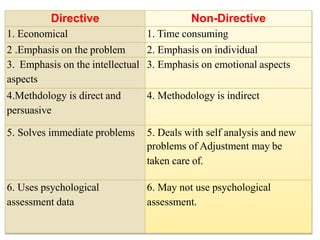
Directive Non-Directive
1. Economical 1. Time consuming
2 .Emphasis on the problem 2. Emphasis on individual
3. Emphasis on the intellectual
aspects
3. Emphasis on emotional aspects
4.Methdology is direct and
persuasive
4. Methodology is indirect
5. Solves immediate problems 5. Deals with self analysis and new
problems of Adjustment may be
taken care of.
6. Uses psychological
assessment data
6. May not use psychological
assessment.
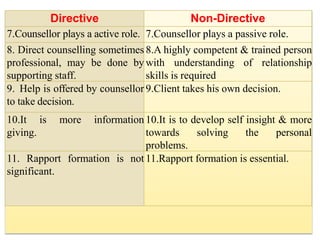
Directive Non-Directive
7.Counsellor plays a active role. 7.Counsellor plays a passive role.
8. Direct counselling sometimes
professional, may be done by
supporting staff.
8.A highly competent & trained person
with understanding of relationship
skills is required
9. Help is offered by counsellor
to take decision.
9.Client takes his own decision.
10.It is more information
giving.
10.It is to develop self insight & more
towards solving the personal
problems.
11. Rapport formation is not
significant.
11.Rapport formation is essential.
3. Eclectic Counselling
• The chief advocate of this type of
counselling is ‘Thorne’.
• Eclectic counselling is a type of
counselling which is neither counsellor-
centred nor client centred; but a
combination of both.
• Here the counsellor is neither too active as
in directive counselling nor too passive as in
non-directive counselling, but follows a
middle course.
Characteristics of Eclectic Counselling
• Methods of counselling may change from client to
client or even with the same client from time to
time.
• It is highly flexible.
• Freedom of choice and expression is open to both
the counsellor and the counselee.
• Experience of mutual confidence and faith in the
relationship are basic.
• The client and the philosophical framework are
adjusted to save the purpose of the relationship.
Steps of Eclectic Counselling
• Thorne, suggested the following steps
1) Diagnosis of the cause.
2) Analysis of the problem.
3) Preparation of a tentative plan for modifying
factors.
4) Securing effective conditions for
counselling.
5) Interviewing and stimulating the client to
develop his own resources and to assume its
responsibility for trying new modes of
adjustment.
6) Proper handling of any related problems
which may contribute to adjustment.
Merits Of Eclectic Counselling
• The features of eclectic counselling that is,
flexibility in choosing directive or non-
directive or both the techniques, and
alternating between the two techniques, the
freedom of choice and expression to the
counsellor and the client – are itself its
major advantages. It removes the rigidity of
the other two methods that is directive and
non-directive, and hence produces better
results. It is economical and effective.
Demerits Of Eclectic Counselling
• 1) Some people are of the view that eclectic
counselling is vague, opportunistic and
superficial.
2) Both directive and non-directive counselling
cannot be mixed together.
3) In this, the question arises how much
freedom should be given to the client? For this
there is non-definite rule.
4) The problem with an eclectic orientation is
that counsellors often do more harm than good
if they have little or no understanding about
what is helping the client.
Prepared by
Ms Minakshi Jaswal
Assistant Professor

counselling

  • 3.
    COUNSELLING Counselling is ascientific process of assistance extended by an expert in an individual situation to a needy person. Counselling involves relationship between two persons in which one of them (counsellor) attempts to assists the other (counselee or client) in so organising himself as to attain a particular form of happiness, adjusting to a life situation , or in short ,self actualisation.
  • 4.
    Shostorm: counselling asa self adjustive process, which helps the client become more self directive and self responsible. • Shortly, it is a personal and dynamic relationship between two individuals in which the more experienced person helps the less experienced person to find self determined solution for his problem.
  • 5.
    Objectives • To understandonce own problems clearly. • To realise what he is able to do and what he should do that means to accept abilities and weaknesses. • Develop insight and understanding in relation to self and environment, opportunities open to improve in respect to his potentials and goals he has chosen. • Decide a course of action by making his own decision .
  • 6.
    Features Counselling • Counsellingis a professional service,which is imparted by a professional counsellor who is properly trained to handle various kind of situations • Counselling helps the client make his own decision during the process of counselling. The counsellor is not supposed to make decision for the client. Counsellor may provide various types of information so that the client could get insight to take a decision.
  • 7.
    • It ismore focused on one to one relationship even when the participants are involved with group counselling programmes. They are generally some or the other time approach for individual counselling because it is personal and more confidential. • Problems and needs of the individual are important. • The individual counselling is more about personal problems
  • 8.
    Elements of Counselling The counsellor • a person who is professionally capable to extend help.  The counselee • the person who seeks help and lets himself/herselfbe subjective for counselling.  Thecounselling environment • a place to facilitate counselling.
  • 9.
    Types of Counselling •DirectiveCounselling •Non –Directive Counselling •Eclectic Counselling
  • 10.
    Directive Counselling. • E.GWILLIAMSON is the chief exponent in this viewpoint. • Counsellor –centred: the counsellor direct the client to take steps in order to resolve his conflicts. • It is based on assumption that the client cannot solve his own problems for lack of information.
  • 11.
    • The counsellorplays an important role; he tries to direct the thinking of counselee by informing , explaining, interpreting and advising. • It gives more importance to intellectual aspect than emotional aspects.
  • 12.
    Steps of DirectiveCounselling Williamson hasgiven six steps directive counselling: • Analysis • Diagnosis • Prognosis • Counselling • Follow up
  • 13.
    Steps of DirectiveCounselling • Analysis – collecting, summarizing, and organizing data. • Diagnosis – formulating hypothesis as to the cause or causes of the problem. • Prognosis – predicting the development of the problem. • Counselling – the heart of the process wherein the counsellor and the counselee talk and discuss the problem, and, by means of leading questions, enables the counselee to develop insight. • Follow-up – helping the pupils with recurring or new problems.
  • 14.
    Merits • It isless time consuming; hence this method can be adopted when an early solution is required. • This method is best; less matured and less intelligent client interact with an experienced counsellor. • This is best method at lower levels where the client is not in a position to analyse his own problem • In this method, the counsellor becomes readily available to help the client which makes the client very happy.
  • 15.
    Demerits • In directivecounselling, the client never becomes independent of the counsellor. So it is not an effective or best guidance. • The personal autonomy and integrity of the client is not respected, it leads to new adjustment problems. • It will not help the individual to develop any attitudes through his own experiences. • The counsellor fails in saving the client to commit the mistakes in future.
  • 16.
    Non-directive Counselling • CARLR. ROGER is the chief exponent in this viewpoint. • This school of thought is just reverse to that of directive counseling. • It is a client-centred process. • In this, the counselee is the pivot of the whole counselling process. • The main function of the counsellor is to create an atmosphere in which the client can work out his problem.
  • 17.
    Steps in ClientCentred Counselling Carl Rogers has given the following steps of this non-directive counselling: 1.Defining the Problematic Situation : First of all the counsellor should define the problematic situation. 2.Free Expression of Feelings : After the first step, the client is made aware of the fact that he can express his feelings freely and the counselor approves this.
  • 18.
    • It isalso known as permissive counselling. • In this type of counselling, emotional elements rather than intellectual element are stressed.
  • 19.
    3. Development ofInsight: The counsellor goes on thinking regarding the client's new feelings along with the development of client's insight and he goes on classifying all those new feelings. 4. Classification of Positive and Negative Feelings:After the free expression of feelings by the client, the counsellor identifies his negative and positive feelings and he classifies them.
  • 20.
    5. Termination ofCounselling Situation: The counsellor looks for a point where he can terminate the counselling situation after all the above steps. According to this school of thought, either the client or the counsellor can suggest for such termination of counselling situation.
  • 21.
    Merits • It helpsthe counselee to become independent and self-reliant and to attain the ability for self-direction. • It helps the client to attain emotional integrity; and helps to reach his full growth. • It helps to attain more sustainable adjustment to his situation. • This type of counselling leaves it’s impressions for a longer period.
  • 22.
    Demerits • It isusually more time-consuming • It is not suitable for a less matured and less intelligent counselee. • Thecounsellor’s passiveattitude might irritate the counselee so much that he might hesitate to express his feelings. • It is not possible in schools because the counsellor has to attend many pupils. • It is usually more time-consuming • It is not suitable for a less matured and less intelligent counselee. • Thecounsellor’s passiveattitude might irritate the counselee so much that he might hesitate to express his feelings. • It is not possible in schools because the counsellor has to attend many pupils.
  • 23.
  • 24.
    Directive Non-Directive 1. Economical1. Time consuming 2 .Emphasis on the problem 2. Emphasis on individual 3. Emphasis on the intellectual aspects 3. Emphasis on emotional aspects 4.Methdology is direct and persuasive 4. Methodology is indirect 5. Solves immediate problems 5. Deals with self analysis and new problems of Adjustment may be taken care of. 6. Uses psychological assessment data 6. May not use psychological assessment.
  • 25.
    Directive Non-Directive 7.Counsellor playsa active role. 7.Counsellor plays a passive role. 8. Direct counselling sometimes professional, may be done by supporting staff. 8.A highly competent & trained person with understanding of relationship skills is required 9. Help is offered by counsellor to take decision. 9.Client takes his own decision. 10.It is more information giving. 10.It is to develop self insight & more towards solving the personal problems. 11. Rapport formation is not significant. 11.Rapport formation is essential.
  • 26.
    3. Eclectic Counselling •The chief advocate of this type of counselling is ‘Thorne’. • Eclectic counselling is a type of counselling which is neither counsellor- centred nor client centred; but a combination of both. • Here the counsellor is neither too active as in directive counselling nor too passive as in non-directive counselling, but follows a middle course.
  • 27.
    Characteristics of EclecticCounselling • Methods of counselling may change from client to client or even with the same client from time to time. • It is highly flexible. • Freedom of choice and expression is open to both the counsellor and the counselee. • Experience of mutual confidence and faith in the relationship are basic. • The client and the philosophical framework are adjusted to save the purpose of the relationship.
  • 28.
    Steps of EclecticCounselling • Thorne, suggested the following steps 1) Diagnosis of the cause. 2) Analysis of the problem. 3) Preparation of a tentative plan for modifying factors. 4) Securing effective conditions for counselling. 5) Interviewing and stimulating the client to develop his own resources and to assume its responsibility for trying new modes of adjustment. 6) Proper handling of any related problems which may contribute to adjustment.
  • 29.
    Merits Of EclecticCounselling • The features of eclectic counselling that is, flexibility in choosing directive or non- directive or both the techniques, and alternating between the two techniques, the freedom of choice and expression to the counsellor and the client – are itself its major advantages. It removes the rigidity of the other two methods that is directive and non-directive, and hence produces better results. It is economical and effective.
  • 30.
    Demerits Of EclecticCounselling • 1) Some people are of the view that eclectic counselling is vague, opportunistic and superficial. 2) Both directive and non-directive counselling cannot be mixed together. 3) In this, the question arises how much freedom should be given to the client? For this there is non-definite rule. 4) The problem with an eclectic orientation is that counsellors often do more harm than good if they have little or no understanding about what is helping the client.
  • 31.
    Prepared by Ms MinakshiJaswal Assistant Professor