Methods of counselling/Approaches to
Counselling
• Directive Counselling.
• Non – Directive Counselling.
• Eclectic Counselling.
• Group counselling.
1
Directive counseling or Dispensary Approach or
prescriptive counselling:
E.G WILLIAMSON is the chief exponent in this viewpoint.
• Counselor –centered: the counselor direct the client
to take steps in order to resolve his conflicts.
• It is based on assumption that the client cannot solve
his own problems for lack of information.
• The counselor plays an important role; he tries to direct
the thinking of counselee by informing, explaining,
interpreting and advising.
• It gives more importance to intellectual aspect than
emotional aspects.
2
Steps of Directive Counselling:
•Analysis
•Synthesis
•Diagnosis
•Prognosis
•Counselling(Prescribing remedial measure)
•Follow up
3
Merits :
• It is less time consuming; hence this method can
be adopted when an early solution is required.
• This method is best; less matured and less
intelligent client interact with an experienced
counsellor.
• This is best method at lower levels where the
client is not in a position to analyse his own
problem
• In this method, the counsellor becomes readily
available to help the client which makes the client
very happy.
4
Demerits:
• In directive counselling, the client never becomes
independent of the counsellor. So it is not an
effective or best guidance.
• The personal autonomy and integrity of the client
is not respected, it leads to new adjustment
problems.
• It will not help the individual to develop any
attitudes through his own experiences.
• The counsellor fails in saving the client to commit
the mistakes in future.
5
Non-Directive Approach:
Non-directive approach is advocated by Carl R Roger, who
assumes that every individual has the ability to solve
his/her own problems.
• This school of thought is just reverse to that of directive
counseling.
• It is a client-centered process.
• In this, the counselee is the pivot of the whole counselling
process.
• The main function of the counsellor is to create an
atmosphere in which the client can work out his problem.
• It is also known as permissive counselling.
• In this type of counselling, emotional elements rather than
intellectual element are stressed.
6
Steps of this non-directive counselling:
Carl Roger has given the following steps,
• Defining the Problematic Situation.
• Free Expression of Feelings:
• Development of Insight:
• Classification of Positive and Negative
Feelings:
• Termination of Counselling Situation:
7
Merits:
• It helps the counselee to become independent
and self-reliant and to attain the ability for self-
direction.
• It helps the client to attain emotional integrity;
and helps to reach his full growth.
• It helps to attain more sustainable adjustment
to his situation.
• This type of counselling leaves it’s impressions
for a longer period.
8
Demerits:
• It is usually more time-consuming
• It is not suitable for a less matured and less
intelligent counselee.
• The counsellor’s passive attitude might irritate
the counselee so much that he might hesitate to
express his feelings.
• It is not possible in schools because the
counsellor has to attend many pupils.
9
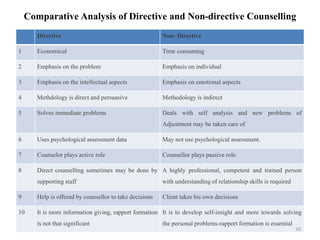
Comparative Analysis of Directive and Non-directive Counselling
Directive Non- Directive
1 Economical Time consuming
2 Emphasis on the problem Emphasis on individual
3 Emphasis on the intellectual aspects Emphasis on emotional aspects
4 Methdology is direct and persuasive Methodology is indirect
5 Solves immediate problems Deals with self analysis and new problems of
Adjustment may be taken care of
6 Uses psychological assessment data May not use psychological assessment.
7 Counselor plays active role Counsellor plays passive role.
8 Direct counselling sometimes may be done by
supporting staff
A highly professional, competent and trained person
with understanding of relationship skills is required
9 Help is offered by counsellor to take decisions Client takes his own decisions
10 It is more information giving, rapport formation
is not that significant
It is to develop self-insight and more towards solving
the personal problems-rapport formation is essential
10
Eclectic Approach:
The chief advocate of this type of counselling is ‘Thorne’.
• Eclectic counselling is a type of counselling which is neither counsellor-
centered nor client centered; but a combination of both.
• Here the counsellor is neither too active as in directive counselling nor too
passive as in non-directive counselling, but follows a middle course.
• Eclectic approach to Counselling is based on the fact that no two
individuals are alike and therefore no single approach can solve their
problems.
• This approach does not recommend just one set of values but believes in
blending the best values from different cultures.
• Eclecticism refers to selection and orderly combination of best features
from diverse sources into a harmonious whole.
• In this approach the counsellor motivates the client to solve his or her own
problems, and provides him with a permissive, accepting environment.
• Here the individual determines his/her goals and selects his or her own way
of life. Eclectic approach is useful with individuals, who are self-motivated
and are ready to assume full responsibility.
11
Characteristics of Eclectic Counselling
• Methods of counselling may change from student
to student or even with the same student from
time to time.
• It is highly flexible.
• Freedom of choice and expression is open to both
the counsellor and the counselee.
• Experience of mutual confidence and faith in the
relationship are basic.
• The student and the philosophical framework are
adjusted to save the purpose of the relationship.
12
Group Counselling:
• Most of us suffer from similar kind of problems but hesitate to admit
and discuss with others. Group Counselling provides a platform
where on meeting each other.
• Group Counselling is a technique where a group of individuals is
counseled by applying group interaction methods for the purpose of
arriving at a solution to the individual problem of the group
members.
• In group counselling method all the members are encouraged to
discuss their problems together in a free atmosphere.
• In group counselling, group interaction helps the individuals to find
a solution to their problem.
• In the process of group interaction the group members, experience,
understand and learn reality, self-knowledge, self-realization and
self-correction.
• These help to unlearn certain faulty social behaviors and learn
certain attitudes and dispositions, which are essential for healthy
adjustment.
13
Basic steps to organizing group Counselling
• In group-counselling, the counsellor plays a very
important role. In-depth knowledge of human
psychology, group behaviour and group process is
very essential.
• Knowledge of the background of the group members
and their specific problems is important to organize
group Counselling.
1. Selection of participants .
2. Scheduling and starting of session.
3. Sustaining the group discussion.
4. Follow up
14
Phases of Counselling:
• Introduction and rapport development.
• Assessment and Identification of problem.
• Setting goals.
• Planning and intervention.
• Follow up.
• Termination
15

methods of counselling.pptx

  • 1.
    Methods of counselling/Approachesto Counselling • Directive Counselling. • Non – Directive Counselling. • Eclectic Counselling. • Group counselling. 1
  • 2.
    Directive counseling orDispensary Approach or prescriptive counselling: E.G WILLIAMSON is the chief exponent in this viewpoint. • Counselor –centered: the counselor direct the client to take steps in order to resolve his conflicts. • It is based on assumption that the client cannot solve his own problems for lack of information. • The counselor plays an important role; he tries to direct the thinking of counselee by informing, explaining, interpreting and advising. • It gives more importance to intellectual aspect than emotional aspects. 2
  • 3.
    Steps of DirectiveCounselling: •Analysis •Synthesis •Diagnosis •Prognosis •Counselling(Prescribing remedial measure) •Follow up 3
  • 4.
    Merits : • Itis less time consuming; hence this method can be adopted when an early solution is required. • This method is best; less matured and less intelligent client interact with an experienced counsellor. • This is best method at lower levels where the client is not in a position to analyse his own problem • In this method, the counsellor becomes readily available to help the client which makes the client very happy. 4
  • 5.
    Demerits: • In directivecounselling, the client never becomes independent of the counsellor. So it is not an effective or best guidance. • The personal autonomy and integrity of the client is not respected, it leads to new adjustment problems. • It will not help the individual to develop any attitudes through his own experiences. • The counsellor fails in saving the client to commit the mistakes in future. 5
  • 6.
    Non-Directive Approach: Non-directive approachis advocated by Carl R Roger, who assumes that every individual has the ability to solve his/her own problems. • This school of thought is just reverse to that of directive counseling. • It is a client-centered process. • In this, the counselee is the pivot of the whole counselling process. • The main function of the counsellor is to create an atmosphere in which the client can work out his problem. • It is also known as permissive counselling. • In this type of counselling, emotional elements rather than intellectual element are stressed. 6
  • 7.
    Steps of thisnon-directive counselling: Carl Roger has given the following steps, • Defining the Problematic Situation. • Free Expression of Feelings: • Development of Insight: • Classification of Positive and Negative Feelings: • Termination of Counselling Situation: 7
  • 8.
    Merits: • It helpsthe counselee to become independent and self-reliant and to attain the ability for self- direction. • It helps the client to attain emotional integrity; and helps to reach his full growth. • It helps to attain more sustainable adjustment to his situation. • This type of counselling leaves it’s impressions for a longer period. 8
  • 9.
    Demerits: • It isusually more time-consuming • It is not suitable for a less matured and less intelligent counselee. • The counsellor’s passive attitude might irritate the counselee so much that he might hesitate to express his feelings. • It is not possible in schools because the counsellor has to attend many pupils. 9
  • 10.
    Comparative Analysis ofDirective and Non-directive Counselling Directive Non- Directive 1 Economical Time consuming 2 Emphasis on the problem Emphasis on individual 3 Emphasis on the intellectual aspects Emphasis on emotional aspects 4 Methdology is direct and persuasive Methodology is indirect 5 Solves immediate problems Deals with self analysis and new problems of Adjustment may be taken care of 6 Uses psychological assessment data May not use psychological assessment. 7 Counselor plays active role Counsellor plays passive role. 8 Direct counselling sometimes may be done by supporting staff A highly professional, competent and trained person with understanding of relationship skills is required 9 Help is offered by counsellor to take decisions Client takes his own decisions 10 It is more information giving, rapport formation is not that significant It is to develop self-insight and more towards solving the personal problems-rapport formation is essential 10
  • 11.
    Eclectic Approach: The chiefadvocate of this type of counselling is ‘Thorne’. • Eclectic counselling is a type of counselling which is neither counsellor- centered nor client centered; but a combination of both. • Here the counsellor is neither too active as in directive counselling nor too passive as in non-directive counselling, but follows a middle course. • Eclectic approach to Counselling is based on the fact that no two individuals are alike and therefore no single approach can solve their problems. • This approach does not recommend just one set of values but believes in blending the best values from different cultures. • Eclecticism refers to selection and orderly combination of best features from diverse sources into a harmonious whole. • In this approach the counsellor motivates the client to solve his or her own problems, and provides him with a permissive, accepting environment. • Here the individual determines his/her goals and selects his or her own way of life. Eclectic approach is useful with individuals, who are self-motivated and are ready to assume full responsibility. 11
  • 12.
    Characteristics of EclecticCounselling • Methods of counselling may change from student to student or even with the same student from time to time. • It is highly flexible. • Freedom of choice and expression is open to both the counsellor and the counselee. • Experience of mutual confidence and faith in the relationship are basic. • The student and the philosophical framework are adjusted to save the purpose of the relationship. 12
  • 13.
    Group Counselling: • Mostof us suffer from similar kind of problems but hesitate to admit and discuss with others. Group Counselling provides a platform where on meeting each other. • Group Counselling is a technique where a group of individuals is counseled by applying group interaction methods for the purpose of arriving at a solution to the individual problem of the group members. • In group counselling method all the members are encouraged to discuss their problems together in a free atmosphere. • In group counselling, group interaction helps the individuals to find a solution to their problem. • In the process of group interaction the group members, experience, understand and learn reality, self-knowledge, self-realization and self-correction. • These help to unlearn certain faulty social behaviors and learn certain attitudes and dispositions, which are essential for healthy adjustment. 13
  • 14.
    Basic steps toorganizing group Counselling • In group-counselling, the counsellor plays a very important role. In-depth knowledge of human psychology, group behaviour and group process is very essential. • Knowledge of the background of the group members and their specific problems is important to organize group Counselling. 1. Selection of participants . 2. Scheduling and starting of session. 3. Sustaining the group discussion. 4. Follow up 14
  • 15.
    Phases of Counselling: •Introduction and rapport development. • Assessment and Identification of problem. • Setting goals. • Planning and intervention. • Follow up. • Termination 15