Charge &
Coulomb’s Law
AP Physics C
**(1a1) Students should understand the concept of electric
charge, so they can describe the types of charge and the
attraction and repulsion of charges.
• Electrons (-) and protons (+) have the same magnitude of charge.
• Atoms are electrically neutral – they have no charge. If an atom
gains or loses electrons, it gains a charge and becomes an ion.
• Different elements vary widely in their ability to gain or lose
electrons.
– Rubber objects almost always gain a negative charge during rubbing
operations.
– A glass rod rubbed with silk will gain a positive charge.
• Fundamental Law of Static Electricity  Like charges
repel; opposite charges attract.
• Principle of Conservation of Charge  charge is not
created or destroyed, merely transferred from one
system to another.
**(1a2) Students should understand the concept of electric
charge, so they can describe polarization and induced charges.
• Conductors - usually metals.
– The charge is carried through the material by the free electrons that
metals have because of their metallic bonds.
• Insulators - non-metals; materials like plastic, rubber, ceramics,
etc.
– These substances have their electrons tightly bound in their chemical
bonds. The charge can’t go anywhere in these substances because
there’s nothing to carry the charge. The electrons are not free to
move. When a charge is placed on an insulator, the charge stays
where you put it.
– When a charge is placed on a conductor it will immediately spread out
over the entire object
• Electrolytes are liquid solutions that can conduct electricity. The
electrolyte contains ions that transfer charge.
• Charging Objects: There are two methods that can be used to
charge objects:
Charging by Conduction
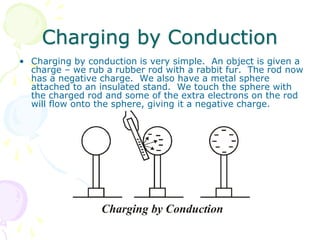
• Charging by conduction is very simple. An object is given a
charge – we rub a rubber rod with a rabbit fur. The rod now
has a negative charge. We also have a metal sphere
attached to an insulated stand. We touch the sphere with
the charged rod and some of the extra electrons on the rod
will flow onto the sphere, giving it a negative charge.
Charging by Conduction
Charging by Induction
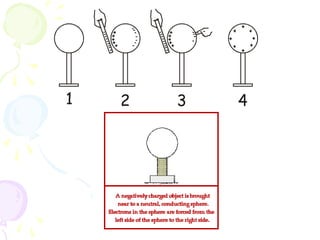
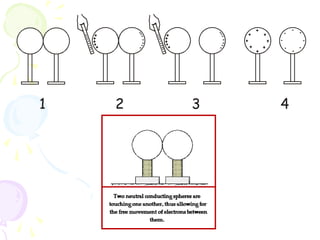
• Charging by induction is a bit more complicated. We start
out with a charged object and an uncharged object. Charge
is transferred, but there is no physical contact between the
two objects. There are two ways to do this.
2 3 4
1
1 2 3 4
Polarizing Objects
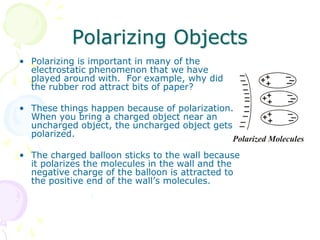
• Polarizing is important in many of the
electrostatic phenomenon that we have
played around with. For example, why did
the rubber rod attract bits of paper?
• These things happen because of polarization.
When you bring a charged object near an
uncharged object, the uncharged object gets
polarized.
• The charged balloon sticks to the wall because
it polarizes the molecules in the wall and the
negative charge of the balloon is attracted to
the positive end of the wall’s molecules.
Polarized Molecules
**(1b1) Students should understand Coulomb’s Law and the
principle of superposition, so they can calculate the magnitude
and direction of the force on a positive or negative charge due
to other specified point charges.
• The basic standard unit of charge is called a Coulomb (C).
• The symbol for charge is Q however q is used as well.
• One Coulomb is equal to the charge of 6.25 x 10¹⁸
electrons or protons.
• The charge of a single electron is - 1.60 x 10⁻¹⁹ C. The
charge of a proton is + 1.60 x 10⁻¹⁹ C.
• The Coulomb is a large amount of charge, so it is very
common to use milli Coulombs and micro Coulombs.
• 1 mC = 10-3 C
• 1 C = 10-6 C
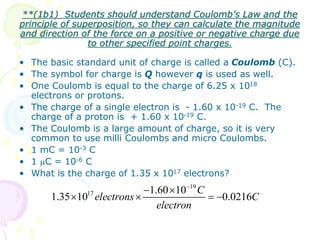
• What is the charge of 1.35 x 10¹⁷ electrons?
19
17 1.60 10
1.35 10 0.0216
C
electrons C
electron

 
   
Coulomb’s Law
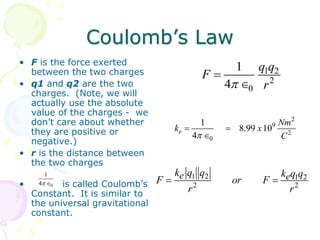
• F is the force exerted
between the two charges
• q1 and q2 are the two
charges. (Note, we will
actually use the absolute
value of the charges - we
don’t care about whether
they are positive or
negative.)
• r is the distance between
the two charges
• is called Coulomb’s
Constant. It is similar to
the universal gravitational
constant.
1 2
2
0
1
4
q q
F
r



0
1
4 
2
9
2
0
1
8.99 10
4
e
Nm
k x
C

 

1 2 1 2
2 2
e e
k q q k q q
F or F
r r
 
Coulomb Force
• The force between two charged
objects can be either attractive or
repulsive, depending on whether the
charges are like or unlike.
• We will also assume that the charges
are concentrated into a small area –
point charges.
• Coulomb’s Experiment
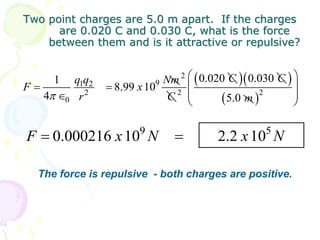
Two point charges are 5.0 m apart. If the charges
are 0.020 C and 0.030 C, what is the force
between them and is it attractive or repulsive?
  
 
2
9
1 2
2 2 2
0
0.020 0.030
1
8.99 10
4 5.0
C C
q q Nm
F x
r C m

 
 
 
 

 
9 5
0.000216 10 2.2 10
F x N x N
 
The force is repulsive - both charges are positive.
Gravity vs. Electromagnetic
Force
• Gravity Force Electromagnetic
• Attracts attracts and repels
• inverse square law inverse square law
• surround objects surround objects
• cannot be shielded can be shielded
• incredibly weaker enormously stronger
**(1b2) Students should understand Coulomb’s Law and the
principle of superposition, so they can analyze the motion of a
particle of specified charge and mass under the influence of an
electrostatic force.
• Superposition Principle: When we have
more than two charges in proximity, the
forces between them get more
complicated. The forces, being vectors,
just have to be added up. We call this the
superposition principle.
• Superposition Principle  The
resultant force on a charge is the
vector sum of the forces exerted on it
by other charges.
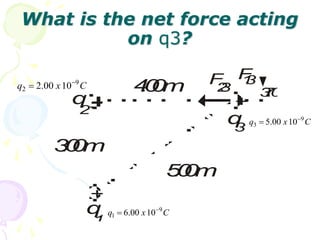
What is the net force acting
on q3?
+
+
-
q
1
q
2
q
3
F
2
3
F
1
3
5
.
0
0
m
4
.
0
0
m
3
.
0
0
m
3
7
.0
0
9
1 6.00 10
q x C


9
2 2.00 10
q x C


9
3 5.00 10
q x C


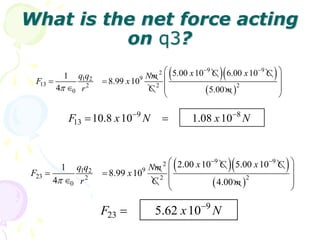
What is the net force acting
on q3?
  
 
9 9
2
9
1 2
13 2 2 2
0
5.00 10 6.00 10
1
8.99 10
4 5.00
x C x C
q q Nm
F x
r C m

 
 
 
 
 

 
9 8
13 10.8 10 1.08 10
F x N x N
 
 
  
 
9 9
2
9
1 2
23 2 2 2
0
2.00 10 5.00 10
1
8.99 10
4 4.00
x C x C
q q Nm
F x
r C m

 
 
 
 
 

 
9
23 5.62 10
F x N


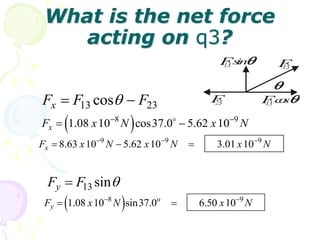
What is the net force
acting on q3?
13 23
cos
x
F F F

 
 
8 9
1.08 10 cos37.0 5.62 10
x
F x N x N
 
 
9 9 9
8.63 10 5.62 10 3.01 10
x
F x N x N x N
  
  
13 sin
y
F F 

 
8 9
1.08 10 sin37.0 6.50 10
o
y
F x N x N
 
 
c
o
s

F
F
F
s
i
n

F
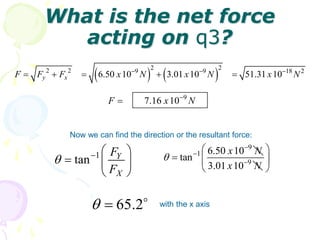
What is the net force
acting on q3?
   
2 2
2 2 9 9 18 2
6.50 10 3.01 10 51.31 10
y x
F F F x N x N x N
  
    
9
7.16 10
F x N


1
tan Y
X
F
F
   
  
 
9
1
9
6.50 10
tan
3.01 10
x N
x N




 
  
 
65.2
 
Now we can find the direction or the resultant force:
with the x axis

Charge and Coulombs Law.ppt

  • 1.
  • 2.
    **(1a1) Students shouldunderstand the concept of electric charge, so they can describe the types of charge and the attraction and repulsion of charges. • Electrons (-) and protons (+) have the same magnitude of charge. • Atoms are electrically neutral – they have no charge. If an atom gains or loses electrons, it gains a charge and becomes an ion. • Different elements vary widely in their ability to gain or lose electrons. – Rubber objects almost always gain a negative charge during rubbing operations. – A glass rod rubbed with silk will gain a positive charge. • Fundamental Law of Static Electricity  Like charges repel; opposite charges attract. • Principle of Conservation of Charge  charge is not created or destroyed, merely transferred from one system to another.
  • 3.
    **(1a2) Students shouldunderstand the concept of electric charge, so they can describe polarization and induced charges. • Conductors - usually metals. – The charge is carried through the material by the free electrons that metals have because of their metallic bonds. • Insulators - non-metals; materials like plastic, rubber, ceramics, etc. – These substances have their electrons tightly bound in their chemical bonds. The charge can’t go anywhere in these substances because there’s nothing to carry the charge. The electrons are not free to move. When a charge is placed on an insulator, the charge stays where you put it. – When a charge is placed on a conductor it will immediately spread out over the entire object • Electrolytes are liquid solutions that can conduct electricity. The electrolyte contains ions that transfer charge. • Charging Objects: There are two methods that can be used to charge objects:
  • 4.
    Charging by Conduction •Charging by conduction is very simple. An object is given a charge – we rub a rubber rod with a rabbit fur. The rod now has a negative charge. We also have a metal sphere attached to an insulated stand. We touch the sphere with the charged rod and some of the extra electrons on the rod will flow onto the sphere, giving it a negative charge. Charging by Conduction
  • 5.
    Charging by Induction •Charging by induction is a bit more complicated. We start out with a charged object and an uncharged object. Charge is transferred, but there is no physical contact between the two objects. There are two ways to do this.
  • 6.
  • 7.
  • 8.
    Polarizing Objects • Polarizingis important in many of the electrostatic phenomenon that we have played around with. For example, why did the rubber rod attract bits of paper? • These things happen because of polarization. When you bring a charged object near an uncharged object, the uncharged object gets polarized. • The charged balloon sticks to the wall because it polarizes the molecules in the wall and the negative charge of the balloon is attracted to the positive end of the wall’s molecules. Polarized Molecules
  • 9.
    **(1b1) Students shouldunderstand Coulomb’s Law and the principle of superposition, so they can calculate the magnitude and direction of the force on a positive or negative charge due to other specified point charges. • The basic standard unit of charge is called a Coulomb (C). • The symbol for charge is Q however q is used as well. • One Coulomb is equal to the charge of 6.25 x 10¹⁸ electrons or protons. • The charge of a single electron is - 1.60 x 10⁻¹⁹ C. The charge of a proton is + 1.60 x 10⁻¹⁹ C. • The Coulomb is a large amount of charge, so it is very common to use milli Coulombs and micro Coulombs. • 1 mC = 10-3 C • 1 C = 10-6 C • What is the charge of 1.35 x 10¹⁷ electrons? 19 17 1.60 10 1.35 10 0.0216 C electrons C electron       
  • 10.
    Coulomb’s Law • Fis the force exerted between the two charges • q1 and q2 are the two charges. (Note, we will actually use the absolute value of the charges - we don’t care about whether they are positive or negative.) • r is the distance between the two charges • is called Coulomb’s Constant. It is similar to the universal gravitational constant. 1 2 2 0 1 4 q q F r    0 1 4  2 9 2 0 1 8.99 10 4 e Nm k x C     1 2 1 2 2 2 e e k q q k q q F or F r r  
  • 11.
    Coulomb Force • Theforce between two charged objects can be either attractive or repulsive, depending on whether the charges are like or unlike. • We will also assume that the charges are concentrated into a small area – point charges. • Coulomb’s Experiment
  • 12.
    Two point chargesare 5.0 m apart. If the charges are 0.020 C and 0.030 C, what is the force between them and is it attractive or repulsive?      2 9 1 2 2 2 2 0 0.020 0.030 1 8.99 10 4 5.0 C C q q Nm F x r C m             9 5 0.000216 10 2.2 10 F x N x N   The force is repulsive - both charges are positive.
  • 13.
    Gravity vs. Electromagnetic Force •Gravity Force Electromagnetic • Attracts attracts and repels • inverse square law inverse square law • surround objects surround objects • cannot be shielded can be shielded • incredibly weaker enormously stronger
  • 14.
    **(1b2) Students shouldunderstand Coulomb’s Law and the principle of superposition, so they can analyze the motion of a particle of specified charge and mass under the influence of an electrostatic force. • Superposition Principle: When we have more than two charges in proximity, the forces between them get more complicated. The forces, being vectors, just have to be added up. We call this the superposition principle. • Superposition Principle  The resultant force on a charge is the vector sum of the forces exerted on it by other charges.
  • 15.
    What is thenet force acting on q3? + + - q 1 q 2 q 3 F 2 3 F 1 3 5 . 0 0 m 4 . 0 0 m 3 . 0 0 m 3 7 .0 0 9 1 6.00 10 q x C   9 2 2.00 10 q x C   9 3 5.00 10 q x C  
  • 16.
    What is thenet force acting on q3?      9 9 2 9 1 2 13 2 2 2 0 5.00 10 6.00 10 1 8.99 10 4 5.00 x C x C q q Nm F x r C m               9 8 13 10.8 10 1.08 10 F x N x N          9 9 2 9 1 2 23 2 2 2 0 2.00 10 5.00 10 1 8.99 10 4 4.00 x C x C q q Nm F x r C m               9 23 5.62 10 F x N  
  • 17.
    What is thenet force acting on q3? 13 23 cos x F F F      8 9 1.08 10 cos37.0 5.62 10 x F x N x N     9 9 9 8.63 10 5.62 10 3.01 10 x F x N x N x N       13 sin y F F     8 9 1.08 10 sin37.0 6.50 10 o y F x N x N     c o s  F F F s i n  F
  • 18.
    What is thenet force acting on q3?     2 2 2 2 9 9 18 2 6.50 10 3.01 10 51.31 10 y x F F F x N x N x N         9 7.16 10 F x N   1 tan Y X F F          9 1 9 6.50 10 tan 3.01 10 x N x N            65.2   Now we can find the direction or the resultant force: with the x axis