Electric Charge
and
Coulomb’s Law
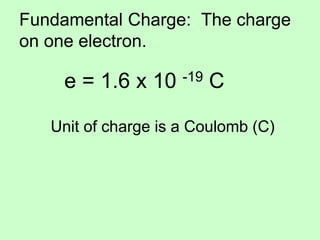
Fundamental Charge: The charge
on one electron.
e = 1.6 x 10 -19 C
Unit of charge is a Coulomb (C)
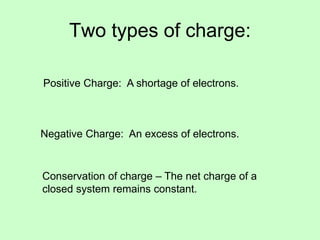
Two types of charge:
Positive Charge: A shortage of electrons.
Negative Charge: An excess of electrons.
Conservation of charge – The net charge of a
closed system remains constant.
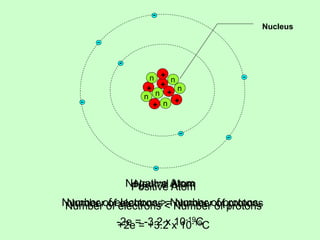
+
n
+ +
+
+
+
n
n
n
n n
-
-
-
-
-
-
Neutral Atom
Number of electrons = Number of protons
Nucleus
Negative Atom
Number of electrons > Number of protons
-2e = -3.2 x 10⁻¹⁹C
-
-
Positive Atom
Number of electrons < Number of protons
+2e = +3.2 x 10⁻¹⁹C
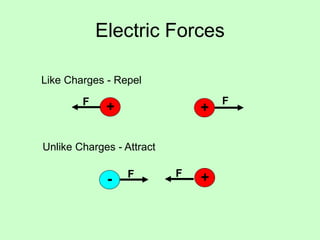
Electric Forces
Like Charges - Repel
Unlike Charges - Attract
- +F F
+ +
FF
Electric Charge
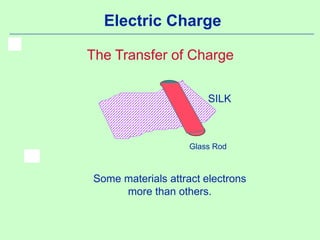
The Transfer of Charge
SILK
Glass Rod
Some materials attract electrons
more than others.
Electric Charge
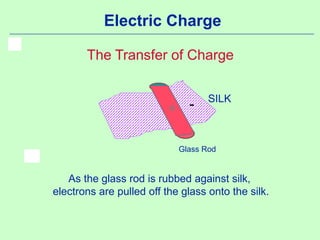
The Transfer of Charge
SILK
Glass Rod
-+
As the glass rod is rubbed against silk,
electrons are pulled off the glass onto the silk.
Electric Charge
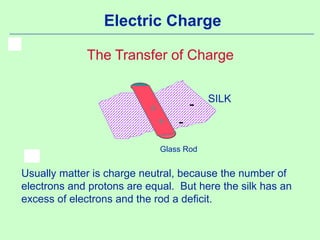
The Transfer of Charge
SILK
Glass Rod
-
-+
+
Usually matter is charge neutral, because the number of
electrons and protons are equal. But here the silk has an
excess of electrons and the rod a deficit.
Electric Charge
The Transfer of Charge
SILK
Glass Rod
-
+
+
+
+
+
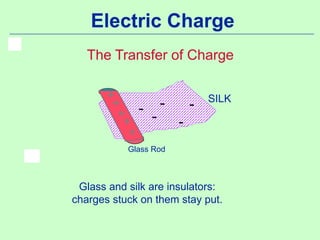
Glass and silk are insulators:
charges stuck on them stay put.
---
-
Electric Charge
+ +
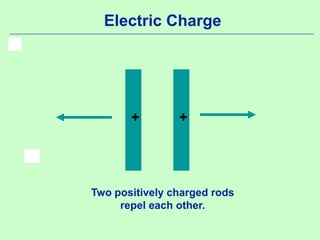
Two positively charged rods
repel each other.
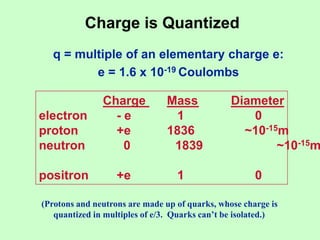
Charge is Quantized
q = multiple of an elementary charge e:
e = 1.6 x 10⁻¹⁹ Coulombs
Charge Mass Diameter
electron - e 1 0
proton +e 1836 ~10-15m
neutron 0 1839 ~10-15m
positron +e 1 0
(Protons and neutrons are made up of quarks, whose charge is
quantized in multiples of e/3. Quarks can’t be isolated.)
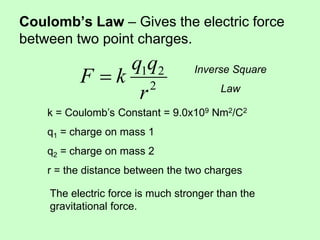
Coulomb’s Law – Gives the electric force
between two point charges.
2
21
r
qq
kF 
k = Coulomb’s Constant = 9.0x10⁹ Nm2/C2
q1 = charge on mass 1
q2 = charge on mass 2
r = the distance between the two charges
The electric force is much stronger than the
gravitational force.
Inverse Square
Law
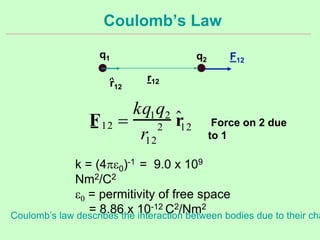
Coulomb’s Law
q1 q2
r12r12
F12
Force on 2 due
to 1
F12 
kq1q2
r12
2
ˆr12
k = (4pe0)-1 = 9.0 x 10⁹
Nm2/C2
e0 = permitivity of free space
= 8.86 x 10⁻¹² C2/Nm2
Coulomb’s law describes the interaction between bodies due to their cha
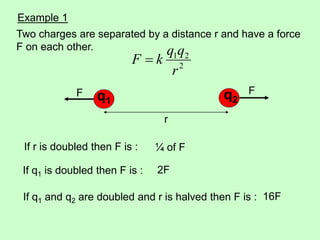
2
21
r
qq
kF 
If r is doubled then F is :
If q1 is doubled then F is :
If q1 and q2 are doubled and r is halved then F is :
¼ of F
2F
16F
Two charges are separated by a distance r and have a force
F on each other.
q1 q2
r
F F
Example 1
Example 2
Two 40 gram masses each with a charge of 3μC are
placed 50cm apart. Compare the gravitational force
between the two masses to the electric force between the
two masses. (Ignore the force of the earth on the two
masses)
3μC
40g
50cm
3μC
40g
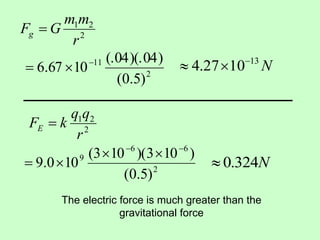
2
21
r
mm
GFg 
2
11
)5.0(
)04)(.04(.
1067.6 
 N13
1027.4 

2
21
r
qq
kFE 
2
66
9
)5.0(
)103)(103(
100.9


 N324.0
The electric force is much greater than the
gravitational force

Coulombs law

  • 1.
  • 2.
    Fundamental Charge: Thecharge on one electron. e = 1.6 x 10 -19 C Unit of charge is a Coulomb (C)
  • 3.
    Two types ofcharge: Positive Charge: A shortage of electrons. Negative Charge: An excess of electrons. Conservation of charge – The net charge of a closed system remains constant.
  • 4.
    + n + + + + + n n n n n - - - - - - NeutralAtom Number of electrons = Number of protons Nucleus Negative Atom Number of electrons > Number of protons -2e = -3.2 x 10⁻¹⁹C - - Positive Atom Number of electrons < Number of protons +2e = +3.2 x 10⁻¹⁹C
  • 5.
    Electric Forces Like Charges- Repel Unlike Charges - Attract - +F F + + FF
  • 6.
    Electric Charge The Transferof Charge SILK Glass Rod Some materials attract electrons more than others.
  • 7.
    Electric Charge The Transferof Charge SILK Glass Rod -+ As the glass rod is rubbed against silk, electrons are pulled off the glass onto the silk.
  • 8.
    Electric Charge The Transferof Charge SILK Glass Rod - -+ + Usually matter is charge neutral, because the number of electrons and protons are equal. But here the silk has an excess of electrons and the rod a deficit.
  • 9.
    Electric Charge The Transferof Charge SILK Glass Rod - + + + + + Glass and silk are insulators: charges stuck on them stay put. --- -
  • 10.
    Electric Charge + + Twopositively charged rods repel each other.
  • 11.
    Charge is Quantized q= multiple of an elementary charge e: e = 1.6 x 10⁻¹⁹ Coulombs Charge Mass Diameter electron - e 1 0 proton +e 1836 ~10-15m neutron 0 1839 ~10-15m positron +e 1 0 (Protons and neutrons are made up of quarks, whose charge is quantized in multiples of e/3. Quarks can’t be isolated.)
  • 12.
    Coulomb’s Law –Gives the electric force between two point charges. 2 21 r qq kF  k = Coulomb’s Constant = 9.0x10⁹ Nm2/C2 q1 = charge on mass 1 q2 = charge on mass 2 r = the distance between the two charges The electric force is much stronger than the gravitational force. Inverse Square Law
  • 13.
    Coulomb’s Law q1 q2 r12r12 F12 Forceon 2 due to 1 F12  kq1q2 r12 2 ˆr12 k = (4pe0)-1 = 9.0 x 10⁹ Nm2/C2 e0 = permitivity of free space = 8.86 x 10⁻¹² C2/Nm2 Coulomb’s law describes the interaction between bodies due to their cha
  • 14.
    2 21 r qq kF  If ris doubled then F is : If q1 is doubled then F is : If q1 and q2 are doubled and r is halved then F is : ¼ of F 2F 16F Two charges are separated by a distance r and have a force F on each other. q1 q2 r F F Example 1
  • 15.
    Example 2 Two 40gram masses each with a charge of 3μC are placed 50cm apart. Compare the gravitational force between the two masses to the electric force between the two masses. (Ignore the force of the earth on the two masses) 3μC 40g 50cm 3μC 40g
  • 16.
    2 21 r mm GFg  2 11 )5.0( )04)(.04(. 1067.6  N13 1027.4   2 21 r qq kFE  2 66 9 )5.0( )103)(103( 100.9    N324.0 The electric force is much greater than the gravitational force

Editor's Notes