Prepared by
Md. Amirul Islam
Lecturer
Department of Applied Physics & Electronics
Bangabandhu Sheikh Mujibur Rahman Science &
Technology University, Gopalganj – 8100
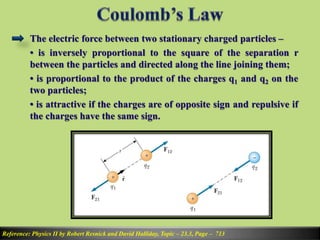
The electric force between two stationary charged particles –
• is inversely proportional to the square of the separation r
between the particles and directed along the line joining them;
• is proportional to the product of the charges q1 and q2 on the
two particles;
• is attractive if the charges are of opposite sign and repulsive if
the charges have the same sign.
Reference: Physics II by Robert Resnick and David Halliday, Topic – 23.3, Page – 713
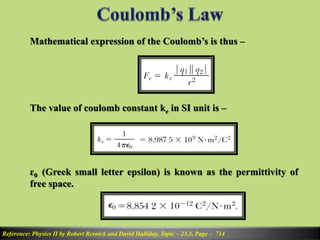
Mathematical expression of the Coulomb’s is thus –
Reference: Physics II by Robert Resnick and David Halliday, Topic – 23.3, Page – 714
The value of coulomb constant ke in SI unit is –
ɛ0 (Greek small letter epsilon) is known as the permittivity of
free space.
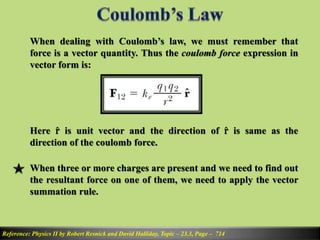
When dealing with Coulomb’s law, we must remember that
force is a vector quantity. Thus the coulomb force expression in
vector form is:
Reference: Physics II by Robert Resnick and David Halliday, Topic – 23.3, Page – 714
Here r is unit vector and the direction of r is same as the
direction of the coulomb force.
When three or more charges are present and we need to find out
the resultant force on one of them, we need to apply the vector
summation rule.
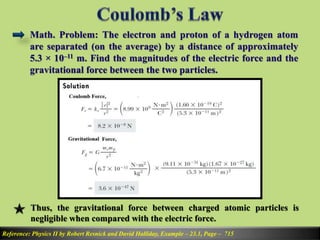
Math. Problem: The electron and proton of a hydrogen atom
are separated (on the average) by a distance of approximately
5.3 × 10⁻¹¹ m. Find the magnitudes of the electric force and the
gravitational force between the two particles.
Reference: Physics II by Robert Resnick and David Halliday, Example – 23.1, Page – 715
Thus, the gravitational force between charged atomic particles is
negligible when compared with the electric force.
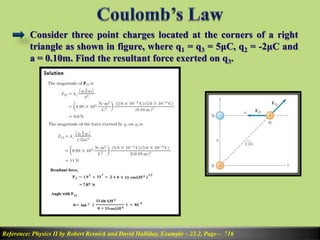
Consider three point charges located at the corners of a right
triangle as shown in figure, where q1 = q3 = 5μC, q2 = -2μC and
a = 0.10m. Find the resultant force exerted on q3.
Reference: Physics II by Robert Resnick and David Halliday, Example – 23.2, Page – 716
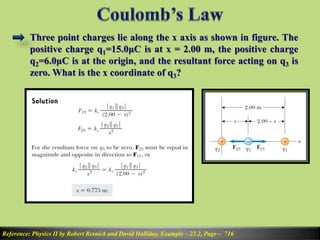
Three point charges lie along the x axis as shown in figure. The
positive charge q1=15.0μC is at x = 2.00 m, the positive charge
q2=6.0μC is at the origin, and the resultant force acting on q3 is
zero. What is the x coordinate of q3?
Reference: Physics II by Robert Resnick and David Halliday, Example – 23.2, Page – 716
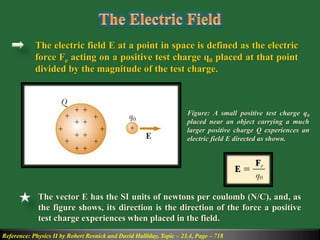
The electric field E at a point in space is defined as the electric
force Fe acting on a positive test charge q0 placed at that point
divided by the magnitude of the test charge.
Reference: Physics II by Robert Resnick and David Halliday, Topic – 23.4, Page – 718
Figure: A small positive test charge q0
placed near an object carrying a much
larger positive charge Q experiences an
electric field E directed as shown.
The vector E has the SI units of newtons per coulomb (N/C), and, as
the figure shows, its direction is the direction of the force a positive
test charge experiences when placed in the field.
Equation of electric field:
Reference: Physics II by Robert Resnick and David Halliday, Topic – 23.4, Page – 718
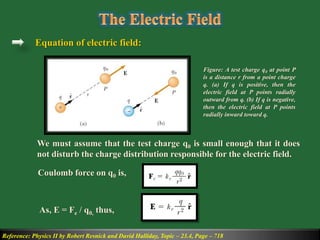
Figure: A test charge q0 at point P
is a distance r from a point charge
q. (a) If q is positive, then the
electric field at P points radially
outward from q. (b) If q is negative,
then the electric field at P points
radially inward toward q.
We must assume that the test charge q0 is small enough that it does
not disturb the charge distribution responsible for the electric field.
Coulomb force on q0 is,
As, E = Fe / q0, thus,
Reference: Physics II by Robert Resnick and David Halliday, Topic – 23.4, Page – 720,721
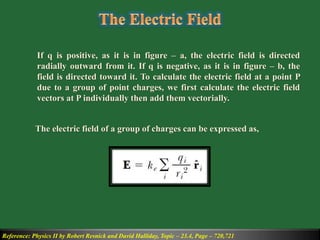
If q is positive, as it is in figure – a, the electric field is directed
radially outward from it. If q is negative, as it is in figure – b, the
field is directed toward it. To calculate the electric field at a point P
due to a group of point charges, we first calculate the electric field
vectors at P individually then add them vectorially.
The electric field of a group of charges can be expressed as,
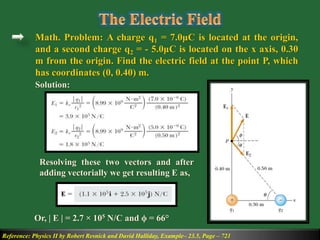
Math. Problem: A charge q1 = 7.0μC is located at the origin,
and a second charge q2 = - 5.0μC is located on the x axis, 0.30
m from the origin. Find the electric field at the point P, which
has coordinates (0, 0.40) m.
Reference: Physics II by Robert Resnick and David Halliday, Example– 23.5, Page – 721
Solution:
Resolving these two vectors and after
adding vectorially we get resulting E as,
Or, | E | = 2.7 × 10⁵ N/C and ϕ = 66°
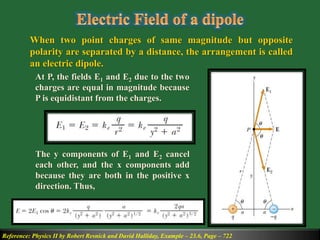
When two point charges of same magnitude but opposite
polarity are separated by a distance, the arrangement is called
an electric dipole.
Reference: Physics II by Robert Resnick and David Halliday, Example – 23.6, Page – 722
At P, the fields E1 and E2 due to the two
charges are equal in magnitude because
P is equidistant from the charges.
The y components of E1 and E2 cancel
each other, and the x components add
because they are both in the positive x
direction. Thus,
Reference: Physics II by Robert Resnick and David Halliday, Example – 23.6, Page – 722
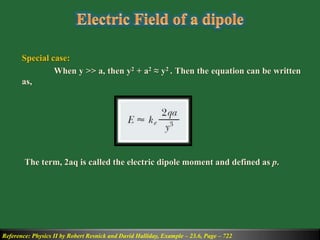
Special case:
When y >> a, then y2 + a2 ≈ y2 . Then the equation can be written
as,
The term, 2aq is called the electric dipole moment and defined as p.
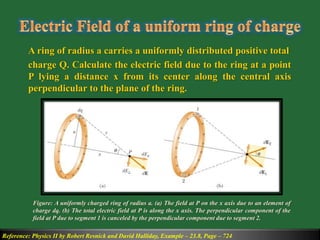
A ring of radius a carries a uniformly distributed positive total
charge Q. Calculate the electric field due to the ring at a point
P lying a distance x from its center along the central axis
perpendicular to the plane of the ring.
Reference: Physics II by Robert Resnick and David Halliday, Example – 23.8, Page – 724
Figure: A uniformly charged ring of radius a. (a) The field at P on the x axis due to an element of
charge dq. (b) The total electric field at P is along the x axis. The perpendicular component of the
field at P due to segment 1 is canceled by the perpendicular component due to segment 2.
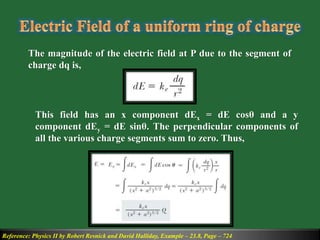
The magnitude of the electric field at P due to the segment of
charge dq is,
Reference: Physics II by Robert Resnick and David Halliday, Example – 23.8, Page – 724
This field has an x component dEx = dE cosθ and a y
component dEy = dE sinθ. The perpendicular components of
all the various charge segments sum to zero. Thus,
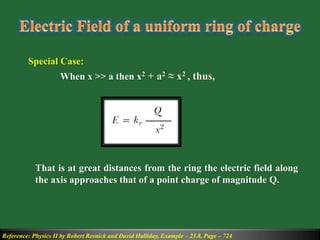
Special Case:
When x >> a then x2 + a2 ≈ x2 , thus,
Reference: Physics II by Robert Resnick and David Halliday, Example – 23.8, Page – 724
That is at great distances from the ring the electric field along
the axis approaches that of a point charge of magnitude Q.
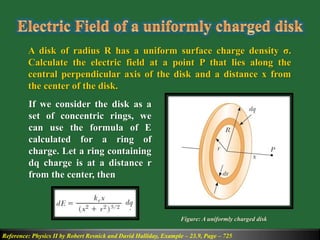
A disk of radius R has a uniform surface charge density σ.
Calculate the electric field at a point P that lies along the
central perpendicular axis of the disk and a distance x from
the center of the disk.
Reference: Physics II by Robert Resnick and David Halliday, Example – 23.9, Page – 725
Figure: A uniformly charged disk
If we consider the disk as a
set of concentric rings, we
can use the formula of E
calculated for a ring of
charge. Let a ring containing
dq charge is at a distance r
from the center, then
Reference: Physics II by Robert Resnick and David Halliday, Example – 23.9, Page – 725
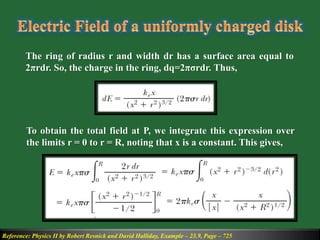
The ring of radius r and width dr has a surface area equal to
2πrdr. So, the charge in the ring, dq=2πσrdr. Thus,
To obtain the total field at P, we integrate this expression over
the limits r = 0 to r = R, noting that x is a constant. This gives,
Reference: Physics II by Robert Resnick and David Halliday, Example – 23.9, Page – 725
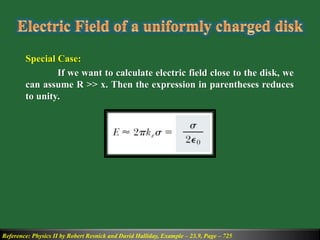
Special Case:
If we want to calculate electric field close to the disk, we
can assume R >> x. Then the expression in parentheses reduces
to unity.
A convenient way of visualizing electric field patterns is to draw
lines that follow the same direction as the electric field vector at
any point. These lines, called electric field lines, have the
following properties:
• The electric field vector E is tangent to the electric field line at
each point.
Reference: Physics II by Robert Resnick and David Halliday, Topic – 23.6, Page – 726
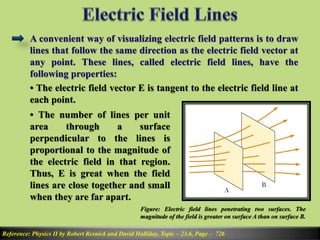
• The number of lines per unit
area through a surface
perpendicular to the lines is
proportional to the magnitude of
the electric field in that region.
Thus, E is great when the field
lines are close together and small
when they are far apart.
Figure: Electric field lines penetrating two surfaces. The
magnitude of the field is greater on surface A than on surface B.
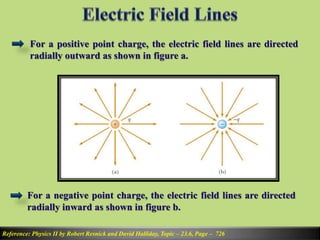
For a positive point charge, the electric field lines are directed
radially outward as shown in figure a.
Reference: Physics II by Robert Resnick and David Halliday, Topic – 23.6, Page – 726
For a negative point charge, the electric field lines are directed
radially inward as shown in figure b.
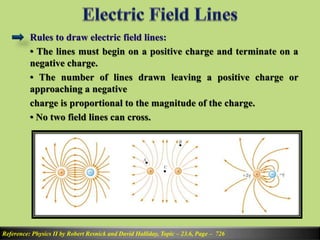
Rules to draw electric field lines:
• The lines must begin on a positive charge and terminate on a
negative charge.
• The number of lines drawn leaving a positive charge or
approaching a negative
charge is proportional to the magnitude of the charge.
• No two field lines can cross.
Reference: Physics II by Robert Resnick and David Halliday, Topic – 23.6, Page – 726
2. electric field calculation

2. electric field calculation

  • 1.
    Prepared by Md. AmirulIslam Lecturer Department of Applied Physics & Electronics Bangabandhu Sheikh Mujibur Rahman Science & Technology University, Gopalganj – 8100
  • 3.
    The electric forcebetween two stationary charged particles – • is inversely proportional to the square of the separation r between the particles and directed along the line joining them; • is proportional to the product of the charges q1 and q2 on the two particles; • is attractive if the charges are of opposite sign and repulsive if the charges have the same sign. Reference: Physics II by Robert Resnick and David Halliday, Topic – 23.3, Page – 713
  • 4.
    Mathematical expression ofthe Coulomb’s is thus – Reference: Physics II by Robert Resnick and David Halliday, Topic – 23.3, Page – 714 The value of coulomb constant ke in SI unit is – ɛ0 (Greek small letter epsilon) is known as the permittivity of free space.
  • 5.
    When dealing withCoulomb’s law, we must remember that force is a vector quantity. Thus the coulomb force expression in vector form is: Reference: Physics II by Robert Resnick and David Halliday, Topic – 23.3, Page – 714 Here r is unit vector and the direction of r is same as the direction of the coulomb force. When three or more charges are present and we need to find out the resultant force on one of them, we need to apply the vector summation rule.
  • 6.
    Math. Problem: Theelectron and proton of a hydrogen atom are separated (on the average) by a distance of approximately 5.3 × 10⁻¹¹ m. Find the magnitudes of the electric force and the gravitational force between the two particles. Reference: Physics II by Robert Resnick and David Halliday, Example – 23.1, Page – 715 Thus, the gravitational force between charged atomic particles is negligible when compared with the electric force.
  • 7.
    Consider three pointcharges located at the corners of a right triangle as shown in figure, where q1 = q3 = 5μC, q2 = -2μC and a = 0.10m. Find the resultant force exerted on q3. Reference: Physics II by Robert Resnick and David Halliday, Example – 23.2, Page – 716
  • 8.
    Three point chargeslie along the x axis as shown in figure. The positive charge q1=15.0μC is at x = 2.00 m, the positive charge q2=6.0μC is at the origin, and the resultant force acting on q3 is zero. What is the x coordinate of q3? Reference: Physics II by Robert Resnick and David Halliday, Example – 23.2, Page – 716
  • 10.
    The electric fieldE at a point in space is defined as the electric force Fe acting on a positive test charge q0 placed at that point divided by the magnitude of the test charge. Reference: Physics II by Robert Resnick and David Halliday, Topic – 23.4, Page – 718 Figure: A small positive test charge q0 placed near an object carrying a much larger positive charge Q experiences an electric field E directed as shown. The vector E has the SI units of newtons per coulomb (N/C), and, as the figure shows, its direction is the direction of the force a positive test charge experiences when placed in the field.
  • 11.
    Equation of electricfield: Reference: Physics II by Robert Resnick and David Halliday, Topic – 23.4, Page – 718 Figure: A test charge q0 at point P is a distance r from a point charge q. (a) If q is positive, then the electric field at P points radially outward from q. (b) If q is negative, then the electric field at P points radially inward toward q. We must assume that the test charge q0 is small enough that it does not disturb the charge distribution responsible for the electric field. Coulomb force on q0 is, As, E = Fe / q0, thus,
  • 12.
    Reference: Physics IIby Robert Resnick and David Halliday, Topic – 23.4, Page – 720,721 If q is positive, as it is in figure – a, the electric field is directed radially outward from it. If q is negative, as it is in figure – b, the field is directed toward it. To calculate the electric field at a point P due to a group of point charges, we first calculate the electric field vectors at P individually then add them vectorially. The electric field of a group of charges can be expressed as,
  • 13.
    Math. Problem: Acharge q1 = 7.0μC is located at the origin, and a second charge q2 = - 5.0μC is located on the x axis, 0.30 m from the origin. Find the electric field at the point P, which has coordinates (0, 0.40) m. Reference: Physics II by Robert Resnick and David Halliday, Example– 23.5, Page – 721 Solution: Resolving these two vectors and after adding vectorially we get resulting E as, Or, | E | = 2.7 × 10⁵ N/C and ϕ = 66°
  • 14.
    When two pointcharges of same magnitude but opposite polarity are separated by a distance, the arrangement is called an electric dipole. Reference: Physics II by Robert Resnick and David Halliday, Example – 23.6, Page – 722 At P, the fields E1 and E2 due to the two charges are equal in magnitude because P is equidistant from the charges. The y components of E1 and E2 cancel each other, and the x components add because they are both in the positive x direction. Thus,
  • 15.
    Reference: Physics IIby Robert Resnick and David Halliday, Example – 23.6, Page – 722 Special case: When y >> a, then y2 + a2 ≈ y2 . Then the equation can be written as, The term, 2aq is called the electric dipole moment and defined as p.
  • 16.
    A ring ofradius a carries a uniformly distributed positive total charge Q. Calculate the electric field due to the ring at a point P lying a distance x from its center along the central axis perpendicular to the plane of the ring. Reference: Physics II by Robert Resnick and David Halliday, Example – 23.8, Page – 724 Figure: A uniformly charged ring of radius a. (a) The field at P on the x axis due to an element of charge dq. (b) The total electric field at P is along the x axis. The perpendicular component of the field at P due to segment 1 is canceled by the perpendicular component due to segment 2.
  • 17.
    The magnitude ofthe electric field at P due to the segment of charge dq is, Reference: Physics II by Robert Resnick and David Halliday, Example – 23.8, Page – 724 This field has an x component dEx = dE cosθ and a y component dEy = dE sinθ. The perpendicular components of all the various charge segments sum to zero. Thus,
  • 18.
    Special Case: When x>> a then x2 + a2 ≈ x2 , thus, Reference: Physics II by Robert Resnick and David Halliday, Example – 23.8, Page – 724 That is at great distances from the ring the electric field along the axis approaches that of a point charge of magnitude Q.
  • 19.
    A disk ofradius R has a uniform surface charge density σ. Calculate the electric field at a point P that lies along the central perpendicular axis of the disk and a distance x from the center of the disk. Reference: Physics II by Robert Resnick and David Halliday, Example – 23.9, Page – 725 Figure: A uniformly charged disk If we consider the disk as a set of concentric rings, we can use the formula of E calculated for a ring of charge. Let a ring containing dq charge is at a distance r from the center, then
  • 20.
    Reference: Physics IIby Robert Resnick and David Halliday, Example – 23.9, Page – 725 The ring of radius r and width dr has a surface area equal to 2πrdr. So, the charge in the ring, dq=2πσrdr. Thus, To obtain the total field at P, we integrate this expression over the limits r = 0 to r = R, noting that x is a constant. This gives,
  • 21.
    Reference: Physics IIby Robert Resnick and David Halliday, Example – 23.9, Page – 725 Special Case: If we want to calculate electric field close to the disk, we can assume R >> x. Then the expression in parentheses reduces to unity.
  • 23.
    A convenient wayof visualizing electric field patterns is to draw lines that follow the same direction as the electric field vector at any point. These lines, called electric field lines, have the following properties: • The electric field vector E is tangent to the electric field line at each point. Reference: Physics II by Robert Resnick and David Halliday, Topic – 23.6, Page – 726 • The number of lines per unit area through a surface perpendicular to the lines is proportional to the magnitude of the electric field in that region. Thus, E is great when the field lines are close together and small when they are far apart. Figure: Electric field lines penetrating two surfaces. The magnitude of the field is greater on surface A than on surface B.
  • 24.
    For a positivepoint charge, the electric field lines are directed radially outward as shown in figure a. Reference: Physics II by Robert Resnick and David Halliday, Topic – 23.6, Page – 726 For a negative point charge, the electric field lines are directed radially inward as shown in figure b.
  • 25.
    Rules to drawelectric field lines: • The lines must begin on a positive charge and terminate on a negative charge. • The number of lines drawn leaving a positive charge or approaching a negative charge is proportional to the magnitude of the charge. • No two field lines can cross. Reference: Physics II by Robert Resnick and David Halliday, Topic – 23.6, Page – 726