In the name of GOD 
Cough 
Brought to you by
:Definition 
Cough is an protective mechanism that 
ensures the removal of mucus, noxious 
substances, and infectious organisms from 
the larynx, trachea, and large bronchi . 
Cough is an explosive expiration that 
provides a normal protective mechanism 
for clearing the tracheobronchial tree of 
secretions and foreign material. 
cough interference with normal lifestyle, 
and concern for the cause of the cough, 
especially fear of cancer. 
Brought to you by
Mechanism 
Coughing may be initiated either voluntarily or 
reflexively. 
As a defensive reflex it has both afferent and 
efferent pathways . 
The cough starts with a deep inspiration 
followed by glottic closure, relaxation of the 
diaphragm, and muscle contraction against a 
closed glottis. 
Brought to you by
Etiology 
 An exogenous source 
(smoke, dust, fumes, foreign bodies) 
 An endogenous origin 
(upper airway secretions, gastric contents). 
 Any disorder resulting in inflammation, constriction, infiltration, 
or compression of airways can be associated with cough. 
 Asthma is a common cause of cough. 
 In a nonsmoker the most common causes of chronic cough are 
postnasal drip , asthma, and gastroesophageal reflux 
Brought to you by
Etiology 
 Acute cough (<3 weeks) 
Is most often due to upper respiratory infection (common cold, 
acute bacterial sinusitis, and pertussis), serious disorders, such as 
pneumonia, pulmonary embolus, and congestive heart failure, can 
also present in this fashion. 
 Sub acute cough (between 3 and 8 weeks) 
Is commonly post-infectious, resulting from persistent airway 
inflammation and/or postnasal drip following viral infection, 
pertussis, or infection with Mycoplasma or Chlamydia. 
 Chronic cough (>8 weeks) 
In a smoker raises the possibilities of asthma, COPD or 
bronchogenic carcinoma, Eosinophilic Bronchitis , Esophageal 
Disease, Post Nasal Drip , ACEI , Smoking. Brought to you by
Common Causes of Chronic 
Cough 
Postnasal drip (38-87%) 
Asthma (14-43%) 
GERD (10-40%) 
Chronic Bronchitis (0-12%) 
More than one cause (24-72%) Brought to you by
Chronic ) cough (> 8 weeks 
Chronic Cough of Post-Nasal Drip 
 PNDS is a symptom complex without objective findings. 
 The diagnosis is by a history of the sensation of “something 
dripping into the throat,” frequent throat clearing, nasal congestion 
or discharge. 
 There is wide cultural diversity in reporting such symptoms by 
patients with “colds.” 
 In the USA, 50% with colds reported these symptoms, in the UK 
less than 25%, and in Latin America and India almost none. 
 Cough may be the only manifestation of PNDS. There may be no 
symptoms of the “drip.” 
 PNDS is often seen due to Allergic Rhinitis, Non-Allergic Rhinitis, 
Vasomotor Rhinitis and Chronic Bacterial Sinusitis. Brought to you by
Chronic ( cough (> 8 weeks 
Asthma 
 Asthma is a chronic inflammatory disease of 
airways characterized by increased 
responsiveness of the tracheo-bronchial tree to 
many stimuli. 
 Physiologically there is a reversible narrowing of 
bronchi and clinically there are paroxysms of 
wheezing, cough, and dyspnea. 
 If airway obstruction exists, reversibility is shown 
by > 12% ↑ in FEV1 after two puffs of a β2- 
adrenergic agonist. Brought to you by
Chronic ( cough (> 8 weeks 
Gastro-esophageal disease (GED( 
There are two main mechanisms of cough in GED:* 
 1- Micro or macro-aspiration of esophageal 
contents into the tracheo-bronchial tree. 
 2- Acid in the distal esophagus stimulating a 
vagally mediated esophageal-tracheobronchial 
cough reflex (GI symptoms may be absent(. 
Brought to you by
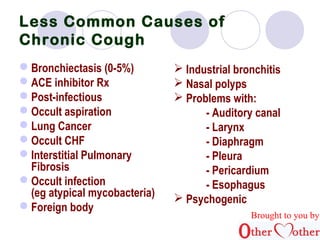
Less Common Causes of 
Chronic Cough 
Bronchiectasis (0-5%) 
ACE inhibitor Rx 
Post-infectious 
Occult aspiration 
Lung Cancer 
Occult CHF 
Interstitial Pulmonary 
Fibrosis 
Occult infection 
(eg atypical mycobacteria) 
Foreign body 
 Industrial bronchitis 
 Nasal polyps 
 Problems with: 
- Auditory canal 
- Larynx 
- Diaphragm 
- Pleura 
- Pericardium 
- Esophagus 
 Psychogenic 
Brought to you by
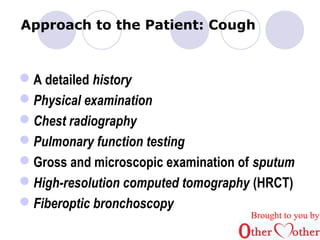
Approach to the Patient: Cough 
A detailed history 
Physical examination 
Chest radiography 
Pulmonary function testing 
Gross and microscopic examination of sputum 
High-resolution computed tomography (HRCT) 
Fiberoptic bronchoscopy 
Brought to you by
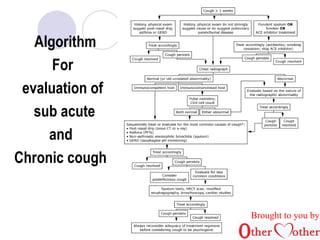
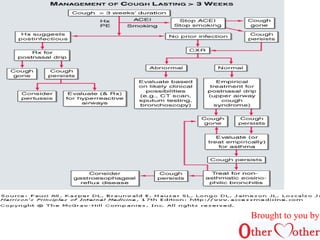
Algorithm 
For 
evaluation of 
sub acute 
and 
Chronic cough 
Brought to you by
Brought to you by
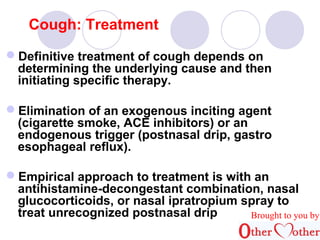
Cough: Treatment 
Definitive treatment of cough depends on 
determining the underlying cause and then 
initiating specific therapy. 
Elimination of an exogenous inciting agent 
(cigarette smoke, ACE inhibitors( or an 
endogenous trigger (postnasal drip, gastro 
esophageal reflux(. 
Empirical approach to treatment is with an 
antihistamine-decongestant combination, nasal 
glucocorticoids, or nasal ipratropium spray to 
treat unrecognized postnasal drip Brought to you by
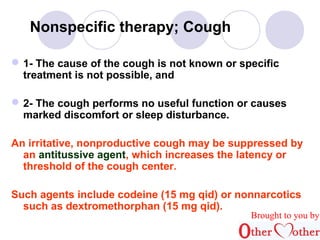
Nonspecific therapy; Cough 
1- The cause of the cough is not known or specific 
treatment is not possible, and 
2- The cough performs no useful function or causes 
marked discomfort or sleep disturbance. 
An irritative, nonproductive cough may be suppressed by 
an antitussive agent, which increases the latency or 
threshold of the cough center. 
Such agents include codeine (15 mg qid) or nonnarcotics 
such as dextromethorphan (15 mg qid). 
Brought to you by
Hemoptysis 
Brought to you by
:Definition 
Hemoptysis: 
Expectoration of blood from the respiratory tract 
Massive hemoptysis: 
Expectoration of >100–600 mL over a 24-h period 
Brought to you by
?Etiology: Hemoptysis? Hematemesis 
It is important to determine initially that the 
blood is not coming from alternative sites. 
 Dark red appearance versus bright red 
appearance. 
An acidic pH, in contrast to the alkaline pH 
of true hemoptysis. 
Brought to you by
Brought to you by
)Differential Diagnosis(1 
Tracheobronchial source 
Neoplasm (bronchogenic carcinoma, endobronchial 
metastatic tumor, Kaposi's sarcoma, bronchial 
carcinoid) 
Bronchitis (acute or chronic) 
Bronchiectasis 
Broncholithiasis 
Airway trauma 
Foreign body 
Brought to you by
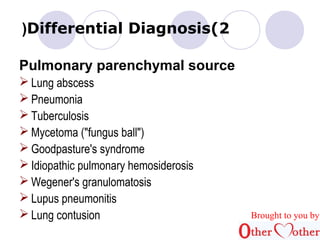
)Differential Diagnosis(2 
Pulmonary parenchymal source 
Lung abscess 
Pneumonia 
Tuberculosis 
Mycetoma ("fungus ball") 
Goodpasture's syndrome 
Idiopathic pulmonary hemosiderosis 
Wegener's granulomatosis 
Lupus pneumonitis 
Lung contusion Brought to you by
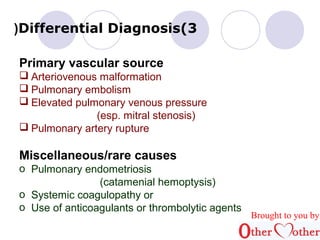
(Differential Diagnosis(3 
Primary vascular source 
 Arteriovenous malformation 
 Pulmonary embolism 
 Elevated pulmonary venous pressure 
(esp. mitral stenosis) 
 Pulmonary artery rupture 
Miscellaneous/rare causes 
o Pulmonary endometriosis 
(catamenial hemoptysis) 
o Systemic coagulopathy or 
o Use of anticoagulants or thrombolytic agents 
Brought to you by
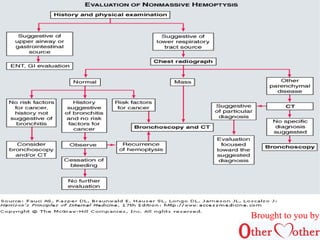
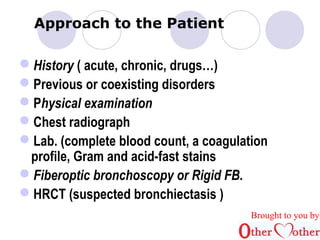
Approach to the Patient 
History ( acute, chronic, drugs…) 
Previous or coexisting disorders 
Physical examination 
Chest radiograph 
Lab. (complete blood count, a coagulation 
profile, Gram and acid-fast stains 
Fiberoptic bronchoscopy or Rigid FB. 
HRCT (suspected bronchiectasis ) 
Brought to you by
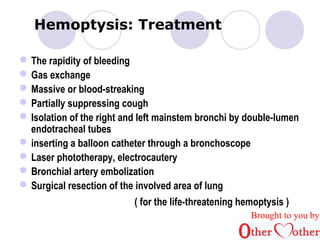
Hemoptysis: Treatment 
The rapidity of bleeding 
Gas exchange 
Massive or blood-streaking 
Partially suppressing cough 
Isolation of the right and left mainstem bronchi by double-lumen 
endotracheal tubes 
inserting a balloon catheter through a bronchoscope 
Laser phototherapy, electrocautery 
Bronchial artery embolization 
Surgical resection of the involved area of lung 
( for the life-threatening hemoptysis ) 
Brought to you by
This platform has been started by 
Parveen Kumar Chadha with the 
vision that nobody should suffer the 
way he has suffered because of lack 
and improper healthcare facilities in 
India. We need lots of funds 
manpower etc. to make this vision a 
reality please contact us. Join us as 
.a member for a noble cause 
Brought to you by
Our views have increased the mark 
of the 25,000 
Thank you viewers 
Looking forward for franchise, collaboration, 
.partners 
Brought to you by
:-Contact Us 
011- ,011-41425180 ,011-25464531 
91-+,91-981830835636+217387 
Brought to you by 
othermotherindia@9g8m1a8il5.c6o9m476 
www.other-mother.in 
Saxbee Consultants Details :-www.parveenchadha.com 
http://www.linkedin.com/profile/view? 
id=326103341&trk=nav_responsive_tab_profile 
https://cparveen.wix.com/other-mother 
https://www.facebook.com/pages/Other-Mother-Nursing-Crusade/224235031114989? 
ref=hl 
https://twitter.com/othermotherind 
i 
A WORLDWIDE MISSITION 
JOIN US
Cough

Cough

  • 1.
    In the nameof GOD Cough Brought to you by
  • 2.
    :Definition Cough isan protective mechanism that ensures the removal of mucus, noxious substances, and infectious organisms from the larynx, trachea, and large bronchi . Cough is an explosive expiration that provides a normal protective mechanism for clearing the tracheobronchial tree of secretions and foreign material. cough interference with normal lifestyle, and concern for the cause of the cough, especially fear of cancer. Brought to you by
  • 3.
    Mechanism Coughing maybe initiated either voluntarily or reflexively. As a defensive reflex it has both afferent and efferent pathways . The cough starts with a deep inspiration followed by glottic closure, relaxation of the diaphragm, and muscle contraction against a closed glottis. Brought to you by
  • 4.
    Etiology  Anexogenous source (smoke, dust, fumes, foreign bodies)  An endogenous origin (upper airway secretions, gastric contents).  Any disorder resulting in inflammation, constriction, infiltration, or compression of airways can be associated with cough.  Asthma is a common cause of cough.  In a nonsmoker the most common causes of chronic cough are postnasal drip , asthma, and gastroesophageal reflux Brought to you by
  • 5.
    Etiology  Acutecough (<3 weeks) Is most often due to upper respiratory infection (common cold, acute bacterial sinusitis, and pertussis), serious disorders, such as pneumonia, pulmonary embolus, and congestive heart failure, can also present in this fashion.  Sub acute cough (between 3 and 8 weeks) Is commonly post-infectious, resulting from persistent airway inflammation and/or postnasal drip following viral infection, pertussis, or infection with Mycoplasma or Chlamydia.  Chronic cough (>8 weeks) In a smoker raises the possibilities of asthma, COPD or bronchogenic carcinoma, Eosinophilic Bronchitis , Esophageal Disease, Post Nasal Drip , ACEI , Smoking. Brought to you by
  • 6.
    Common Causes ofChronic Cough Postnasal drip (38-87%) Asthma (14-43%) GERD (10-40%) Chronic Bronchitis (0-12%) More than one cause (24-72%) Brought to you by
  • 7.
    Chronic ) cough(> 8 weeks Chronic Cough of Post-Nasal Drip  PNDS is a symptom complex without objective findings.  The diagnosis is by a history of the sensation of “something dripping into the throat,” frequent throat clearing, nasal congestion or discharge.  There is wide cultural diversity in reporting such symptoms by patients with “colds.”  In the USA, 50% with colds reported these symptoms, in the UK less than 25%, and in Latin America and India almost none.  Cough may be the only manifestation of PNDS. There may be no symptoms of the “drip.”  PNDS is often seen due to Allergic Rhinitis, Non-Allergic Rhinitis, Vasomotor Rhinitis and Chronic Bacterial Sinusitis. Brought to you by
  • 8.
    Chronic ( cough(> 8 weeks Asthma  Asthma is a chronic inflammatory disease of airways characterized by increased responsiveness of the tracheo-bronchial tree to many stimuli.  Physiologically there is a reversible narrowing of bronchi and clinically there are paroxysms of wheezing, cough, and dyspnea.  If airway obstruction exists, reversibility is shown by > 12% ↑ in FEV1 after two puffs of a β2- adrenergic agonist. Brought to you by
  • 9.
    Chronic ( cough(> 8 weeks Gastro-esophageal disease (GED( There are two main mechanisms of cough in GED:*  1- Micro or macro-aspiration of esophageal contents into the tracheo-bronchial tree.  2- Acid in the distal esophagus stimulating a vagally mediated esophageal-tracheobronchial cough reflex (GI symptoms may be absent(. Brought to you by
  • 10.
    Less Common Causesof Chronic Cough Bronchiectasis (0-5%) ACE inhibitor Rx Post-infectious Occult aspiration Lung Cancer Occult CHF Interstitial Pulmonary Fibrosis Occult infection (eg atypical mycobacteria) Foreign body  Industrial bronchitis  Nasal polyps  Problems with: - Auditory canal - Larynx - Diaphragm - Pleura - Pericardium - Esophagus  Psychogenic Brought to you by
  • 11.
    Approach to thePatient: Cough A detailed history Physical examination Chest radiography Pulmonary function testing Gross and microscopic examination of sputum High-resolution computed tomography (HRCT) Fiberoptic bronchoscopy Brought to you by
  • 12.
    Algorithm For evaluationof sub acute and Chronic cough Brought to you by
  • 13.
  • 14.
    Cough: Treatment Definitivetreatment of cough depends on determining the underlying cause and then initiating specific therapy. Elimination of an exogenous inciting agent (cigarette smoke, ACE inhibitors( or an endogenous trigger (postnasal drip, gastro esophageal reflux(. Empirical approach to treatment is with an antihistamine-decongestant combination, nasal glucocorticoids, or nasal ipratropium spray to treat unrecognized postnasal drip Brought to you by
  • 15.
    Nonspecific therapy; Cough 1- The cause of the cough is not known or specific treatment is not possible, and 2- The cough performs no useful function or causes marked discomfort or sleep disturbance. An irritative, nonproductive cough may be suppressed by an antitussive agent, which increases the latency or threshold of the cough center. Such agents include codeine (15 mg qid) or nonnarcotics such as dextromethorphan (15 mg qid). Brought to you by
  • 16.
  • 17.
    :Definition Hemoptysis: Expectorationof blood from the respiratory tract Massive hemoptysis: Expectoration of >100–600 mL over a 24-h period Brought to you by
  • 18.
    ?Etiology: Hemoptysis? Hematemesis It is important to determine initially that the blood is not coming from alternative sites.  Dark red appearance versus bright red appearance. An acidic pH, in contrast to the alkaline pH of true hemoptysis. Brought to you by
  • 19.
  • 20.
    )Differential Diagnosis(1 Tracheobronchialsource Neoplasm (bronchogenic carcinoma, endobronchial metastatic tumor, Kaposi's sarcoma, bronchial carcinoid) Bronchitis (acute or chronic) Bronchiectasis Broncholithiasis Airway trauma Foreign body Brought to you by
  • 21.
    )Differential Diagnosis(2 Pulmonaryparenchymal source Lung abscess Pneumonia Tuberculosis Mycetoma ("fungus ball") Goodpasture's syndrome Idiopathic pulmonary hemosiderosis Wegener's granulomatosis Lupus pneumonitis Lung contusion Brought to you by
  • 22.
    (Differential Diagnosis(3 Primaryvascular source  Arteriovenous malformation  Pulmonary embolism  Elevated pulmonary venous pressure (esp. mitral stenosis)  Pulmonary artery rupture Miscellaneous/rare causes o Pulmonary endometriosis (catamenial hemoptysis) o Systemic coagulopathy or o Use of anticoagulants or thrombolytic agents Brought to you by
  • 23.
    Approach to thePatient History ( acute, chronic, drugs…) Previous or coexisting disorders Physical examination Chest radiograph Lab. (complete blood count, a coagulation profile, Gram and acid-fast stains Fiberoptic bronchoscopy or Rigid FB. HRCT (suspected bronchiectasis ) Brought to you by
  • 24.
    Hemoptysis: Treatment Therapidity of bleeding Gas exchange Massive or blood-streaking Partially suppressing cough Isolation of the right and left mainstem bronchi by double-lumen endotracheal tubes inserting a balloon catheter through a bronchoscope Laser phototherapy, electrocautery Bronchial artery embolization Surgical resection of the involved area of lung ( for the life-threatening hemoptysis ) Brought to you by
  • 25.
    This platform hasbeen started by Parveen Kumar Chadha with the vision that nobody should suffer the way he has suffered because of lack and improper healthcare facilities in India. We need lots of funds manpower etc. to make this vision a reality please contact us. Join us as .a member for a noble cause Brought to you by
  • 26.
    Our views haveincreased the mark of the 25,000 Thank you viewers Looking forward for franchise, collaboration, .partners Brought to you by
  • 27.
    :-Contact Us 011-,011-41425180 ,011-25464531 91-+,91-981830835636+217387 Brought to you by othermotherindia@9g8m1a8il5.c6o9m476 www.other-mother.in Saxbee Consultants Details :-www.parveenchadha.com http://www.linkedin.com/profile/view? id=326103341&trk=nav_responsive_tab_profile https://cparveen.wix.com/other-mother https://www.facebook.com/pages/Other-Mother-Nursing-Crusade/224235031114989? ref=hl https://twitter.com/othermotherind i A WORLDWIDE MISSITION JOIN US