DRY COUGH
CAUSES & MANAGEMENT
Dr Jeetam singh rajput
PG Dept of Internal Medicine
MLN Medical college
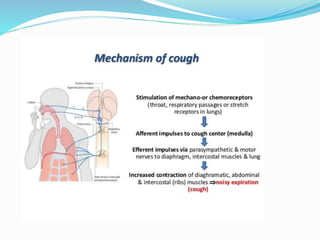
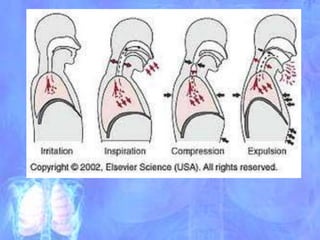
COUGH
 One of the most common symptoms for which
patients seek medical attention.
 Defensive reflex that enhance the clearance of
secretions and particles from the airway.
 Protects the lower airways from the aspiration
of foreign materials.
 Coughing may be initiated either voluntarily or
reflexively.
Normal frequency of cough
• Rate of 2.5 coughs/min has been quoted for a
gathering.
• In a healthy people the frequency of cough over a 24-h
period was found to be less than 16 coughs.
• Bursts of 11 cough per 24 h (range 1–34) in children.
7
Different Types of Cough
Duration1,2
Acute
<3 weeks
Subacute/
Prolonged
acute
3–8-weeks
Chronic
> 8 weeks
Nature3
Productive
Wet; with
sputum
Nonproductive
Dry with no
sputum
Cause4
Specific
Associated with
specific
condition
Nonspecific
No specific
disease
association
Refractory
Persists after
therapy
1.Irwin RS, et al. Chest. 2006;129:1– 23; 2. Shields MD, et al. Thorax. 2008;63(Suppl III):iii1–iii15; 3. Schoor J. S Afr Pharm J. 2012;79(6):30– 33; 4. Gibson PG,
et al. MJA. 2010;192:265–271.
10
Recurrent
cough
≥2 episodes/yr
each lasting for
>7– 14 days
Classification
Acute
cough
~ maximum of
3 weeks
Subacute
cough
~ 3 to 8 weeks
Chronic
Cough
~ more than 8
weeks
De Blasio et al. Cough 2011, 7:7
ETIOLOGY
Acute cough
~ maximum of 3
weeks
• Upper Respiratory
Infection (common
cold, acute
bacterial sinusitis,
and pertussis)
• Pneumonia
• Pulmonary
embolus
• Congestive cardiac
failure
Subacute cough
~ 3 to 8 weeks
• Post-infectious
• Postnasal drip
following viral
infection,
• Pertussis
• Tuberculosis
• Mycoplasma or
Chlamydia
infection
Chronic Cough
~ more than 8 weeks
• Asthma
• COPD
• Tuberculosis
• Bronchogenic
carcinoma
• Eosinophilic
Bronchitis
• Esophageal
Disease,
• Post Nasal Drip
• ACEI
• Smoking.
Dry Cough- Etiology
 Infections:-
1) Common cold: Rhinitis, Rhinusinusitis.
2) Posterior nasal discharge/drip.
3)Upperairwaydisease: : Epiglotitis, Laryngitis,
tracheobronchitis.
4) Viral respiratory infections.
5) Tuberculosis( miliary)
6) Whooping cough.
7) Atypical pneumonia.
8) Legionnaire disease.
Etiology continue……
 Esophageal disease:- GERD, laryngopharyngeal reflux
dis, tracheoesophageal fistula.
 Airway hyperresponsiveness:- Asthma
 Chronic obstructive airway disease:- Emphysema.
 Irritation to airway:- Dust, smoke, powder.
 Malignancy:- Endobronchial growth, Mediastinal
tumor.
 Lung parenchymal disease:- ILD, Occupational lung
dis.
 Drug induced: ACE inhibitors, Beta blocker.
Etiology cont….
 Other:
1) Pleurisy.
2) Foreign body inhalation.
3) Pneumothorax.
4) Aortic aneurysm.
5) Neurogenic & Psychogenic cough.
Chronic cough is reported in nearly
10-20% of the general population.
Most common causes of chronic
cough
Adult Cough: Epidemiology(IN INDIA)
Acute cough is one of the most common
presentations in general practice.
PNDS: Postnasal drip syndrome; BA: Bronchial asthma;
GERD: Gastro-esophageal reflux disease
1. Mahashur A. . Lung India. 2015;32(1):44–49.
2. Worrall G. Can Fam Physician. 2010;57:48–51.
60%20%
10%
4%
2% 2%
2%
Common cold
Acute bronchitis
Asthma
Chronic bronchitis/
COPD
Environmental
Influenza
Rare serious disease
67%4%
6%
2.8%
18.8%
PNDS/BA/GERD
Eosinophilic bronchitis
Postinfectious
Distribution of causes of acute cough
among adults in typical general
practice
16
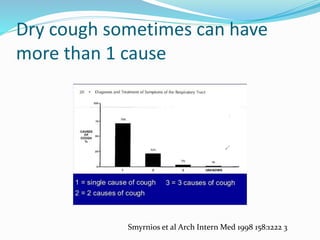
Dry cough sometimes can have
more than 1 cause
Smyrnios et al Arch Intern Med 1998 158:1222 3
Evaluation 0f Dry Cough
• A systematic, diagnostic approach has been validated in
immunocompetent patients-
5 steps plan:
Step 1: Review history and examination focusing on the
most common causes of cough.
 Step 2: Order a CXR in all patients
 Step 3: Do not order additional tests in present smokers or
patients taking ACE inhibitors until the response to
smoking cessation or drug discontinuation for at least 4
weeks can be assessed.
- Cough due to smoking or ACE inhibitors should
improve substantially or disappear during this
time- frame of abstinence.
Step 4: Order additional diagnostic tests or embark on
empiric treatment
Step 5: Determine the cause(s) of cough by observing
which specific therapy eliminates cough
• If the evaluation suggests more than one possible
cause, initiate treatment in the same sequence that the
abnormalities were discovered
• Since cough can be simultaneously caused by more
than one condition, do NOT stop therapy that appears to
be partially successful; rather, sequentially add to it.
History Reasons
Onset To determine acute/subacute or chronic
causes of cough
Fever Ongoing infection
SOB(shortness of breath) Respiratory distress
Noisy breathing Wheezing suggest asthma
Loss of appetite, loss of weight, hemoptysis Suggesting Tuberculosis, malignancy
Allergy, nasal obstruction or congestion,
rhinorrhoea, sneezing, facial pain, post-
nasal drip or repetitive throat clearance
Suggesting Rhinosinusitis
Aggravating factor, relieving factor • Cough due to GERD affected by
postural changes, post meal
• Cold induced or MDI relieved cough in
asthma or COPD
Dyspepsia, heartburn, waterbrash GERD
History taking
History Reasons
Medication used ACE-inhibitor
Occupation Exposure to asbestos, chemical or
cigarette smoke
Family history Asthma, tuberculosis, lung cancer, cystic
fibrosis
Social history Contact with PTB
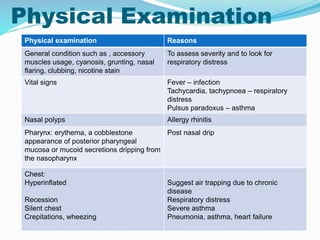
Physical Examination
Physical examination Reasons
General condition such as , accessory
muscles usage, cyanosis, grunting, nasal
flaring, clubbing, nicotine stain
To assess severity and to look for
respiratory distress
Vital signs Fever – infection
Tachycardia, tachypnoea – respiratory
distress
Pulsus paradoxus – asthma
Nasal polyps Allergy rhinitis
Pharynx: erythema, a cobblestone
appearance of posterior pharyngeal
mucosa or mucoid secretions dripping from
the nasopharynx
Post nasal drip
Chest:
Hyperinflated
Recession
Silent chest
Crepitations, wheezing
Suggest air trapping due to chronic
disease
Respiratory distress
Severe asthma
Pneumonia, asthma, heart failure
Physical examination Reasons
Eczema, transverse nasal crease, injected
conjunctiva
Signs of atopic disease
Lymphadenopathy To suggest infection
• Abnormal physical signs are rare in a chronic dry cough
• Wheeze may be audible on examination but is usually absent in cough variant
asthma
Relevance of Cough Quality
1. Chang AB. Cough. 2005;1:7 .
2. Chang AB, et al. MJA. 2006;184:398–403.
Croup, tracheomalacia, habit coughBarking or brassy cough
Classically recognizable cough
Psychogenic
Dry honking cough
disappearing when engaged
in activity or during sleep
Pertussis and parapertussisParoxysmal
(with/without inspiratory “whoop”)
Chlamydia in infantsStaccato
Plastic bronchitis/asthma (rare)Cough productive of casts
Suppurative lung disease
Chronic wet cough in
mornings only
25
Relevance of Cough Quality
Sinusitis
Cough at the time of
going to bed & after
getting up in the morning
Classically recognizable cough
Asthma
Cough especially early in
the morning (2-3 AM)
GERD
Cough that starts as soon
as you lie down in bed
URTIHacking cough
Bacterial tracheitisBarking cough
CroupBarking seal-like cough
26
GERD: Gastro-esophageal reflux disease
Management
• Investigation
• Treatment
Investigations
 CXR mandatory a early stage as is significant
abnormality will alter the diagnostic algorithm and avoid
unnecessary Ix.
 Spirometry:
-demonstrate significant airway reversibility (asthma)
-unavailable or normal and history suggestive: serial
measurement of PEF (diurnal variability).
 Plain sinus radiography: low specificity but improves
with history and findings.
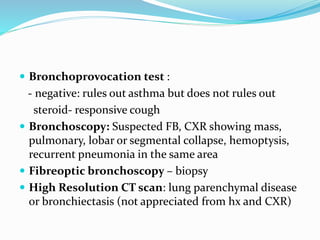
 Bronchoprovocation test :
- negative: rules out asthma but does not rules out
steroid- responsive cough
 Bronchoscopy: Suspected FB, CXR showing mass,
pulmonary, lobar or segmental collapse, hemoptysis,
recurrent pneumonia in the same area
 Fibreoptic bronchoscopy – biopsy
 High Resolution CT scan: lung parenchymal disease
or bronchiectasis (not appreciated from hx and CXR)
Treatment:
• Treat the cause.
• Detail about some specific condition :
1) Upper airway cough syndrome.
2) Cough variant asthma.
3) GERD.
4) ACE Inhibitor induced cough.
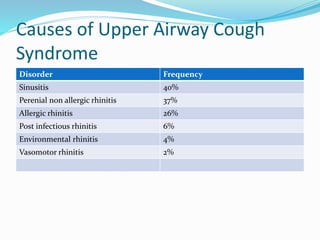
Causes of Upper Airway Cough
Syndrome
Disorder Frequency
Sinusitis 40%
Perenial non allergic rhinitis 37%
Allergic rhinitis 26%
Post infectious rhinitis 6%
Environmental rhinitis 4%
Vasomotor rhinitis 2%
Upper Airway Cough Syndrome
 Also called “Post-nasal drip syndrome” (PNDS)
 Common cause of cough in all age groups
– Second most common cause in children
– Most common cause in adults and the elderly
 In addition to cough, UACS can also cause
- Wheeze
- Dyspnea
Upper Airway Cough Syndrome
 Clues to UACS
– History of
• Need to frequently clear their throat
• Friend/relative notices that the patient
frequently clears their throat
• Sensation of dripping into throat
• Nasal symptoms
– Physical Exam demonstrating
• Secretions in nose or oropharynx
• Cobblestone appearance of mucosa
Upper Airway Cough Syndrome
 Diagnosis of UACS as a cause of cough is established
when:
a) frequent throat clearing is elicited from the history
b) cobblestoning and phlegm are present on
physical examination of the posterior pharynx
c) cough responds favourably to specific therapy
aimed at eliminating the drip
Treatment
 Antibiotics – sinusitis
 Oral antihistamine/decongestant x 3 weeks
 Intranasal decongestant for maximum of 5 days: e.g.
oxymetazoline 2 sprays each nostril bid x 3 days only
Asthma
 Second most common cause of cough in adults
• Clues that chronic cough is due to asthma:
– Episodic wheezing, dyspnea , cold or exercise
induced
– Reversible airflow obstruction
– Bronchial hyperresponsiveness
• Confirmed by resolution of cough with asthma
treatment
Cough Variant Asthma
• 30-60% of patients presenting with chronic cough that
was due to asthma had cough as their ONLY symptom
 Clues:
- nocturnal cough, exercise induced, after allergen
exposure
 Bronchoprovocation test: positive
 Negative test exclude asthma but does not rule out
steroid responsive cough
ASTHMA/Cough Variant Asthma
Treatment
• Inhaled corticosteroid
• ICS/LABA combination > 8 weeks
 Leukotrine receptor antagonist
-Confirmed by resolution of cough with asthma
treatment
GERD
 Suspect GERD when…
– Symptoms of heartburn or sour taste in
mouth
– Reflux demonstrated by
• 24-hour pH-impedance monitoring
• Barium x-ray
• Cough is the only symptom of GERD in 40-75% of
patients with chronic dry cough due to GERD
GERD
 Cough due to GERD occurs most commonly while
patients are awake, stooping posture, meal related,
and usually does not occur during the night
• Diagnosis of GERD as cause of chronic cough
requires resolution of cough with GERD treatment
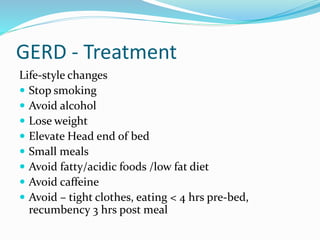
GERD - Treatment
Life-style changes
 Stop smoking
 Avoid alcohol
 Lose weight
 Elevate Head end of bed
 Small meals
 Avoid fatty/acidic foods /low fat diet
 Avoid caffeine
 Avoid – tight clothes, eating < 4 hrs pre-bed,
recumbency 3 hrs post meal
Treatment
Conservative measures :
• Antacid therapy ≥ 2 months :
– Proton pump inhibitor (high dose)
– H2 blockers less effective
• Motility therapy:
– Metoclopromide
ACE-inhibitor therapy
 Angiotensin converting enzyme (ACE) inhibitors
(enalapril, captopril, lisinopril, ramipril, etc.)
 Dry cough in 3-30% patients
 Begins 1 week to 6 months after drug started
 Usually resolves 1-7 days after stopping therapy, but can
take 4 weeks
 Diagnosis is confirmed when cough disappears after drug
in discontinued
ANTITUSSIVE
44
Mucolytics
 Bromhexine/Ambroxol:
 Derivatives of the alkaloid vasicine obtained from Adhantoda
vasica.
 Potent mucolytic and mucokinetic, capable of inducing thin
copious bronchial secretion.
 Dissolve hard phelgum/mucus plug
 Side effect: Rhinorrhoea, lacrymation, gastric irritation,
hypersecrition.
 Dose: Bromhexine 8mg tab tds
 Acetylcysteine:
 Derivatives of cysteine.
 Reduces/open the disulfide bridge in mucoprotein present
in sputum.
 These drug also act as antioxidant and may therfore
reduces airway inflammation.
 Route of administration: oral, parentral, inhalation
 Most effective route is inhalational.
 Brand name and dose: Tab mucinac 600mg tds, inj
mucomix for iv use and for nebulisation.
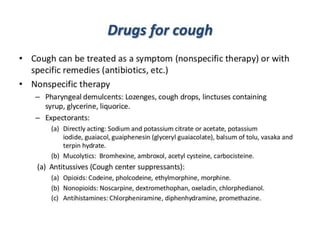
ANTITUSSIVE :
 These drug act in the CNS, to raise the threshold of cough
centre(main MOA ) or act peripherally in respiratory tract
to reduce cough impulse.
 OPIOIDS:-
Suppress the cough reflex by acting on the cough centre
in the medulla.
 NON-OPIODS:-
Suppress the cough reflex by numbing the stretch
receptors in the respiratory tract and preventing the
cough reflex from being stimulated.
50
ANTITUSSIVE INDICATION
 Used to stop the cough reflex when the cough is non-
productive i.e dry cough.
51
ANTITUSSIVE CONTRAINDICATIONS
 Asthma
 COPD
 Hypersensitivity
 Head injury
 Pregnancy
52
OPOIDS:
CODEINE:
An opium alkaloid: less potent than morphine.
It decreases senstivity of central cough centre to peripheral
stimuli and decreases mucosal secretions.
Suppresses cough centre for 6 hrs.
The antitussive action blocked by naloxone.
Abuse liability is low but at present constipation is the chief
drawback.
Higher doses respiratory depression and drowsiness can
occurs.
53
Brand Names
• Codifos,Corex ,Codokuff ,Cufex,Tossex in the form of syp.
• Dose: 10-30mg per day
• Codeine 15 mg tablets are also available.
Side Effects
• Shortness of breath
• Sedation
• Euphoria
• Allergic reactions
• Constipation
54
HYDROCODONE:
Antitussive agent,Analgesic agent
More potent than codeine.
5mg of hydrocodone is equivalent to 30 mg of
codeine when administered orally.
Is combined anticholinergic drug(homatropine).
Side effects:Light-headedness,Sedation,Constipation
55
PHOLCODEINE:
 Similar in efficacy as antitussive to codeine.
 Long acting than codeine(12hrs).
 Dose:10-15mg/day(syp; ethinine 5 mg/5ml)
MORPHINE:(2-4mg i.m.):
 It is antitussive in subanalgesic doses but is seldom used for this
purpose because of high abusive potential.
56
NONOPOIDS:
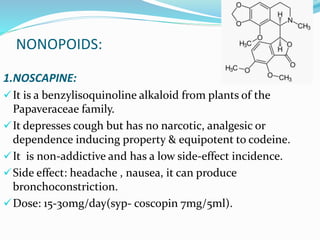
1.NOSCAPINE:
It is a benzylisoquinoline alkaloid from plants of the
Papaveraceae family.
It depresses cough but has no narcotic, analgesic or
dependence inducing property & equipotent to codeine.
It is non-addictive and has a low side-effect incidence.
Side effect: headache , nausea, it can produce
bronchoconstriction.
Dose: 15-30mg/day(syp- coscopin 7mg/5ml).
2.Dextromethorphan(DXM)
Effective as codeine ,doesn’t depress mucociliary
function.
Antitussive action not blocked by nalaxone.
Primary metabolite is a NMDA receptor antagonist ie
has a CNS depressant effect and also sigma receptor
agonist.
Side effect: Dizziness, nausea, drowsiness, ataxia.
Dose : 10-20mg/day(Suppressa, Corex-DX, Cotuss, Action
DMR tablet).
3.OXELADIN:
 It is asynthetic centrally acting antitussive agent devoid of
opoid side effect.
 Dose : 15-30mg(syp- Pectamol 15mg/5ml).
4. CHLOPHEDIANOL:
 It is similar to oxeladin in antitussive action but has longer
duration of action.
 Dose: 20-40mg( syp- detigon, tussigon 20mg/5ml)
Antihistamines
The antitussive activity of antihistamines are established
from clinical trials (not enough research to establish MOA)
Following effect has been linked to antitussive action of
Antihistamines but no research is conclusive enough
 Sedative (study shows non-sedating Antihistamines are not
antitussive)
 Anticholinergic (no rank based action)
 histamine H1 receptor binding strength (no rank based
action)
Example: Chlorpheniramine(2-5mg),
Diphenhydramine, Promethazine(15-20mg Phenargan5mg/ml)
 Second generation antihistamines are ineffective.
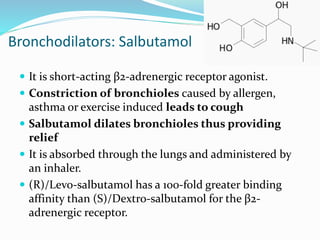
Bronchodilators: Salbutamol
 It is short-acting β2-adrenergic receptor agonist.
 Constriction of bronchioles caused by allergen,
asthma or exercise induced leads to cough
 Salbutamol dilates bronchioles thus providing
relief
 It is absorbed through the lungs and administered by
an inhaler.
 (R)/Levo-salbutamol has a 100-fold greater binding
affinity than (S)/Dextro-salbutamol for the β2-
adrenergic receptor.
Take Home Message
In patients with cough and a normal CXR
finding who are nonsmokers and are not
receiving therapy with an ACE inhibitor,
the diagnostic approach should focus on the
detection and treatment of UACS (formerly
called PNDS), asthma, GERD, alone or in
combination.
This approach is most likely to result in a high
rate of success in achieving cough resolution.
THANK
YOU
1.Most common cause of dry cough is
a) Laryngo-tracheo-bronchitis
b) ILD
c) Atypical pneumonia
d) Bronchial asthma
2. Aspirin sensitive asthma associated with which of the
following:
a) Obesity
b) Urticaria
c) Nasal polyp
d) Extrinsic asthma
ANS is C
Features of intrinsic asthma
Negative f/h of allergy
Negative skin test to common inhalant allergens
Normal serum conc. of IgE.
Concommitant nasal polyp
Senstivity to aspirin and related chemicals
Later onset of disease
3. Investigation of choice for GERD
a) Ba swallow
b) Endoscopy and duodenal biopsy
c) 24 hrs Ph monitoring in esophagus
d) Urea breath test
4. Most common cause upper airway cough syndrome
a) Allergic rhinitis
b) Postinfectious rhinitis
c) Perenial nonallergic rhinitis
d) Vasomotor rhinitis
5. Safest antitussive agent during pregnancy
a) Codeine
b) Pholcodeine
c) 2nd generation antihistaminic
d) Chlorpheniramine
6.True about Globus hystericus
a) It is a hysterical aphonia
b) It is a sensation of lump in throat.
c) It is a sensation of lump in abdomen
d) It is abnormal sensation of large tongue
7. DOC for acute opoid poisoning
a) Naltrexone
b) Nalaxone
c) Acamprosate
d) Nalmefene
8. Tolerance develop to all of the following action of
opoid except
a) Analgesia
b) Euphoria
c) Nausea & vomiting
d) Constipation
9) Which of the following antitussive devoid of
constipation side effect
a) Codeine
b) Dextromethorphan
c) Noscapine
d) Pholcodeine
10) Which of the following cranial nerve does not take
part in cough reflex
1) Vagus
2) Glossopharyngeal
3) Phrenic nerve
4) None of the above

Dry cough

  • 1.
  • 2.
    Dr Jeetam singhrajput PG Dept of Internal Medicine MLN Medical college
  • 3.
    COUGH  One ofthe most common symptoms for which patients seek medical attention.  Defensive reflex that enhance the clearance of secretions and particles from the airway.  Protects the lower airways from the aspiration of foreign materials.  Coughing may be initiated either voluntarily or reflexively.
  • 4.
    Normal frequency ofcough • Rate of 2.5 coughs/min has been quoted for a gathering. • In a healthy people the frequency of cough over a 24-h period was found to be less than 16 coughs. • Bursts of 11 cough per 24 h (range 1–34) in children.
  • 7.
  • 10.
    Different Types ofCough Duration1,2 Acute <3 weeks Subacute/ Prolonged acute 3–8-weeks Chronic > 8 weeks Nature3 Productive Wet; with sputum Nonproductive Dry with no sputum Cause4 Specific Associated with specific condition Nonspecific No specific disease association Refractory Persists after therapy 1.Irwin RS, et al. Chest. 2006;129:1– 23; 2. Shields MD, et al. Thorax. 2008;63(Suppl III):iii1–iii15; 3. Schoor J. S Afr Pharm J. 2012;79(6):30– 33; 4. Gibson PG, et al. MJA. 2010;192:265–271. 10 Recurrent cough ≥2 episodes/yr each lasting for >7– 14 days
  • 11.
    Classification Acute cough ~ maximum of 3weeks Subacute cough ~ 3 to 8 weeks Chronic Cough ~ more than 8 weeks De Blasio et al. Cough 2011, 7:7
  • 12.
    ETIOLOGY Acute cough ~ maximumof 3 weeks • Upper Respiratory Infection (common cold, acute bacterial sinusitis, and pertussis) • Pneumonia • Pulmonary embolus • Congestive cardiac failure Subacute cough ~ 3 to 8 weeks • Post-infectious • Postnasal drip following viral infection, • Pertussis • Tuberculosis • Mycoplasma or Chlamydia infection Chronic Cough ~ more than 8 weeks • Asthma • COPD • Tuberculosis • Bronchogenic carcinoma • Eosinophilic Bronchitis • Esophageal Disease, • Post Nasal Drip • ACEI • Smoking.
  • 13.
    Dry Cough- Etiology Infections:- 1) Common cold: Rhinitis, Rhinusinusitis. 2) Posterior nasal discharge/drip. 3)Upperairwaydisease: : Epiglotitis, Laryngitis, tracheobronchitis. 4) Viral respiratory infections. 5) Tuberculosis( miliary) 6) Whooping cough. 7) Atypical pneumonia. 8) Legionnaire disease.
  • 14.
    Etiology continue……  Esophagealdisease:- GERD, laryngopharyngeal reflux dis, tracheoesophageal fistula.  Airway hyperresponsiveness:- Asthma  Chronic obstructive airway disease:- Emphysema.  Irritation to airway:- Dust, smoke, powder.  Malignancy:- Endobronchial growth, Mediastinal tumor.  Lung parenchymal disease:- ILD, Occupational lung dis.  Drug induced: ACE inhibitors, Beta blocker.
  • 15.
    Etiology cont….  Other: 1)Pleurisy. 2) Foreign body inhalation. 3) Pneumothorax. 4) Aortic aneurysm. 5) Neurogenic & Psychogenic cough.
  • 16.
    Chronic cough isreported in nearly 10-20% of the general population. Most common causes of chronic cough Adult Cough: Epidemiology(IN INDIA) Acute cough is one of the most common presentations in general practice. PNDS: Postnasal drip syndrome; BA: Bronchial asthma; GERD: Gastro-esophageal reflux disease 1. Mahashur A. . Lung India. 2015;32(1):44–49. 2. Worrall G. Can Fam Physician. 2010;57:48–51. 60%20% 10% 4% 2% 2% 2% Common cold Acute bronchitis Asthma Chronic bronchitis/ COPD Environmental Influenza Rare serious disease 67%4% 6% 2.8% 18.8% PNDS/BA/GERD Eosinophilic bronchitis Postinfectious Distribution of causes of acute cough among adults in typical general practice 16
  • 17.
    Dry cough sometimescan have more than 1 cause Smyrnios et al Arch Intern Med 1998 158:1222 3
  • 18.
    Evaluation 0f DryCough • A systematic, diagnostic approach has been validated in immunocompetent patients- 5 steps plan: Step 1: Review history and examination focusing on the most common causes of cough.
  • 19.
     Step 2:Order a CXR in all patients  Step 3: Do not order additional tests in present smokers or patients taking ACE inhibitors until the response to smoking cessation or drug discontinuation for at least 4 weeks can be assessed. - Cough due to smoking or ACE inhibitors should improve substantially or disappear during this time- frame of abstinence. Step 4: Order additional diagnostic tests or embark on empiric treatment
  • 20.
    Step 5: Determinethe cause(s) of cough by observing which specific therapy eliminates cough • If the evaluation suggests more than one possible cause, initiate treatment in the same sequence that the abnormalities were discovered • Since cough can be simultaneously caused by more than one condition, do NOT stop therapy that appears to be partially successful; rather, sequentially add to it.
  • 21.
    History Reasons Onset Todetermine acute/subacute or chronic causes of cough Fever Ongoing infection SOB(shortness of breath) Respiratory distress Noisy breathing Wheezing suggest asthma Loss of appetite, loss of weight, hemoptysis Suggesting Tuberculosis, malignancy Allergy, nasal obstruction or congestion, rhinorrhoea, sneezing, facial pain, post- nasal drip or repetitive throat clearance Suggesting Rhinosinusitis Aggravating factor, relieving factor • Cough due to GERD affected by postural changes, post meal • Cold induced or MDI relieved cough in asthma or COPD Dyspepsia, heartburn, waterbrash GERD History taking
  • 22.
    History Reasons Medication usedACE-inhibitor Occupation Exposure to asbestos, chemical or cigarette smoke Family history Asthma, tuberculosis, lung cancer, cystic fibrosis Social history Contact with PTB
  • 23.
    Physical Examination Physical examinationReasons General condition such as , accessory muscles usage, cyanosis, grunting, nasal flaring, clubbing, nicotine stain To assess severity and to look for respiratory distress Vital signs Fever – infection Tachycardia, tachypnoea – respiratory distress Pulsus paradoxus – asthma Nasal polyps Allergy rhinitis Pharynx: erythema, a cobblestone appearance of posterior pharyngeal mucosa or mucoid secretions dripping from the nasopharynx Post nasal drip Chest: Hyperinflated Recession Silent chest Crepitations, wheezing Suggest air trapping due to chronic disease Respiratory distress Severe asthma Pneumonia, asthma, heart failure
  • 24.
    Physical examination Reasons Eczema,transverse nasal crease, injected conjunctiva Signs of atopic disease Lymphadenopathy To suggest infection • Abnormal physical signs are rare in a chronic dry cough • Wheeze may be audible on examination but is usually absent in cough variant asthma
  • 25.
    Relevance of CoughQuality 1. Chang AB. Cough. 2005;1:7 . 2. Chang AB, et al. MJA. 2006;184:398–403. Croup, tracheomalacia, habit coughBarking or brassy cough Classically recognizable cough Psychogenic Dry honking cough disappearing when engaged in activity or during sleep Pertussis and parapertussisParoxysmal (with/without inspiratory “whoop”) Chlamydia in infantsStaccato Plastic bronchitis/asthma (rare)Cough productive of casts Suppurative lung disease Chronic wet cough in mornings only 25
  • 26.
    Relevance of CoughQuality Sinusitis Cough at the time of going to bed & after getting up in the morning Classically recognizable cough Asthma Cough especially early in the morning (2-3 AM) GERD Cough that starts as soon as you lie down in bed URTIHacking cough Bacterial tracheitisBarking cough CroupBarking seal-like cough 26 GERD: Gastro-esophageal reflux disease
  • 27.
  • 28.
    Investigations  CXR mandatorya early stage as is significant abnormality will alter the diagnostic algorithm and avoid unnecessary Ix.  Spirometry: -demonstrate significant airway reversibility (asthma) -unavailable or normal and history suggestive: serial measurement of PEF (diurnal variability).  Plain sinus radiography: low specificity but improves with history and findings.
  • 29.
     Bronchoprovocation test: - negative: rules out asthma but does not rules out steroid- responsive cough  Bronchoscopy: Suspected FB, CXR showing mass, pulmonary, lobar or segmental collapse, hemoptysis, recurrent pneumonia in the same area  Fibreoptic bronchoscopy – biopsy  High Resolution CT scan: lung parenchymal disease or bronchiectasis (not appreciated from hx and CXR)
  • 30.
    Treatment: • Treat thecause. • Detail about some specific condition : 1) Upper airway cough syndrome. 2) Cough variant asthma. 3) GERD. 4) ACE Inhibitor induced cough.
  • 31.
    Causes of UpperAirway Cough Syndrome Disorder Frequency Sinusitis 40% Perenial non allergic rhinitis 37% Allergic rhinitis 26% Post infectious rhinitis 6% Environmental rhinitis 4% Vasomotor rhinitis 2%
  • 32.
    Upper Airway CoughSyndrome  Also called “Post-nasal drip syndrome” (PNDS)  Common cause of cough in all age groups – Second most common cause in children – Most common cause in adults and the elderly  In addition to cough, UACS can also cause - Wheeze - Dyspnea
  • 33.
    Upper Airway CoughSyndrome  Clues to UACS – History of • Need to frequently clear their throat • Friend/relative notices that the patient frequently clears their throat • Sensation of dripping into throat • Nasal symptoms – Physical Exam demonstrating • Secretions in nose or oropharynx • Cobblestone appearance of mucosa
  • 34.
    Upper Airway CoughSyndrome  Diagnosis of UACS as a cause of cough is established when: a) frequent throat clearing is elicited from the history b) cobblestoning and phlegm are present on physical examination of the posterior pharynx c) cough responds favourably to specific therapy aimed at eliminating the drip
  • 35.
    Treatment  Antibiotics –sinusitis  Oral antihistamine/decongestant x 3 weeks  Intranasal decongestant for maximum of 5 days: e.g. oxymetazoline 2 sprays each nostril bid x 3 days only
  • 36.
    Asthma  Second mostcommon cause of cough in adults • Clues that chronic cough is due to asthma: – Episodic wheezing, dyspnea , cold or exercise induced – Reversible airflow obstruction – Bronchial hyperresponsiveness • Confirmed by resolution of cough with asthma treatment
  • 37.
    Cough Variant Asthma •30-60% of patients presenting with chronic cough that was due to asthma had cough as their ONLY symptom  Clues: - nocturnal cough, exercise induced, after allergen exposure  Bronchoprovocation test: positive  Negative test exclude asthma but does not rule out steroid responsive cough
  • 38.
    ASTHMA/Cough Variant Asthma Treatment •Inhaled corticosteroid • ICS/LABA combination > 8 weeks  Leukotrine receptor antagonist -Confirmed by resolution of cough with asthma treatment
  • 39.
    GERD  Suspect GERDwhen… – Symptoms of heartburn or sour taste in mouth – Reflux demonstrated by • 24-hour pH-impedance monitoring • Barium x-ray • Cough is the only symptom of GERD in 40-75% of patients with chronic dry cough due to GERD
  • 40.
    GERD  Cough dueto GERD occurs most commonly while patients are awake, stooping posture, meal related, and usually does not occur during the night • Diagnosis of GERD as cause of chronic cough requires resolution of cough with GERD treatment
  • 41.
    GERD - Treatment Life-stylechanges  Stop smoking  Avoid alcohol  Lose weight  Elevate Head end of bed  Small meals  Avoid fatty/acidic foods /low fat diet  Avoid caffeine  Avoid – tight clothes, eating < 4 hrs pre-bed, recumbency 3 hrs post meal
  • 42.
    Treatment Conservative measures : •Antacid therapy ≥ 2 months : – Proton pump inhibitor (high dose) – H2 blockers less effective • Motility therapy: – Metoclopromide
  • 43.
    ACE-inhibitor therapy  Angiotensinconverting enzyme (ACE) inhibitors (enalapril, captopril, lisinopril, ramipril, etc.)  Dry cough in 3-30% patients  Begins 1 week to 6 months after drug started  Usually resolves 1-7 days after stopping therapy, but can take 4 weeks  Diagnosis is confirmed when cough disappears after drug in discontinued
  • 44.
  • 48.
    Mucolytics  Bromhexine/Ambroxol:  Derivativesof the alkaloid vasicine obtained from Adhantoda vasica.  Potent mucolytic and mucokinetic, capable of inducing thin copious bronchial secretion.  Dissolve hard phelgum/mucus plug  Side effect: Rhinorrhoea, lacrymation, gastric irritation, hypersecrition.  Dose: Bromhexine 8mg tab tds
  • 49.
     Acetylcysteine:  Derivativesof cysteine.  Reduces/open the disulfide bridge in mucoprotein present in sputum.  These drug also act as antioxidant and may therfore reduces airway inflammation.  Route of administration: oral, parentral, inhalation  Most effective route is inhalational.  Brand name and dose: Tab mucinac 600mg tds, inj mucomix for iv use and for nebulisation.
  • 50.
    ANTITUSSIVE :  Thesedrug act in the CNS, to raise the threshold of cough centre(main MOA ) or act peripherally in respiratory tract to reduce cough impulse.  OPIOIDS:- Suppress the cough reflex by acting on the cough centre in the medulla.  NON-OPIODS:- Suppress the cough reflex by numbing the stretch receptors in the respiratory tract and preventing the cough reflex from being stimulated. 50
  • 51.
    ANTITUSSIVE INDICATION  Usedto stop the cough reflex when the cough is non- productive i.e dry cough. 51
  • 52.
    ANTITUSSIVE CONTRAINDICATIONS  Asthma COPD  Hypersensitivity  Head injury  Pregnancy 52
  • 53.
    OPOIDS: CODEINE: An opium alkaloid:less potent than morphine. It decreases senstivity of central cough centre to peripheral stimuli and decreases mucosal secretions. Suppresses cough centre for 6 hrs. The antitussive action blocked by naloxone. Abuse liability is low but at present constipation is the chief drawback. Higher doses respiratory depression and drowsiness can occurs. 53
  • 54.
    Brand Names • Codifos,Corex,Codokuff ,Cufex,Tossex in the form of syp. • Dose: 10-30mg per day • Codeine 15 mg tablets are also available. Side Effects • Shortness of breath • Sedation • Euphoria • Allergic reactions • Constipation 54
  • 55.
    HYDROCODONE: Antitussive agent,Analgesic agent Morepotent than codeine. 5mg of hydrocodone is equivalent to 30 mg of codeine when administered orally. Is combined anticholinergic drug(homatropine). Side effects:Light-headedness,Sedation,Constipation 55
  • 56.
    PHOLCODEINE:  Similar inefficacy as antitussive to codeine.  Long acting than codeine(12hrs).  Dose:10-15mg/day(syp; ethinine 5 mg/5ml) MORPHINE:(2-4mg i.m.):  It is antitussive in subanalgesic doses but is seldom used for this purpose because of high abusive potential. 56
  • 57.
    NONOPOIDS: 1.NOSCAPINE: It is abenzylisoquinoline alkaloid from plants of the Papaveraceae family. It depresses cough but has no narcotic, analgesic or dependence inducing property & equipotent to codeine. It is non-addictive and has a low side-effect incidence. Side effect: headache , nausea, it can produce bronchoconstriction. Dose: 15-30mg/day(syp- coscopin 7mg/5ml).
  • 58.
    2.Dextromethorphan(DXM) Effective as codeine,doesn’t depress mucociliary function. Antitussive action not blocked by nalaxone. Primary metabolite is a NMDA receptor antagonist ie has a CNS depressant effect and also sigma receptor agonist. Side effect: Dizziness, nausea, drowsiness, ataxia. Dose : 10-20mg/day(Suppressa, Corex-DX, Cotuss, Action DMR tablet).
  • 59.
    3.OXELADIN:  It isasynthetic centrally acting antitussive agent devoid of opoid side effect.  Dose : 15-30mg(syp- Pectamol 15mg/5ml). 4. CHLOPHEDIANOL:  It is similar to oxeladin in antitussive action but has longer duration of action.  Dose: 20-40mg( syp- detigon, tussigon 20mg/5ml)
  • 60.
    Antihistamines The antitussive activityof antihistamines are established from clinical trials (not enough research to establish MOA) Following effect has been linked to antitussive action of Antihistamines but no research is conclusive enough  Sedative (study shows non-sedating Antihistamines are not antitussive)  Anticholinergic (no rank based action)  histamine H1 receptor binding strength (no rank based action) Example: Chlorpheniramine(2-5mg), Diphenhydramine, Promethazine(15-20mg Phenargan5mg/ml)  Second generation antihistamines are ineffective.
  • 61.
    Bronchodilators: Salbutamol  Itis short-acting β2-adrenergic receptor agonist.  Constriction of bronchioles caused by allergen, asthma or exercise induced leads to cough  Salbutamol dilates bronchioles thus providing relief  It is absorbed through the lungs and administered by an inhaler.  (R)/Levo-salbutamol has a 100-fold greater binding affinity than (S)/Dextro-salbutamol for the β2- adrenergic receptor.
  • 62.
    Take Home Message Inpatients with cough and a normal CXR finding who are nonsmokers and are not receiving therapy with an ACE inhibitor, the diagnostic approach should focus on the detection and treatment of UACS (formerly called PNDS), asthma, GERD, alone or in combination. This approach is most likely to result in a high rate of success in achieving cough resolution.
  • 63.
  • 64.
    1.Most common causeof dry cough is a) Laryngo-tracheo-bronchitis b) ILD c) Atypical pneumonia d) Bronchial asthma
  • 65.
    2. Aspirin sensitiveasthma associated with which of the following: a) Obesity b) Urticaria c) Nasal polyp d) Extrinsic asthma
  • 66.
    ANS is C Featuresof intrinsic asthma Negative f/h of allergy Negative skin test to common inhalant allergens Normal serum conc. of IgE. Concommitant nasal polyp Senstivity to aspirin and related chemicals Later onset of disease
  • 67.
    3. Investigation ofchoice for GERD a) Ba swallow b) Endoscopy and duodenal biopsy c) 24 hrs Ph monitoring in esophagus d) Urea breath test
  • 68.
    4. Most commoncause upper airway cough syndrome a) Allergic rhinitis b) Postinfectious rhinitis c) Perenial nonallergic rhinitis d) Vasomotor rhinitis
  • 69.
    5. Safest antitussiveagent during pregnancy a) Codeine b) Pholcodeine c) 2nd generation antihistaminic d) Chlorpheniramine
  • 70.
    6.True about Globushystericus a) It is a hysterical aphonia b) It is a sensation of lump in throat. c) It is a sensation of lump in abdomen d) It is abnormal sensation of large tongue
  • 71.
    7. DOC foracute opoid poisoning a) Naltrexone b) Nalaxone c) Acamprosate d) Nalmefene
  • 72.
    8. Tolerance developto all of the following action of opoid except a) Analgesia b) Euphoria c) Nausea & vomiting d) Constipation
  • 73.
    9) Which ofthe following antitussive devoid of constipation side effect a) Codeine b) Dextromethorphan c) Noscapine d) Pholcodeine
  • 74.
    10) Which ofthe following cranial nerve does not take part in cough reflex 1) Vagus 2) Glossopharyngeal 3) Phrenic nerve 4) None of the above

Editor's Notes

  • #11 Different types of cough have been recognized: Based on the duration there are three types of cough: Acute cough lasts less than 3 weeks, subacute or prolonged acute cough is cough lasting for 3 to 8 weeks and chronic cough is cough lasting for more than 8 weeks in both adults and children.1,2 Based on nature, cough is classified into productive cough or wet cough with sputum, and nonproductive cough or dry cough without sputum.3 Based on cause, cough can be associated with a specific condition or may not show any specific disease association. 4 Refractory cough is the one that persists even after therapy4 Recurrent cough in children is defined as more than 2 episodes of cough per year not associated with cold and each lasting for more than 7 to 14 days.2 References Irwin RS, Baumann MH, Bolser DC, et al. Diagnosis and Management of Cough Executive Summary: ACCP Evidence-Based Clinical Practice Guidelines. Chest. 2006;129;1– 23. Shields MD, Bush A, Everard ML, et al. Recommendations for the assessment and management of cough in children. Thorax. 2008;63(Suppl III):iii1–iii15. Schoor J. An approach to recommending cough mixtures in the pharmacy. S Afr Pharm J. 2012;79(6):30– 33. Gibson PG, Chang AB, CICADA: Cough in Children and Adults: Diagnosis and Assessment. Australian Cough Guidelines summary statement. MJA. 2010;192:265–271.
  • #12 Classification of cough based on symptom duration is somewhat arbitrary Acute cough (<3 weeks) Is most often due to upper respiratory infection (common cold, acute bacterial sinusitis, and pertussis), serious disorders, such as pneumonia, pulmonary embolus, and congestive heart failure, can also present in this fashion. Sub acute cough (between 3 and 8 weeks) Is commonly post-infectious, resulting from persistent airway inflammation and/or postnasal drip following viral infection, pertussis, or infection with Mycoplasma or Chlamydia. Chronic cough (>8 weeks) In a smoker raises the possibilities of asthma, COPD or bronchogenic carcinoma, Eosinophilic Bronchitis , Esophageal Disease, Post Nasal Drip , ACEI , Smoking.
  • #17 Acute cough is one of the most common presentations in general practice. The slide shows distribution of causes of acute cough among adults in typical general practice. Common cold is the most common cause of acute cough in clinical practice at 60% followed by acute bronchitis at 20% and asthma at 10%.1 Chronic cough is reported in nearly 10–20% of the general population. Postnasal drip syndrome, bronchial asthma, and gastro-esophageal syndrome or GERD account for 67% of chronic cough. About 18% of coughs fall into the miscellaneous category or undiagnosed category. 2 References Worrall G. Acute cough in adults. Can Fam Physician. 2010;57:48–51. Mahashur A. Chronic dry cough: Diagnostic and management approaches. Lung India. 2015;32(1):44–49.
  • #22 Reflux: usually caused by transient relaxation of low esophageal sphincter. Thus, relaxation cough may occur after meal, during meal, supine, bending or stooping position : diminish at sleep (LOS closed) but recur on adopting an upright position : talking, laughing may precipitate reflux cough (diaphragm important component of LOS) Dyspnoea, wheezing n chest tightness suggest asthma but can be absent in CVA -variability from day to day and nocturnal exacerbation suggestive Pharyngeal sm: rhinosinusitis : many of these sm also occur in reflux disease. GERD may be suggested by presence of classic sm – dyspepsia, heartburn, water brash ACE-I :< 15% patient on ACE-I develop dry cough soon after commencement : usially disappear after cessation of tx but resolution may takes several months, may persists in small minority.
  • #26 Cough characteristics are of little diagnostic value in adults.1 However, in children , certain cough characteristics can point towards a specific etiology. Barking or brassy cough points towards croup, tracheomalacia or habit cough, dry honking cough disappearing when engaged in activity or during sleep may suggest a psychogenic origin. Paraoxysmal cough with or without inspiratory whoop may suggest a pertussis or parapertussis. Staccato in infants points towards Chlamydia and cough productive of casts can suggest plastic bronchitis or asthma. Chronic wet cough in the mornings in children suggests suppurative lung disease. 2 References Chang AB. Cough: are children really different to adults? Cough. 2005;1:7 . Chang AB, Landau LI, Asperen PPV, et al. Cough in children: definitions and clinical evaluation Position statement of the Thoracic Society of Australia and New Zealand. MJA. 2006;184:398–403.
  • #27 Cough at the time of going to bed & after getting up in the morning may suggest sinusitis and cough especially early in the early morning around 2-3 am is suggestive of asthma. Cough that starts as soon as you lie down in bed may indicate gastro-esophageal reflux disease (GERD) and hacking cough may suggest an upper respiratory tract infection (URTI). While barking cough is suggestive of croup and barking seal-like cough is suggestive of croup. Inputs by Dr Nagaraju
  • #29 Cxr mandatory a early stage as is significant abnormality will alter the diagnostic algorithm and avoid unnecessary Ix. Spirometry : before and after inhaled bronchodilator Bronchoscopy: Suspected FB, CXR showing mass, pulmonary, lobar or segmental collapse, hemoptysis, recurrent pneumonia in the same area Fibreoptic bronchoscopy – biopsy High Resolution CT scan: lung parenchymal disease or bronchiectasis (not appreciated from hx and CXR)
  • #44 Minority of patient will have persistent cough even after the medication was off
  • #61  http://www.ncbi.nlm.nih.gov/pmc/articles/PMC3131005/