APPROACH TO POLYURIA   Dr.Padmesh.V
Dr.Padmesh. V
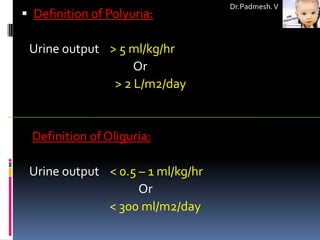
 Definition of Polyuria:

 Urine output > 5 ml/kg/hr
                   Or
               > 2 L/m2/day


  Definition of Oliguria:

 Urine output < 0.5 – 1 ml/kg/hr
                    Or
              < 300 ml/m2/day
Dr.Padmesh. V


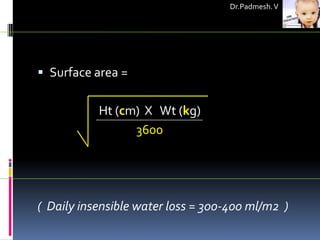
 Surface area =


           Ht (cm) X Wt (kg)
                 3600


( Daily insensible water loss = 300-400 ml/m2 )
Dr.Padmesh. V
 CAUSES OF POLYURIA:


 1. INCREASED FLUID INTAKE


 2. INCREASED URINARY SOLUTE EXCRETION


 3. IMPAIRED URINARY CONCENTRATION
   CAUSES OF POLYURIA:                                         Dr.Padmesh. V
   1. INCREASED FLUID INTAKE
         1.Iatrogenic
         2.Compulsive water drinking (Psychogenic polydipsia)
   2. INCREASED URINARY SOLUTE EXCRETION
   OSMOTIC DIURESIS:
         1.Diabetes mellitus
         2.Mannitol treatment
   SALT LOSS:
         1.Adrenal insufficiency
         2.Diuretics
         3.Cerebral salt wasting
         4.Aldosterone resistance
   3. IMPAIRED URINARY CONCENTRATION
   INEFFICIENT ADH ACTION: (DIABETES INSIPIDUS):
         1.CENTRAL (NEUROGENIC) DIABETES INSIPIDUS:
         2.NEPHROGENIC DIABETES INSIPIDUS:
   RENAL DISORDERS:
         1.Renal Tubular acidosis
         2.Bartter Syndrome
         3.Gitelman Syndrome
Dr.Padmesh. V
 CAUSES OF POLYURIA:
 1. INCREASED FLUID INTAKE:
 Iatrogenic
 Compulsive water drinking (Psychogenic polydipsia)
Dr.Padmesh. V
 CAUSES OF POLYURIA:
 2. INCREASED URINARY SOLUTE EXCRETION:

 OSMOTIC DIURESIS:
     1.Diabetes mellitus
     2.Mannitol treatment
 SALT LOSS:
     1.Adrenal insufficiency
     2.Diuretics
     3.Cerebral salt wasting
     4.Aldosterone resistance
Dr.Padmesh. V
 CAUSES OF POLYURIA:
 3. IMPAIRED URINARY CONCENTRATION:

 INEFFICIENT ADH ACTION: (DIABETES INSIPIDUS):
     1.CENTRAL (NEUROGENIC) DIABETES INSIPIDUS:
     2.NEPHROGENIC DIABETES INSIPIDUS:

 RENAL DISORDERS:
     1.Renal Tubular acidosis
     2.Bartter Syndrome
     3.Gitelman Syndrome
Dr.Padmesh. V
 CAUSES OF POLYURIA:
 3. IMPAIRED URINARY CONCENTRATION:

 INEFFICIENT ADH ACTION: (DIABETES INSIPIDUS):
     1.CENTRAL (NEUROGENIC) DIABETES INSIPIDUS:
           -Genetic defects: AR, AD, Wolfram DIDMOAD Synd.
           -Malformations: Septo-optic dysplasia,
            Holoprosencephaly,Anencephaly.
           -Neurological insults: Head trauma, Neurosurgery,
            Infection,Brain death.
           -Infiltrative disorders: Sarcoidosis, Histiocytosis.
           -CNS tumors: Craniopharyngioma, Germinoma,
            Pinealoma
Dr.Padmesh. V
 CAUSES OF POLYURIA:
 3. IMPAIRED URINARY CONCENTRATION:

 INEFFICIENT ADH ACTION: (DIABETES INSIPIDUS):
     2.NEPHROGENIC DIABETES INSIPIDUS:
           -Genetic: XL (V2 receptor defect), AR,
            AD (Aquaporin defect)
           -Acquired: Hypokalemia, Hypercalcemia,
           Obstructive uropathy, Nephrocalcinosis.
Dr.Padmesh. V


APPROACH TO POLYURIA:

 1.HISTORY
 2.CLINICAL EXAMINATION
 3.INVESTIGATIONS
Dr.Padmesh. V
 HISTORY:

 Age of onset: Congenital / Acquired


 H/O fever: UTI


 Failure to thrive: DM, Nephrogenic D.I, RTA, CAH, Bartter


 H/O head trauma,neurosurgery: Central D.I


 H/O meningitis: Central D.I
Dr.Padmesh. V
 HISTORY: contd…

 H/O weight loss: DM, RTA


 H/O rash,seborrhea: Histiocytosis


 H/O muscle weakness: Hypokalemia- RTA, Bartter


 H/O drug intake: Mannitol, Diuretics, out-dated Tetracyclines.
Dr.Padmesh. V
 HISTORY: contd…

 Symptoms of increased ICT: CNS tumors


 H/O polyuria, shock in newborn period: CAH


 H/O constipation,paresthesia: Hypercalcemia


 H/O psychological problems: Psychogenic polydipsia


 H/O abdominal cramps, arthralgia, etc: Sickle cell anemia
Dr.Padmesh. V
 CLINICAL EXAMINATION:

 Anthropometry: To r/o Failure to thrive : DM, DI, RTA, CAH


 Fever: UTI


 Mental retardation: CNS malformations


 Neurological deficits: CNS pathologies
Dr.Padmesh. V
 CLINICAL EXAMINATION:

 Genital ambiguity: CAH


 Mid line defects: Central D.I


 Features of Rickets: Renal Tubular Acidosis, Renal failure


 Acidotic breathing: RTA
Dr.Padmesh. V
 CLINICAL EXAMINATION:

 Rash, Seborrhea, ear discharge: Histiocytosis


 Hyperpigmentation: Adrenal insufficiency


 Muscle weakness,neck flop: Hypokalemia: RTA, Bartter


 Also look for signs of dehydration, shock..
Dr.Padmesh. V
 INVESTIGATIONS:

            24 hour urine output

           >5ml/kg/hr or >2L/m2/day

                 POLYURIA

            Further investigations
Dr.Padmesh. V
 INVESTIGATIONS: Contd…
 Urine examination for:

 WBCs: UTI


 Sugar: D.M


 Specific gravity: <1.005 – D.I


 Urine Osmolality: <300 mOsm/kg- D.I
Dr.Padmesh. V
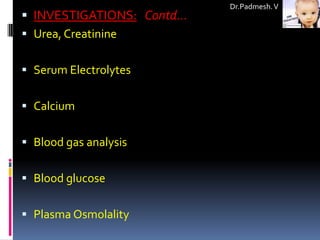
 INVESTIGATIONS: Contd…
 Urea, Creatinine


 Serum Electrolytes


 Calcium


 Blood gas analysis


 Blood glucose


 Plasma Osmolality
Dr.Padmesh. V
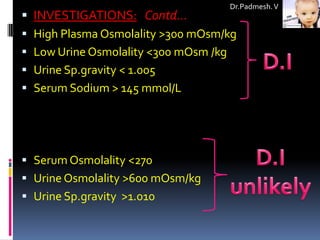
 INVESTIGATIONS: Contd…
 High Plasma Osmolality >300 mOsm/kg
 Low Urine Osmolality <300 mOsm /kg
 Urine Sp.gravity < 1.005
 Serum Sodium > 145 mmol/L


 Serum Osmolality <270
 Urine Osmolality >600 mOsm/kg
 Urine Sp.gravity >1.010
Dr.Padmesh. V
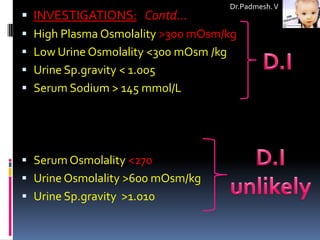
 INVESTIGATIONS: Contd…
 High Plasma Osmolality >300 mOsm/kg
 Low Urine Osmolality <300 mOsm /kg
 Urine Sp.gravity < 1.005
 Serum Sodium > 145 mmol/L


 Serum Osmolality <270
 Urine Osmolality >600 mOsm/kg
 Urine Sp.gravity >1.010
Dr.Padmesh. V
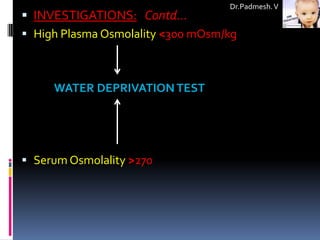
 INVESTIGATIONS: Contd…
 High Plasma Osmolality <300 mOsm/kg


     WATER DEPRIVATION TEST


 Serum Osmolality >270
Dr.Padmesh. V
 WATER DEPRIVATION TEST

-Determines ability of kidneys to concentrate urine.

-Useful in the diagnosis of DI.

-Requires careful supervision because dehydration and
 hypernatremia may occur.
Dr.Padmesh. V

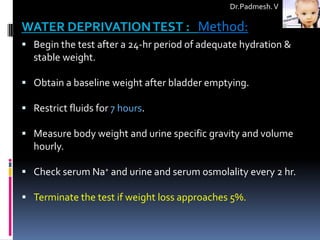
WATER DEPRIVATION TEST : Method:
 Begin the test after a 24-hr period of adequate hydration &
  stable weight.

 Obtain a baseline weight after bladder emptying.

 Restrict fluids for 7 hours.

 Measure body weight and urine specific gravity and volume
  hourly.

 Check serum Na+ and urine and serum osmolality every 2 hr.

 Terminate the test if weight loss approaches 5%.
Dr.Padmesh. V
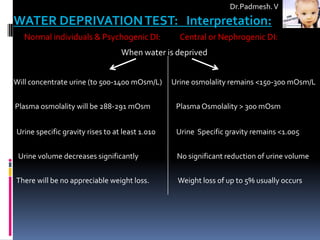
WATER DEPRIVATION TEST: Interpretation:
   Normal individuals & Psychogenic DI:            Central or Nephrogenic DI:
                                  When water is deprived


Will concentrate urine (to 500-1400 mOsm/L)      Urine osmolality remains <150-300 mOsm/L


Plasma osmolality will be 288-291 mOsm            Plasma Osmolality > 300 mOsm


Urine specific gravity rises to at least 1.010    Urine Specific gravity remains <1.005


 Urine volume decreases significantly             No significant reduction of urine volume


There will be no appreciable weight loss.         Weight loss of up to 5% usually occurs
Dr.Padmesh. V
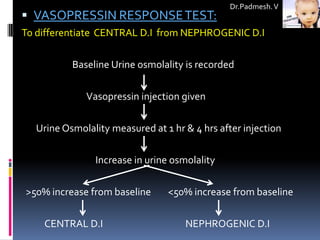
 VASOPRESSIN RESPONSE TEST:
To differentiate CENTRAL D.I from NEPHROGENIC D.I

          Baseline Urine osmolality is recorded

             Vasopressin injection given

  Urine Osmolality measured at 1 hr & 4 hrs after injection

               Increase in urine osmolality

>50% increase from baseline     <50% increase from baseline

    CENTRAL D.I                     NEPHROGENIC D.I
Dr.Padmesh. V
 OTHER TESTS:

 Central D.I: MRI of hypothalamic-pituitary region


 Nephrogenic D.I: Renal imaging


 Genetic Studies as required.
Dr.Padmesh. V

Approach to Polyuria in Children... Dr.Padmesh

  • 1.
    APPROACH TO POLYURIA Dr.Padmesh.V
  • 2.
    Dr.Padmesh. V  Definitionof Polyuria: Urine output > 5 ml/kg/hr Or > 2 L/m2/day Definition of Oliguria: Urine output < 0.5 – 1 ml/kg/hr Or < 300 ml/m2/day
  • 3.
    Dr.Padmesh. V  Surfacearea = Ht (cm) X Wt (kg) 3600 ( Daily insensible water loss = 300-400 ml/m2 )
  • 4.
    Dr.Padmesh. V  CAUSESOF POLYURIA:  1. INCREASED FLUID INTAKE  2. INCREASED URINARY SOLUTE EXCRETION  3. IMPAIRED URINARY CONCENTRATION
  • 5.
    CAUSES OF POLYURIA: Dr.Padmesh. V  1. INCREASED FLUID INTAKE 1.Iatrogenic 2.Compulsive water drinking (Psychogenic polydipsia)  2. INCREASED URINARY SOLUTE EXCRETION  OSMOTIC DIURESIS: 1.Diabetes mellitus 2.Mannitol treatment  SALT LOSS: 1.Adrenal insufficiency 2.Diuretics 3.Cerebral salt wasting 4.Aldosterone resistance  3. IMPAIRED URINARY CONCENTRATION  INEFFICIENT ADH ACTION: (DIABETES INSIPIDUS): 1.CENTRAL (NEUROGENIC) DIABETES INSIPIDUS: 2.NEPHROGENIC DIABETES INSIPIDUS:  RENAL DISORDERS: 1.Renal Tubular acidosis 2.Bartter Syndrome 3.Gitelman Syndrome
  • 6.
    Dr.Padmesh. V  CAUSESOF POLYURIA:  1. INCREASED FLUID INTAKE:  Iatrogenic  Compulsive water drinking (Psychogenic polydipsia)
  • 7.
    Dr.Padmesh. V  CAUSESOF POLYURIA:  2. INCREASED URINARY SOLUTE EXCRETION:  OSMOTIC DIURESIS: 1.Diabetes mellitus 2.Mannitol treatment  SALT LOSS: 1.Adrenal insufficiency 2.Diuretics 3.Cerebral salt wasting 4.Aldosterone resistance
  • 8.
    Dr.Padmesh. V  CAUSESOF POLYURIA:  3. IMPAIRED URINARY CONCENTRATION:  INEFFICIENT ADH ACTION: (DIABETES INSIPIDUS): 1.CENTRAL (NEUROGENIC) DIABETES INSIPIDUS: 2.NEPHROGENIC DIABETES INSIPIDUS:  RENAL DISORDERS: 1.Renal Tubular acidosis 2.Bartter Syndrome 3.Gitelman Syndrome
  • 9.
    Dr.Padmesh. V  CAUSESOF POLYURIA:  3. IMPAIRED URINARY CONCENTRATION:  INEFFICIENT ADH ACTION: (DIABETES INSIPIDUS): 1.CENTRAL (NEUROGENIC) DIABETES INSIPIDUS: -Genetic defects: AR, AD, Wolfram DIDMOAD Synd. -Malformations: Septo-optic dysplasia, Holoprosencephaly,Anencephaly. -Neurological insults: Head trauma, Neurosurgery, Infection,Brain death. -Infiltrative disorders: Sarcoidosis, Histiocytosis. -CNS tumors: Craniopharyngioma, Germinoma, Pinealoma
  • 10.
    Dr.Padmesh. V  CAUSESOF POLYURIA:  3. IMPAIRED URINARY CONCENTRATION:  INEFFICIENT ADH ACTION: (DIABETES INSIPIDUS): 2.NEPHROGENIC DIABETES INSIPIDUS: -Genetic: XL (V2 receptor defect), AR, AD (Aquaporin defect) -Acquired: Hypokalemia, Hypercalcemia, Obstructive uropathy, Nephrocalcinosis.
  • 11.
    Dr.Padmesh. V APPROACH TOPOLYURIA: 1.HISTORY 2.CLINICAL EXAMINATION 3.INVESTIGATIONS
  • 12.
    Dr.Padmesh. V  HISTORY: Age of onset: Congenital / Acquired  H/O fever: UTI  Failure to thrive: DM, Nephrogenic D.I, RTA, CAH, Bartter  H/O head trauma,neurosurgery: Central D.I  H/O meningitis: Central D.I
  • 13.
    Dr.Padmesh. V  HISTORY:contd…  H/O weight loss: DM, RTA  H/O rash,seborrhea: Histiocytosis  H/O muscle weakness: Hypokalemia- RTA, Bartter  H/O drug intake: Mannitol, Diuretics, out-dated Tetracyclines.
  • 14.
    Dr.Padmesh. V  HISTORY:contd…  Symptoms of increased ICT: CNS tumors  H/O polyuria, shock in newborn period: CAH  H/O constipation,paresthesia: Hypercalcemia  H/O psychological problems: Psychogenic polydipsia  H/O abdominal cramps, arthralgia, etc: Sickle cell anemia
  • 15.
    Dr.Padmesh. V  CLINICALEXAMINATION:  Anthropometry: To r/o Failure to thrive : DM, DI, RTA, CAH  Fever: UTI  Mental retardation: CNS malformations  Neurological deficits: CNS pathologies
  • 16.
    Dr.Padmesh. V  CLINICALEXAMINATION:  Genital ambiguity: CAH  Mid line defects: Central D.I  Features of Rickets: Renal Tubular Acidosis, Renal failure  Acidotic breathing: RTA
  • 17.
    Dr.Padmesh. V  CLINICALEXAMINATION:  Rash, Seborrhea, ear discharge: Histiocytosis  Hyperpigmentation: Adrenal insufficiency  Muscle weakness,neck flop: Hypokalemia: RTA, Bartter  Also look for signs of dehydration, shock..
  • 18.
    Dr.Padmesh. V  INVESTIGATIONS: 24 hour urine output >5ml/kg/hr or >2L/m2/day POLYURIA Further investigations
  • 19.
    Dr.Padmesh. V  INVESTIGATIONS:Contd…  Urine examination for:  WBCs: UTI  Sugar: D.M  Specific gravity: <1.005 – D.I  Urine Osmolality: <300 mOsm/kg- D.I
  • 20.
    Dr.Padmesh. V  INVESTIGATIONS:Contd…  Urea, Creatinine  Serum Electrolytes  Calcium  Blood gas analysis  Blood glucose  Plasma Osmolality
  • 21.
    Dr.Padmesh. V  INVESTIGATIONS:Contd…  High Plasma Osmolality >300 mOsm/kg  Low Urine Osmolality <300 mOsm /kg  Urine Sp.gravity < 1.005  Serum Sodium > 145 mmol/L  Serum Osmolality <270  Urine Osmolality >600 mOsm/kg  Urine Sp.gravity >1.010
  • 22.
    Dr.Padmesh. V  INVESTIGATIONS:Contd…  High Plasma Osmolality >300 mOsm/kg  Low Urine Osmolality <300 mOsm /kg  Urine Sp.gravity < 1.005  Serum Sodium > 145 mmol/L  Serum Osmolality <270  Urine Osmolality >600 mOsm/kg  Urine Sp.gravity >1.010
  • 23.
    Dr.Padmesh. V  INVESTIGATIONS:Contd…  High Plasma Osmolality <300 mOsm/kg WATER DEPRIVATION TEST  Serum Osmolality >270
  • 24.
    Dr.Padmesh. V  WATERDEPRIVATION TEST -Determines ability of kidneys to concentrate urine. -Useful in the diagnosis of DI. -Requires careful supervision because dehydration and hypernatremia may occur.
  • 25.
    Dr.Padmesh. V WATER DEPRIVATIONTEST : Method:  Begin the test after a 24-hr period of adequate hydration & stable weight.  Obtain a baseline weight after bladder emptying.  Restrict fluids for 7 hours.  Measure body weight and urine specific gravity and volume hourly.  Check serum Na+ and urine and serum osmolality every 2 hr.  Terminate the test if weight loss approaches 5%.
  • 26.
    Dr.Padmesh. V WATER DEPRIVATIONTEST: Interpretation: Normal individuals & Psychogenic DI: Central or Nephrogenic DI: When water is deprived Will concentrate urine (to 500-1400 mOsm/L) Urine osmolality remains <150-300 mOsm/L Plasma osmolality will be 288-291 mOsm Plasma Osmolality > 300 mOsm Urine specific gravity rises to at least 1.010 Urine Specific gravity remains <1.005 Urine volume decreases significantly No significant reduction of urine volume There will be no appreciable weight loss. Weight loss of up to 5% usually occurs
  • 27.
    Dr.Padmesh. V  VASOPRESSINRESPONSE TEST: To differentiate CENTRAL D.I from NEPHROGENIC D.I Baseline Urine osmolality is recorded Vasopressin injection given Urine Osmolality measured at 1 hr & 4 hrs after injection Increase in urine osmolality >50% increase from baseline <50% increase from baseline CENTRAL D.I NEPHROGENIC D.I
  • 28.
    Dr.Padmesh. V  OTHERTESTS:  Central D.I: MRI of hypothalamic-pituitary region  Nephrogenic D.I: Renal imaging  Genetic Studies as required.
  • 29.