COSC 426: Augmented Reality
     426 A        d R li

           Mark Billinghurst
     mark.billinghurst@hitlabnz.org

               July 2011

               Lecture 1
Mark Billinghurst
PhD Electrical Engineering
  University of Washington
Interaction Design
  Museum experiences
  Tools for designers
Augmented Reality
  Mobile AR, Evaluation
         AR Evaluation,
  Multimodal Interfaces, Collaborative
Collaboration
  Enhanced FtF and remote collaboration
  Social networking
Overview
One tow hour lectures week
  Friday 9 – 11am
You will learn
  Introduction to Augmented Reality
  Augmented Reality technology
  AR Interaction techniques
  Interaction Design
  AR authoring tools
  Research directions in AR
Complete a simple project
Course Outline
                  C      O l
Wk 1 (July 15th): Introduction to AR
     (J y      )
Wk 2 (July 22nd): AR Technology
Wk 3 (July 29th): AR Developer Tools
     (J y      )             p
Wk 4 (Aug 5th): AR Interaction Techniques
Wk 5 (Aug 12th): AR Applications
Wk 6 (Aug 19th): Outdoor and Mobile AR
Wk 7,8 (Aug 26th, Sept 2nd): Holidays
Wk 9 (Sept 9th): Collaborative AR
Wk 10 (Sept 16th): Usability Testing
Wk 11 (Sept 23rd): AR research Directions
Wk 12 (Sept 30th): Final Project Presentations
Assessment - Update
Research project – 40%
  Group work (2-4 people)
  Due Sept 30th
Two Class Assignments – 20 %
  Programming assignments, individual work
     g      g     g      ,
Final Exam – 40%
  Exam week Oct 3rd – 14th
  E       kO      d
Introduction
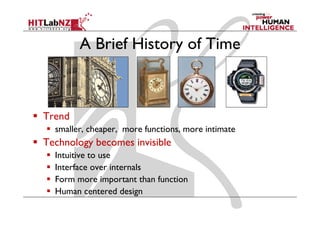
A Brief History of Time


Trend
T d
  smaller, cheaper, more functions, more intimate
Technology b
T h l      becomes invisible
                         bl
  Intuitive to use
  Interface over internals
  I    f          i     l
  Form more important than function
  Human centered design
  H            t dd i
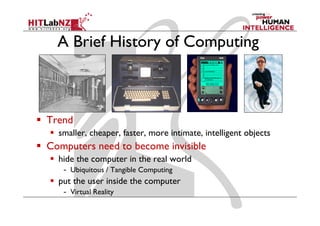
A Brief History of Computing
    B fH           fC


Trend
  smaller, cheaper, faster, more intimate, intelligent objects
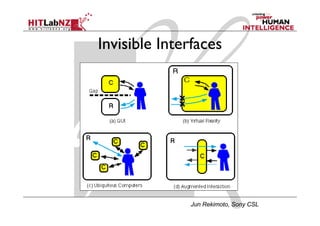
Computers need to become invisible
  hide the computer in the real world
   - Ubiquitous / Tangible Computing
  put the user inside the computer
   - Vi
     Virtual R li
           l Reality
Invisible Interfaces


              Jun Rekimoto, Sony CSL
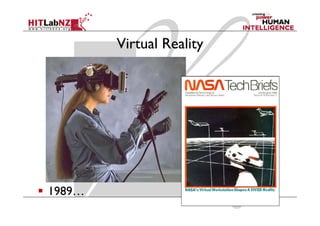
Virtual Reality


1989…
1989
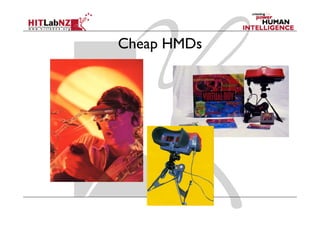
Cheap HMDs
Virtual Reality


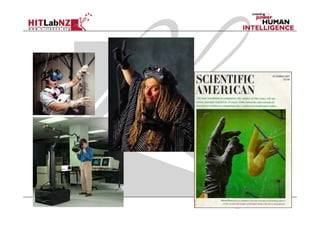
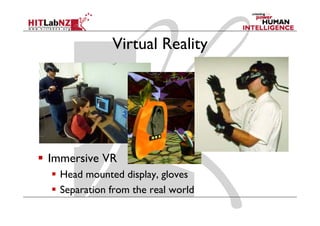
Immersive VR
  Head mounted display, gloves
  Separation from the real world
VR Today


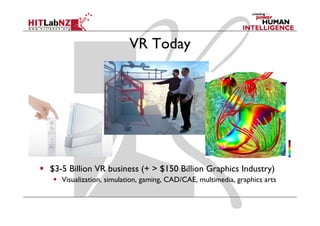
$3-5 Billion VR business (+ > $150 Billion Graphics Industry)
   Visualization, simulation, gaming, CAD/CAE, multimedia, graphics arts
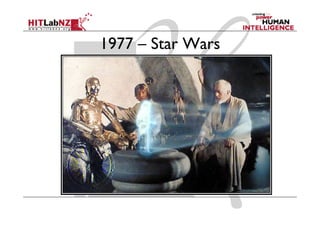
1977 – Star Wars
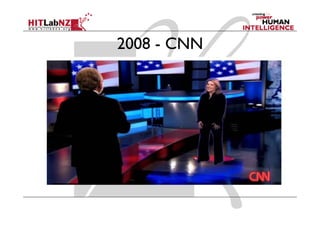
2008 - CNN
Augmented Reality Definition
Defining Characteristics [Azuma 97]
D f      Ch              [A
  Combines Real and Virtual Images
   - Both can be seen at the same time
  Interactive in real-time
   - The virtual content can be interacted with
  Registered in 3D
    g
   - Virtual objects appear fixed in space
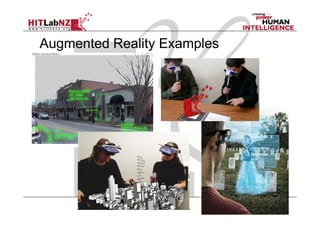
Augmented Reality Examples
 Put AR pictures here
AR vs VR
Virtual Reality: Replaces Reality
  Scene Generation: requires realistic images
                         q                g
  Display Device: fully immersive, wide FOV
  Tracking and Sensing: low accuracy is okay
Augmented Reality: Enhances Reality
  Scene Generation: minimal rendering okay
  Display Device: non-immersive small FOV
                  non immersive,
  Tracking and Sensing: high accuracy needed
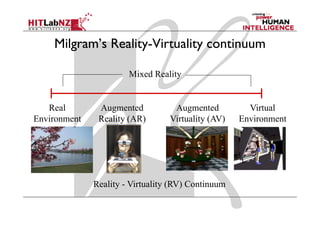
Milgram’s Reality-Virtuality continuum

                       Mixed Reality


   Real        Augmented           Augmented          Virtual
Environment    Reality (AR)       Virtuality (AV)   Environment


              Reality - Virtuality (RV) Continuum
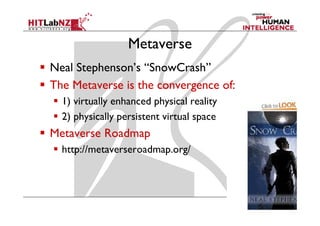
Metaverse
Neal Stephenson’s “SnowCrash”
The Metaverse is the convergence of:
  1) virtually enhanced physical reality
  2) physically persistent virtual space
      h      ll                  l
Metaverse Roadmap
                p
  http://metaverseroadmap.org/
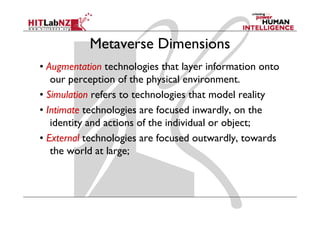
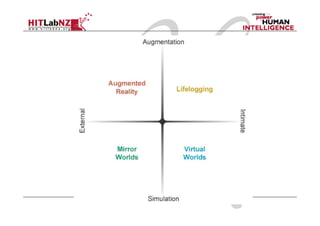
Metaverse Dimensions
• Augmentation technologies that layer information onto
   our perception of the physical environment.
• Simulation refers to technologies that model reality
• Intimate technologies are focused inwardly, on the
   identity and actions of the individual or object;
• External technologies are focused outwardly, towards
                                      outwardly
   the world at large;
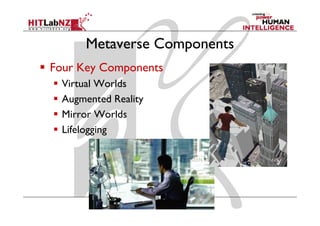
Metaverse Components
Four Key Components
  Virtual Worlds
  Augmented Reality
  Mirror Worlds
  Lifelogging
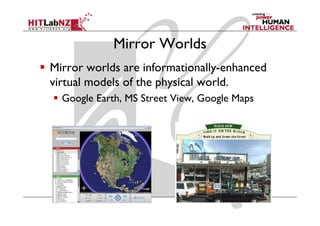
Mirror Worlds
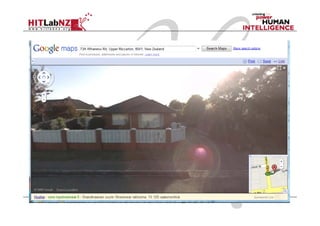
Mirror worlds are informationally-enhanced
virtual models of the physical world.
                      p y
  Google Earth, MS Street View, Google Maps
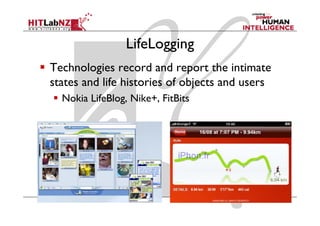
LifeLogging
Technologies record and report the intimate
states and life histories of objects and users
                               j
  Nokia LifeBlog, Nike+, FitBits
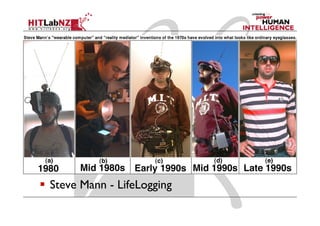
Steve Mann - LifeLogging
                   gg g
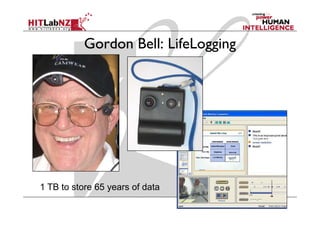
Gordon Bell: LifeLogging


1 TB to store 65 years of data
Summary
Augmented Reality has three key features
  Combines Real and Virtual Images
                               g
  Interactive in real-time
  Registered in 3D
AR can be classified alongside other technologies
  Milgrams Mixed Reality continuum
  MetaVerse
AR History
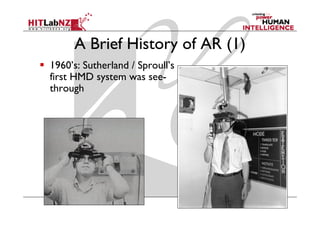
A Brief History of AR (1)
1960’s: Sutherland Sproull’s
1960’ S h l d / S       ll’
first HMD system was see-
through
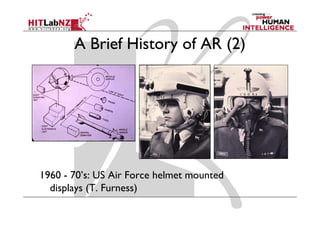
A Brief History of AR (2)


1960 - 70’s: US Air Force helmet mounted
  displays (T. Furness)
           (T
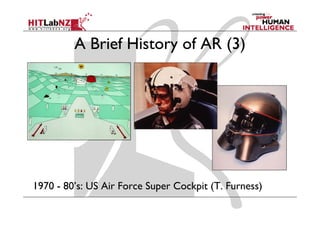
A Brief History of AR (3)


1970 - 80’s: US Air Force Super Cockpit ( Furness)
                            p       p (T.        )
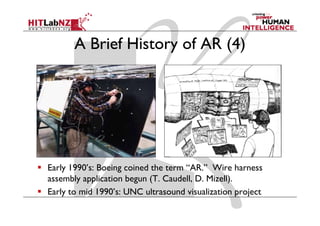
A Brief History of AR (4)


Early 1990’s: Boeing coined the term “AR.” Wire harness
        990’                         “A ”
assembly application begun (T. Caudell, D. Mizell).
Early t
E l to mid 1990’s: UNC ultrasound visualization project
           id 1990’         lt      d i li ti       j t
A Brief History of AR (5)


1994: Motion stabilized display [Azuma]
1995: Fiducial tracking in video see-through [Bajura / Neumann]
1996: UNC hybrid magnetic-vision tracker
              y        g
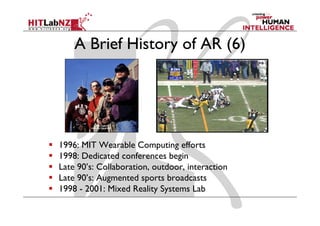
A Brief History of AR (6)


1996: MIT Wearable Computing efforts
1998: Dedicated conferences begin
Late 90’s: Collaboration, outdoor, i
L    90’ C ll b      i       d     interaction
                                           i
Late 90’s: Augmented sports broadcasts
1998 - 2001: Mixed Reality Systems Lab
History Summary
1960’s – 80’s: Early Experimentation
1980 s 90 s:
1980’s – 90’s: Basic Research
  Tracking, displays
1995 – 2005: Tools/Applications
  Interaction, usability, theory
                       y       y
2005 - : Commercial Applications
  Games, M di l Industry
  G      Medical, I d
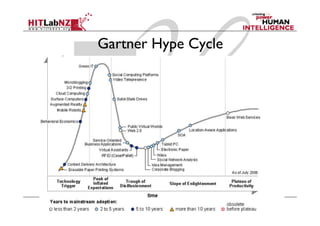
Gartner Hype Cycle
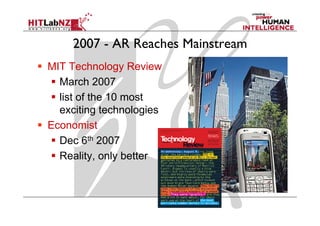
2007 - AR Reaches Mainstream
MIT Technology Review
  March 2007
  list of the 10 most
  exciting technologies
Economist
  Dec 6th 2007
  Reality, only better
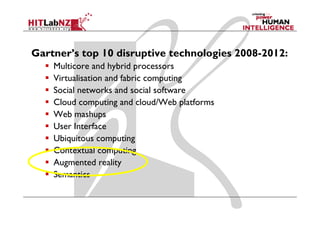
Gartner’s top 10 disruptive technologies 2008-2012:
    Multicore and hybrid processors
    Virtualisation and fabric computing
    Social
    S i l networks and social software
                   k    d     i l f
    Cloud computing and cloud/Web platforms
    Web mash s
          mashups
    User Interface
    Ubiquitous computing
    Contextual computing
    Augmented reality
    Semantics
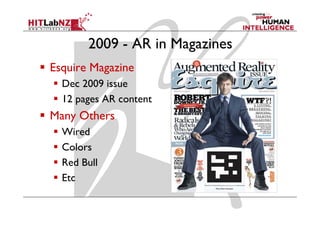
2009 - AR in Magazines
Esquire Magazine
  Dec 2009 issue
  12 pages AR content
Many Others
M    Oth
  Wired
  Colors
  Red Bull
  Etc
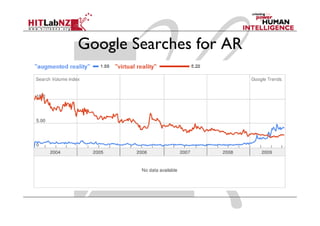
Google Searches for AR
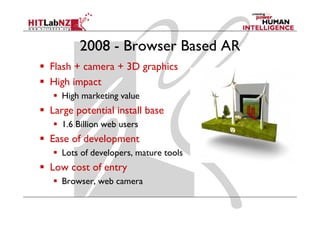
2008 - Browser Based AR
Flash + camera + 3D graphics
High impact
   g    p
  High marketing value
Large potential install base
  1.6 Billion web users
Ease of development
  Lots of developers, mature tools
Low cost of entry
L         f
  Browser, web camera
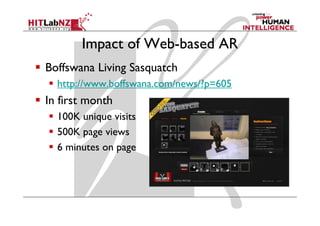
Impact of Web-based AR
Boffswana Living Sasquatch
  http://www.boffswana.com/news/?p=605
     p                           p
In first month
  100K unique visits
  500K page views
  6 minutes on page
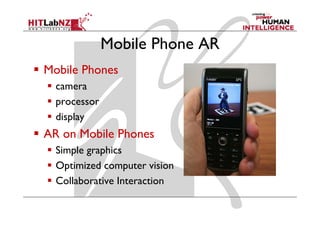
Mobile Phone AR
Mobile Phones
  camera
  processor
  display
  d l
AR on Mobile Phones
  Simple graphics
  Optimized computer vision
  Collaborative Interaction
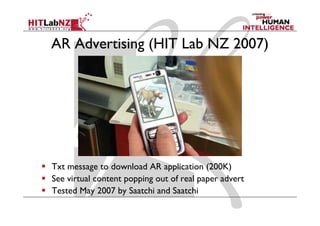
AR Advertising (HIT Lab NZ 2007)


Txt
T message to d  download AR application (200K)
                      l d         li i
See virtual content popping out of real paper advert
Tested May 2007 by Saatchi and Saatchi
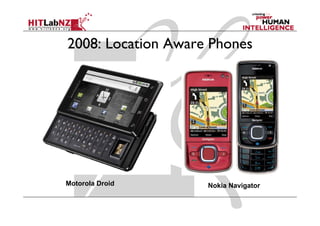
2008: Location Aware Phones


Motorola Droid      Nokia Navigator
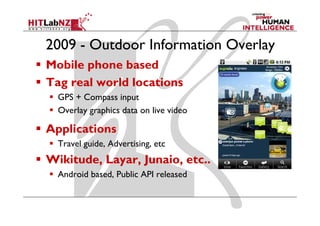
2009 - Outdoor Information Overlay
Mobile h
M bil phone based
              b   d
Tag real world locations
  g
  GPS + Compass input
  Overlay graphics data on live video

Applications
  Travel guide, Advertising, etc
Wikitude, Layar, Junaio, etc..
        , y ,J         ,
  Android based, Public API released
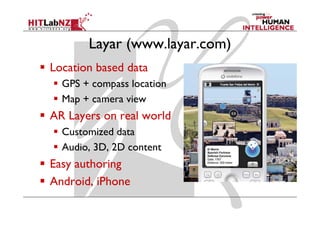
Layar (www.layar.com)
Location based data
  GPS + compass location
           p
  Map + camera view
AR Layers on real world
   L            l    ld
  Customized data
  Audio, 3D, 2D content
Easy authoring
Android, iPhone
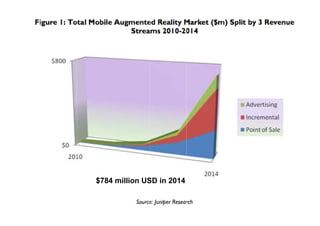
$784 million USD in 2014
Some Commercial AR Companies
ARToolworks (http://www artoolworks com/)
            (http://www.artoolworks.com/)
  ARToolKit, FLARToolKit, SDKs
Metaio (http://www.metaio.com/)
  Marketing, Industry, SDKs
Total Immersion (http://www.t-immersion.com/)
  Marketing, Theme Parks, AR Experiences
Qua co
Qualcomm
(http://developer.qualcomm.com/dev/augmented-reality)
   Mobile AR QCAR SDK
           AR,
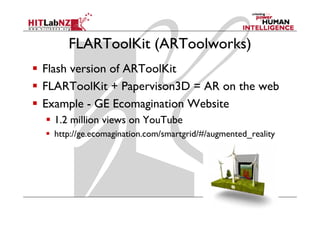
FLARToolKit (ARToolworks)
Flash version of ARToolKit
FLARToolKit + Papervison3D = AR on the web
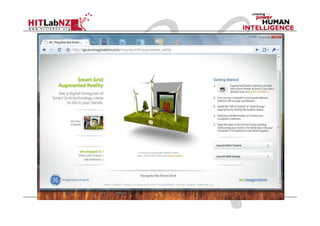
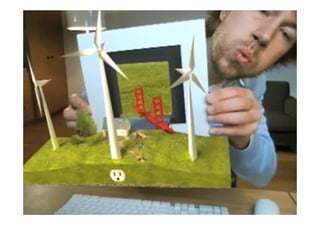
Example - GE Ecomagination Website
  1.2 million views on YouTube
  http://ge.ecomagination.com/smartgrid/#/augmented_reality
     p g         g                 g        g             y
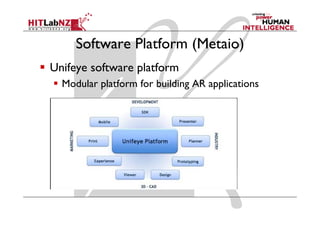
Software Platform (Metaio)
Unifeye software platform
  Modular platform for building AR applications
          p                   g     pp
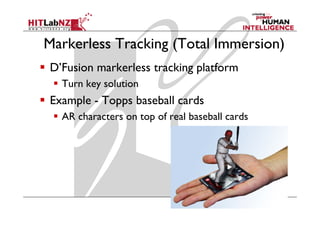
Markerless Tracking (Total Immersion)
D’Fusion markerless tracking platform
  Turn key solution
         y
Example - Topps baseball cards
  AR characters on top of real baseball cards
      h                 f    l b b ll      d
Summary
Augmented Reality has a long history going
back to the 1960’s
Interest in AR has exploded over the last two
years and is being commercialized quickly
AR is growing in a number of areas
  Mobile AR
  Web based AR
  Advertising experiences
Sample AR Applications
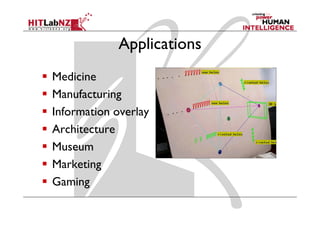
Applications
Medicine
Manufacturing
Information overlay
Architecture
Museum
Marketing
Gaming
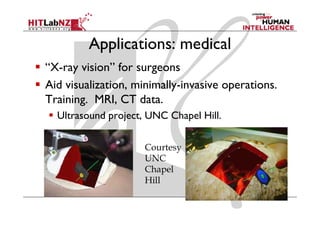
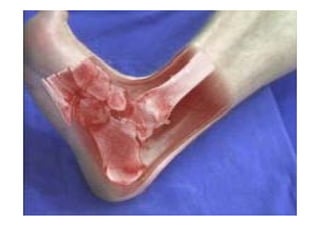
Applications: medical
“X-ray vision” for surgeons
Aid visualization, minimally-invasive operations.
                   minimally invasive
Training. MRI, CT data.
  Ultrasound project, UNC Ch l Hill
  Ul       d    j         Chapel Hill.

                     Courtesy
                     UNC
                     Chapel
                     Hill
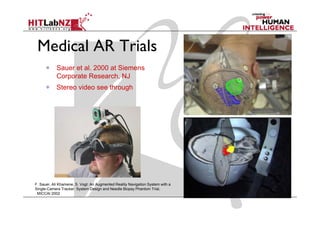
Medical AR Trials
            Sauer et al. 2000 at Siemens
            Corporate Research, NJ
            Stereo video see through


F. Sauer, Ali Khamene, S. Vogt: An Augmented Reality Navigation System with a
Single Camera
Single-Camera Tracker: System Design and Needle Biopsy Phantom Trial,
 MICCAI 2002
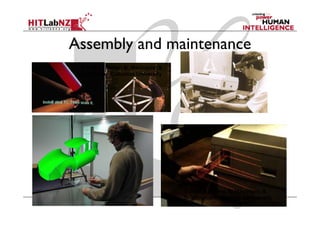
Assembly and maintenance
 © 1996 S. Feiner, B. MacIntyre, &
 A. Webster, Columbia University


                                     © 1993 S F i
                                             S. Feiner, B M I t
                                                        B. MacIntyre, &
                                     D. Seligmann, Columbia University
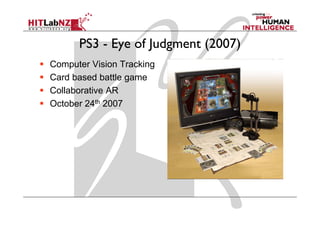
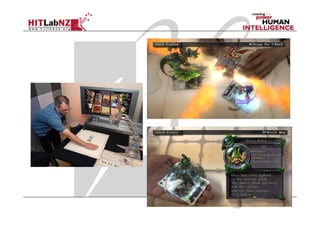
PS3 - Eye of Judgment (2007)
Computer Vi i T ki
C      t Vision Tracking
Card based battle game
Collaborative
C ll b ti AR
October 24th 2007
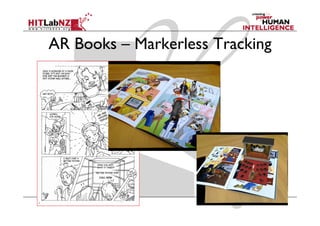
AR Books – Markerless Tracking
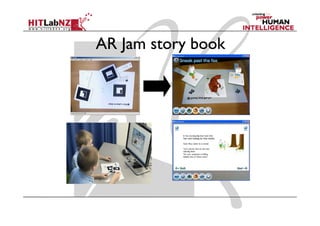
AR Jam story book
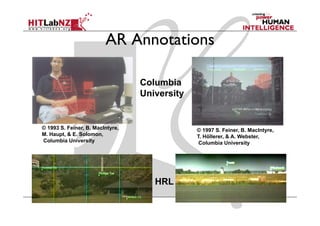
AR A
                            Annotations
                                t ti

                                  Columbia
                                  University


© 1993 S. Feiner, B. MacIntyre,                © 1997 S. Feiner, B. MacIntyre,
M. Haupt, & E. Solomon,                        T. Höllerer, & A. Webster,
                                                          ,             ,
Columbia U i
C l bi University  i                            Columbia University


                                     HRL
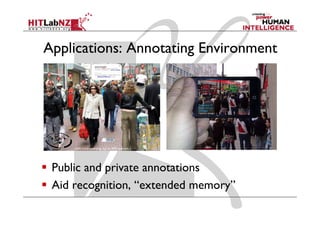
Applications: Annotating Environment


 Public d i
 P bli and private annotations
                          i
 Aid recognition, “extended memory”
         g      ,                y
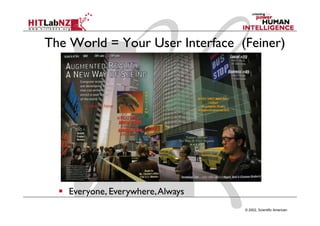
The World = Your User Interface (Feiner)


    Everyone, Everywhere, Always
    E         E     h     Al
                                   © 2002, Scientific American
Application: Broadcast Augmentation
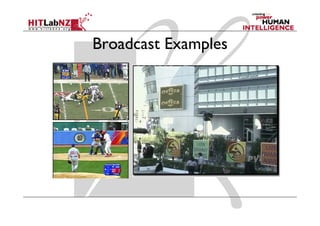
Adding virtual content to live sports broadcasts
  “First down” line in American football
   First down
  Hockey puck trails, virtual advertisements
  National flags in swimming lanes in 2000 Olympics
Commercial application
  Princeton Video Image is one company
   - http://www.pvi.tv/
Broadcast Examples
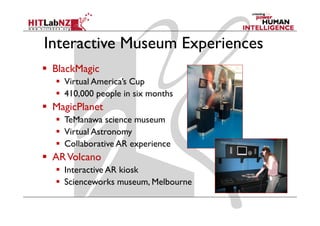
Interactive Museum Experiences
 BlackMagic
   Virtual America’s Cup
   410,000 people in six months
 MagicPlanet
   TeManawa science museum
   Virtual Astronomy
   Collaborative AR experience
 AR Volcano
   Interactive AR kiosk
   Scienceworks museum, Melbourne
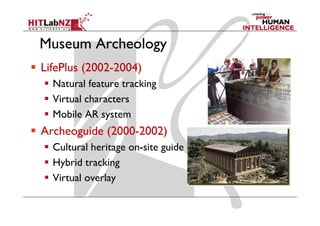
Museum Archeology
LifePlus (2002-2004)
  Natural feature tracking
                         g
  Virtual characters
  Mobile AR system
Archeoguide (2000-2002)
  Cultural heritage on-site guide
  Hybrid tracking
  Virtual overlay
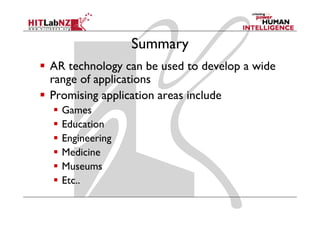
Summary
AR technology can b used to develop a wide
       h l          be    d d l         d
range of applications
Promising application areas include
  Games
  Education
  Engineering
  Medicine
  Museums
  M
  Etc..
AR Experience Design
“The product is no longer
 The
  the basis of value The
               value.
      experience is ”
                   is.

      Venkat Ramaswamy
      The Future of Competition.
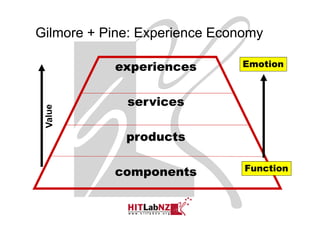
Gilmore + Pine: Experience Economy

           experiences        Emotion
                              E  ti


             services

             products

           components          Function


                                 Sony CSL © 2004
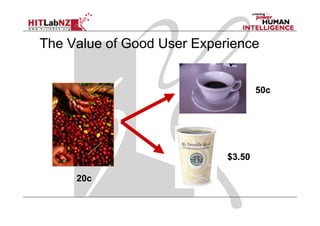
The Value of Good User Experience


                                    50c
                                    50


                            $3.50

     20c
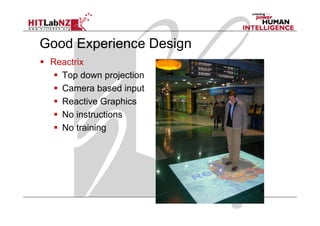
Good Experience Design
 Reactrix
   Top down projection
   Camera based input
   Reactive Graphics
   No instructions
   No training
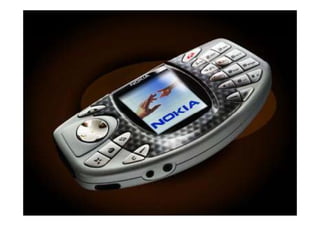
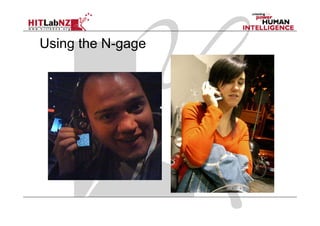
Using the N-gage
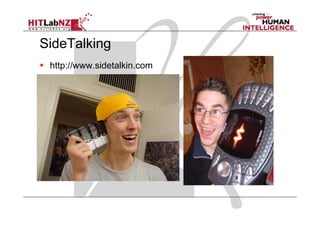
SideTalking
 http://www.sidetalkin.com
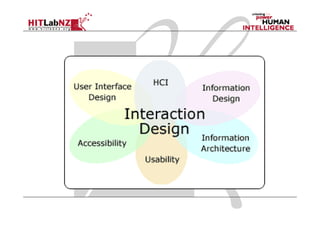
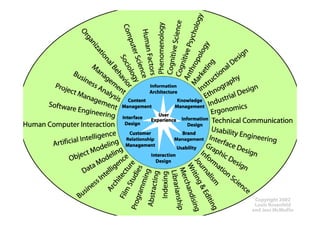
Interaction Design
 “Designing interactive products to support people in their
   everyday and working lives”
                           lives
                      Preece, J., (2002). Interaction Design

   Design of User Experience with Technology
     Higher in the value chain than product design
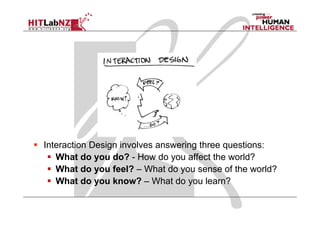
Interaction Design involves answering three questions:
   What do you do? - How do you affect the world?
   What do you feel? – What do you sense of the world?
   What do you know? – What do you learn?
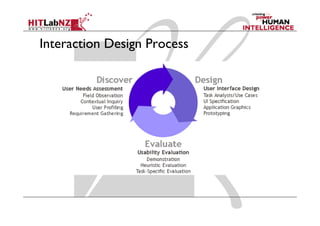
Interaction Design Process
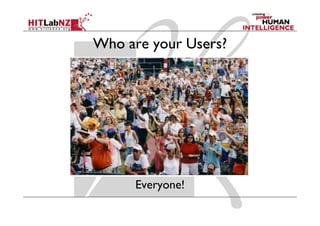
Who are your Users?


      Everyone!
          y
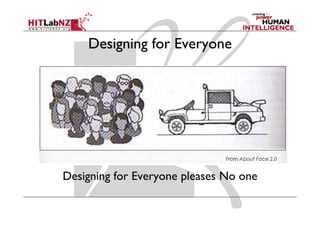
Designing for Everyone


Designing for Everyone pleases No one
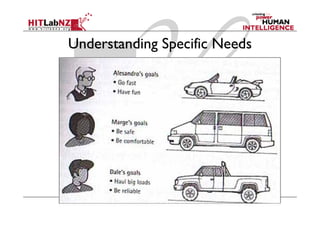
Understanding Specific Needs
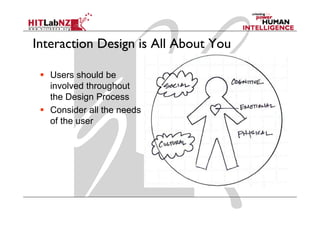
Interaction Design is All About You

   Users should be
   involved throughout
   the Design Process
   Co s de all the eeds
   Consider a t e needs
   of the user
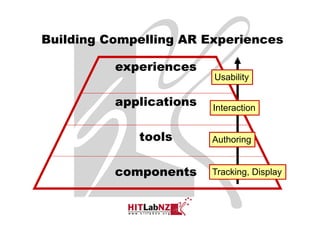
Building Compelling AR Experiences
B ildi   C    lli      E    i

          experiences
                         Usability

          applications   Interaction


             tools       Authoring


          components     Tracking, Display
Summary
In order to build AR applications you need to
                    p
focus on the user experience
Great user experience is based on
  Low l l AR component technology
  L    level                    h l
  Authoring tools
  Application/Interaction design
  User experience texting

COSC 426 Lect. 1 - Introduction to AR

  • 1.
    COSC 426: AugmentedReality 426 A d R li Mark Billinghurst mark.billinghurst@hitlabnz.org July 2011 Lecture 1
  • 2.
    Mark Billinghurst PhD ElectricalEngineering University of Washington Interaction Design Museum experiences Tools for designers Augmented Reality Mobile AR, Evaluation AR Evaluation, Multimodal Interfaces, Collaborative Collaboration Enhanced FtF and remote collaboration Social networking
  • 3.
    Overview One tow hourlectures week Friday 9 – 11am You will learn Introduction to Augmented Reality Augmented Reality technology AR Interaction techniques Interaction Design AR authoring tools Research directions in AR Complete a simple project
  • 4.
    Course Outline C O l Wk 1 (July 15th): Introduction to AR (J y ) Wk 2 (July 22nd): AR Technology Wk 3 (July 29th): AR Developer Tools (J y ) p Wk 4 (Aug 5th): AR Interaction Techniques Wk 5 (Aug 12th): AR Applications Wk 6 (Aug 19th): Outdoor and Mobile AR Wk 7,8 (Aug 26th, Sept 2nd): Holidays Wk 9 (Sept 9th): Collaborative AR Wk 10 (Sept 16th): Usability Testing Wk 11 (Sept 23rd): AR research Directions Wk 12 (Sept 30th): Final Project Presentations
  • 5.
    Assessment - Update Researchproject – 40% Group work (2-4 people) Due Sept 30th Two Class Assignments – 20 % Programming assignments, individual work g g g , Final Exam – 40% Exam week Oct 3rd – 14th E kO d
  • 6.
  • 7.
    A Brief Historyof Time Trend T d smaller, cheaper, more functions, more intimate Technology b T h l becomes invisible bl Intuitive to use Interface over internals I f i l Form more important than function Human centered design H t dd i
  • 8.
    A Brief Historyof Computing B fH fC Trend smaller, cheaper, faster, more intimate, intelligent objects Computers need to become invisible hide the computer in the real world - Ubiquitous / Tangible Computing put the user inside the computer - Vi Virtual R li l Reality
  • 9.
    Invisible Interfaces Jun Rekimoto, Sony CSL
  • 10.
  • 12.
  • 13.
    Virtual Reality Immersive VR Head mounted display, gloves Separation from the real world
  • 14.
    VR Today $3-5 BillionVR business (+ > $150 Billion Graphics Industry) Visualization, simulation, gaming, CAD/CAE, multimedia, graphics arts
  • 15.
  • 16.
  • 17.
    Augmented Reality Definition DefiningCharacteristics [Azuma 97] D f Ch [A Combines Real and Virtual Images - Both can be seen at the same time Interactive in real-time - The virtual content can be interacted with Registered in 3D g - Virtual objects appear fixed in space
  • 18.
    Augmented Reality Examples Put AR pictures here
  • 19.
    AR vs VR VirtualReality: Replaces Reality Scene Generation: requires realistic images q g Display Device: fully immersive, wide FOV Tracking and Sensing: low accuracy is okay Augmented Reality: Enhances Reality Scene Generation: minimal rendering okay Display Device: non-immersive small FOV non immersive, Tracking and Sensing: high accuracy needed
  • 20.
    Milgram’s Reality-Virtuality continuum Mixed Reality Real Augmented Augmented Virtual Environment Reality (AR) Virtuality (AV) Environment Reality - Virtuality (RV) Continuum
  • 21.
    Metaverse Neal Stephenson’s “SnowCrash” TheMetaverse is the convergence of: 1) virtually enhanced physical reality 2) physically persistent virtual space h ll l Metaverse Roadmap p http://metaverseroadmap.org/
  • 22.
    Metaverse Dimensions • Augmentationtechnologies that layer information onto our perception of the physical environment. • Simulation refers to technologies that model reality • Intimate technologies are focused inwardly, on the identity and actions of the individual or object; • External technologies are focused outwardly, towards outwardly the world at large;
  • 23.
    Metaverse Components Four KeyComponents Virtual Worlds Augmented Reality Mirror Worlds Lifelogging
  • 25.
    Mirror Worlds Mirror worldsare informationally-enhanced virtual models of the physical world. p y Google Earth, MS Street View, Google Maps
  • 27.
    LifeLogging Technologies record andreport the intimate states and life histories of objects and users j Nokia LifeBlog, Nike+, FitBits
  • 28.
    Steve Mann -LifeLogging gg g
  • 29.
    Gordon Bell: LifeLogging 1TB to store 65 years of data
  • 30.
    Summary Augmented Reality hasthree key features Combines Real and Virtual Images g Interactive in real-time Registered in 3D AR can be classified alongside other technologies Milgrams Mixed Reality continuum MetaVerse
  • 31.
  • 32.
    A Brief Historyof AR (1) 1960’s: Sutherland Sproull’s 1960’ S h l d / S ll’ first HMD system was see- through
  • 33.
    A Brief Historyof AR (2) 1960 - 70’s: US Air Force helmet mounted displays (T. Furness) (T
  • 34.
    A Brief Historyof AR (3) 1970 - 80’s: US Air Force Super Cockpit ( Furness) p p (T. )
  • 35.
    A Brief Historyof AR (4) Early 1990’s: Boeing coined the term “AR.” Wire harness 990’ “A ” assembly application begun (T. Caudell, D. Mizell). Early t E l to mid 1990’s: UNC ultrasound visualization project id 1990’ lt d i li ti j t
  • 36.
    A Brief Historyof AR (5) 1994: Motion stabilized display [Azuma] 1995: Fiducial tracking in video see-through [Bajura / Neumann] 1996: UNC hybrid magnetic-vision tracker y g
  • 37.
    A Brief Historyof AR (6) 1996: MIT Wearable Computing efforts 1998: Dedicated conferences begin Late 90’s: Collaboration, outdoor, i L 90’ C ll b i d interaction i Late 90’s: Augmented sports broadcasts 1998 - 2001: Mixed Reality Systems Lab
  • 38.
    History Summary 1960’s –80’s: Early Experimentation 1980 s 90 s: 1980’s – 90’s: Basic Research Tracking, displays 1995 – 2005: Tools/Applications Interaction, usability, theory y y 2005 - : Commercial Applications Games, M di l Industry G Medical, I d
  • 39.
  • 40.
    2007 - ARReaches Mainstream MIT Technology Review March 2007 list of the 10 most exciting technologies Economist Dec 6th 2007 Reality, only better
  • 41.
    Gartner’s top 10disruptive technologies 2008-2012: Multicore and hybrid processors Virtualisation and fabric computing Social S i l networks and social software k d i l f Cloud computing and cloud/Web platforms Web mash s mashups User Interface Ubiquitous computing Contextual computing Augmented reality Semantics
  • 42.
    2009 - ARin Magazines Esquire Magazine Dec 2009 issue 12 pages AR content Many Others M Oth Wired Colors Red Bull Etc
  • 43.
  • 44.
    2008 - BrowserBased AR Flash + camera + 3D graphics High impact g p High marketing value Large potential install base 1.6 Billion web users Ease of development Lots of developers, mature tools Low cost of entry L f Browser, web camera
  • 47.
    Impact of Web-basedAR Boffswana Living Sasquatch http://www.boffswana.com/news/?p=605 p p In first month 100K unique visits 500K page views 6 minutes on page
  • 48.
    Mobile Phone AR MobilePhones camera processor display d l AR on Mobile Phones Simple graphics Optimized computer vision Collaborative Interaction
  • 49.
    AR Advertising (HITLab NZ 2007) Txt T message to d download AR application (200K) l d li i See virtual content popping out of real paper advert Tested May 2007 by Saatchi and Saatchi
  • 50.
    2008: Location AwarePhones Motorola Droid Nokia Navigator
  • 51.
    2009 - OutdoorInformation Overlay Mobile h M bil phone based b d Tag real world locations g GPS + Compass input Overlay graphics data on live video Applications Travel guide, Advertising, etc Wikitude, Layar, Junaio, etc.. , y ,J , Android based, Public API released
  • 52.
    Layar (www.layar.com) Location baseddata GPS + compass location p Map + camera view AR Layers on real world L l ld Customized data Audio, 3D, 2D content Easy authoring Android, iPhone
  • 53.
  • 54.
    Some Commercial ARCompanies ARToolworks (http://www artoolworks com/) (http://www.artoolworks.com/) ARToolKit, FLARToolKit, SDKs Metaio (http://www.metaio.com/) Marketing, Industry, SDKs Total Immersion (http://www.t-immersion.com/) Marketing, Theme Parks, AR Experiences Qua co Qualcomm (http://developer.qualcomm.com/dev/augmented-reality) Mobile AR QCAR SDK AR,
  • 55.
    FLARToolKit (ARToolworks) Flash versionof ARToolKit FLARToolKit + Papervison3D = AR on the web Example - GE Ecomagination Website 1.2 million views on YouTube http://ge.ecomagination.com/smartgrid/#/augmented_reality p g g g g y
  • 56.
    Software Platform (Metaio) Unifeyesoftware platform Modular platform for building AR applications p g pp
  • 57.
    Markerless Tracking (TotalImmersion) D’Fusion markerless tracking platform Turn key solution y Example - Topps baseball cards AR characters on top of real baseball cards h f l b b ll d
  • 58.
    Summary Augmented Reality hasa long history going back to the 1960’s Interest in AR has exploded over the last two years and is being commercialized quickly AR is growing in a number of areas Mobile AR Web based AR Advertising experiences
  • 59.
  • 60.
  • 61.
    Applications: medical “X-ray vision”for surgeons Aid visualization, minimally-invasive operations. minimally invasive Training. MRI, CT data. Ultrasound project, UNC Ch l Hill Ul d j Chapel Hill. Courtesy UNC Chapel Hill
  • 62.
    Medical AR Trials Sauer et al. 2000 at Siemens Corporate Research, NJ Stereo video see through F. Sauer, Ali Khamene, S. Vogt: An Augmented Reality Navigation System with a Single Camera Single-Camera Tracker: System Design and Needle Biopsy Phantom Trial, MICCAI 2002
  • 64.
    Assembly and maintenance © 1996 S. Feiner, B. MacIntyre, & A. Webster, Columbia University © 1993 S F i S. Feiner, B M I t B. MacIntyre, & D. Seligmann, Columbia University
  • 65.
    PS3 - Eyeof Judgment (2007) Computer Vi i T ki C t Vision Tracking Card based battle game Collaborative C ll b ti AR October 24th 2007
  • 67.
    AR Books –Markerless Tracking
  • 68.
  • 69.
    AR A Annotations t ti Columbia University © 1993 S. Feiner, B. MacIntyre, © 1997 S. Feiner, B. MacIntyre, M. Haupt, & E. Solomon, T. Höllerer, & A. Webster, , , Columbia U i C l bi University i Columbia University HRL
  • 70.
    Applications: Annotating Environment Public d i P bli and private annotations i Aid recognition, “extended memory” g , y
  • 71.
    The World =Your User Interface (Feiner) Everyone, Everywhere, Always E E h Al © 2002, Scientific American
  • 72.
    Application: Broadcast Augmentation Addingvirtual content to live sports broadcasts “First down” line in American football First down Hockey puck trails, virtual advertisements National flags in swimming lanes in 2000 Olympics Commercial application Princeton Video Image is one company - http://www.pvi.tv/
  • 73.
  • 74.
    Interactive Museum Experiences BlackMagic Virtual America’s Cup 410,000 people in six months MagicPlanet TeManawa science museum Virtual Astronomy Collaborative AR experience AR Volcano Interactive AR kiosk Scienceworks museum, Melbourne
  • 75.
    Museum Archeology LifePlus (2002-2004) Natural feature tracking g Virtual characters Mobile AR system Archeoguide (2000-2002) Cultural heritage on-site guide Hybrid tracking Virtual overlay
  • 76.
    Summary AR technology canb used to develop a wide h l be d d l d range of applications Promising application areas include Games Education Engineering Medicine Museums M Etc..
  • 77.
  • 78.
    “The product isno longer The the basis of value The value. experience is ” is. Venkat Ramaswamy The Future of Competition.
  • 79.
    Gilmore + Pine:Experience Economy experiences Emotion E ti services products components Function Sony CSL © 2004
  • 80.
    The Value ofGood User Experience 50c 50 $3.50 20c
  • 81.
    Good Experience Design Reactrix Top down projection Camera based input Reactive Graphics No instructions No training
  • 84.
  • 85.
  • 88.
    Interaction Design “Designinginteractive products to support people in their everyday and working lives” lives Preece, J., (2002). Interaction Design Design of User Experience with Technology Higher in the value chain than product design
  • 91.
    Interaction Design involvesanswering three questions: What do you do? - How do you affect the world? What do you feel? – What do you sense of the world? What do you know? – What do you learn?
  • 92.
  • 93.
    Who are yourUsers? Everyone! y
  • 94.
    Designing for Everyone Designingfor Everyone pleases No one
  • 95.
  • 97.
    Interaction Design isAll About You Users should be involved throughout the Design Process Co s de all the eeds Consider a t e needs of the user
  • 100.
    Building Compelling ARExperiences B ildi C lli E i experiences Usability applications Interaction tools Authoring components Tracking, Display
  • 101.
    Summary In order tobuild AR applications you need to p focus on the user experience Great user experience is based on Low l l AR component technology L level h l Authoring tools Application/Interaction design User experience texting