Electroencephalography (EEG) basics
IVE Winter School 2024
Ina Bornkessel-Schlesewsky, Matthias Schlesewsky
July 16th 2024
1
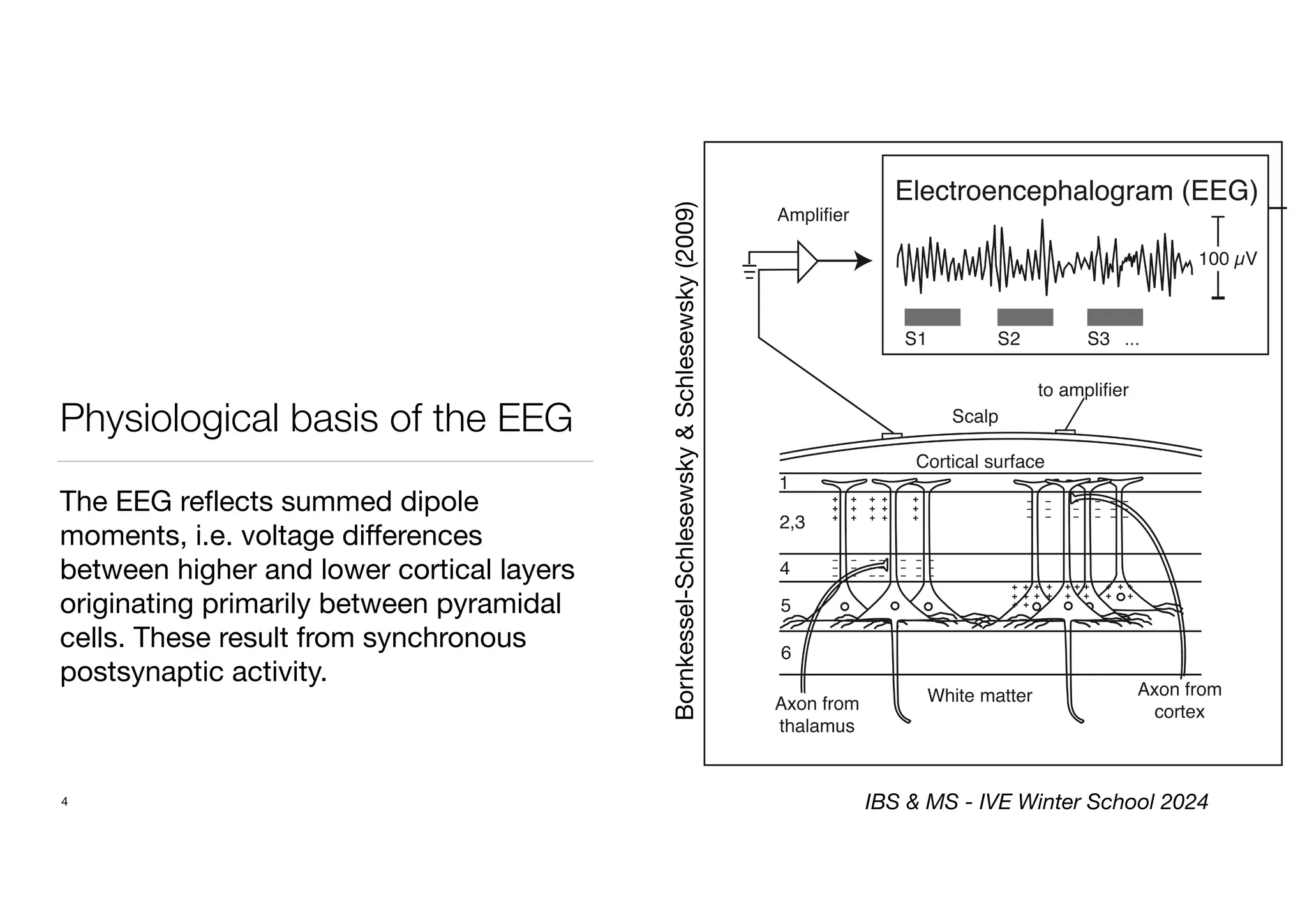
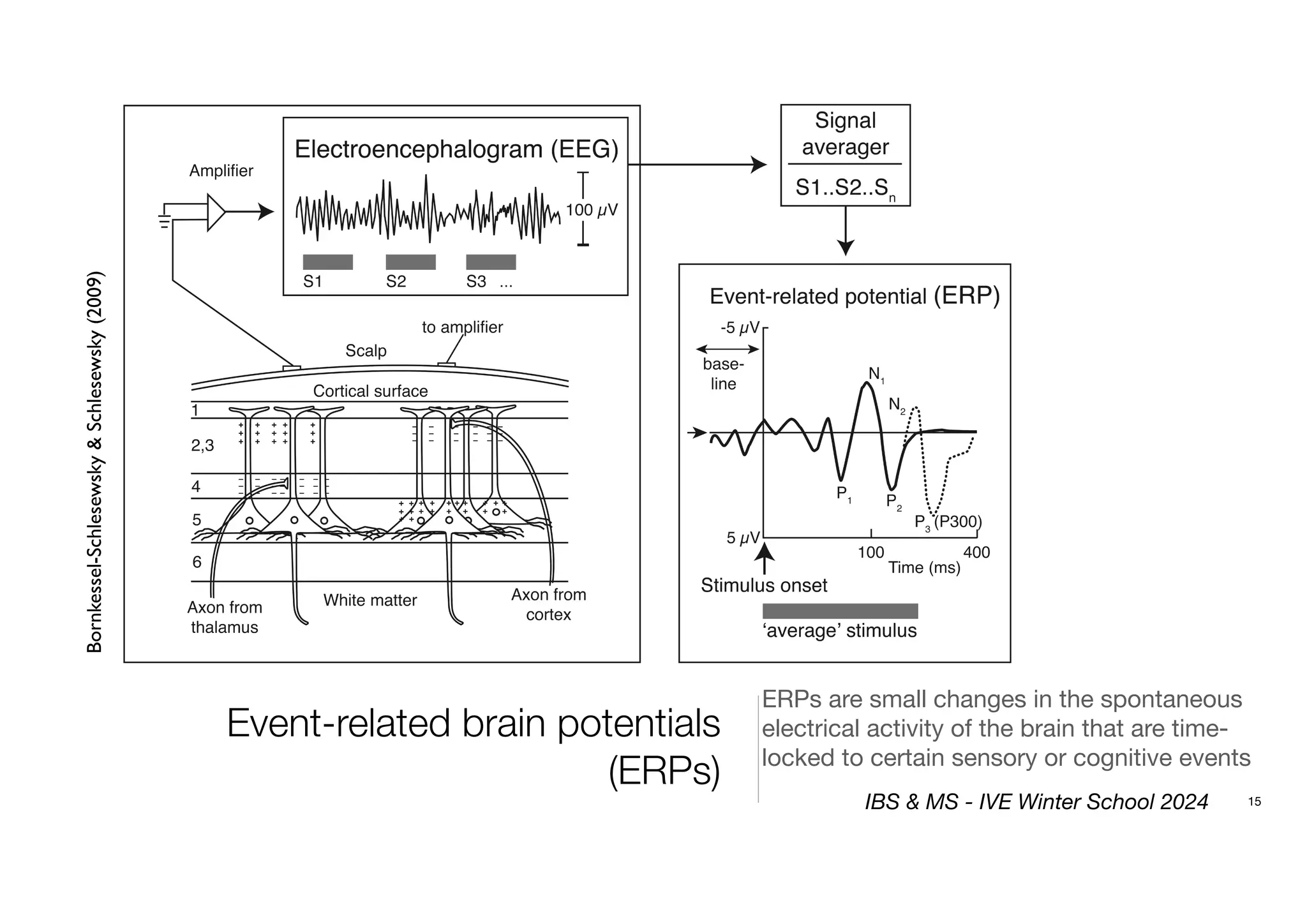
Physiological basis of the EEG
The EEG reflects summed dipole
moments, i.e. voltage differences
between higher and lower cortical layers
originating primarily between pyramidal
cells. These result from synchronous
postsynaptic activity.
4
Bornkessel-Schlesewsky
&
Schlesewsky
(2009)
IBS & MS - IVE Winter School 2024
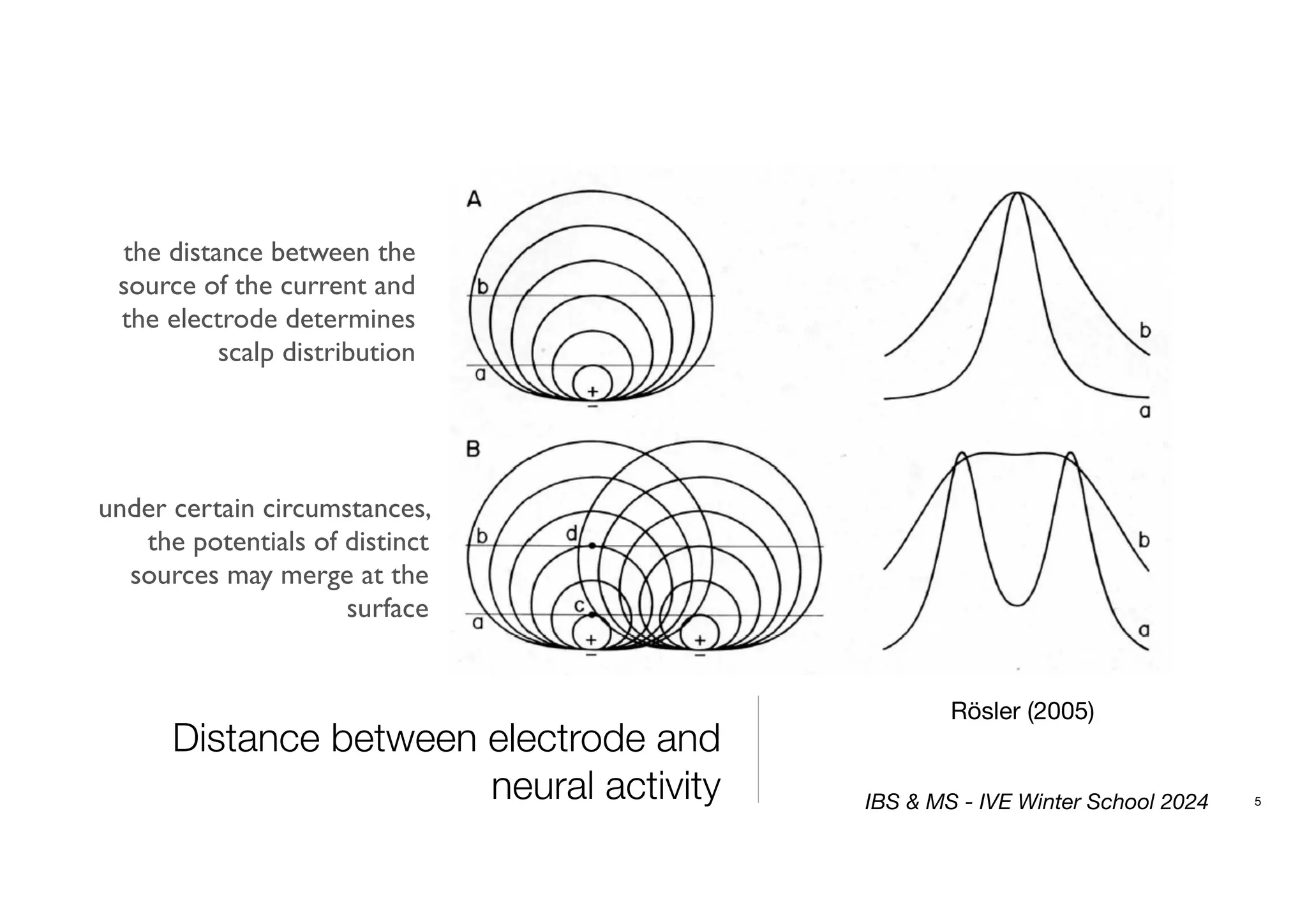
Distance between electrode and
neural activity 5
Rösler (2005)
the distance between the
source of the current and
the electrode determines
scalp distribution
under certain circumstances,
the potentials of distinct
sources may merge at the
surface
IBS & MS - IVE Winter School 2024
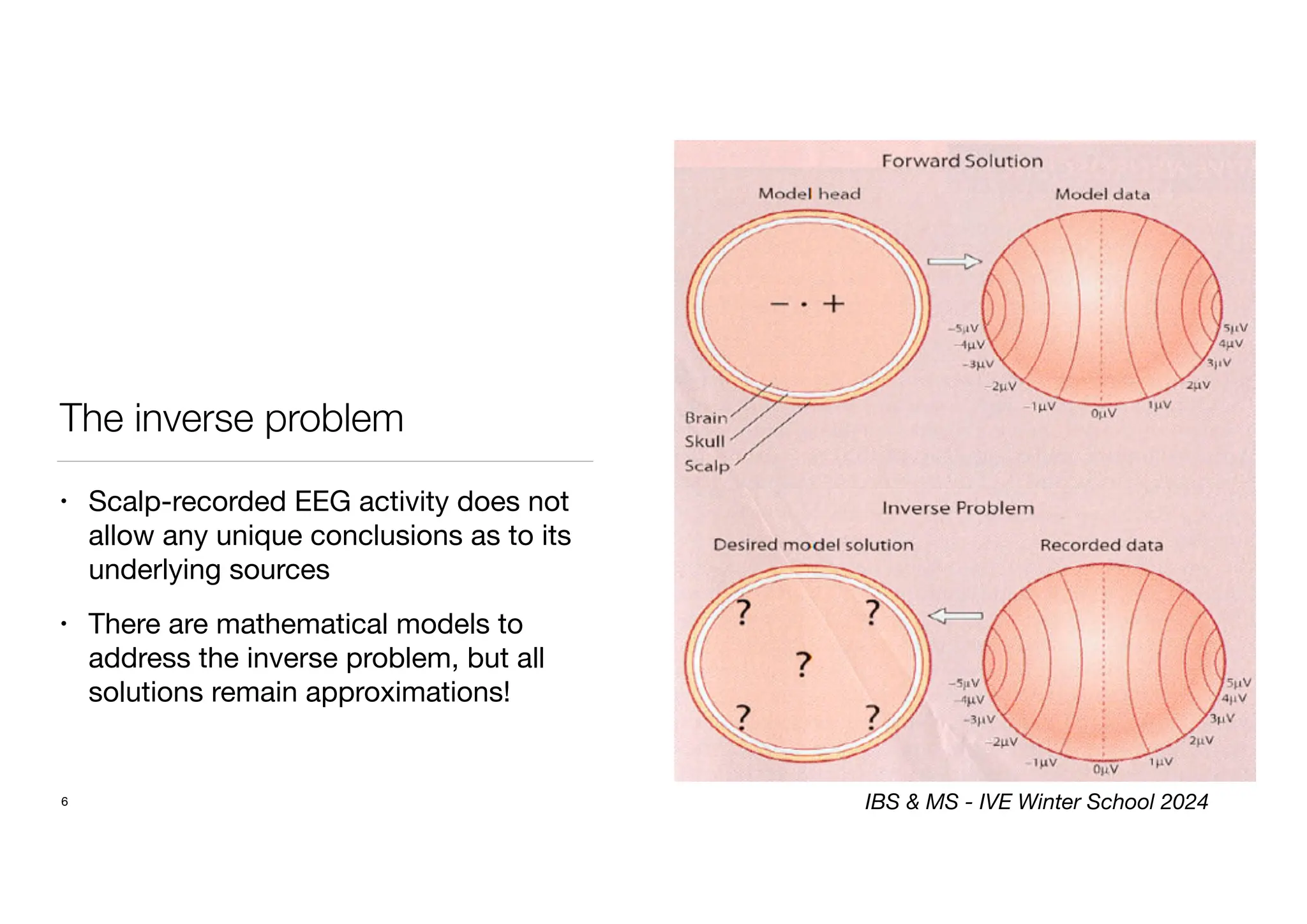
The inverse problem
• Scalp-recorded EEG activity does not
allow any unique conclusions as to its
underlying sources
• There are mathematical models to
address the inverse problem, but all
solutions remain approximations!
6 IBS & MS - IVE Winter School 2024
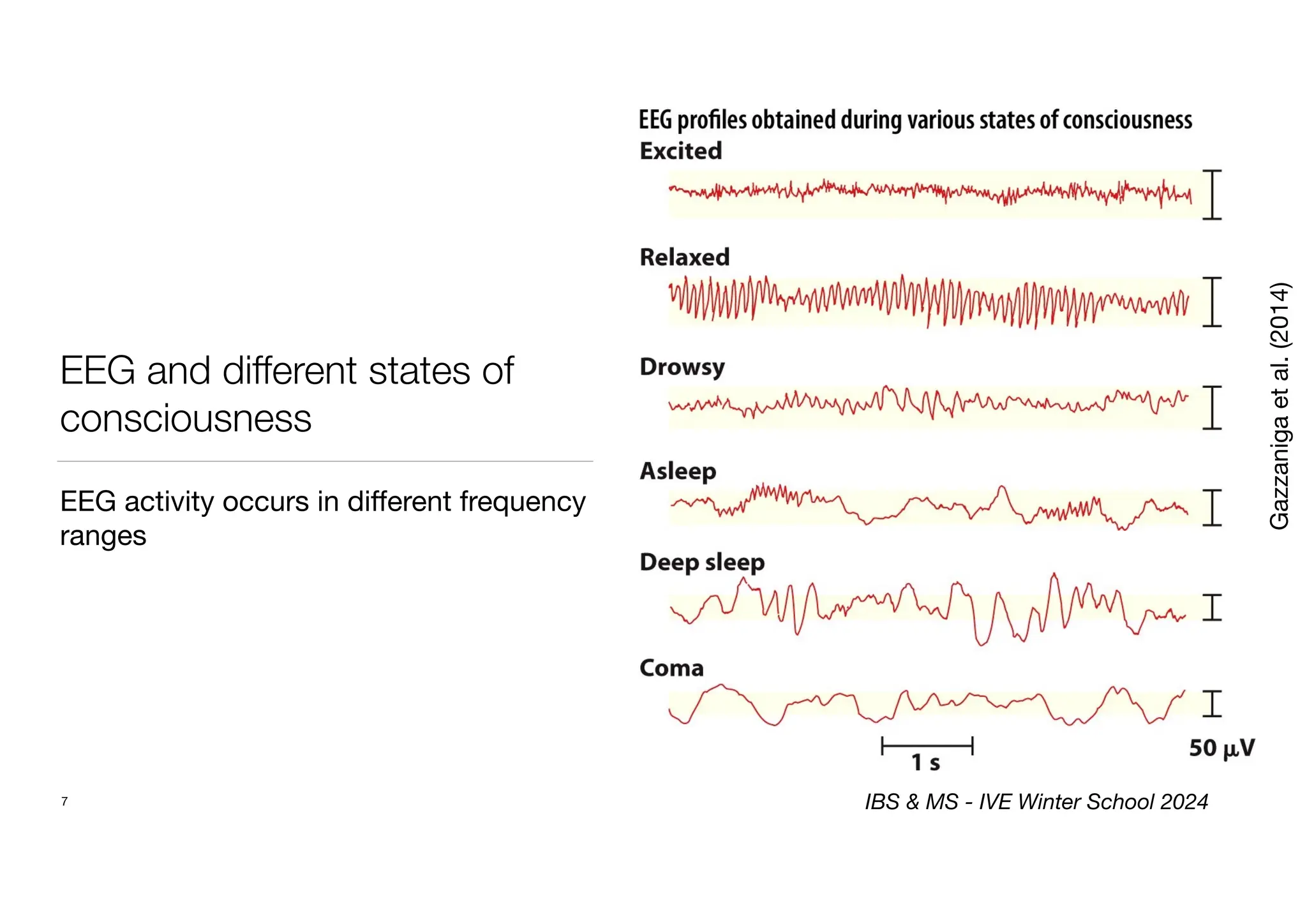
EEG and different states of
consciousness
EEG activity occurs in different frequency
ranges
7
Gazzaniga
et
al.
(2014)
IBS & MS - IVE Winter School 2024
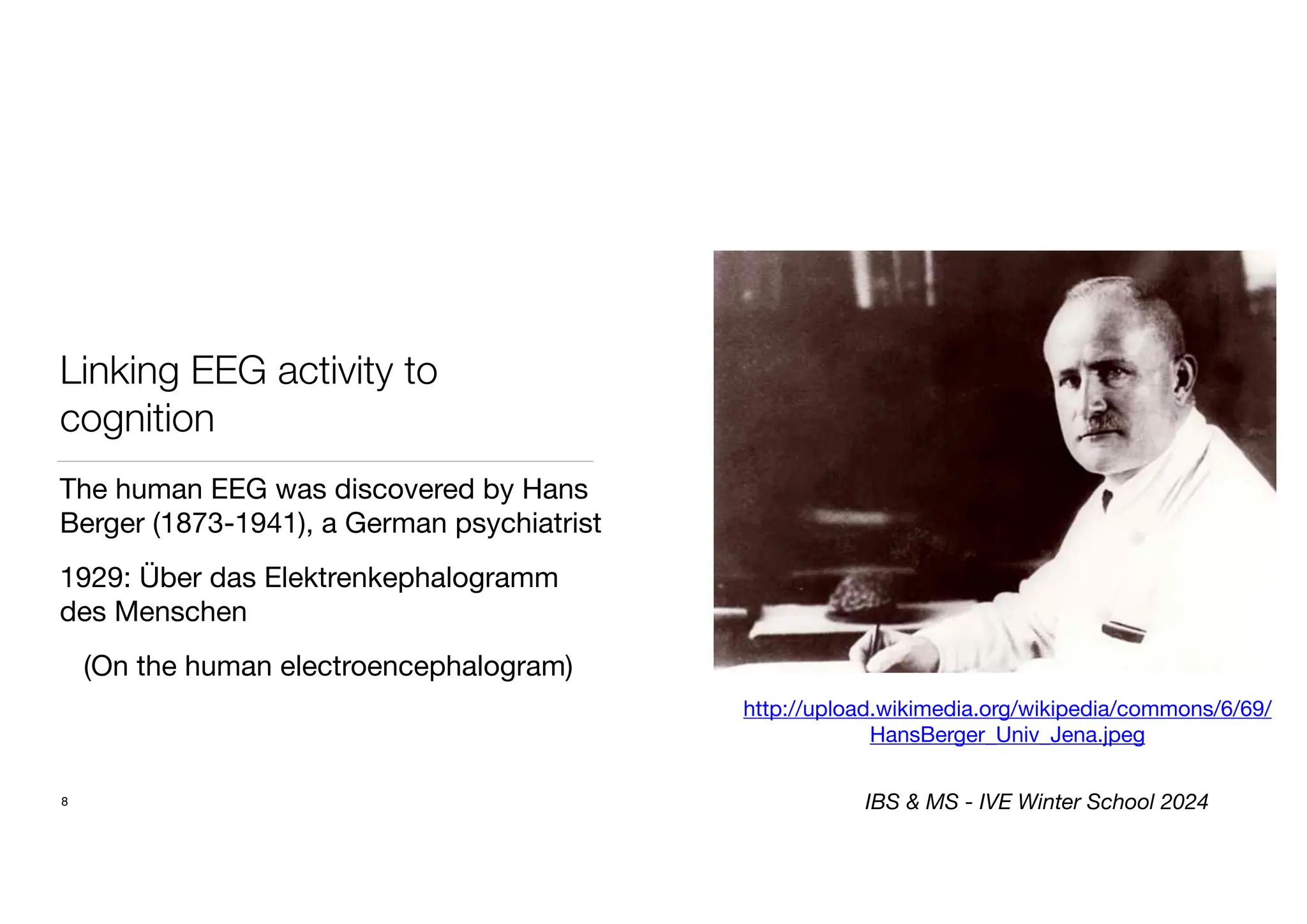
Linking EEG activity to
cognition
The human EEG was discovered by Hans
Berger (1873-1941), a German psychiatrist
1929: Über das Elektrenkephalogramm
des Menschen
(On the human electroencephalogram)
8
http://upload.wikimedia.org/wikipedia/commons/6/69/
HansBerger_Univ_Jena.jpeg
IBS & MS - IVE Winter School 2024
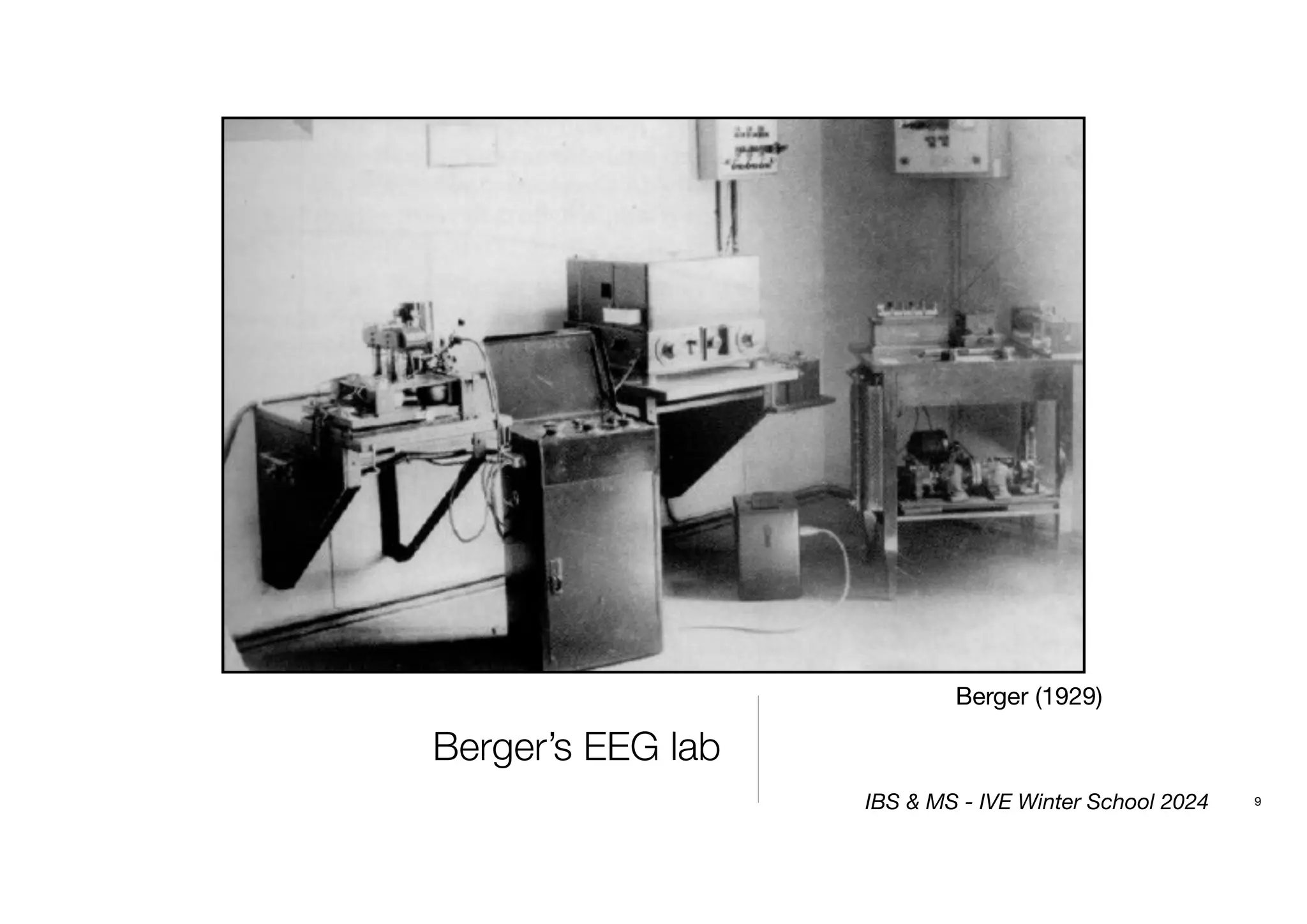
Berger’s EEG lab
9
Berger (1929)
IBS & MS - IVE Winter School 2024
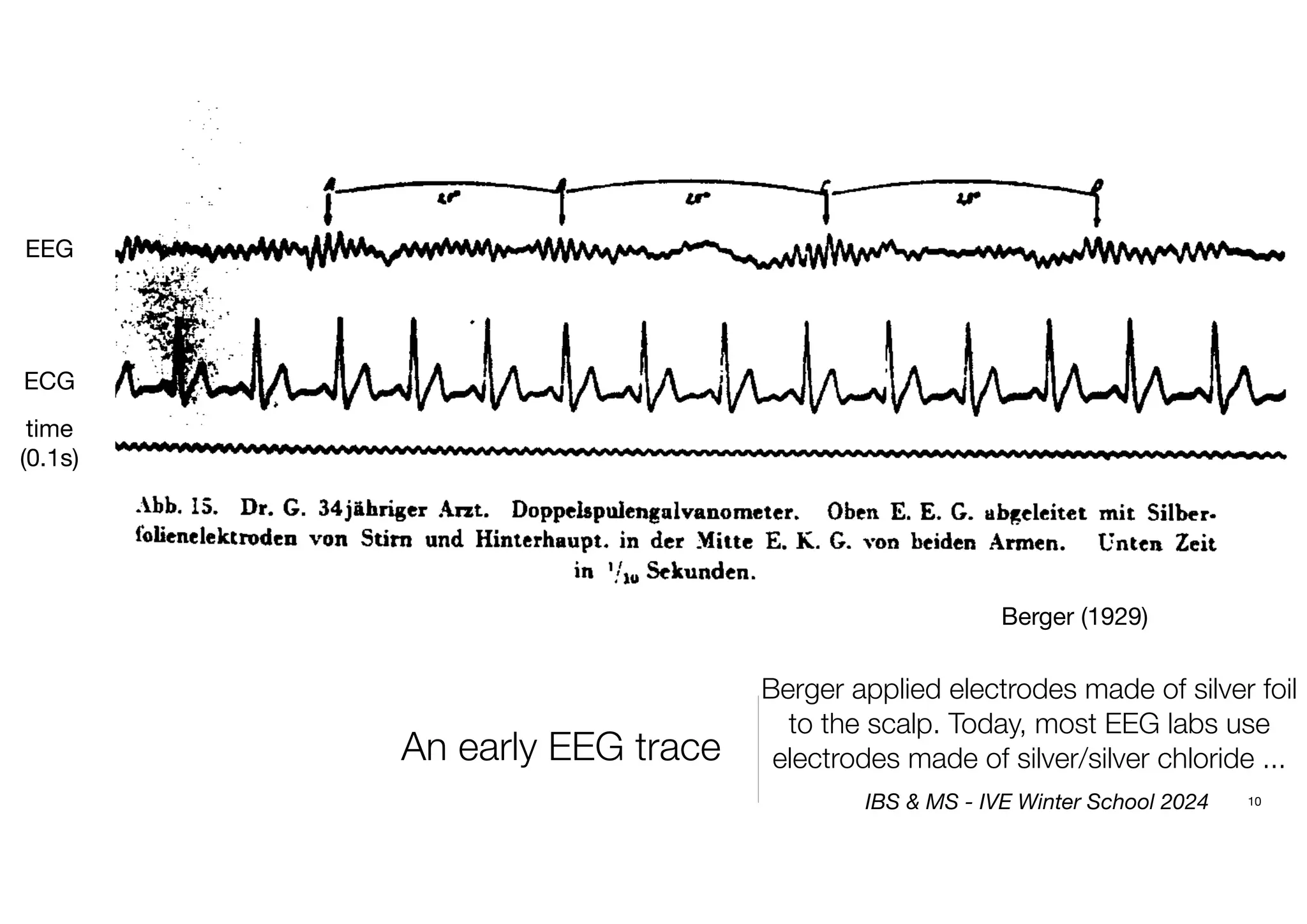
An early EEG trace
10
Berger (1929)
EEG
ECG
time
(0.1s)
Berger applied electrodes made of silver foil
to the scalp. Today, most EEG labs use
electrodes made of silver/silver chloride ...
IBS & MS - IVE Winter School 2024
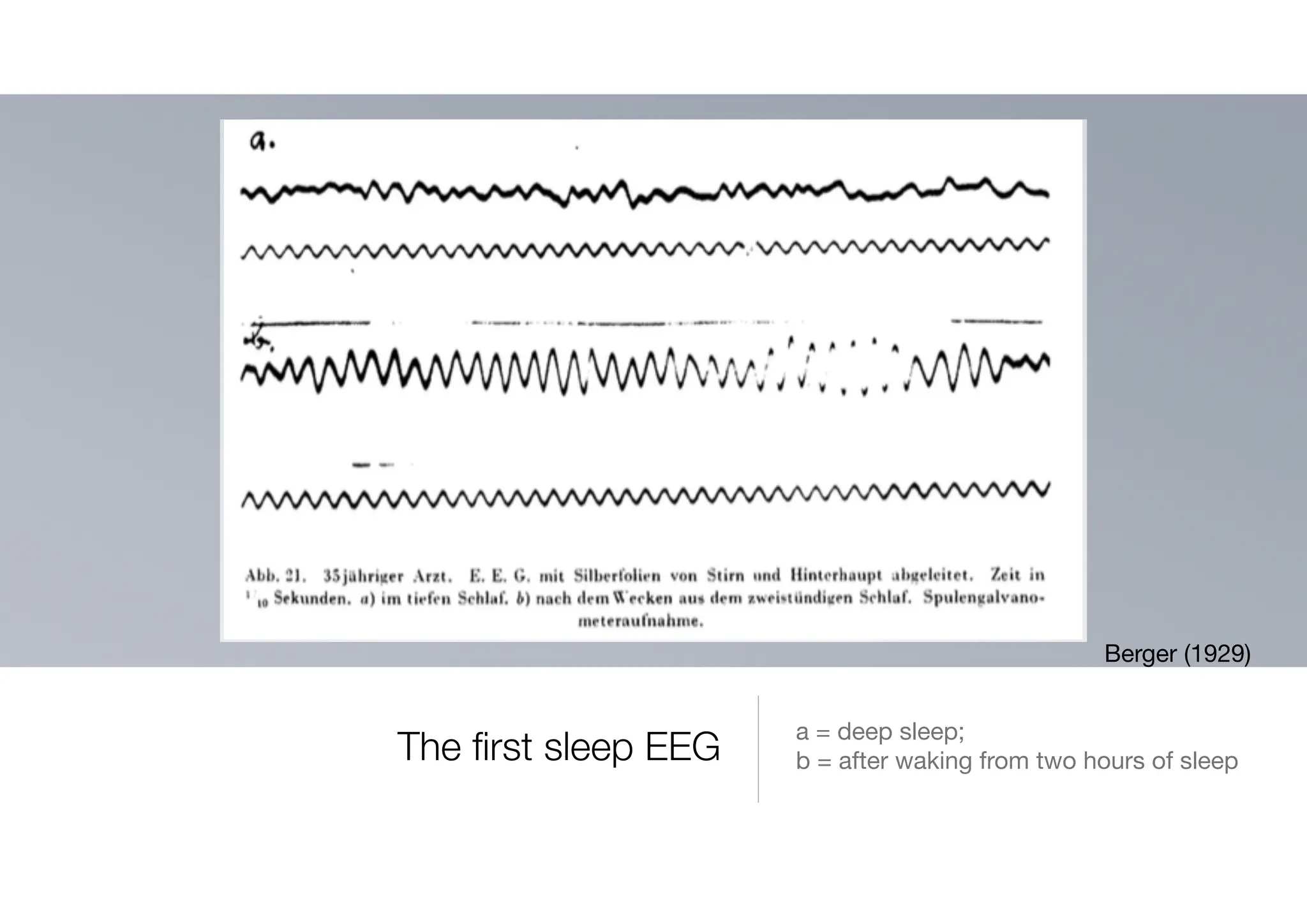
The first sleep EEG
a = deep sleep;
b = after waking from two hours of sleep
THE FIRST SLEEP-EEG
a = deep sleep & b = after waking from two hours of sleep
(top line = EEG; bottom line = metronome for timekeeping)
Berger (1929)
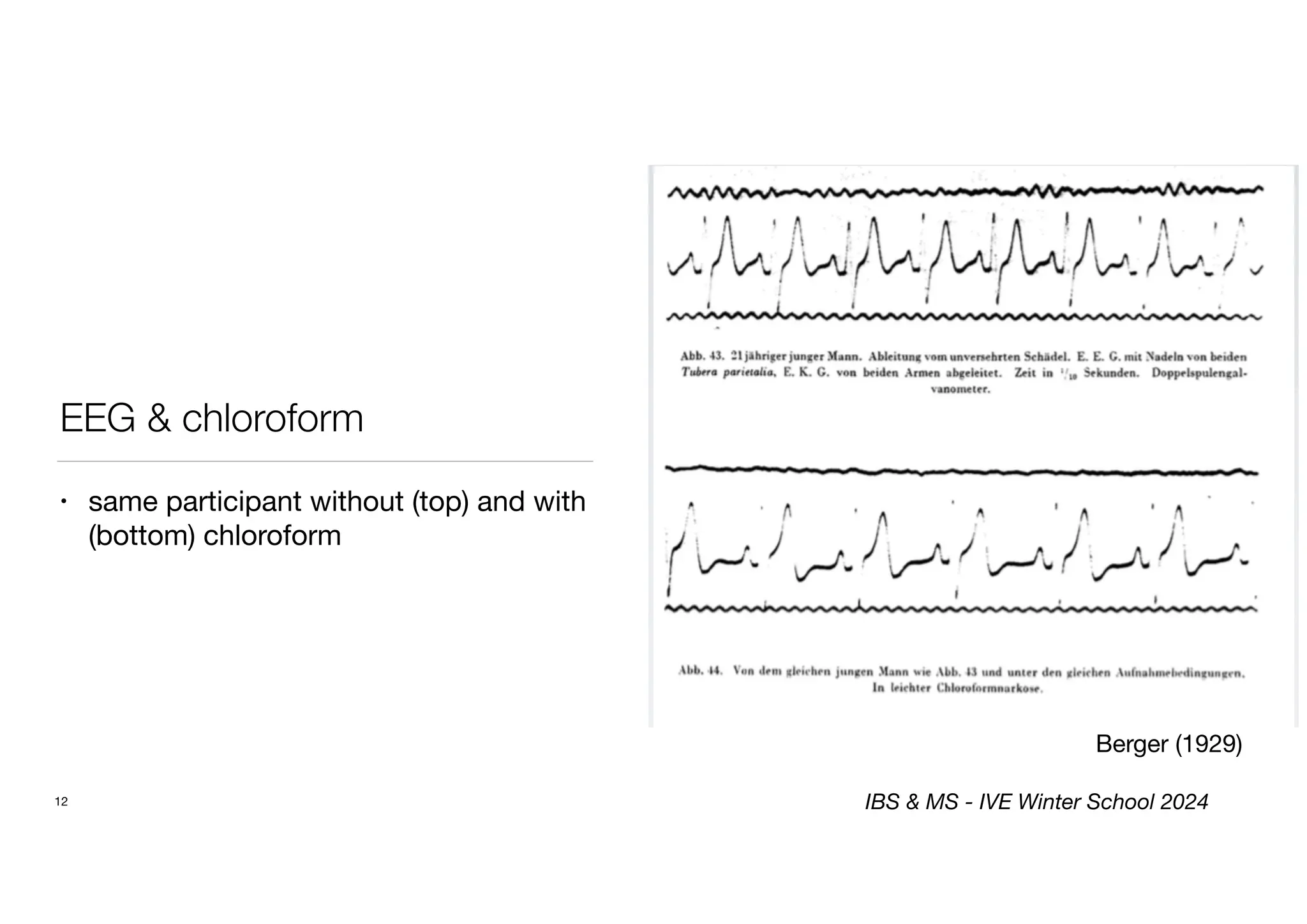
EEG & chloroform
• same participant without (top) and with
(bottom) chloroform
12 IBS & MS - IVE Winter School 2024
EEG & CHLOROFORM
same participant without (top) and with (bottom) chlorof
first line = EEG, second line = EKG, third line = metrono
Berger (1929)
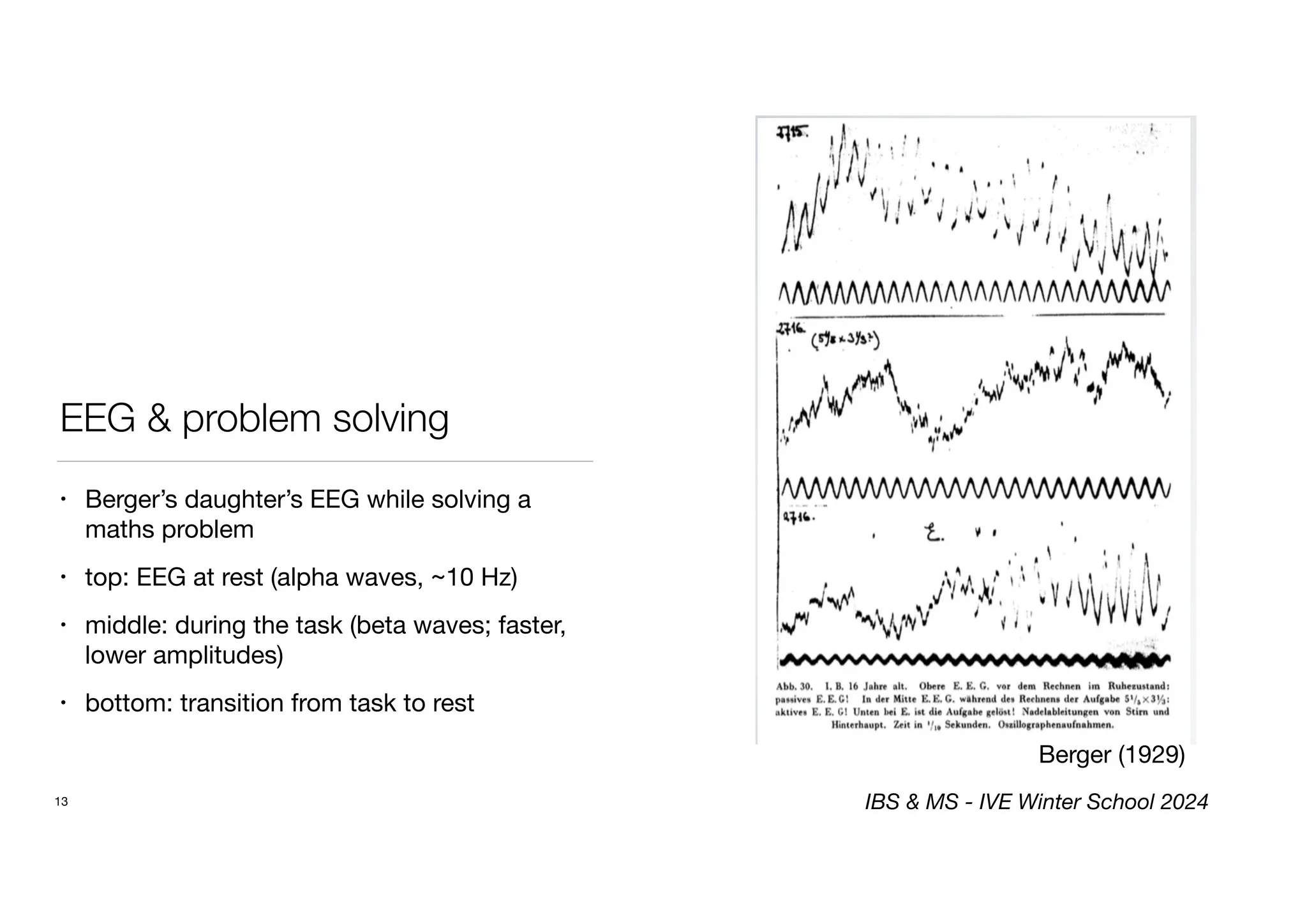
EEG & problem solving
• Berger’s daughter’s EEG while solving a
maths problem
• top: EEG at rest (alpha waves, ~10 Hz)
• middle: during the task (beta waves; faster,
lower amplitudes)
• bottom: transition from task to rest
13 IBS & MS - IVE Winter School 2024
EEG
EEG from
Figu
Figure 2
Figure 3
Rest: al
around
Task: beta
Berger (1929)
Berger’s achievements
• Discovered the α (~8-12 Hz) and β (~12-30 Hz) rhythms
• Observed changes in the rhythmical activity of the EEG depending on changes in
cognitive state
• α decreases during problem solving (e.g. mental arithmetic)
• increases again during relaxed wakefulness
14
IBS & MS - IVE Winter School 2024
Event-related brain potentials
(ERPs)
Bornkessel-Schlesewsky
&
Schlesewsky
(2009)
ERPs are small changes in the spontaneous
electrical activity of the brain that are time-
locked to certain sensory or cognitive events
15
IBS & MS - IVE Winter School 2024
ERPs
16
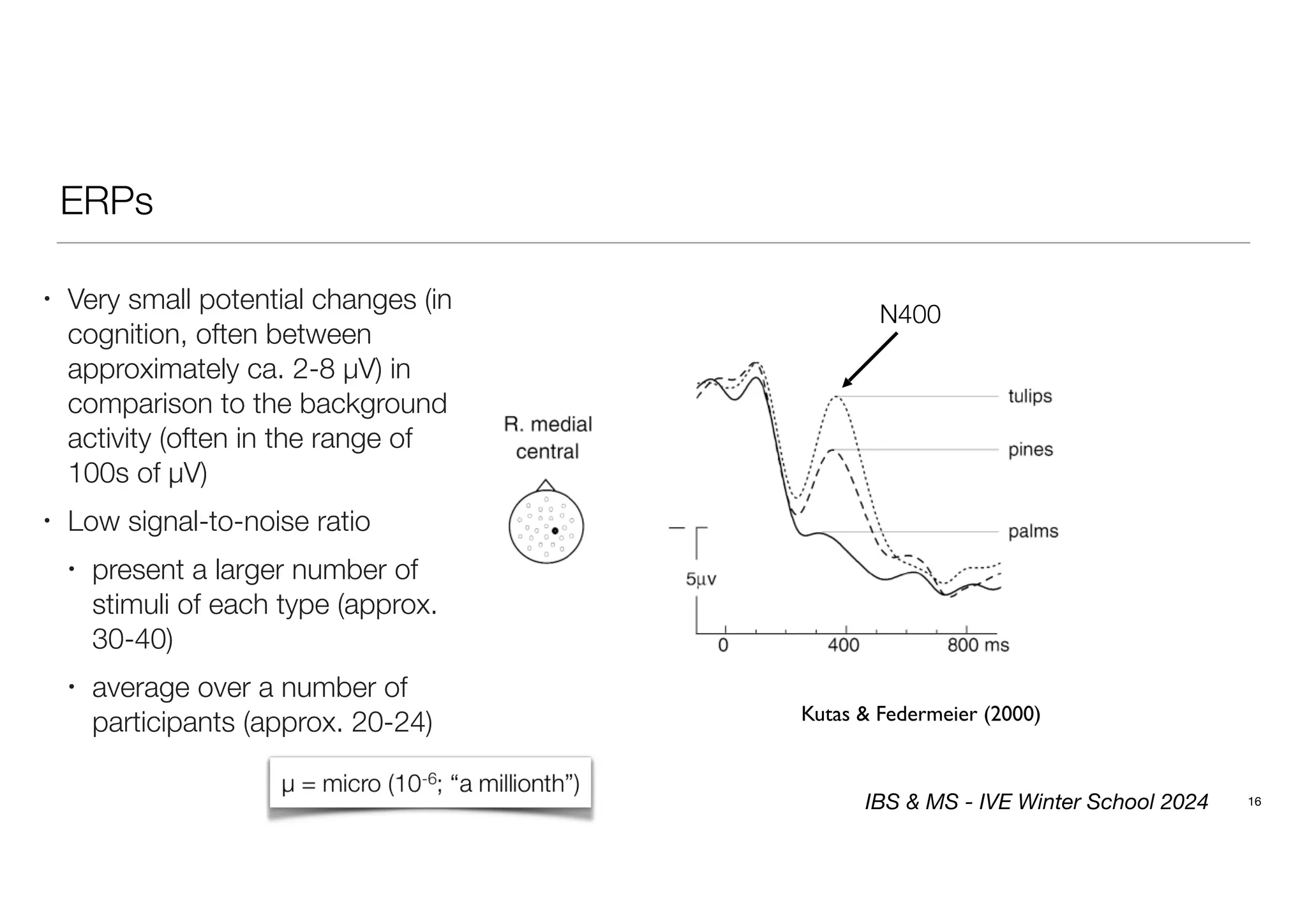
• Very small potential changes (in
cognition, often between
approximately ca. 2-8 μV) in
comparison to the background
activity (often in the range of
100s of μV)
• Low signal-to-noise ratio
• present a larger number of
stimuli of each type (approx.
30-40)
• average over a number of
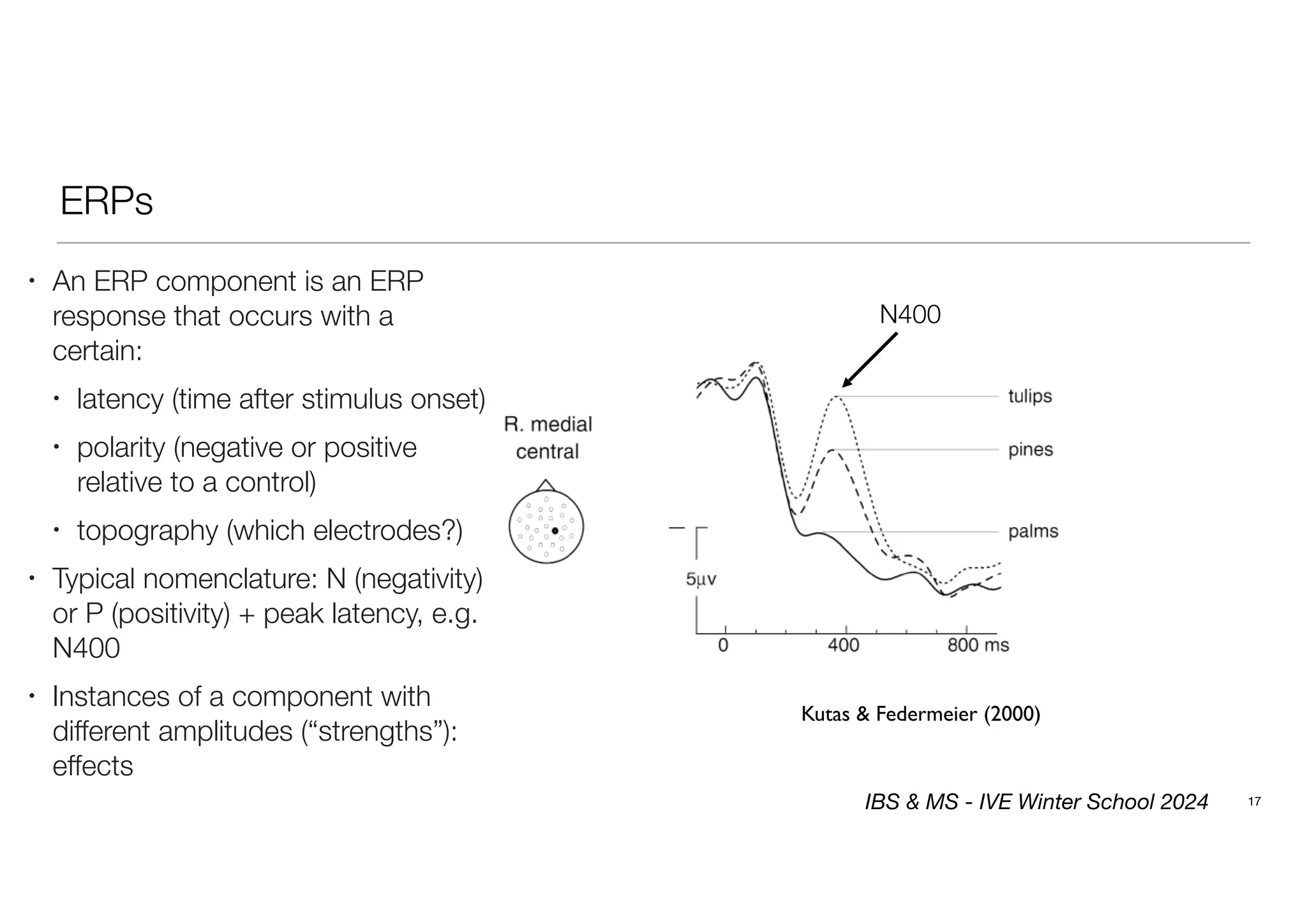
participants (approx. 20-24) Kutas & Federmeier (2000)
N400
IBS & MS - IVE Winter School 2024
ERPs
Kutas & Federmeier (2000)
17
• An ERP component is an ERP
response that occurs with a
certain:
• latency (time after stimulus onset)
• polarity (negative or positive
relative to a control)
• topography (which electrodes?)
• Typical nomenclature: N (negativity)
or P (positivity) + peak latency, e.g.
N400
• Instances of a component with
different amplitudes (“strengths”):
effects
N400
IBS & MS - IVE Winter School 2024
Selected ERP components
IBS & MS - IVE Winter School 2024
The P300 (P3)
19
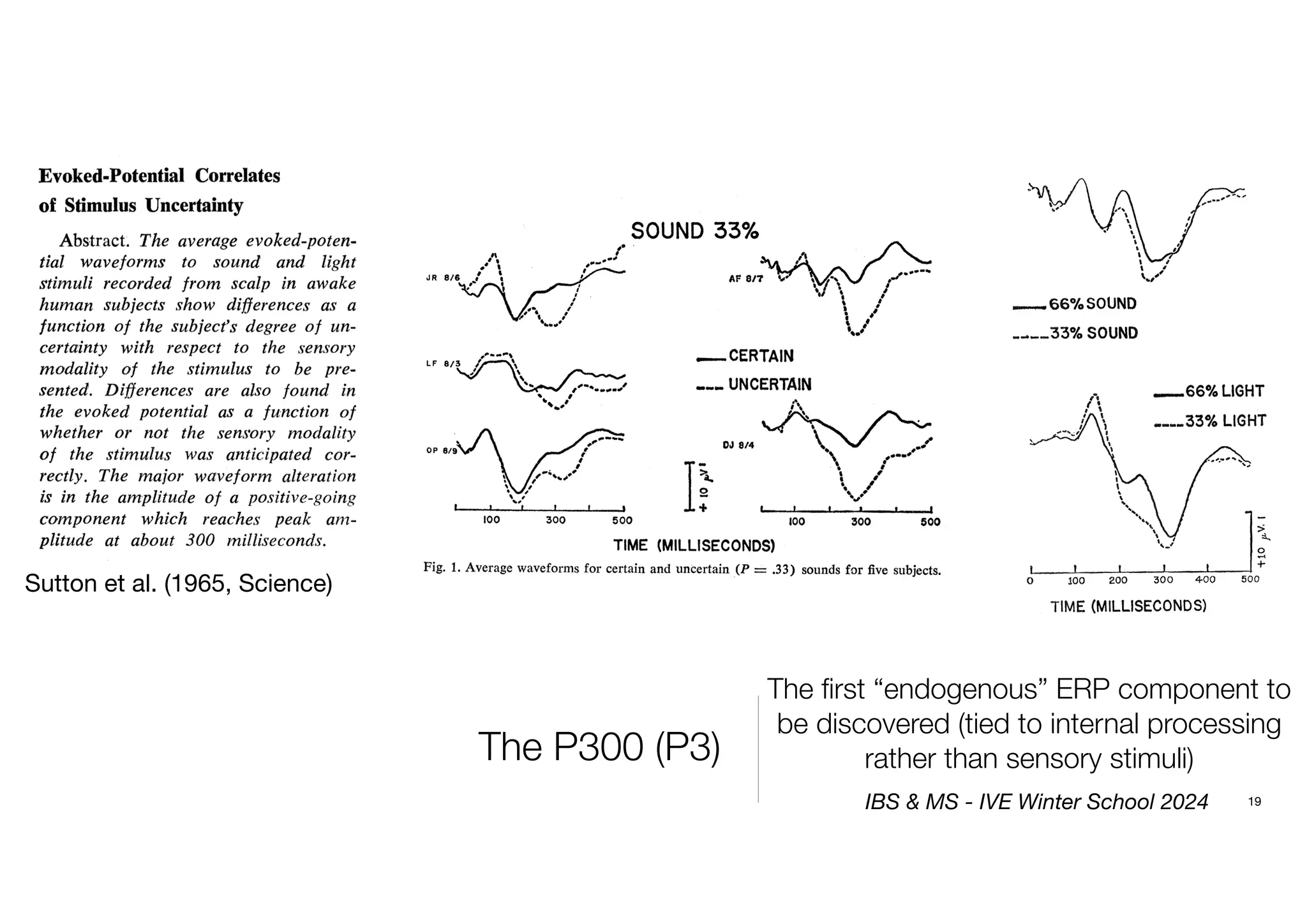
The first “endogenous” ERP component to
be discovered (tied to internal processing
rather than sensory stimuli)
IBS & MS - IVE Winter School 2024
Sutton et al. (1965, Science)
The P300 (P3)
20
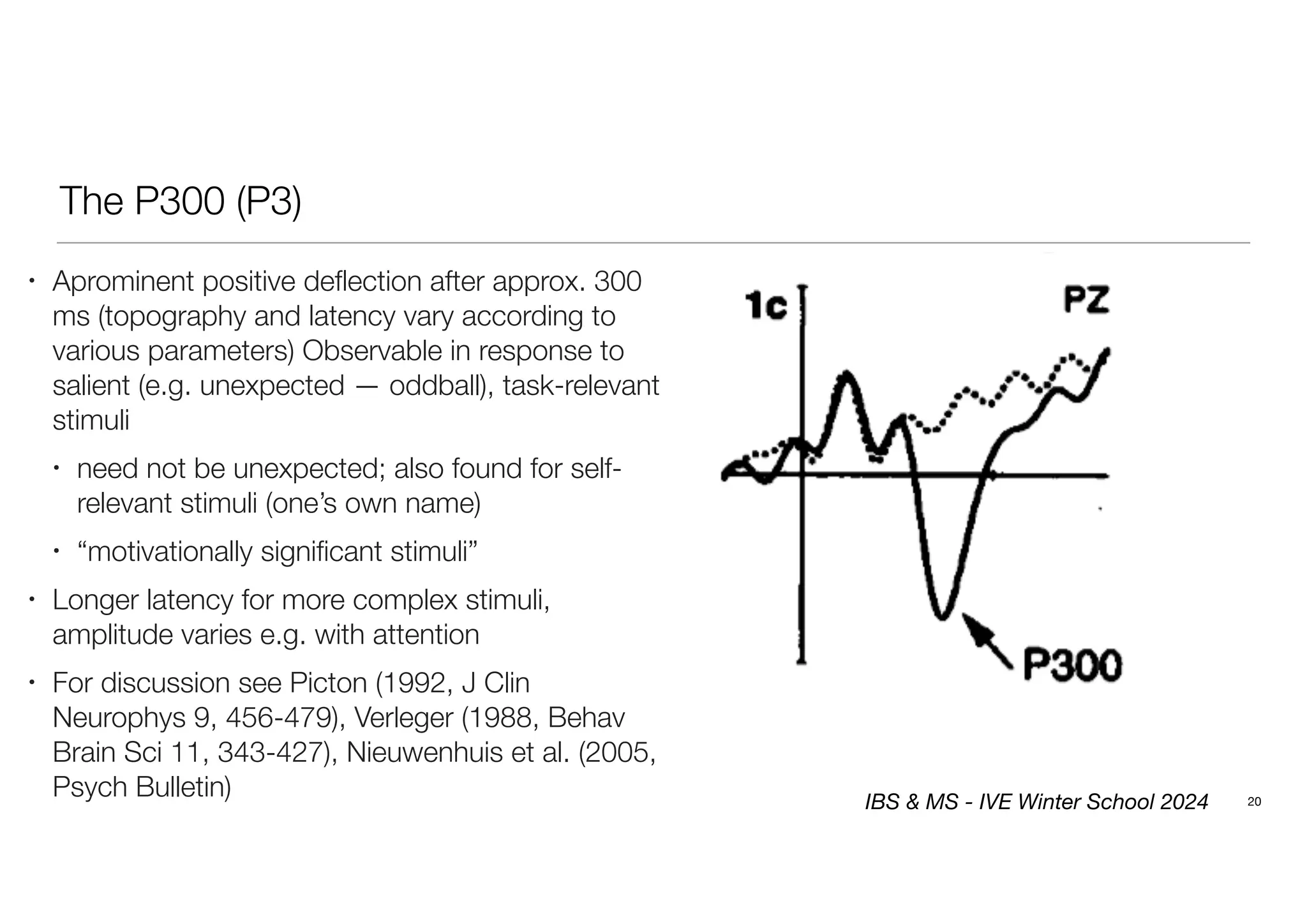
• Aprominent positive deflection after approx. 300
ms (topography and latency vary according to
various parameters) Observable in response to
salient (e.g. unexpected — oddball), task-relevant
stimuli
• need not be unexpected; also found for self-
relevant stimuli (one’s own name)
• “motivationally significant stimuli”
• Longer latency for more complex stimuli,
amplitude varies e.g. with attention
• For discussion see Picton (1992, J Clin
Neurophys 9, 456-479), Verleger (1988, Behav
Brain Sci 11, 343-427), Nieuwenhuis et al. (2005,
Psych Bulletin) IBS & MS - IVE Winter School 2024
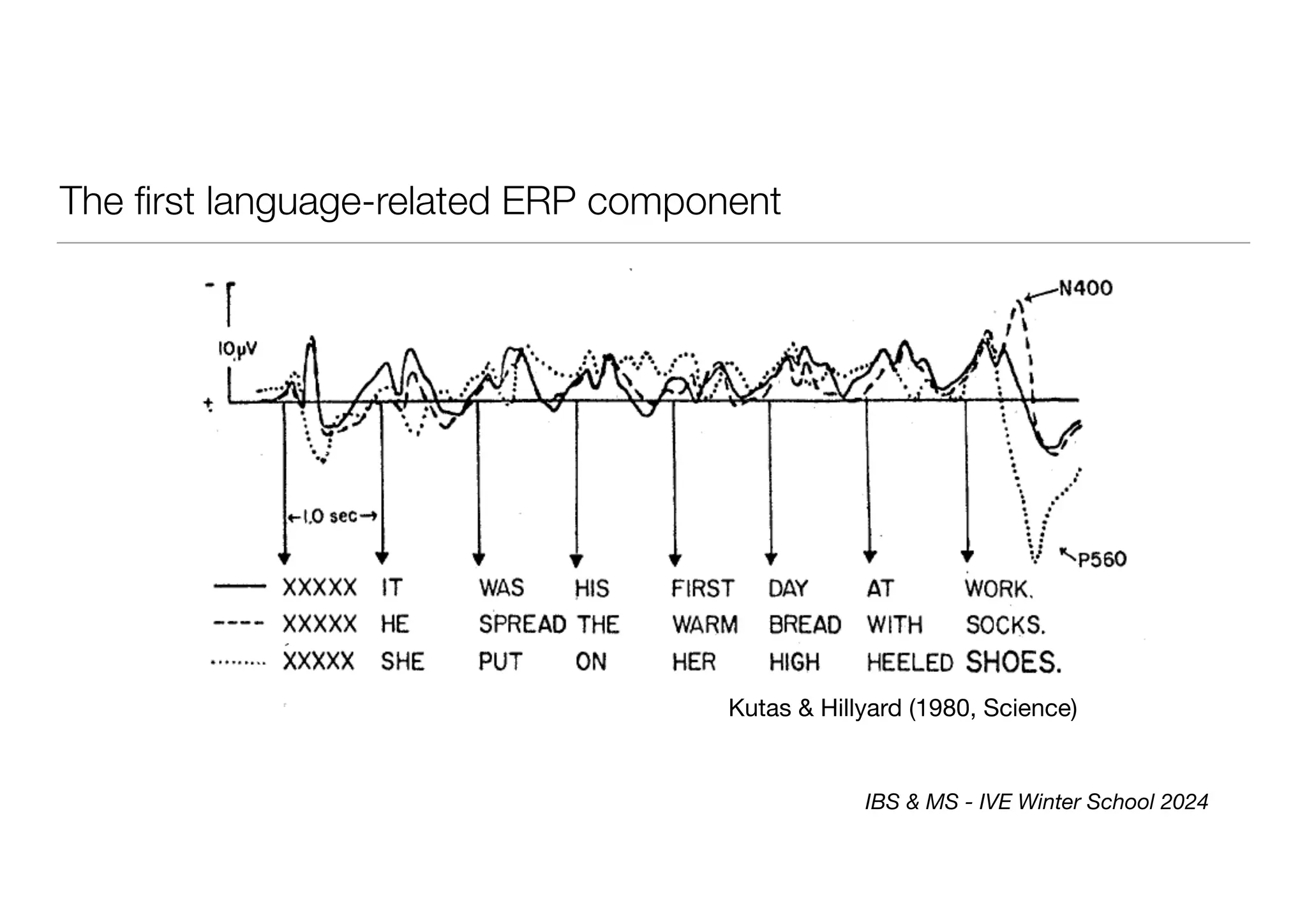
The first language-related ERP component
Kutas & Hillyard (1980, Science)
IBS & MS - IVE Winter School 2024
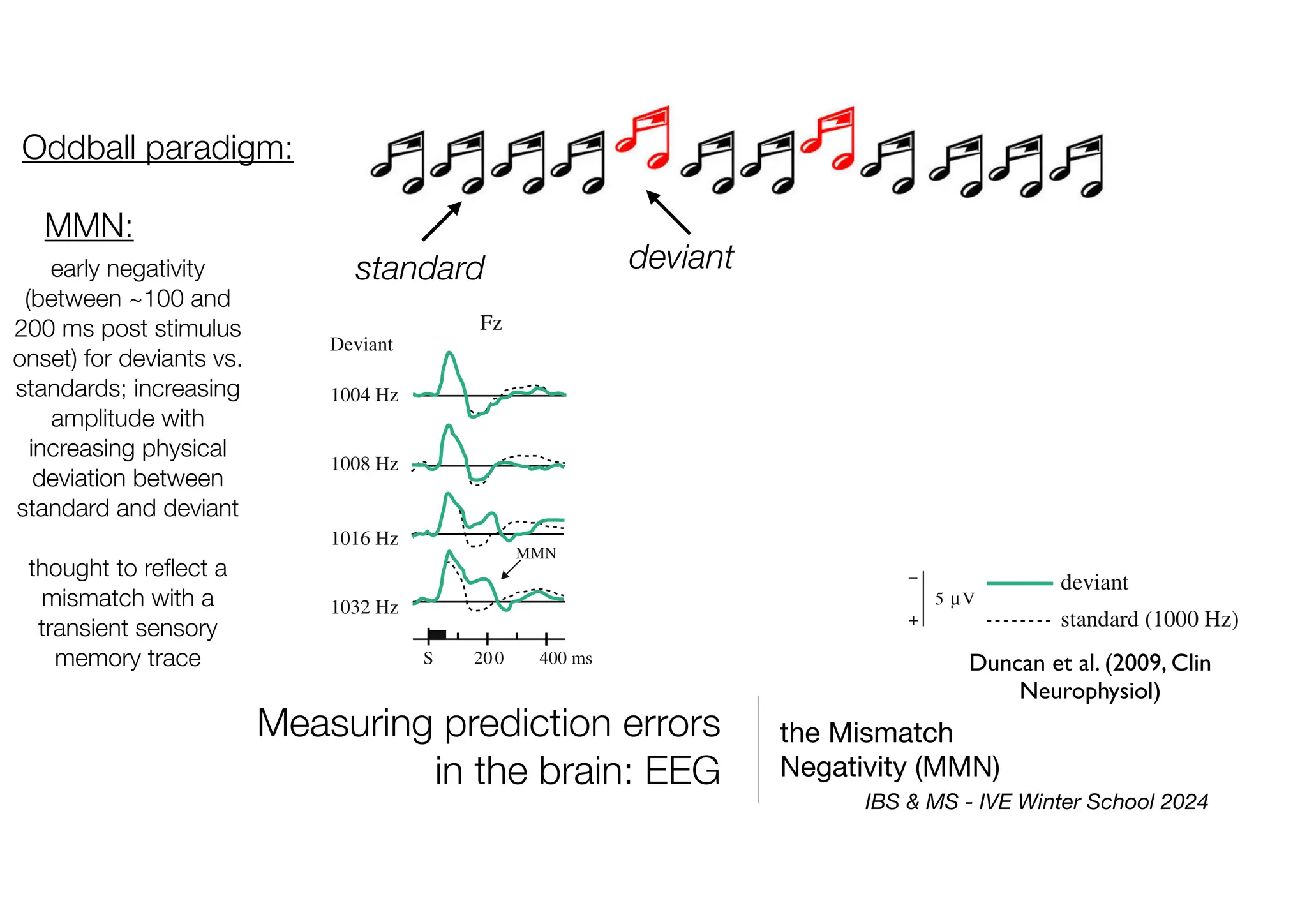
Measuring prediction errors
in the brain: EEG
the Mismatch
Negativity (MMN)
Oddball paradigm:
standard deviant
MMN:
early negativity
(between ~100 and
200 ms post stimulus
onset) for deviants vs.
standards; increasing
amplitude with
increasing physical
deviation between
standard and deviant
thought to re
fl
ect a
mismatch with a
transient sensory
memory trace Duncan et al. (2009, Clin
Neurophysiol)
IBS & MS - IVE Winter School 2024
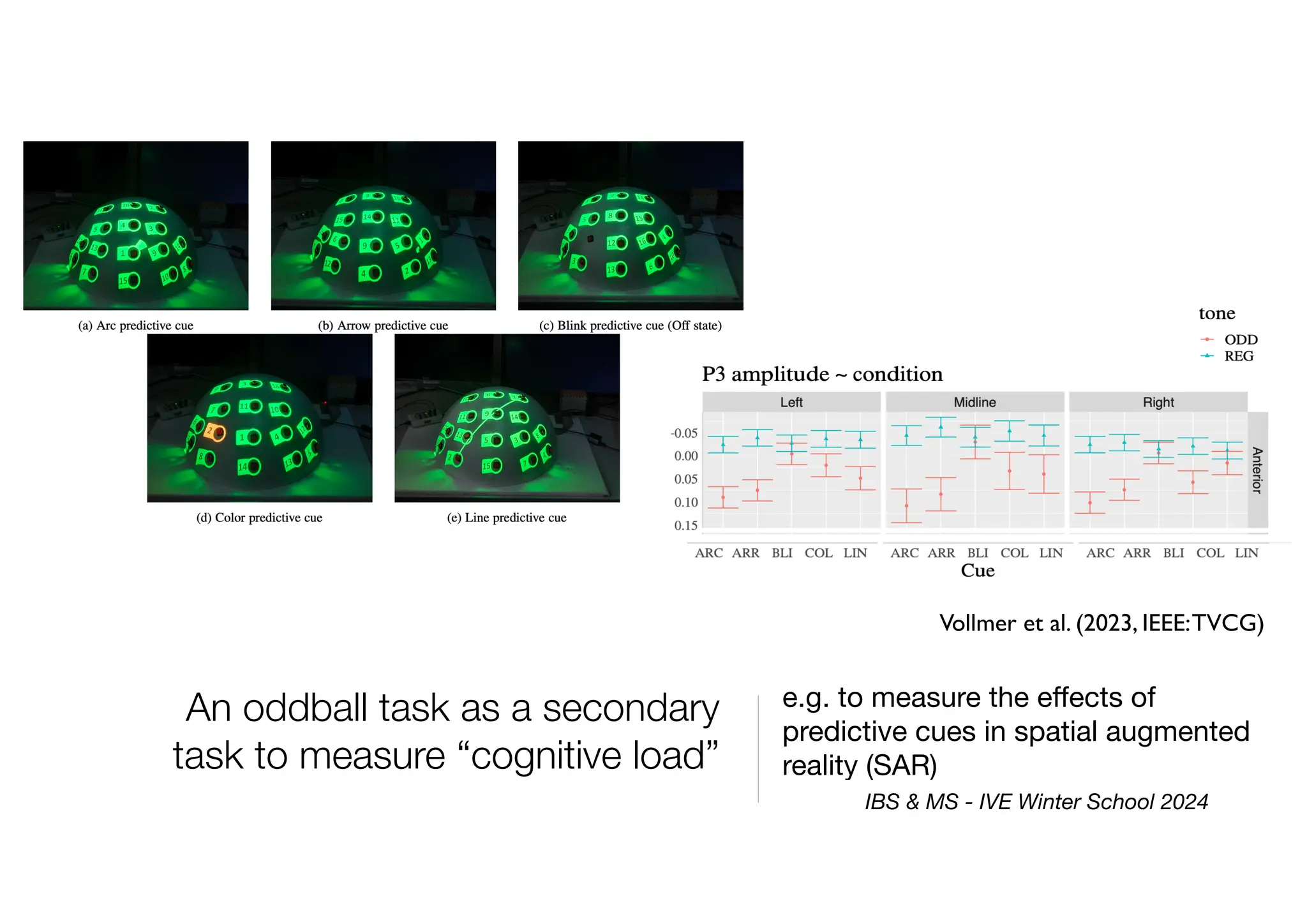
e.g. to measure the e
ff
ects of
predictive cues in spatial augmented
reality (SAR)
Vollmer et al. (2023, IEEE:TVCG)
IBS & MS - IVE Winter School 2024
An oddball task as a secondary
task to measure “cognitive load”
Scalp EEG / ERPs: data acquisition
IBS & MS - IVE Winter School 2024
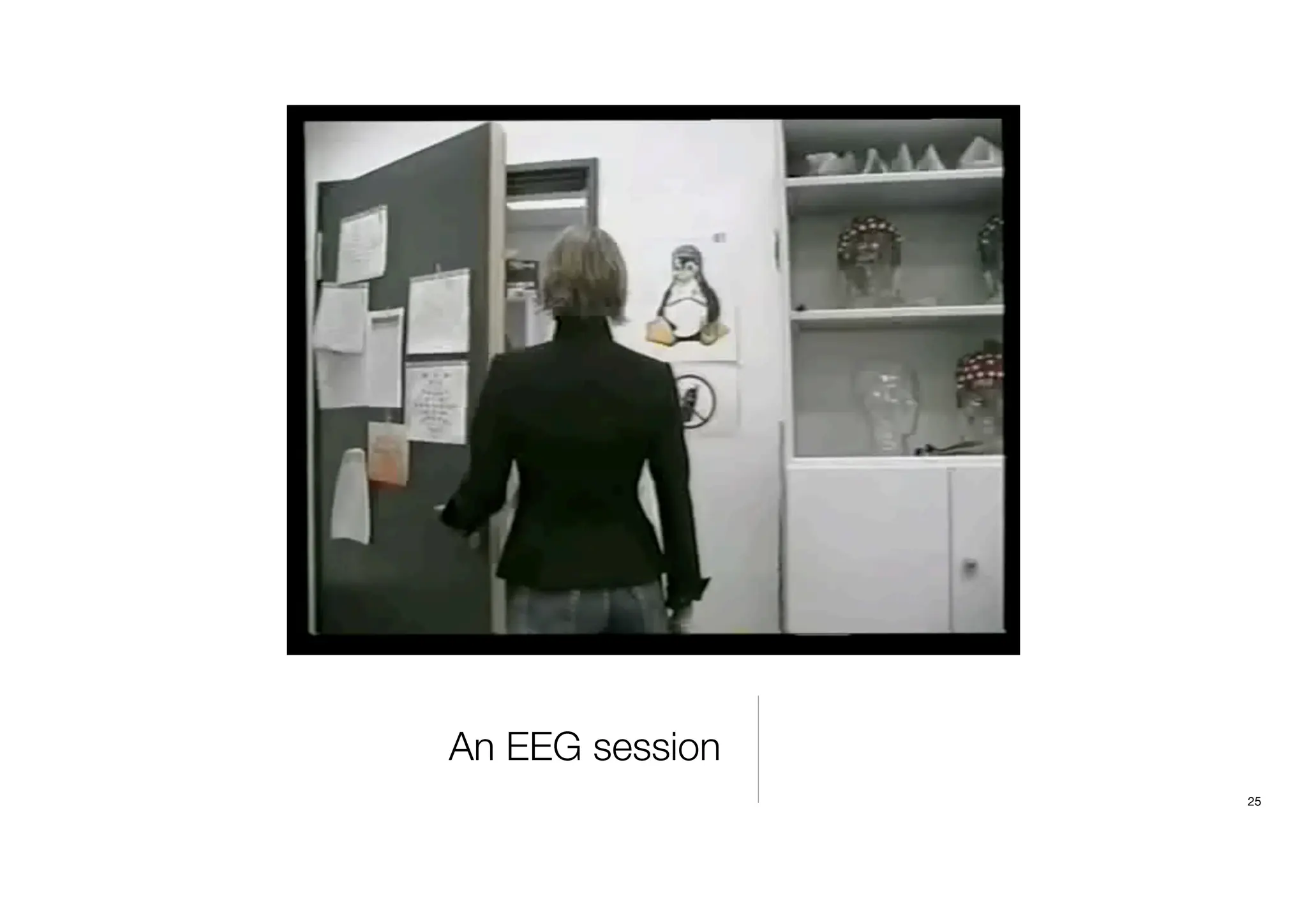
An EEG session
25
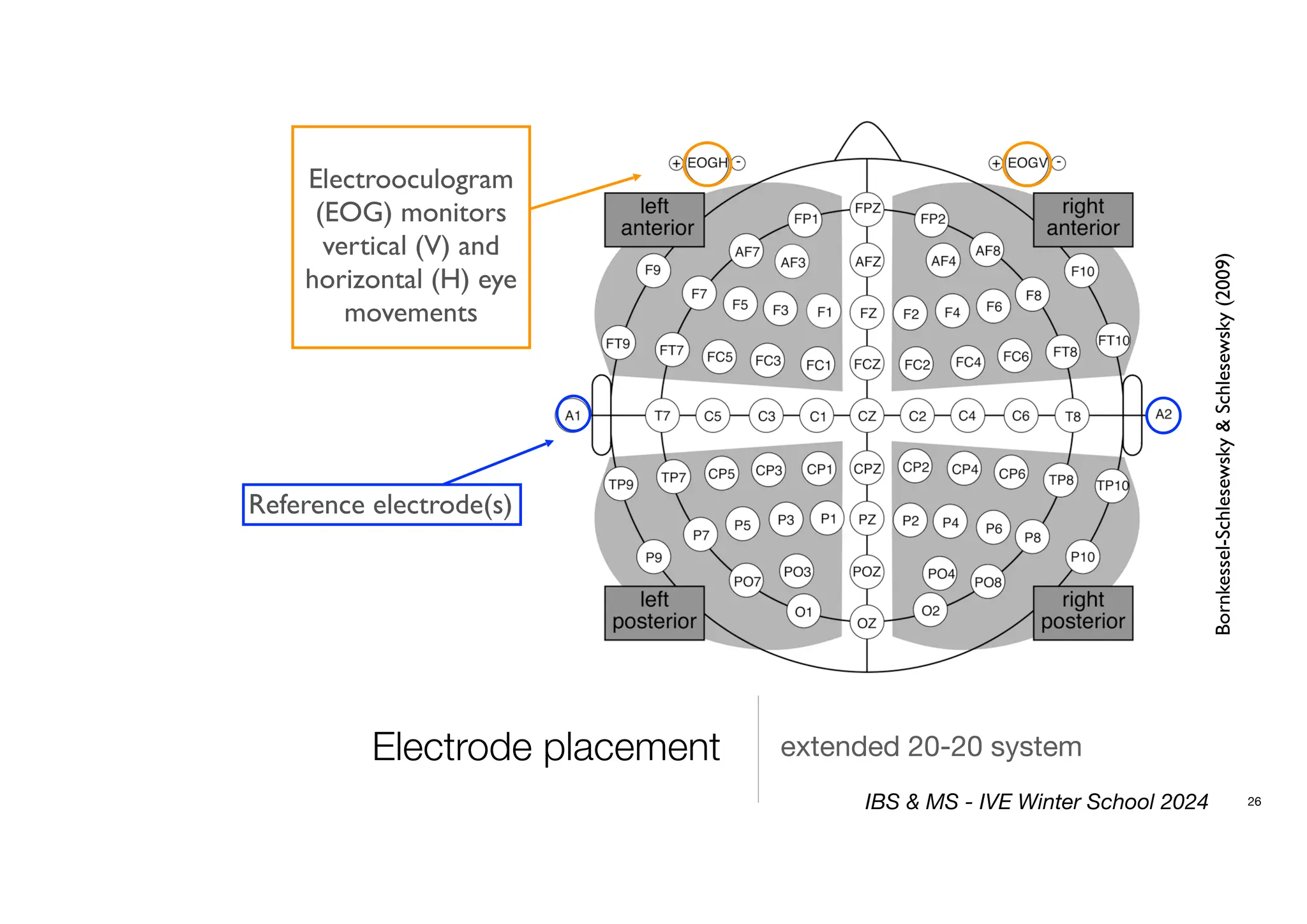
Electrode placement
Bornkessel-Schlesewsky
&
Schlesewsky
(2009)
extended 20-20 system
26
Electrooculogram
(EOG) monitors
vertical (V) and
horizontal (H) eye
movements
Reference electrode(s)
IBS & MS - IVE Winter School 2024
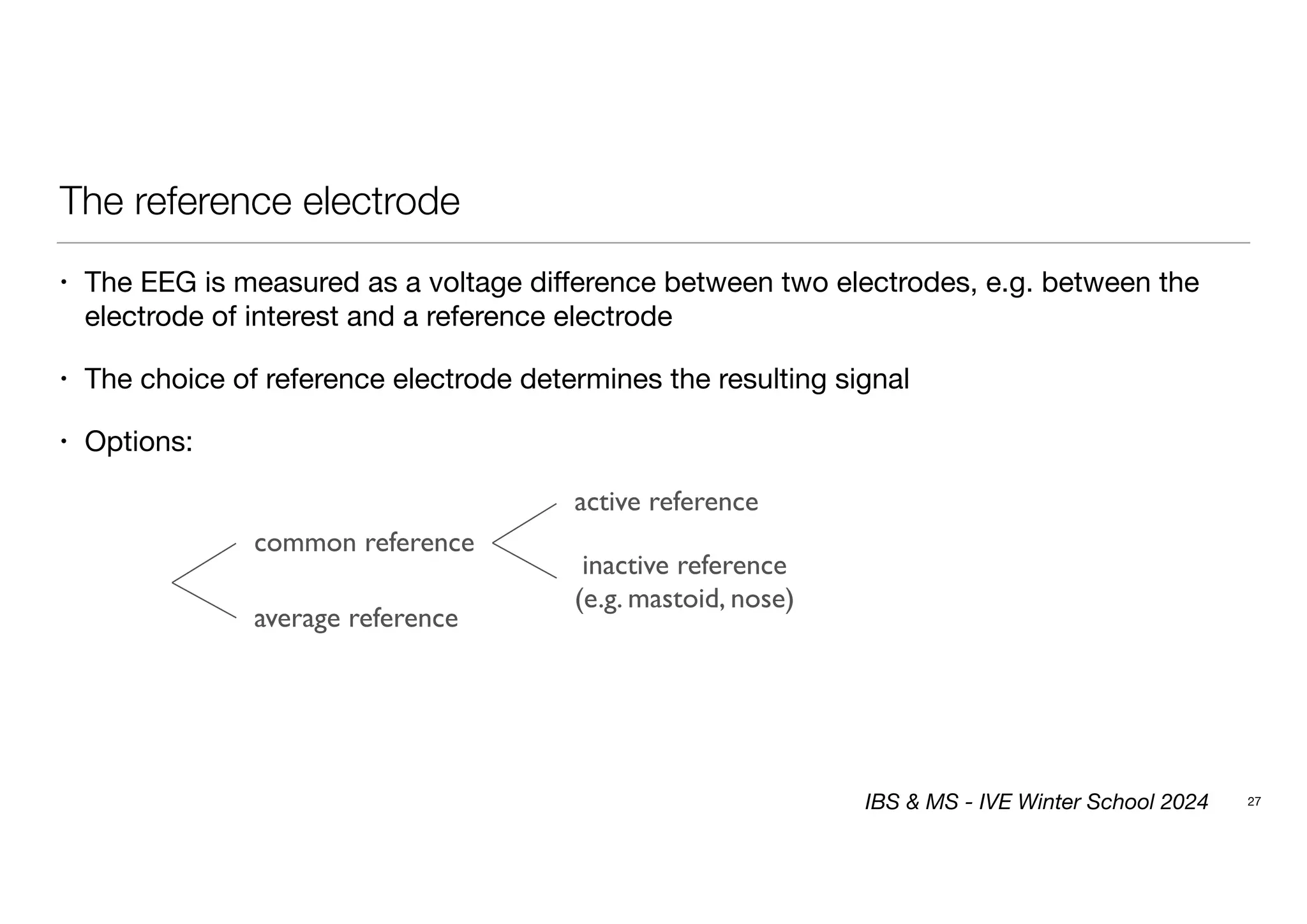
The reference electrode
• The EEG is measured as a voltage difference between two electrodes, e.g. between the
electrode of interest and a reference electrode
• The choice of reference electrode determines the resulting signal
• Options:
27
common reference
average reference
active reference
inactive reference
(e.g. mastoid, nose)
IBS & MS - IVE Winter School 2024
The reference electrode
• Common choice in experiments on cognition:
• left or right mastoid
• + re-referencing to the average of both mastoids offline to avoid topographical
distortions
28
IBS & MS - IVE Winter School 2024
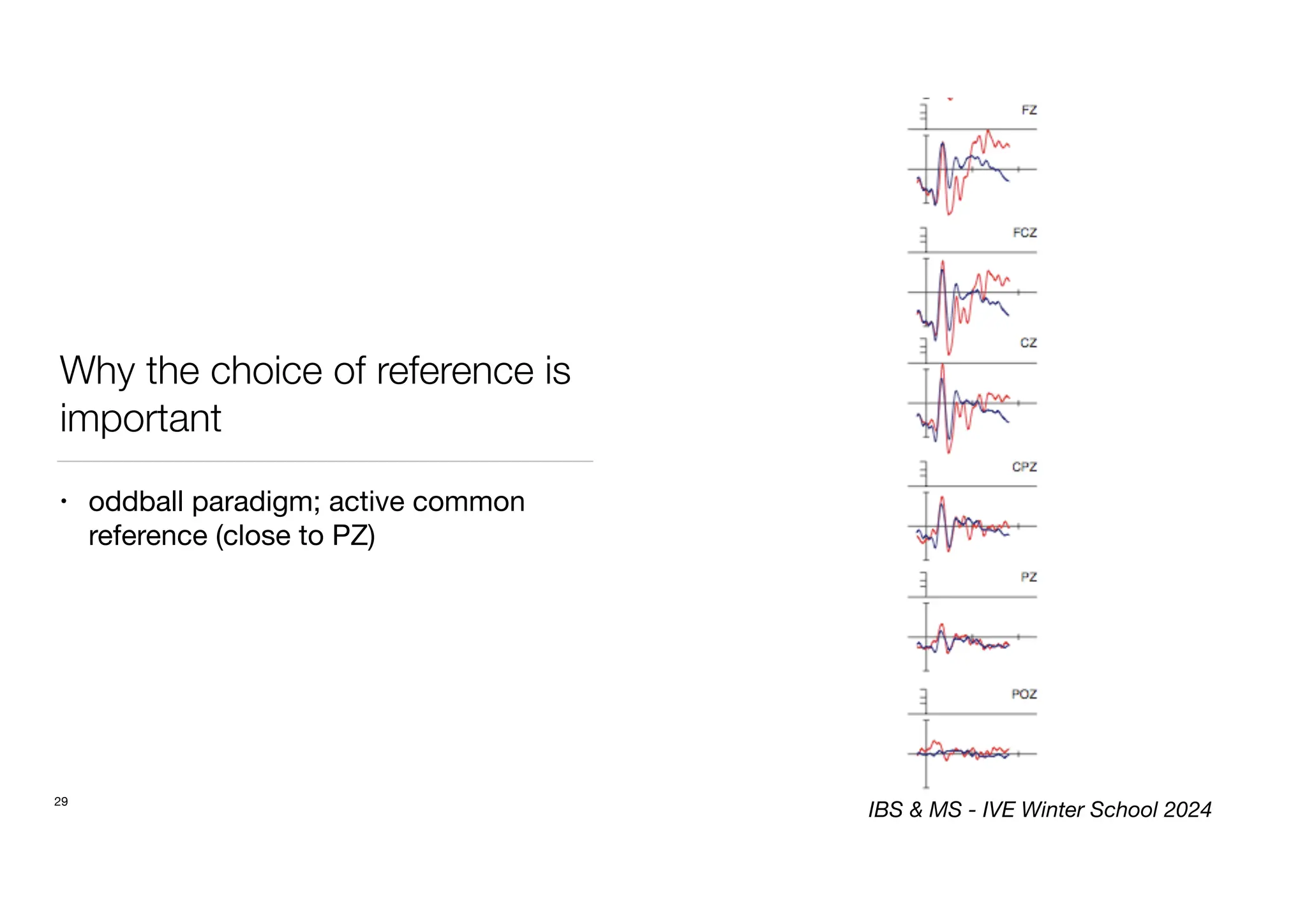
Why the choice of reference is
important
• oddball paradigm; active common
reference (close to PZ)
29
IBS & MS - IVE Winter School 2024
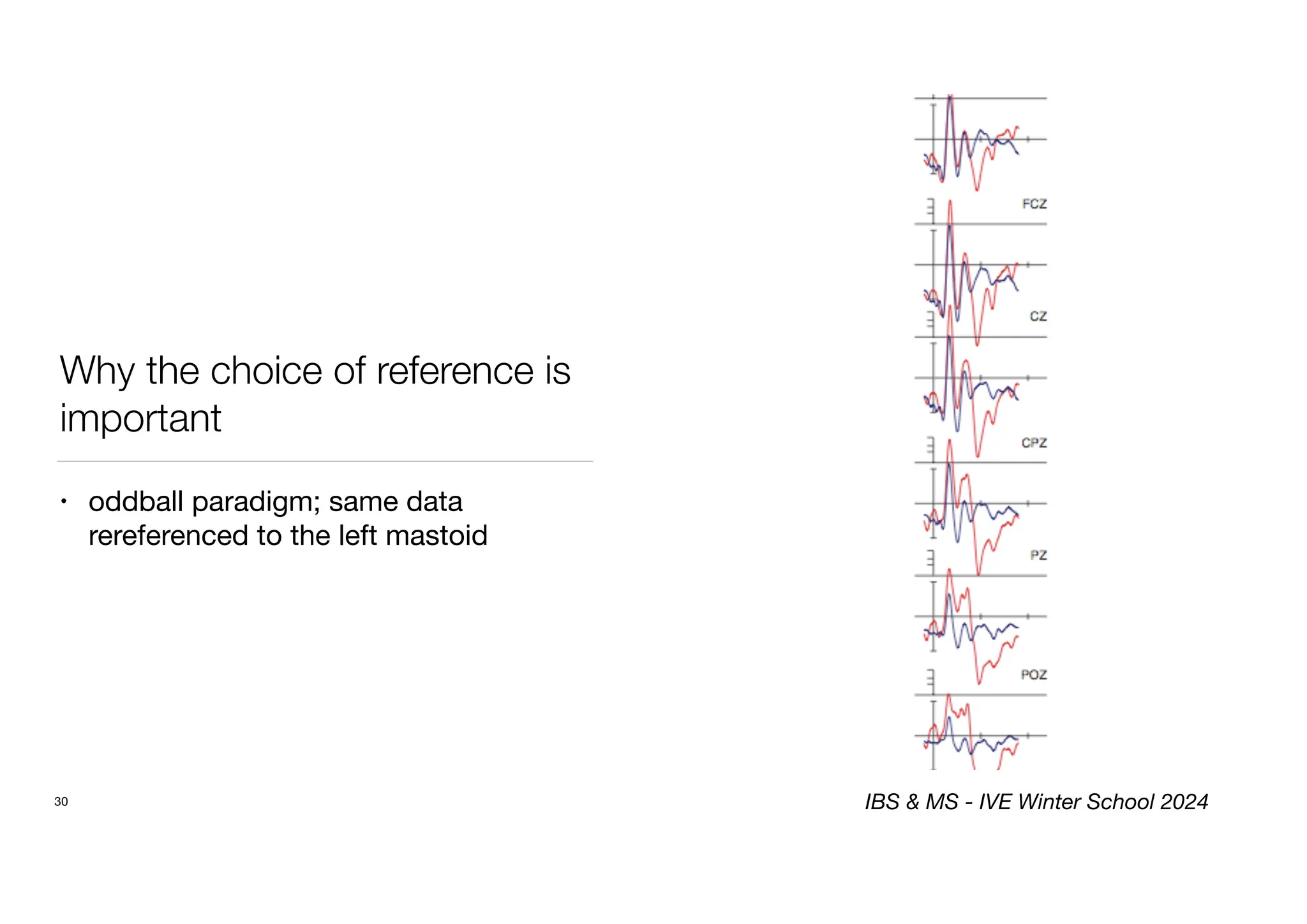
Why the choice of reference is
important
• oddball paradigm; same data
rereferenced to the left mastoid
30 IBS & MS - IVE Winter School 2024
31
Scalp EEG / ERPs: data analysis
IBS & MS - IVE Winter School 2024
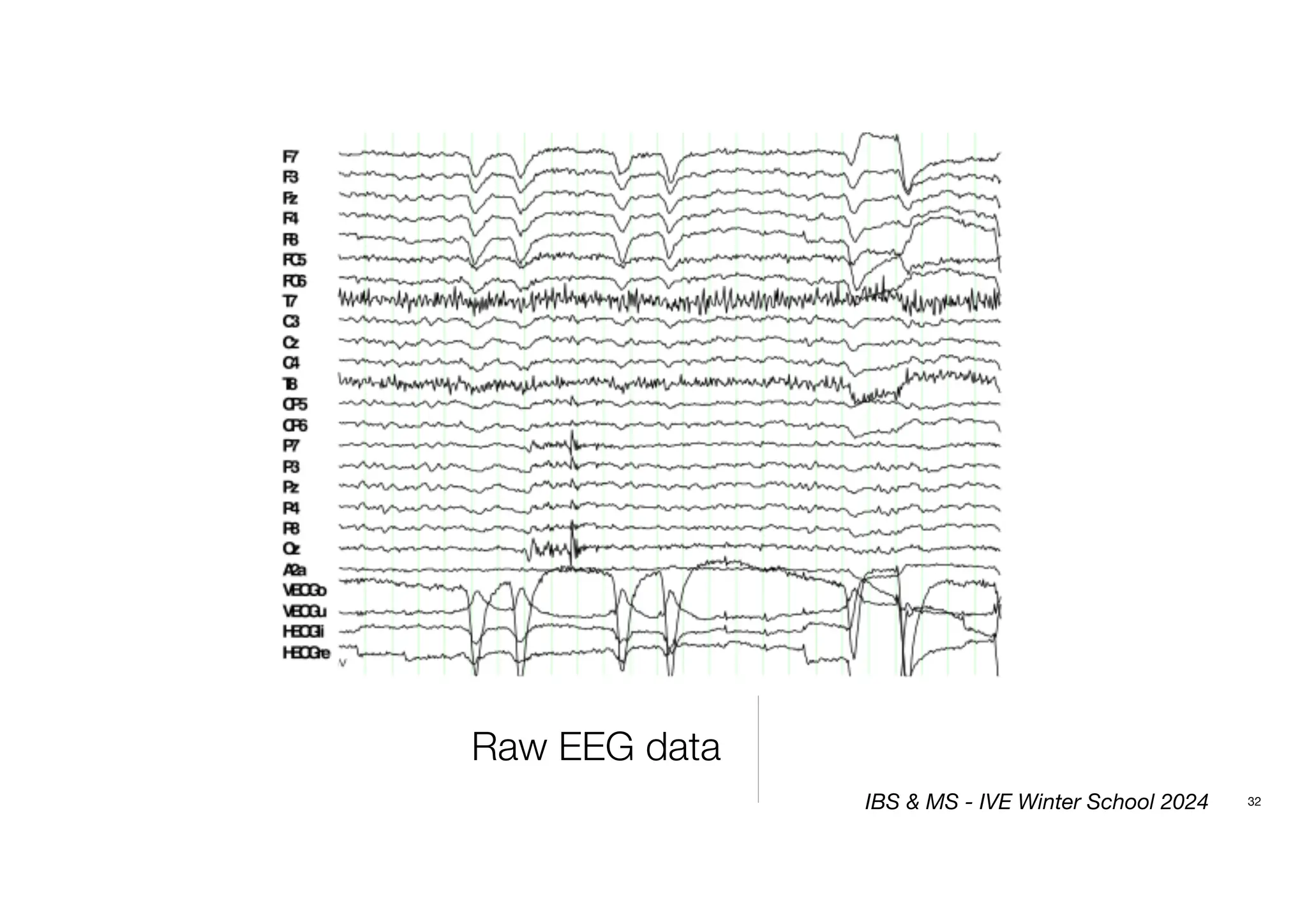
Raw EEG data
32
IBS & MS - IVE Winter School 2024
Steps in data analysis
• Preprocessing
• Re-referencing
• Raw data filtering
• Artefact rejection (automatic + manual)
• Averaging
• single subject average (per electrode, condition and time window)
• grand average (average over single subject averages)
• Statistical analysis
33
IBS & MS - IVE Winter School 2024
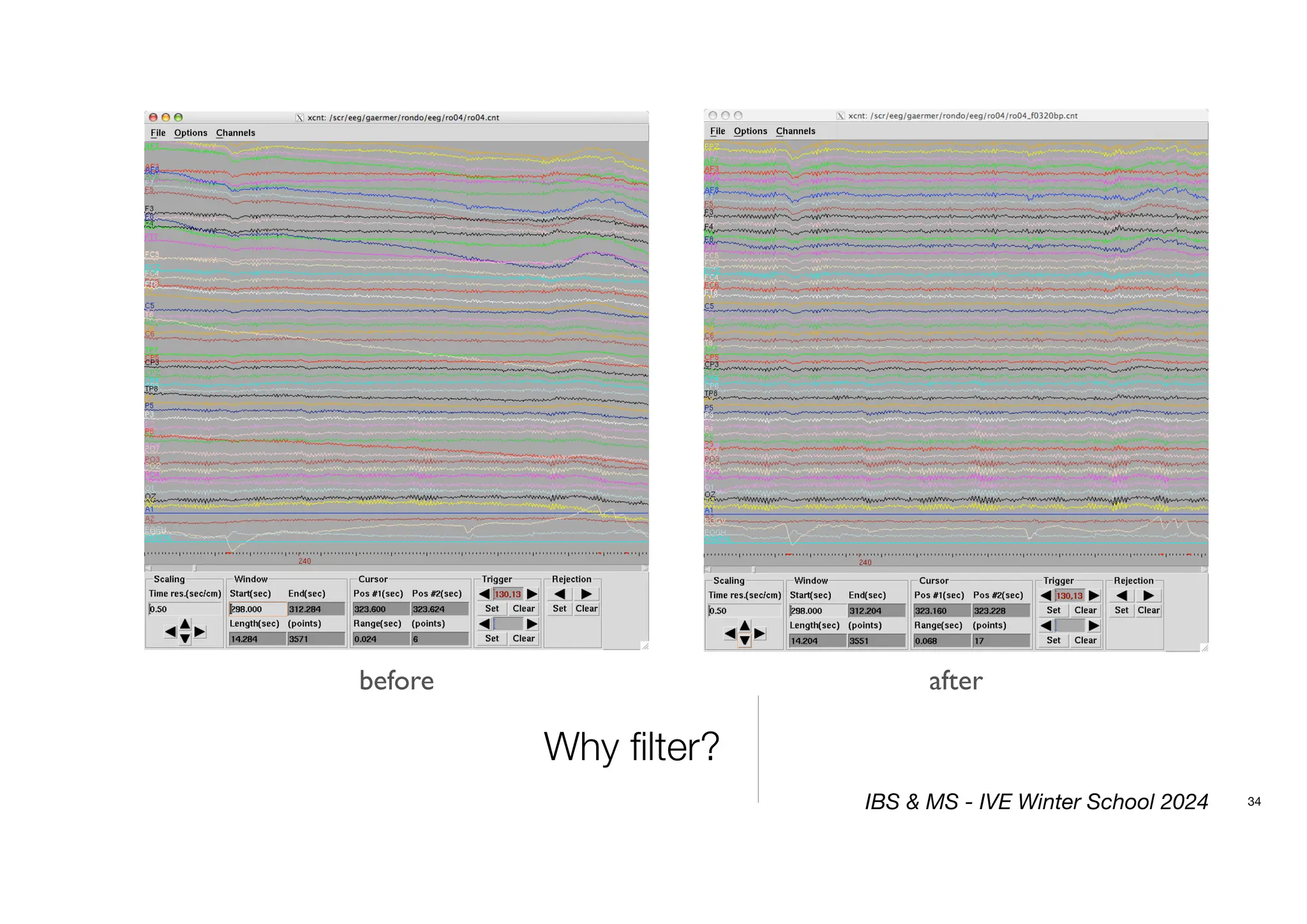
Why filter?
34
before after
IBS & MS - IVE Winter School 2024
Filtering
• High pass
• removes frequencies lower than a specified frequency
• good for removing signal drifts from raw data (see last slide)
• generally between 0.1 and 0.3 Hz (not higher!!)
• must be applied to raw (not epoched) data!
• Low pass
• removes frequencies higher than a specified frequency
• good for “smoothing” averages for data presentation (typically 8-10 Hz)
35
IBS & MS - IVE Winter School 2024
Filtering
• Band pass
• combination of high and low pass filters, i.e. selects a frequency band
• Notch
• removes a specific frequency range from the data
• most common application: removal of 50 or 60 Hz (mains power frequency)
36
IBS & MS - IVE Winter School 2024
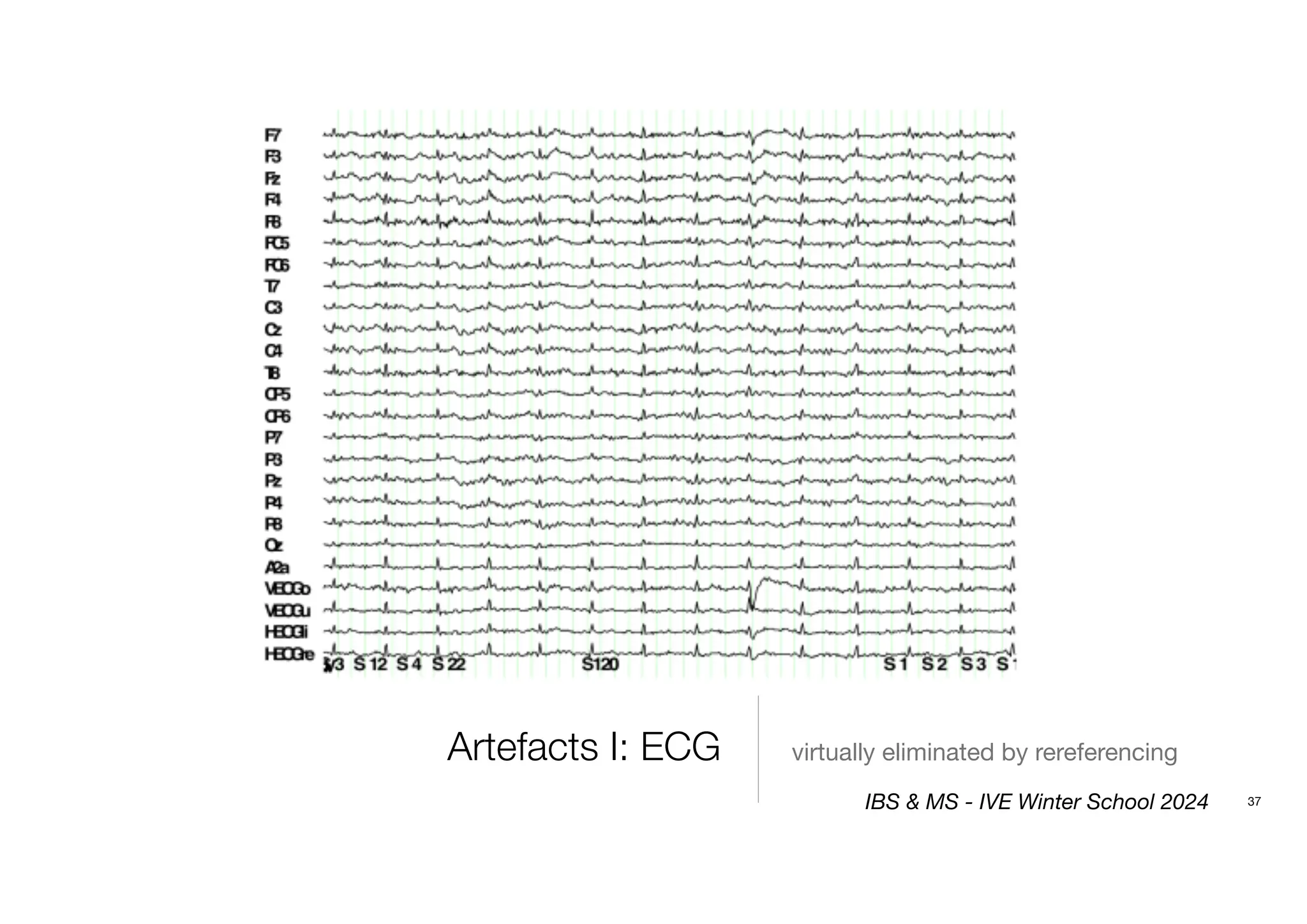
Artefacts I: ECG virtually eliminated by rereferencing
37
IBS & MS - IVE Winter School 2024
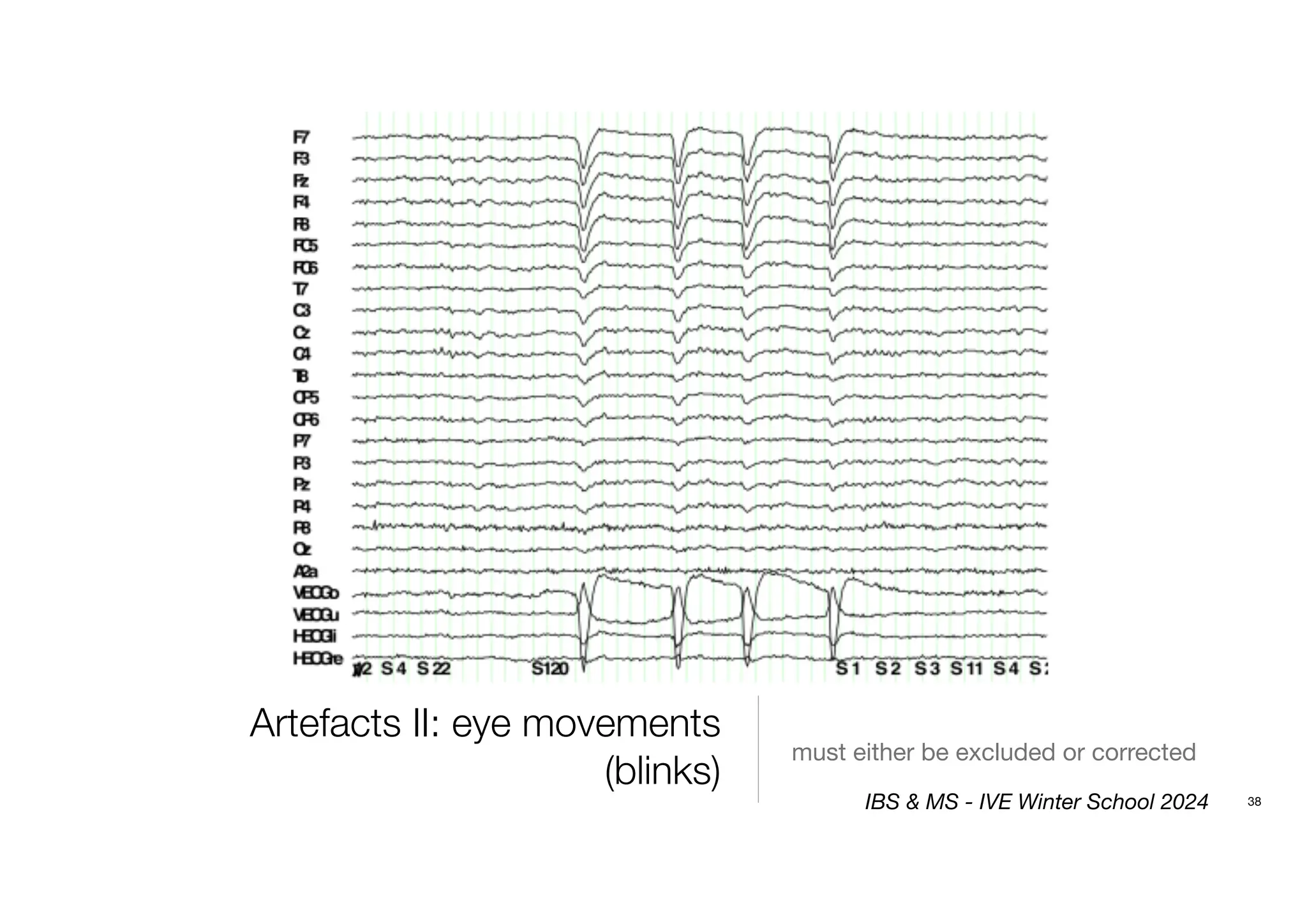
Artefacts II: eye movements
(blinks)
must either be excluded or corrected
38
IBS & MS - IVE Winter School 2024
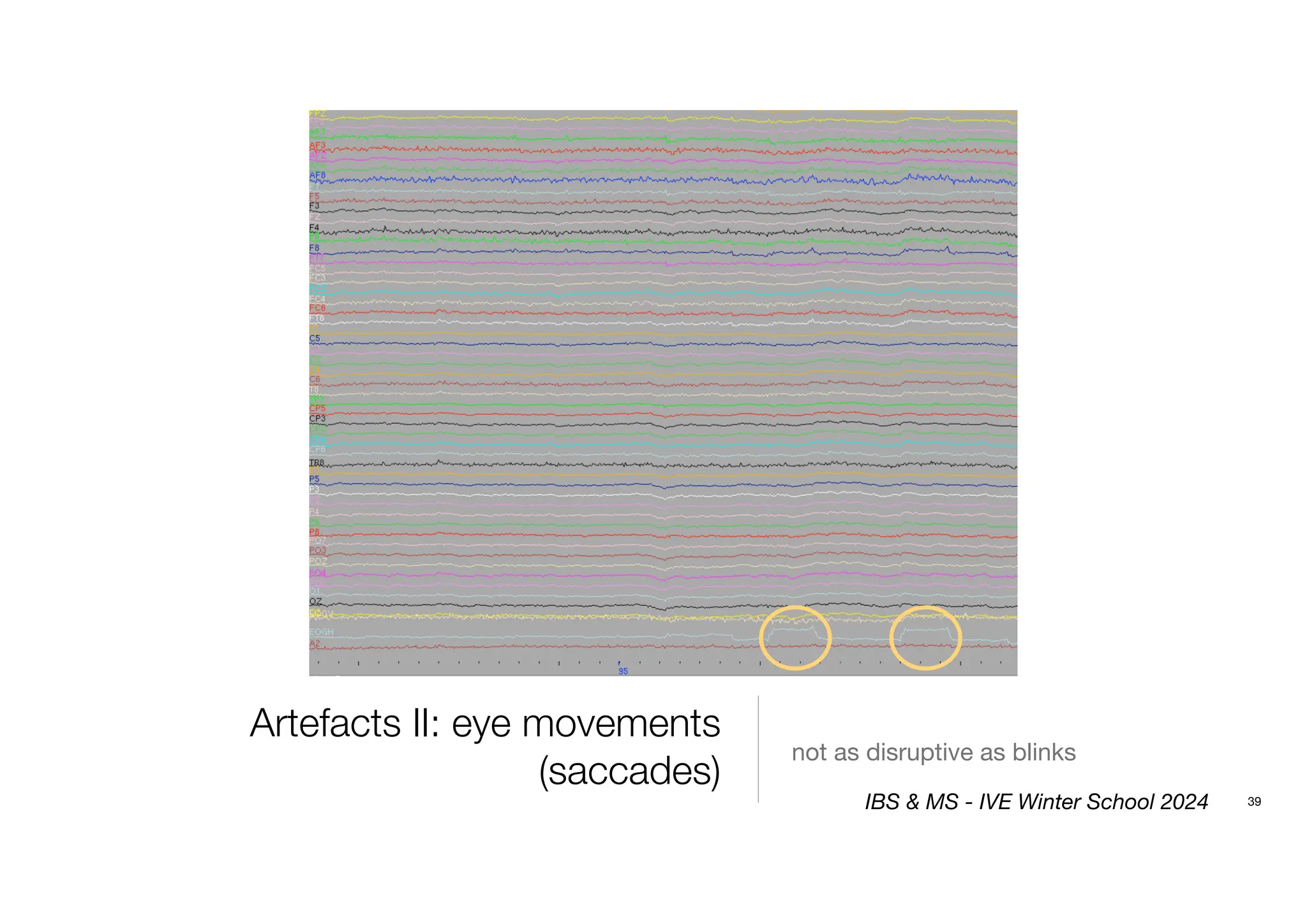
Artefacts II: eye movements
(saccades)
not as disruptive as blinks
39
IBS & MS - IVE Winter School 2024
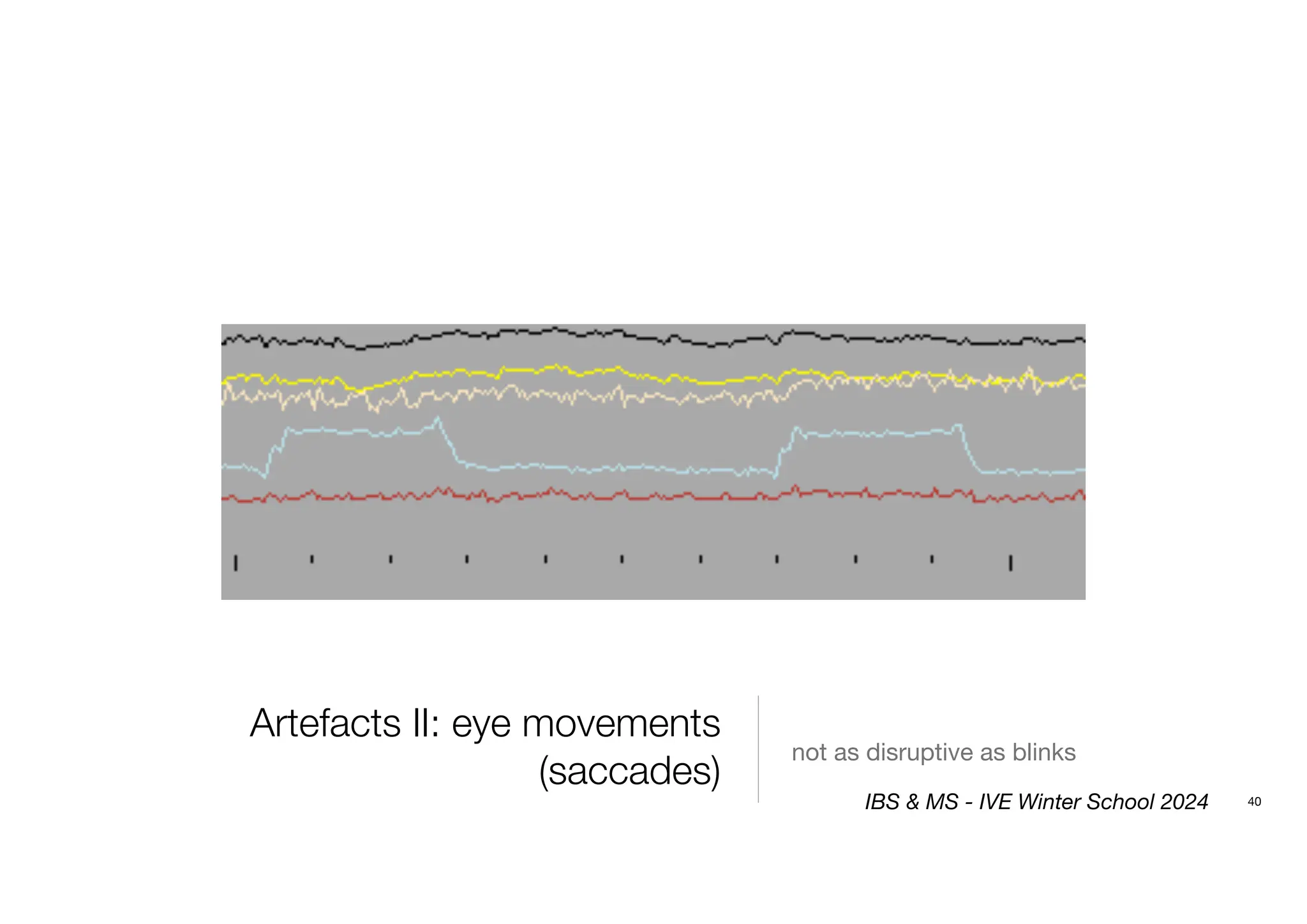
Artefacts II: eye movements
(saccades)
not as disruptive as blinks
40
IBS & MS - IVE Winter School 2024
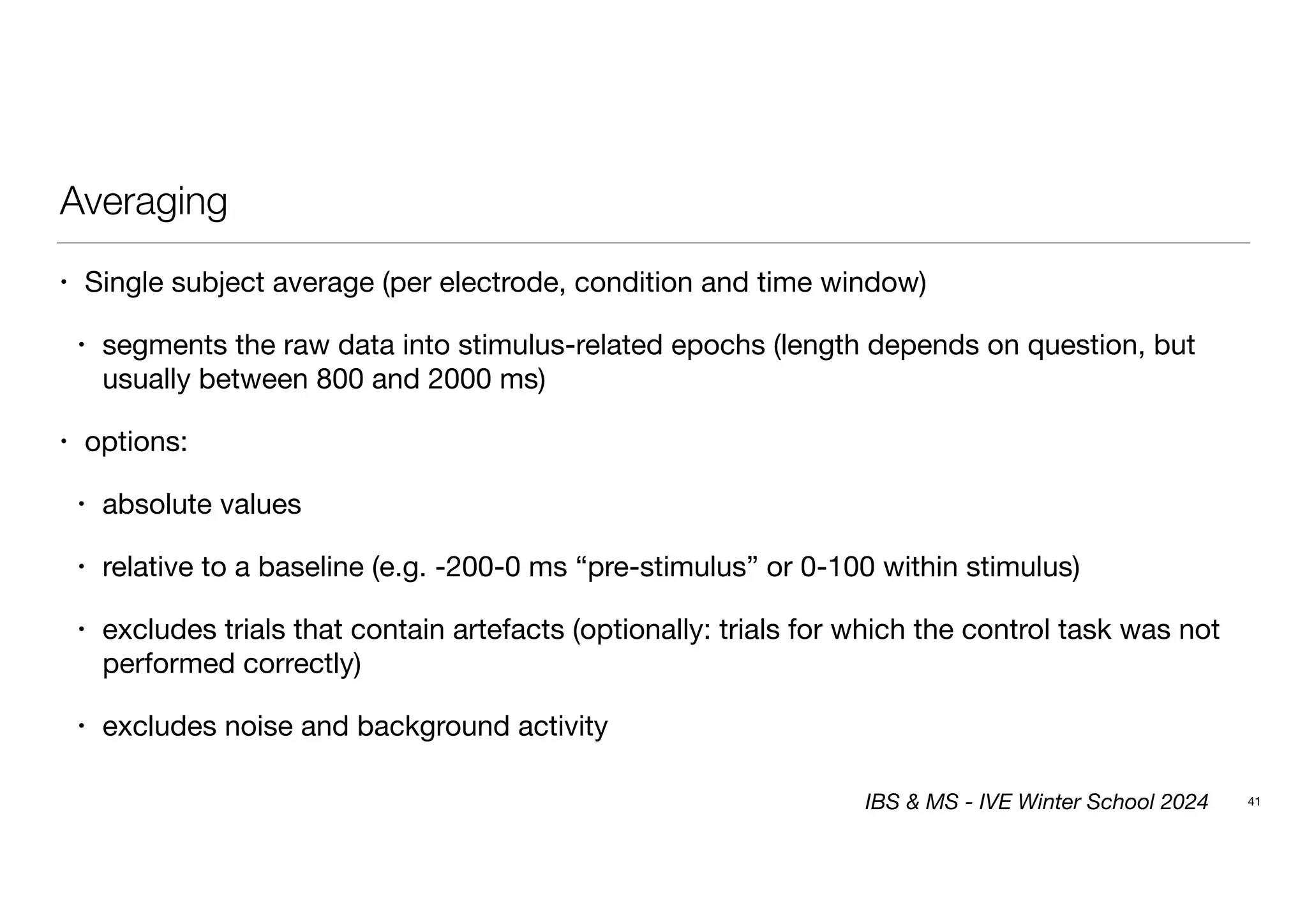
Averaging
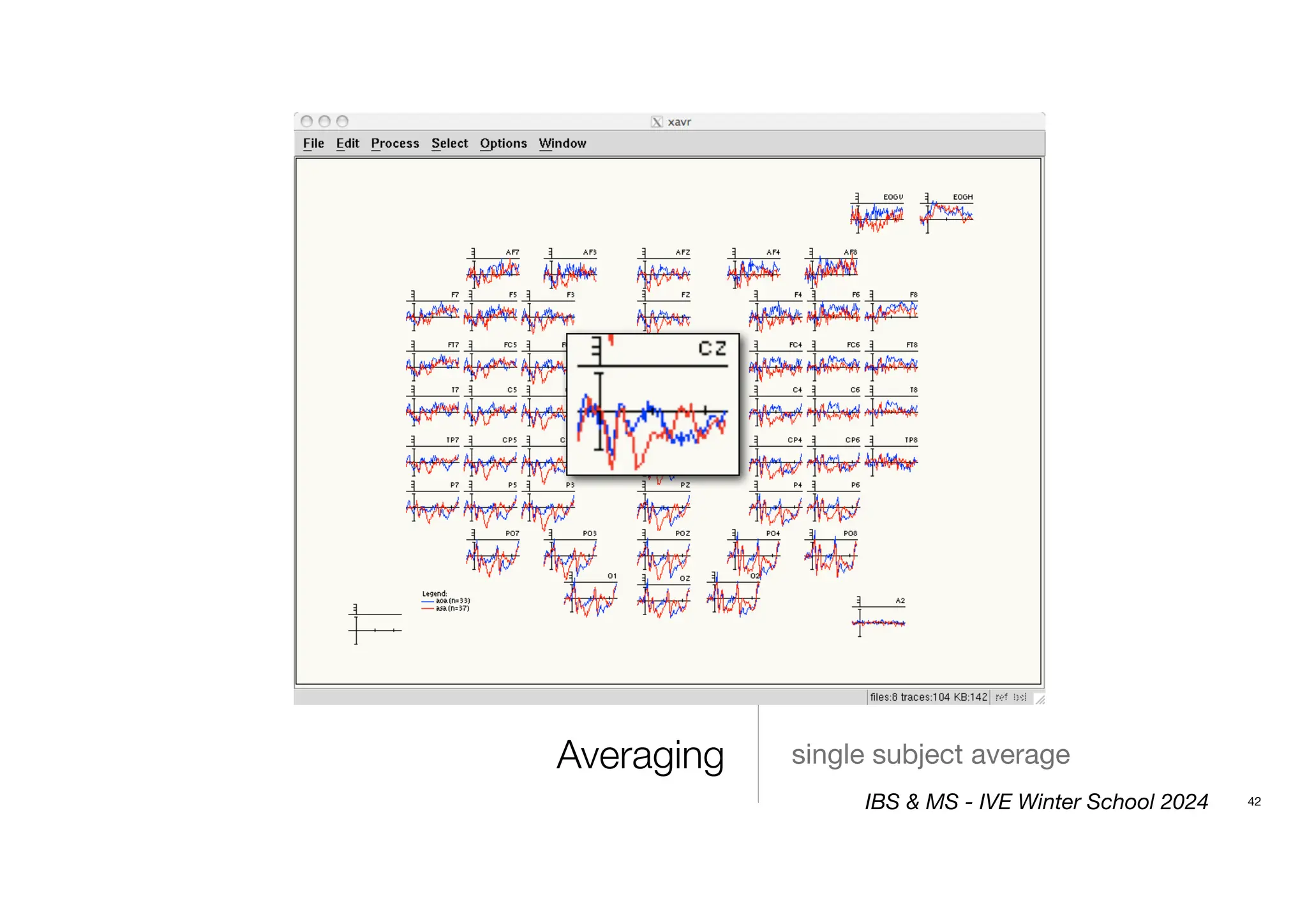
• Single subject average (per electrode, condition and time window)
• segments the raw data into stimulus-related epochs (length depends on question, but
usually between 800 and 2000 ms)
• options:
• absolute values
• relative to a baseline (e.g. -200-0 ms “pre-stimulus” or 0-100 within stimulus)
• excludes trials that contain artefacts (optionally: trials for which the control task was not
performed correctly)
• excludes noise and background activity
41
IBS & MS - IVE Winter School 2024
Averaging single subject average
42
IBS & MS - IVE Winter School 2024
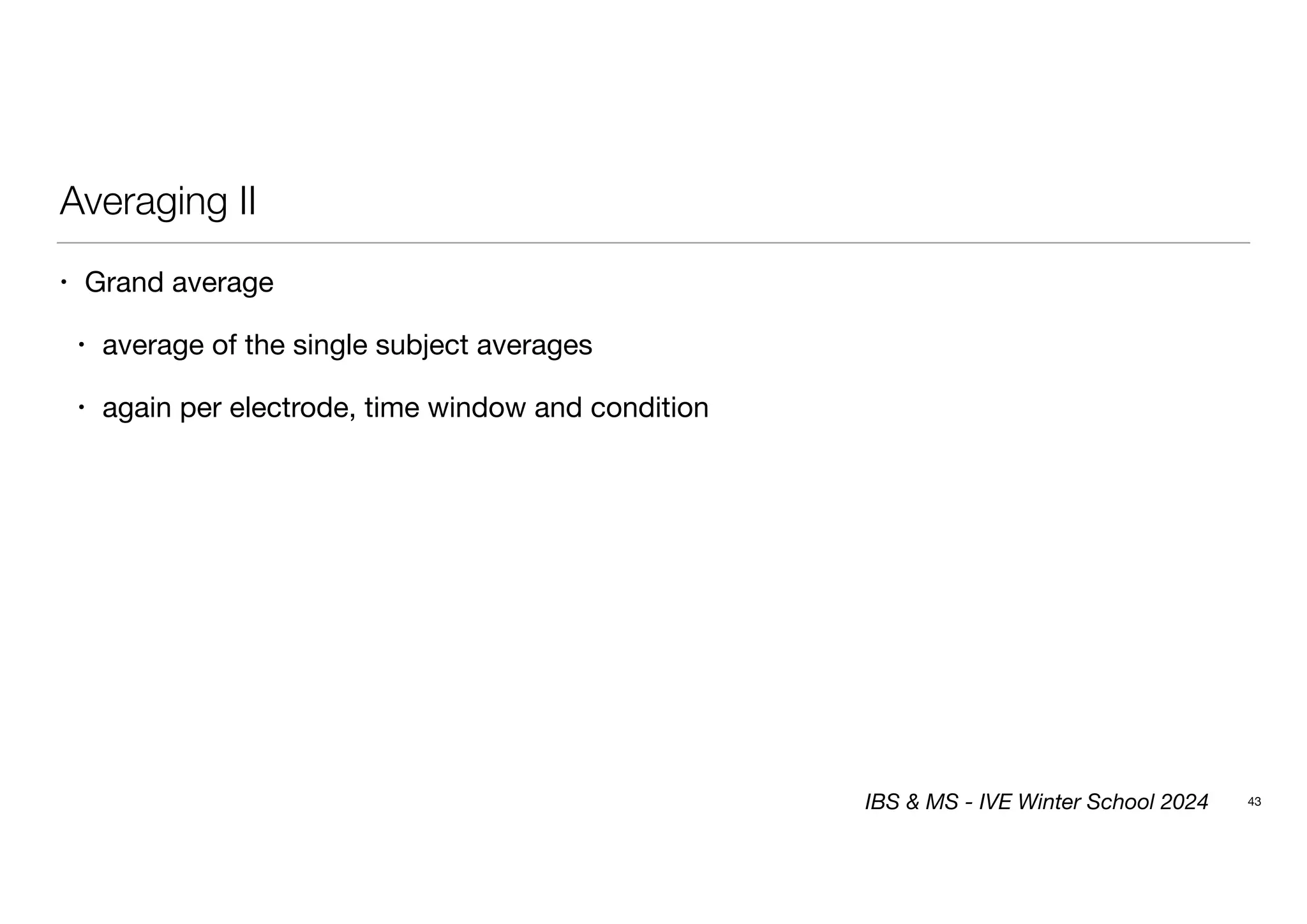
Averaging II
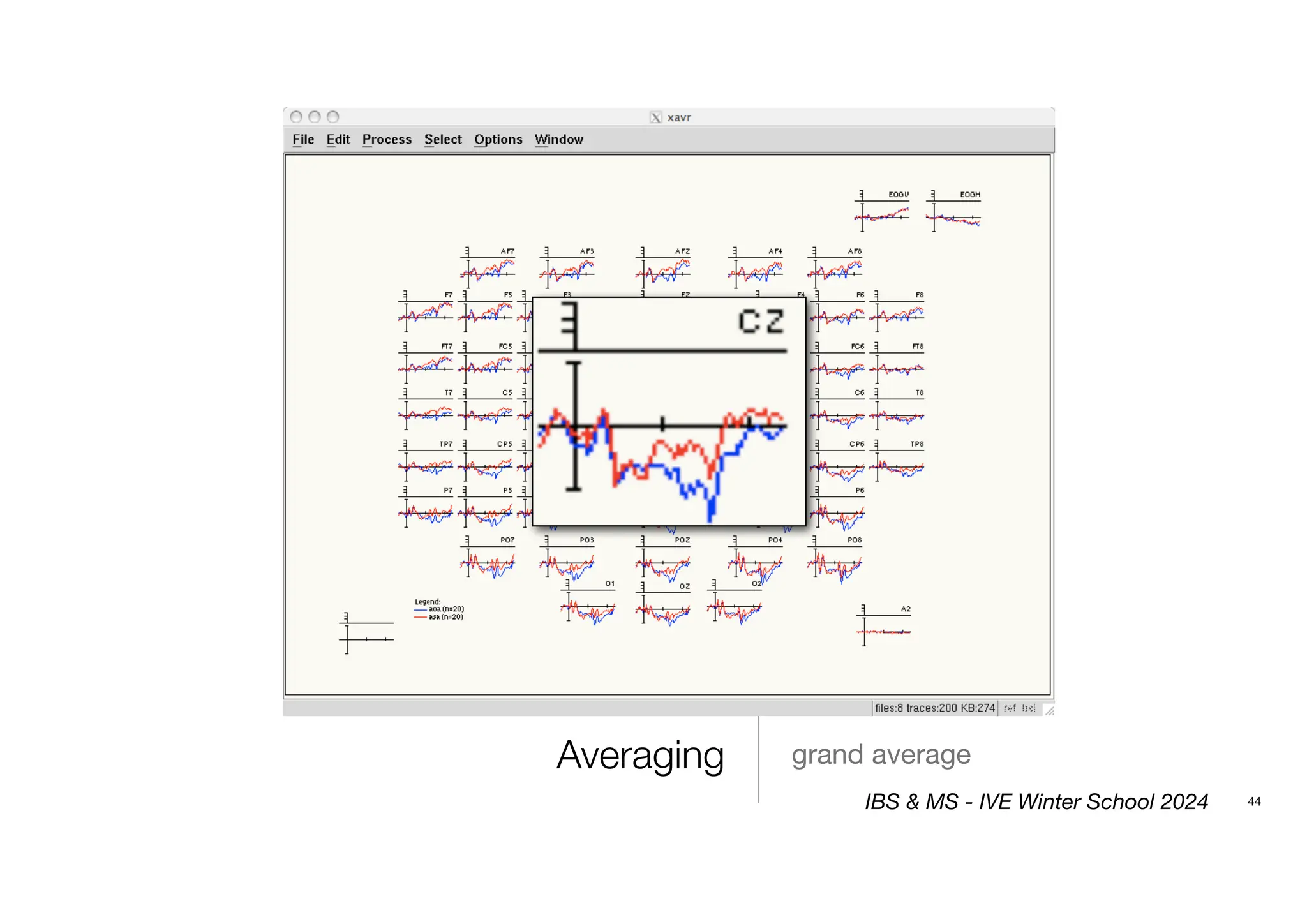
• Grand average
• average of the single subject averages
• again per electrode, time window and condition
43
IBS & MS - IVE Winter School 2024
Averaging grand average
44
IBS & MS - IVE Winter School 2024
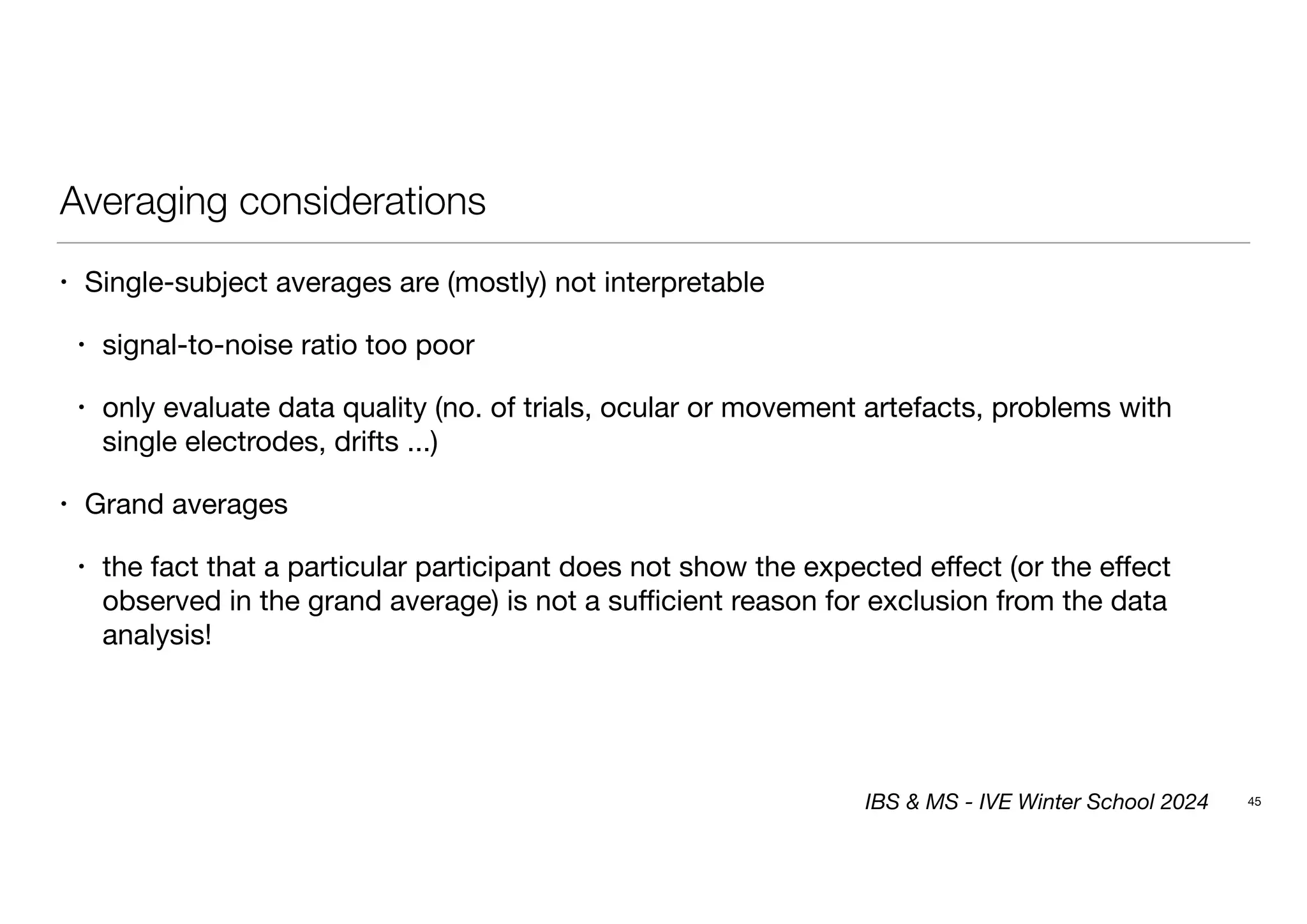
Averaging considerations
• Single-subject averages are (mostly) not interpretable
• signal-to-noise ratio too poor
• only evaluate data quality (no. of trials, ocular or movement artefacts, problems with
single electrodes, drifts ...)
• Grand averages
• the fact that a particular participant does not show the expected effect (or the effect
observed in the grand average) is not a sufficient reason for exclusion from the data
analysis!
45
IBS & MS - IVE Winter School 2024
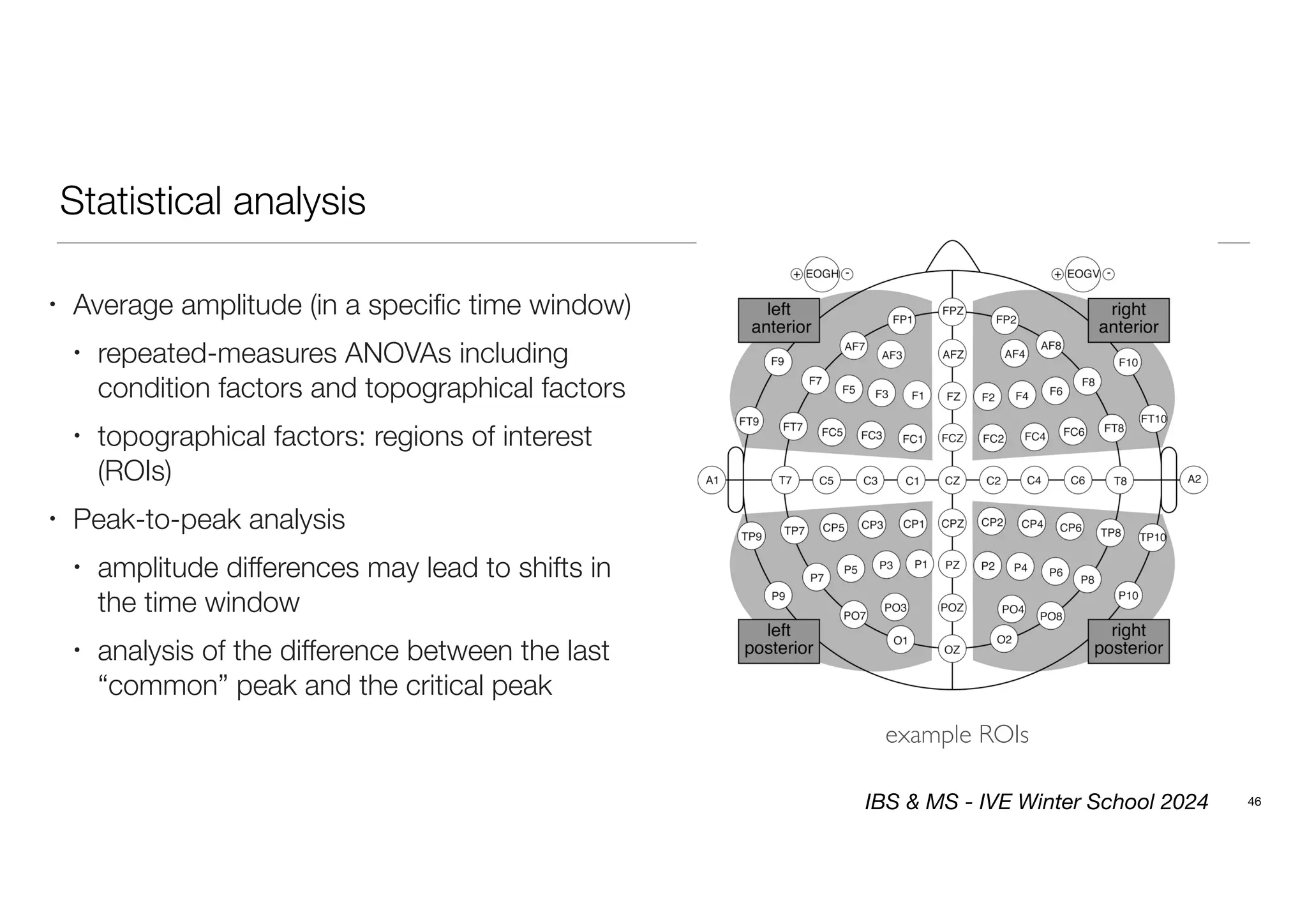
Statistical analysis
46
• Average amplitude (in a specific time window)
• repeated-measures ANOVAs including
condition factors and topographical factors
• topographical factors: regions of interest
(ROIs)
• Peak-to-peak analysis
• amplitude differences may lead to shifts in
the time window
• analysis of the difference between the last
“common” peak and the critical peak
example ROIs
IBS & MS - IVE Winter School 2024
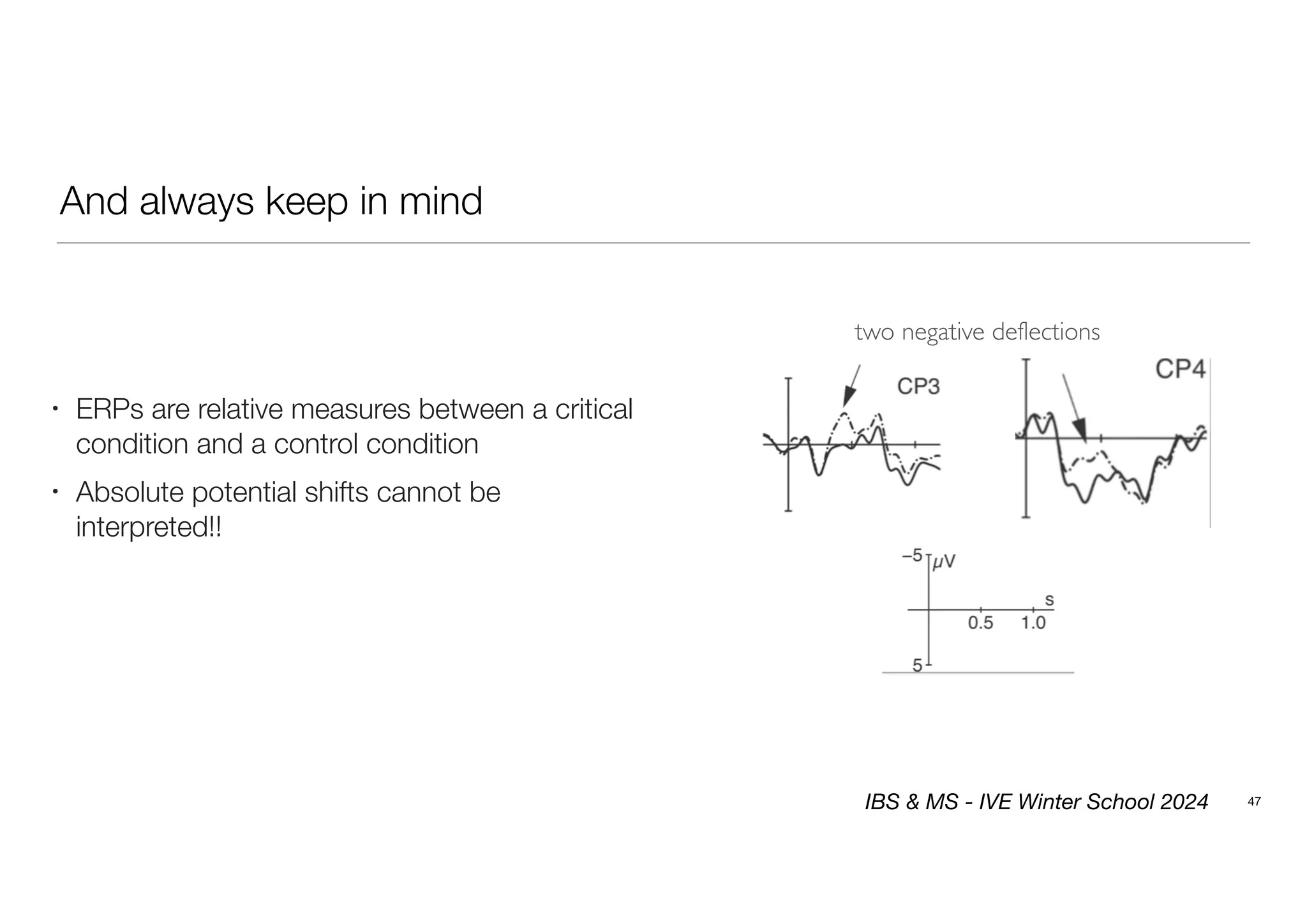
And always keep in mind
47
• ERPs are relative measures between a critical
condition and a control condition
• Absolute potential shifts cannot be
interpreted!!
two negative deflections
IBS & MS - IVE Winter School 2024
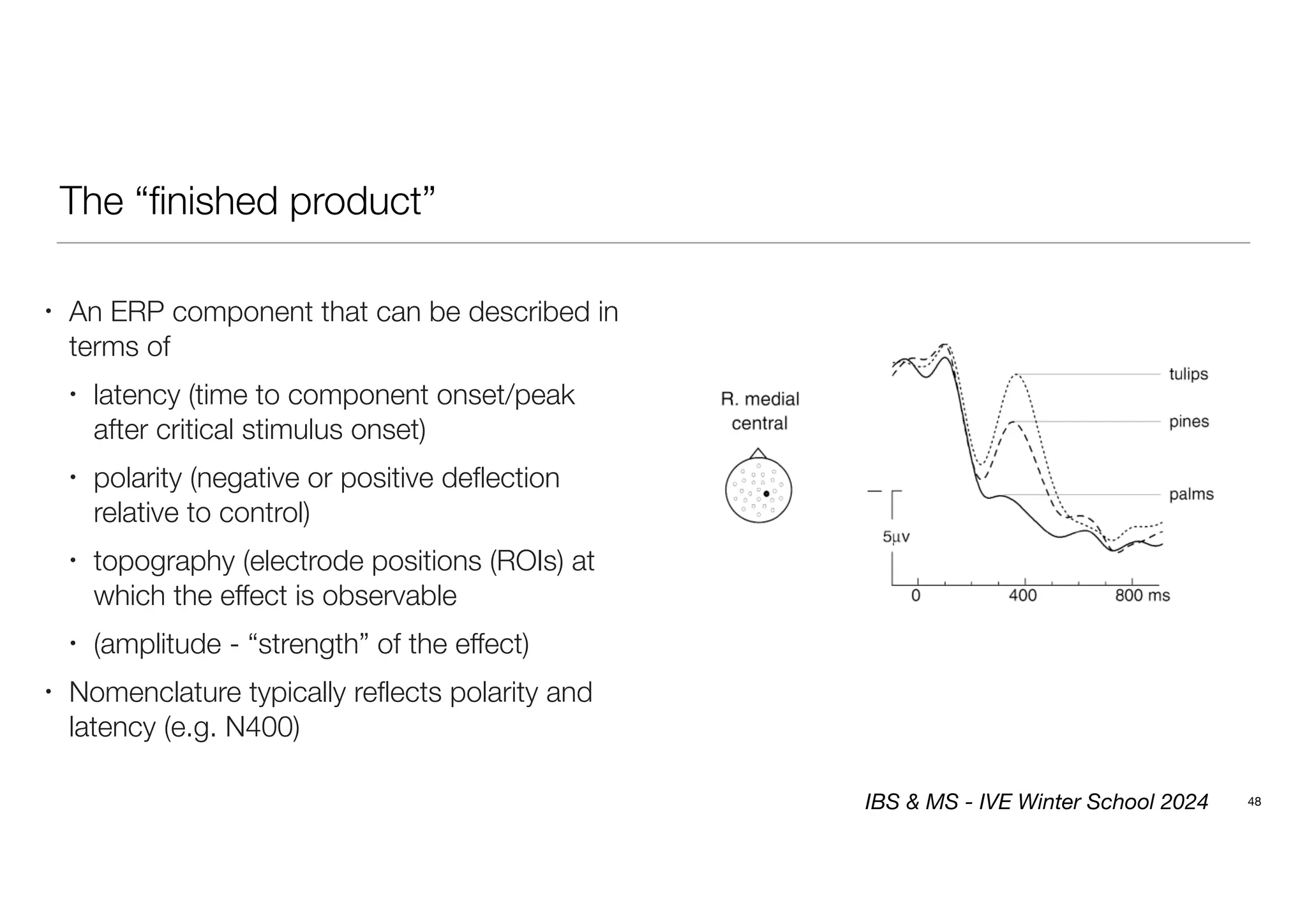
The “finished product”
48
• An ERP component that can be described in
terms of
• latency (time to component onset/peak
after critical stimulus onset)
• polarity (negative or positive deflection
relative to control)
• topography (electrode positions (ROIs) at
which the effect is observable
• (amplitude - “strength” of the effect)
• Nomenclature typically reflects polarity and
latency (e.g. N400)
IBS & MS - IVE Winter School 2024
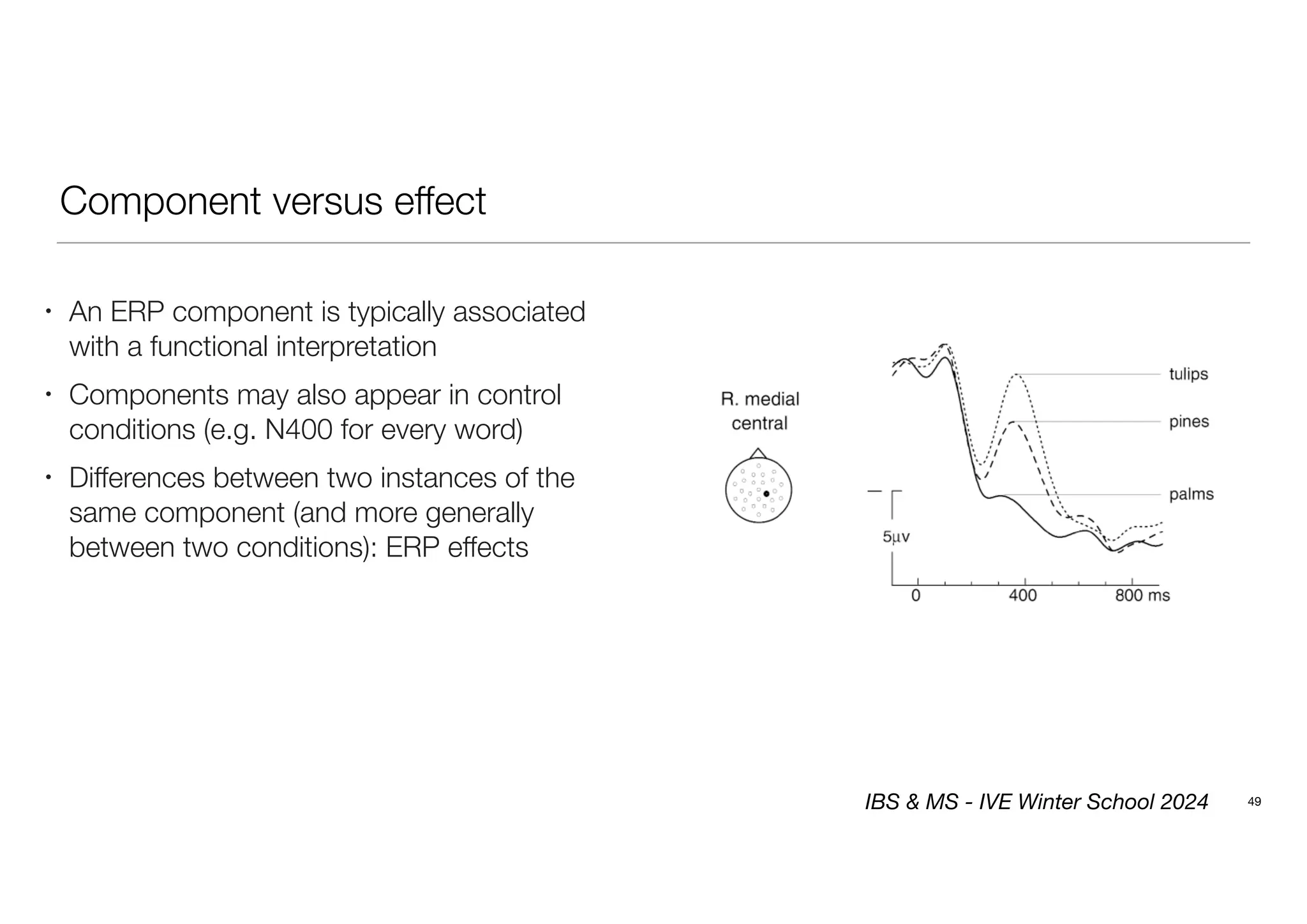
Component versus effect
49
• An ERP component is typically associated
with a functional interpretation
• Components may also appear in control
conditions (e.g. N400 for every word)
• Differences between two instances of the
same component (and more generally
between two conditions): ERP effects
IBS & MS - IVE Winter School 2024
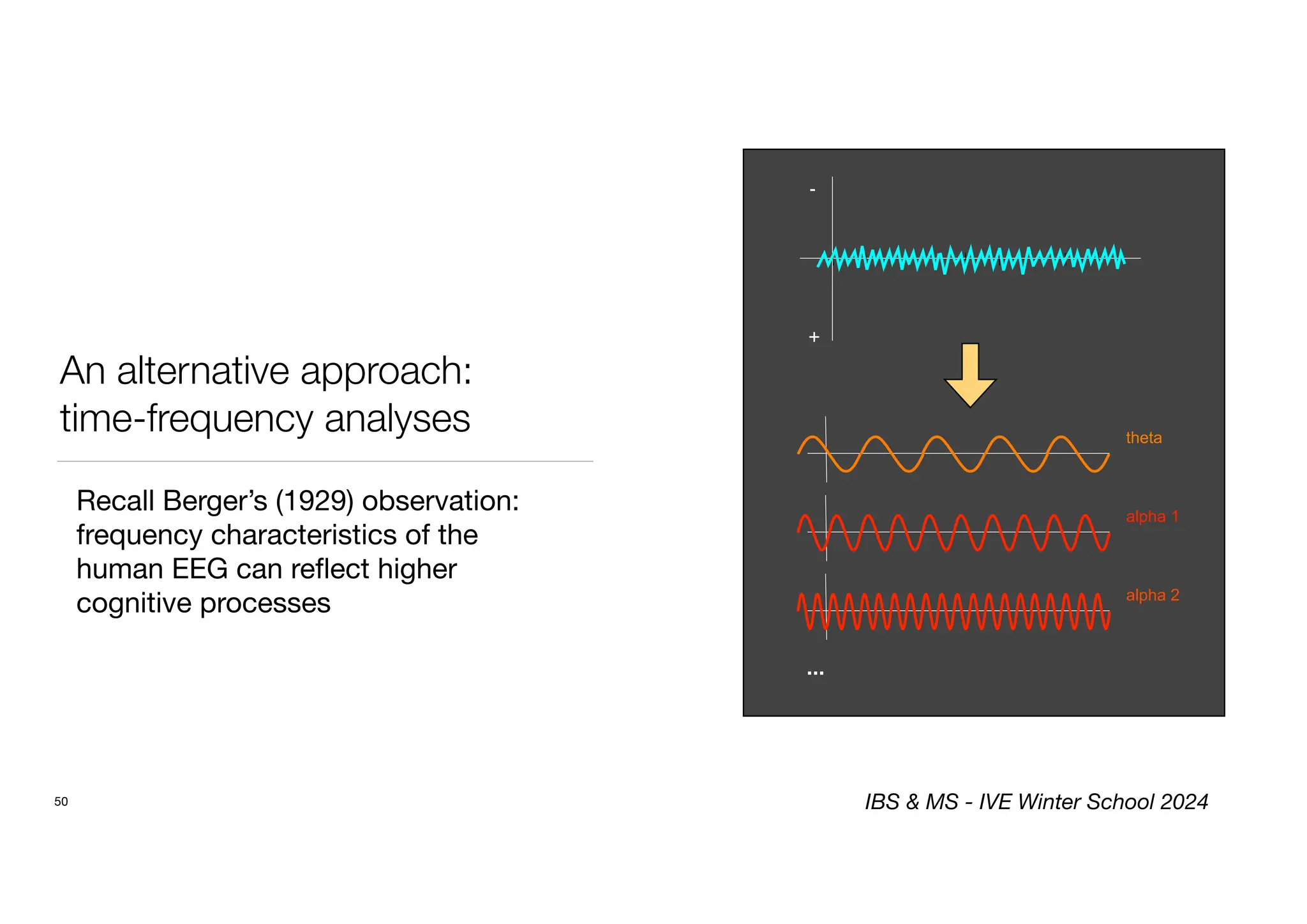
An alternative approach:
time-frequency analyses
Recall Berger’s (1929) observation:
frequency characteristics of the
human EEG can re
fl
ect higher
cognitive processes
50
-
+
theta
alpha 1
alpha 2
...
IBS & MS - IVE Winter School 2024
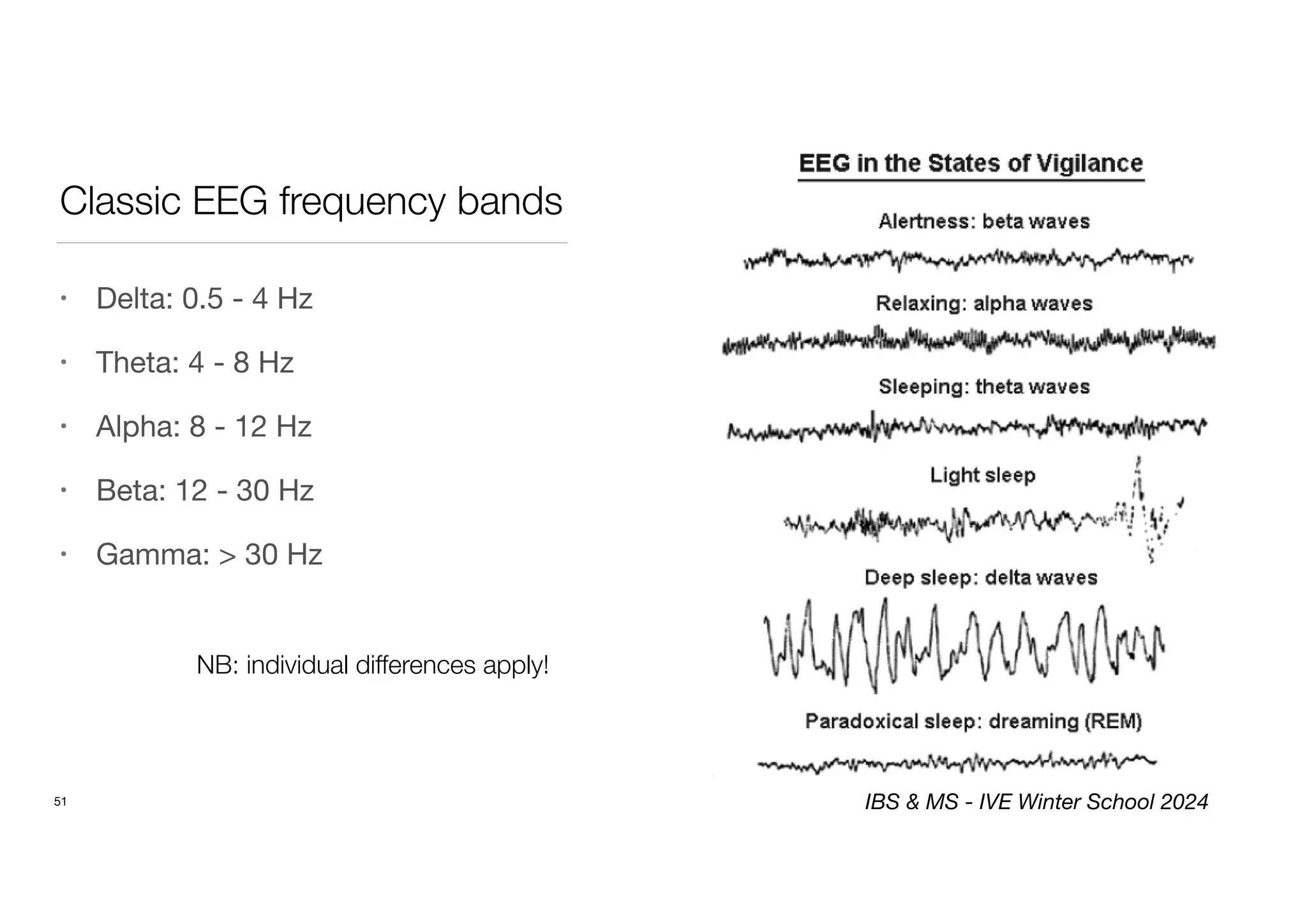
Classic EEG frequency bands
• Delta: 0.5 - 4 Hz
• Theta: 4 - 8 Hz
• Alpha: 8 - 12 Hz
• Beta: 12 - 30 Hz
• Gamma: > 30 Hz
51
NB: individual differences apply!
IBS & MS - IVE Winter School 2024
EEG frequency and higher cognition
• Independently of (and in parallel to) ERP-based research, a frequency-based research
tradition has identi
fi
ed correlates of di
ff
erent cognitive domains / processes within
di
ff
erent frequency bands, e.g.:
• alpha band
• attention (Ray & Cole, 1985, Science, 228, 750-752)
• memory performance (Klimesch, 1997, J Psychophysiol, 26, 319-340)
• intelligence (Doppelmayr et al., 2002, Intelligence, 30, 289-302)
• theta band
• episodic memory (Miller, 1991. Cortico-hippocampal interplay ... Berlin: Springer.)
52
IBS & MS - IVE Winter School 2024
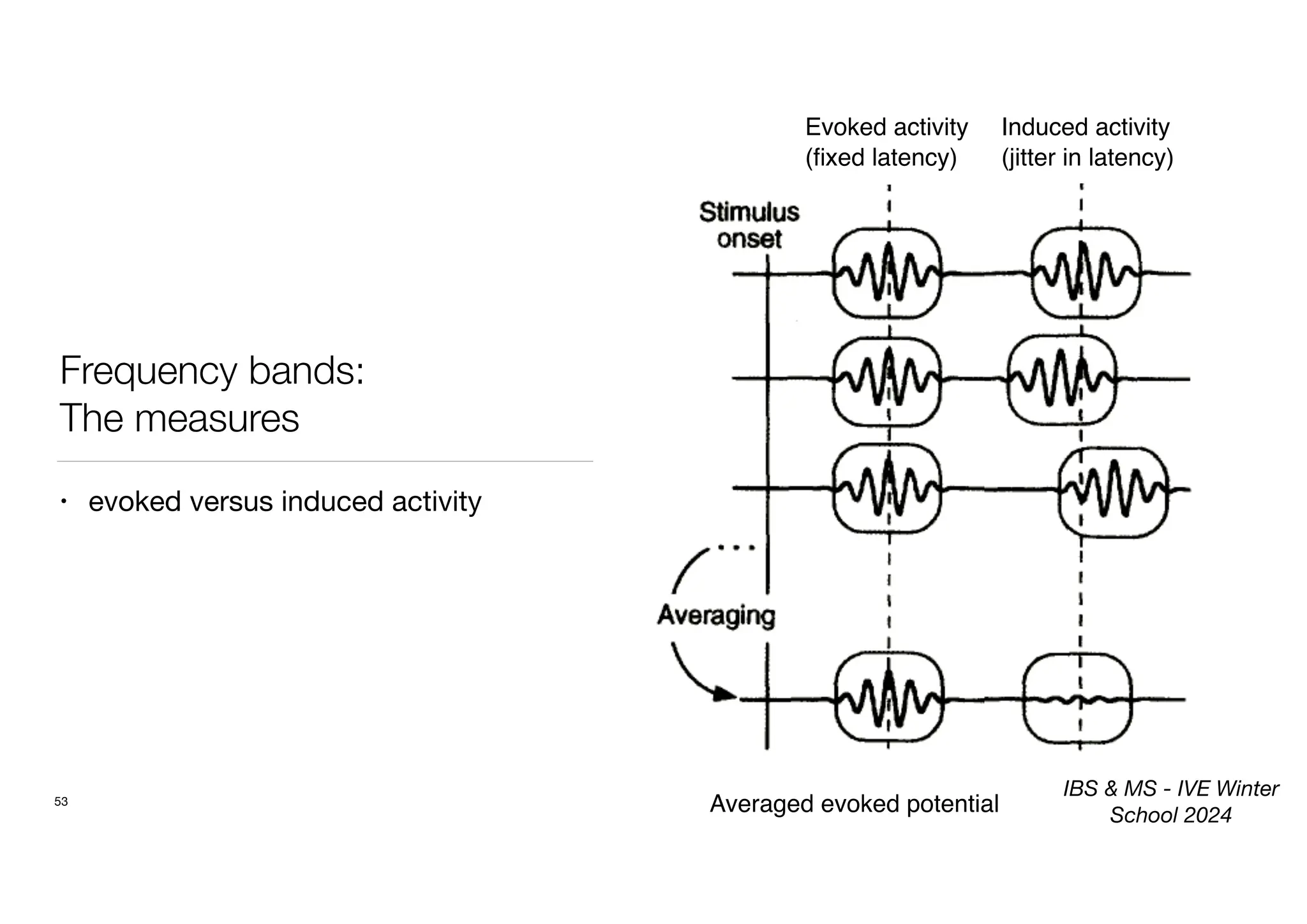
Frequency bands:
The measures
53
Induced activity
(jitter in latency)
Evoked activity
(
fi
xed latency)
Averaged evoked potential
• evoked versus induced activity
IBS & MS - IVE Winter
School 2024
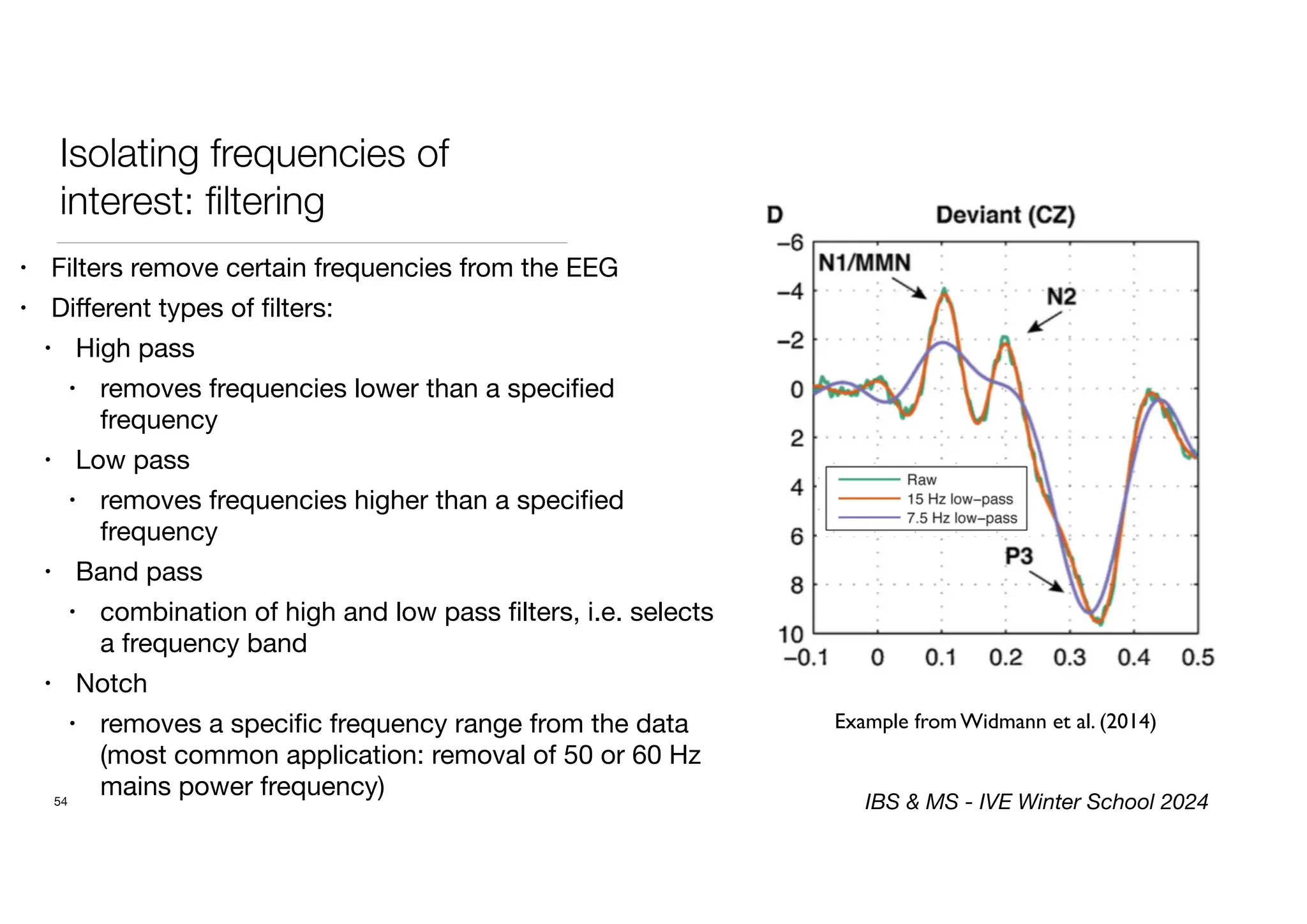
Isolating frequencies of
interest:
fi
ltering
• Filters remove certain frequencies from the EEG
• Di
ff
erent types of
fi
lters:
• High pass
• removes frequencies lower than a speci
fi
ed
frequency
• Low pass
• removes frequencies higher than a speci
fi
ed
frequency
• Band pass
• combination of high and low pass
fi
lters, i.e. selects
a frequency band
• Notch
• removes a speci
fi
c frequency range from the data
(most common application: removal of 50 or 60 Hz
mains power frequency)
54
Example from Widmann et al. (2014)
IBS & MS - IVE Winter School 2024
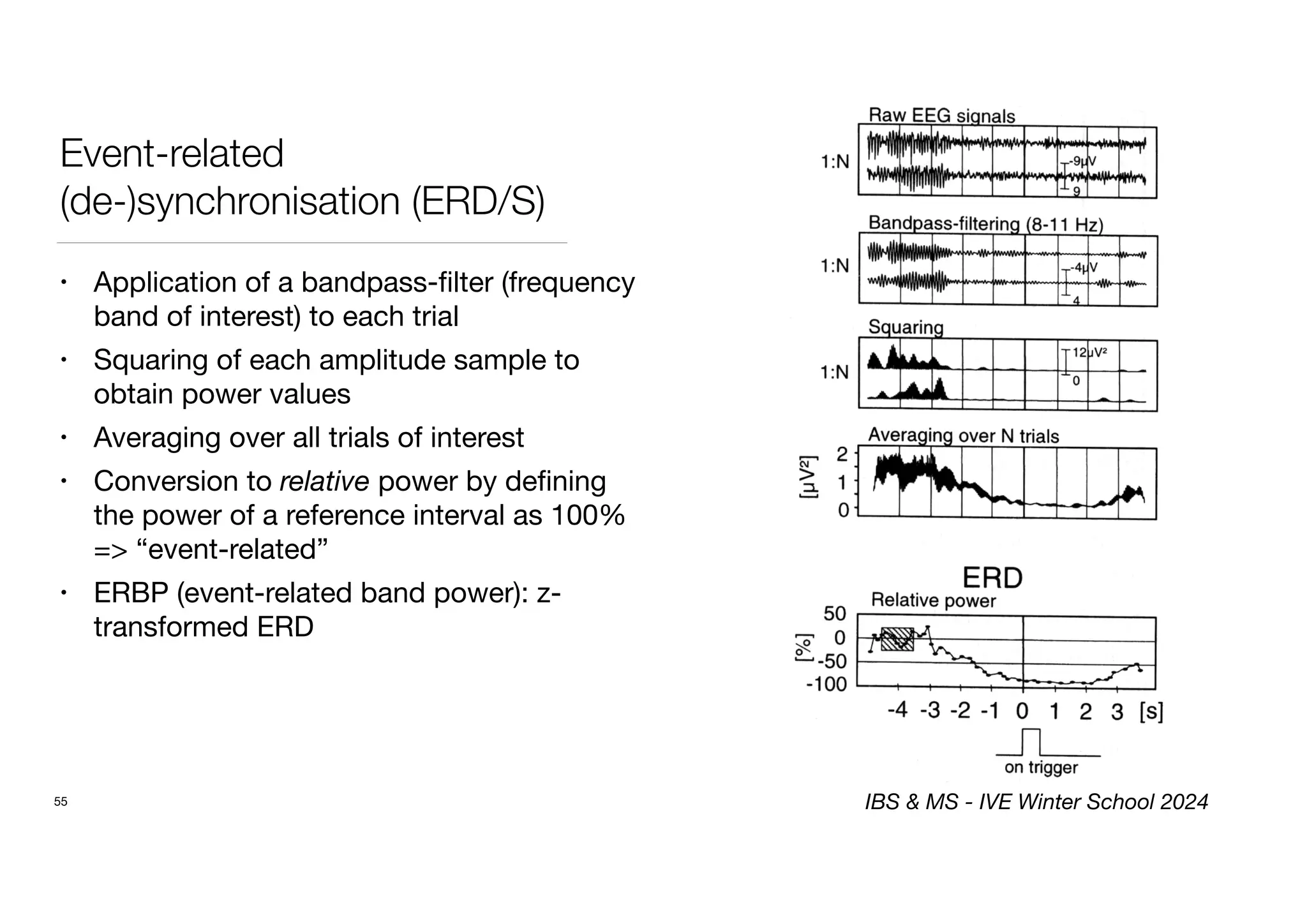
Event-related
(de-)synchronisation (ERD/S)
• Application of a bandpass-
fi
lter (frequency
band of interest) to each trial
• Squaring of each amplitude sample to
obtain power values
• Averaging over all trials of interest
• Conversion to relative power by de
fi
ning
the power of a reference interval as 100%
=> “event-related”
• ERBP (event-related band power): z-
transformed ERD
55 IBS & MS - IVE Winter School 2024
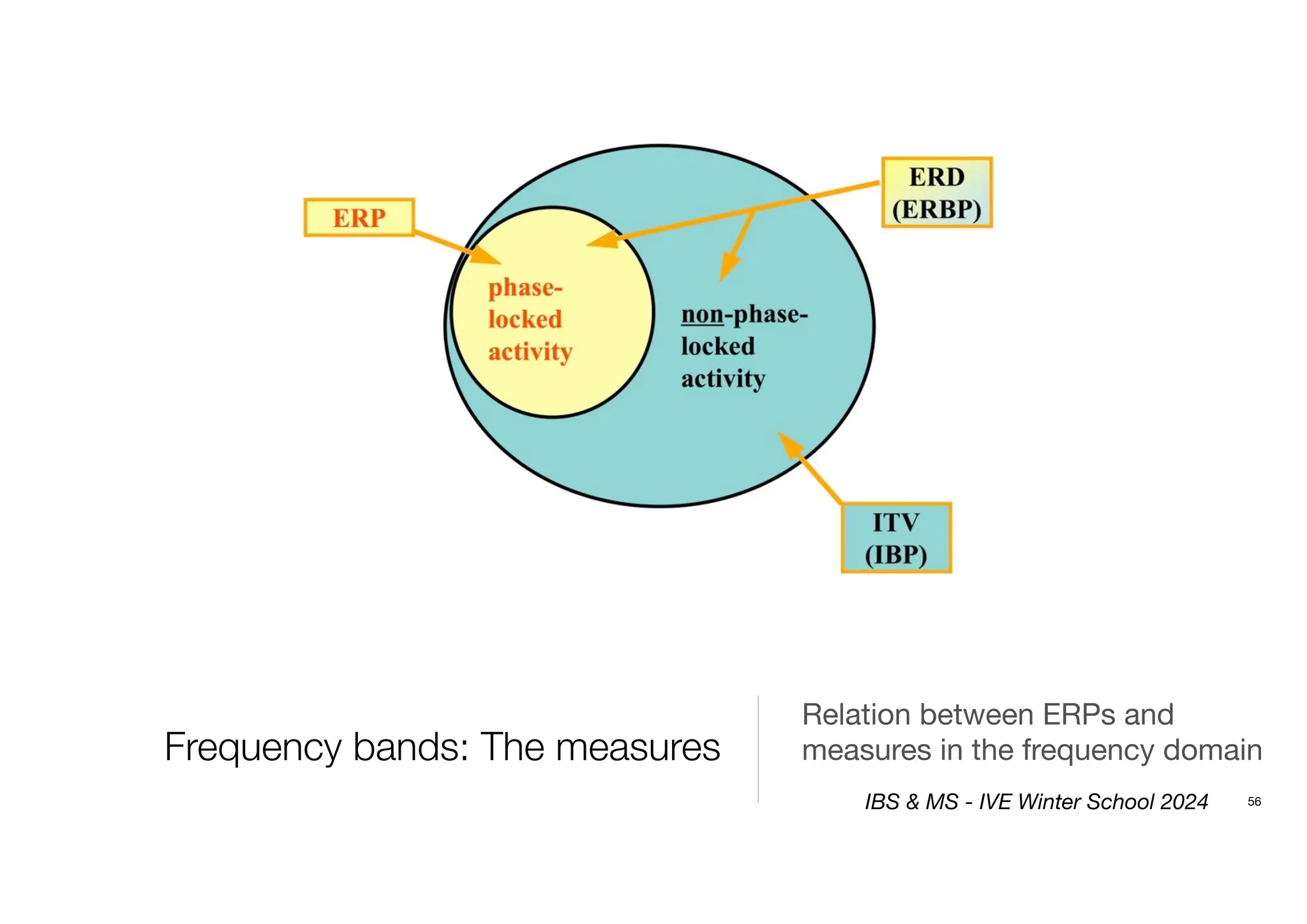
Frequency bands: The measures
56
Relation between ERPs and
measures in the frequency domain
IBS & MS - IVE Winter School 2024
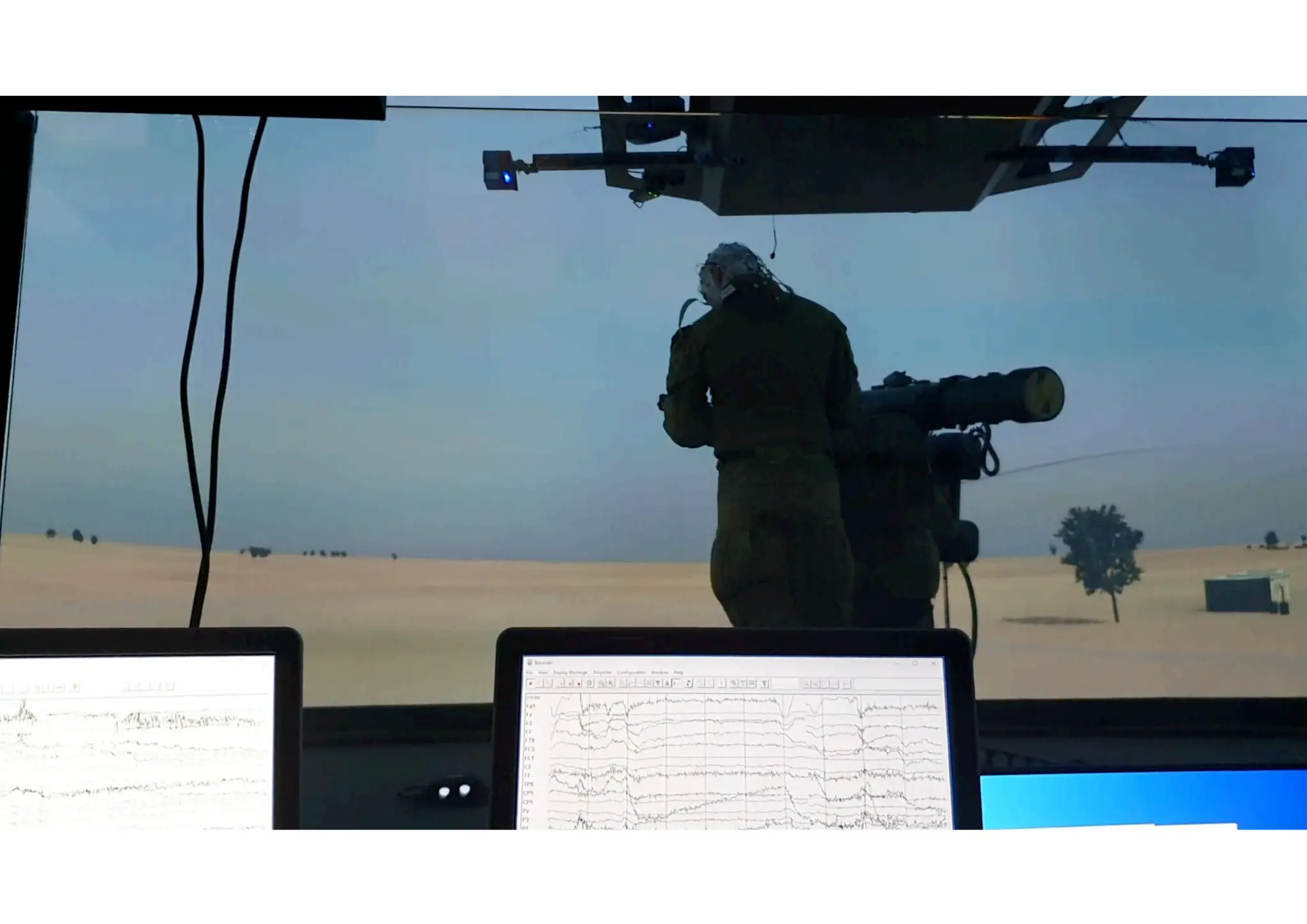
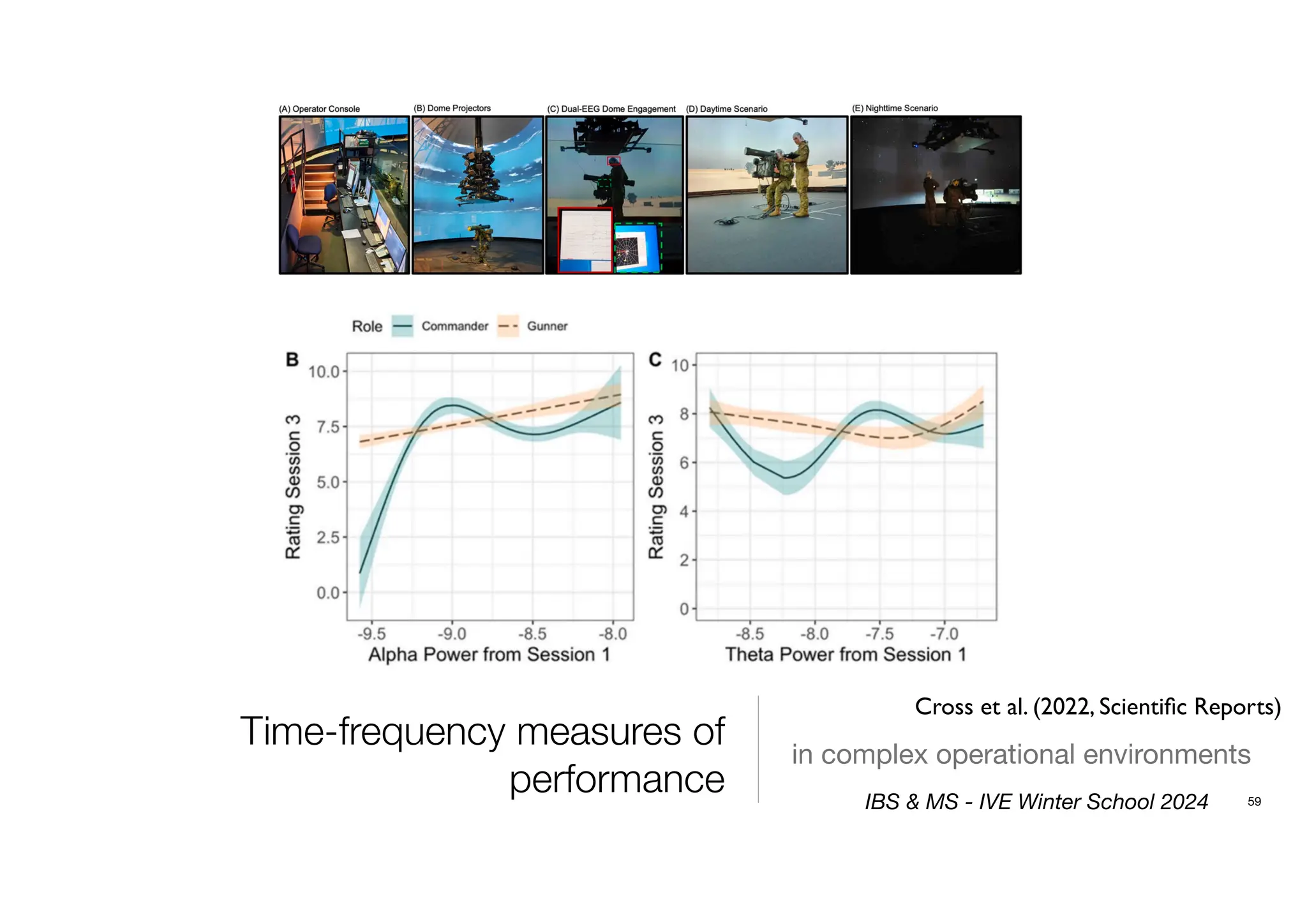
Time-frequency measures of
performance
in complex operational environments
59
IBS & MS - IVE Winter School 2024
Cross et al. (2022, Scienti
fi
c Reports)
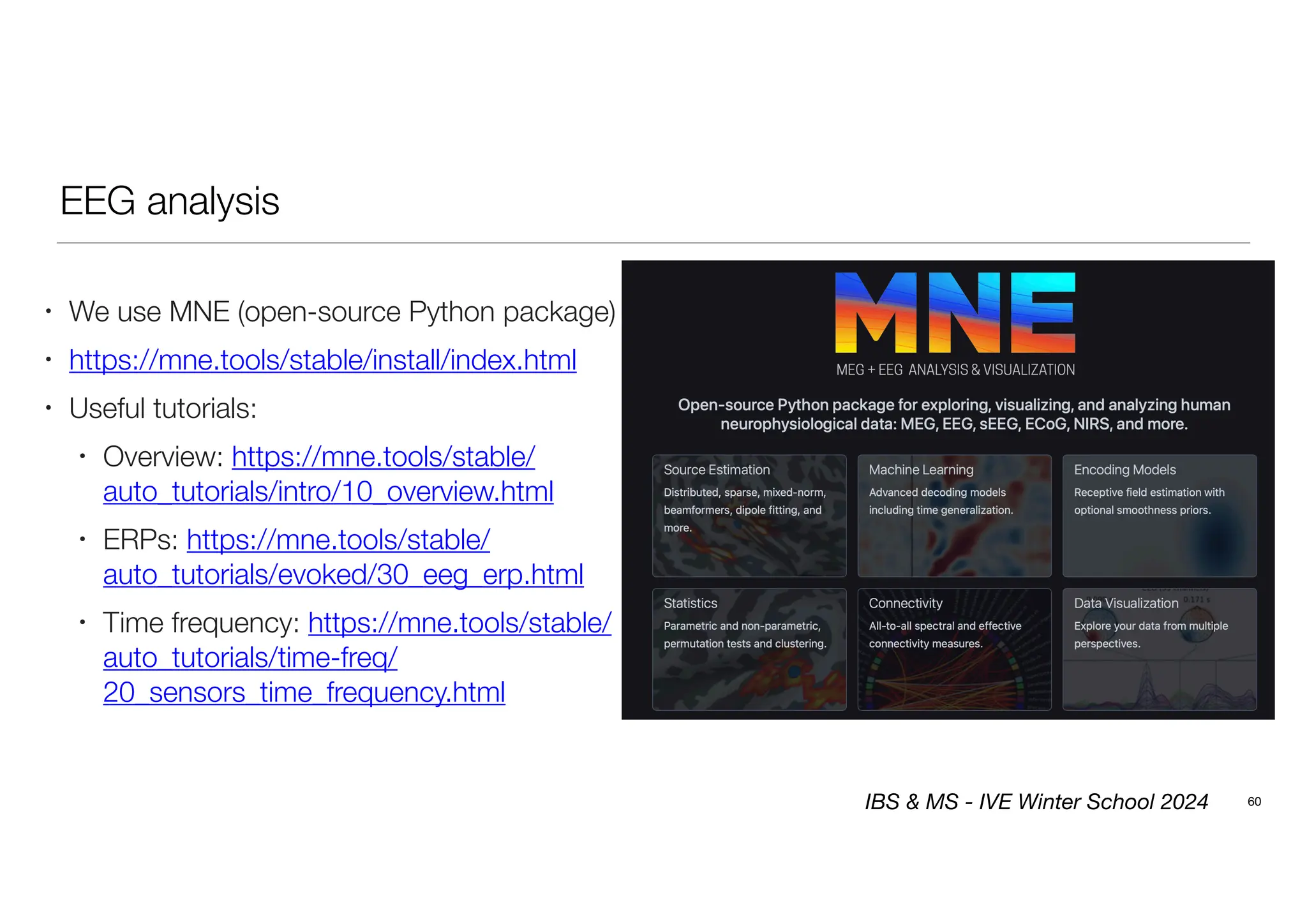
EEG analysis
60
• We use MNE (open-source Python package)
• https://mne.tools/stable/install/index.html
• Useful tutorials:
• Overview: https://mne.tools/stable/
auto_tutorials/intro/10_overview.html
• ERPs: https://mne.tools/stable/
auto_tutorials/evoked/30_eeg_erp.html
• Time frequency: https://mne.tools/stable/
auto_tutorials/time-freq/
20_sensors_time_frequency.html
IBS & MS - IVE Winter School 2024

IVE 2024 Short Course - Lecture 8 - Electroencephalography (EEG) Basics

  • 1.
    Electroencephalography (EEG) basics IVEWinter School 2024 Ina Bornkessel-Schlesewsky, Matthias Schlesewsky July 16th 2024 1
  • 4.
    Physiological basis ofthe EEG The EEG reflects summed dipole moments, i.e. voltage differences between higher and lower cortical layers originating primarily between pyramidal cells. These result from synchronous postsynaptic activity. 4 Bornkessel-Schlesewsky & Schlesewsky (2009) IBS & MS - IVE Winter School 2024
  • 5.
    Distance between electrodeand neural activity 5 Rösler (2005) the distance between the source of the current and the electrode determines scalp distribution under certain circumstances, the potentials of distinct sources may merge at the surface IBS & MS - IVE Winter School 2024
  • 6.
    The inverse problem •Scalp-recorded EEG activity does not allow any unique conclusions as to its underlying sources • There are mathematical models to address the inverse problem, but all solutions remain approximations! 6 IBS & MS - IVE Winter School 2024
  • 7.
    EEG and differentstates of consciousness EEG activity occurs in different frequency ranges 7 Gazzaniga et al. (2014) IBS & MS - IVE Winter School 2024
  • 8.
    Linking EEG activityto cognition The human EEG was discovered by Hans Berger (1873-1941), a German psychiatrist 1929: Über das Elektrenkephalogramm des Menschen (On the human electroencephalogram) 8 http://upload.wikimedia.org/wikipedia/commons/6/69/ HansBerger_Univ_Jena.jpeg IBS & MS - IVE Winter School 2024
  • 9.
    Berger’s EEG lab 9 Berger(1929) IBS & MS - IVE Winter School 2024
  • 10.
    An early EEGtrace 10 Berger (1929) EEG ECG time (0.1s) Berger applied electrodes made of silver foil to the scalp. Today, most EEG labs use electrodes made of silver/silver chloride ... IBS & MS - IVE Winter School 2024
  • 11.
    The first sleepEEG a = deep sleep; b = after waking from two hours of sleep THE FIRST SLEEP-EEG a = deep sleep & b = after waking from two hours of sleep (top line = EEG; bottom line = metronome for timekeeping) Berger (1929)
  • 12.
    EEG & chloroform •same participant without (top) and with (bottom) chloroform 12 IBS & MS - IVE Winter School 2024 EEG & CHLOROFORM same participant without (top) and with (bottom) chlorof first line = EEG, second line = EKG, third line = metrono Berger (1929)
  • 13.
    EEG & problemsolving • Berger’s daughter’s EEG while solving a maths problem • top: EEG at rest (alpha waves, ~10 Hz) • middle: during the task (beta waves; faster, lower amplitudes) • bottom: transition from task to rest 13 IBS & MS - IVE Winter School 2024 EEG EEG from Figu Figure 2 Figure 3 Rest: al around Task: beta Berger (1929)
  • 14.
    Berger’s achievements • Discoveredthe α (~8-12 Hz) and β (~12-30 Hz) rhythms • Observed changes in the rhythmical activity of the EEG depending on changes in cognitive state • α decreases during problem solving (e.g. mental arithmetic) • increases again during relaxed wakefulness 14 IBS & MS - IVE Winter School 2024
  • 15.
    Event-related brain potentials (ERPs) Bornkessel-Schlesewsky & Schlesewsky (2009) ERPsare small changes in the spontaneous electrical activity of the brain that are time- locked to certain sensory or cognitive events 15 IBS & MS - IVE Winter School 2024
  • 16.
    ERPs 16 • Very smallpotential changes (in cognition, often between approximately ca. 2-8 μV) in comparison to the background activity (often in the range of 100s of μV) • Low signal-to-noise ratio • present a larger number of stimuli of each type (approx. 30-40) • average over a number of participants (approx. 20-24) Kutas & Federmeier (2000) N400 IBS & MS - IVE Winter School 2024
  • 17.
    ERPs Kutas & Federmeier(2000) 17 • An ERP component is an ERP response that occurs with a certain: • latency (time after stimulus onset) • polarity (negative or positive relative to a control) • topography (which electrodes?) • Typical nomenclature: N (negativity) or P (positivity) + peak latency, e.g. N400 • Instances of a component with different amplitudes (“strengths”): effects N400 IBS & MS - IVE Winter School 2024
  • 18.
    Selected ERP components IBS& MS - IVE Winter School 2024
  • 19.
    The P300 (P3) 19 Thefirst “endogenous” ERP component to be discovered (tied to internal processing rather than sensory stimuli) IBS & MS - IVE Winter School 2024 Sutton et al. (1965, Science)
  • 20.
    The P300 (P3) 20 •Aprominent positive deflection after approx. 300 ms (topography and latency vary according to various parameters) Observable in response to salient (e.g. unexpected — oddball), task-relevant stimuli • need not be unexpected; also found for self- relevant stimuli (one’s own name) • “motivationally significant stimuli” • Longer latency for more complex stimuli, amplitude varies e.g. with attention • For discussion see Picton (1992, J Clin Neurophys 9, 456-479), Verleger (1988, Behav Brain Sci 11, 343-427), Nieuwenhuis et al. (2005, Psych Bulletin) IBS & MS - IVE Winter School 2024
  • 21.
    The first language-relatedERP component Kutas & Hillyard (1980, Science) IBS & MS - IVE Winter School 2024
  • 22.
    Measuring prediction errors inthe brain: EEG the Mismatch Negativity (MMN) Oddball paradigm: standard deviant MMN: early negativity (between ~100 and 200 ms post stimulus onset) for deviants vs. standards; increasing amplitude with increasing physical deviation between standard and deviant thought to re fl ect a mismatch with a transient sensory memory trace Duncan et al. (2009, Clin Neurophysiol) IBS & MS - IVE Winter School 2024
  • 23.
    e.g. to measurethe e ff ects of predictive cues in spatial augmented reality (SAR) Vollmer et al. (2023, IEEE:TVCG) IBS & MS - IVE Winter School 2024 An oddball task as a secondary task to measure “cognitive load”
  • 24.
    Scalp EEG /ERPs: data acquisition IBS & MS - IVE Winter School 2024
  • 25.
  • 26.
    Electrode placement Bornkessel-Schlesewsky & Schlesewsky (2009) extended 20-20system 26 Electrooculogram (EOG) monitors vertical (V) and horizontal (H) eye movements Reference electrode(s) IBS & MS - IVE Winter School 2024
  • 27.
    The reference electrode •The EEG is measured as a voltage difference between two electrodes, e.g. between the electrode of interest and a reference electrode • The choice of reference electrode determines the resulting signal • Options: 27 common reference average reference active reference inactive reference (e.g. mastoid, nose) IBS & MS - IVE Winter School 2024
  • 28.
    The reference electrode •Common choice in experiments on cognition: • left or right mastoid • + re-referencing to the average of both mastoids offline to avoid topographical distortions 28 IBS & MS - IVE Winter School 2024
  • 29.
    Why the choiceof reference is important • oddball paradigm; active common reference (close to PZ) 29 IBS & MS - IVE Winter School 2024
  • 30.
    Why the choiceof reference is important • oddball paradigm; same data rereferenced to the left mastoid 30 IBS & MS - IVE Winter School 2024
  • 31.
    31 Scalp EEG /ERPs: data analysis IBS & MS - IVE Winter School 2024
  • 32.
    Raw EEG data 32 IBS& MS - IVE Winter School 2024
  • 33.
    Steps in dataanalysis • Preprocessing • Re-referencing • Raw data filtering • Artefact rejection (automatic + manual) • Averaging • single subject average (per electrode, condition and time window) • grand average (average over single subject averages) • Statistical analysis 33 IBS & MS - IVE Winter School 2024
  • 34.
    Why filter? 34 before after IBS& MS - IVE Winter School 2024
  • 35.
    Filtering • High pass •removes frequencies lower than a specified frequency • good for removing signal drifts from raw data (see last slide) • generally between 0.1 and 0.3 Hz (not higher!!) • must be applied to raw (not epoched) data! • Low pass • removes frequencies higher than a specified frequency • good for “smoothing” averages for data presentation (typically 8-10 Hz) 35 IBS & MS - IVE Winter School 2024
  • 36.
    Filtering • Band pass •combination of high and low pass filters, i.e. selects a frequency band • Notch • removes a specific frequency range from the data • most common application: removal of 50 or 60 Hz (mains power frequency) 36 IBS & MS - IVE Winter School 2024
  • 37.
    Artefacts I: ECGvirtually eliminated by rereferencing 37 IBS & MS - IVE Winter School 2024
  • 38.
    Artefacts II: eyemovements (blinks) must either be excluded or corrected 38 IBS & MS - IVE Winter School 2024
  • 39.
    Artefacts II: eyemovements (saccades) not as disruptive as blinks 39 IBS & MS - IVE Winter School 2024
  • 40.
    Artefacts II: eyemovements (saccades) not as disruptive as blinks 40 IBS & MS - IVE Winter School 2024
  • 41.
    Averaging • Single subjectaverage (per electrode, condition and time window) • segments the raw data into stimulus-related epochs (length depends on question, but usually between 800 and 2000 ms) • options: • absolute values • relative to a baseline (e.g. -200-0 ms “pre-stimulus” or 0-100 within stimulus) • excludes trials that contain artefacts (optionally: trials for which the control task was not performed correctly) • excludes noise and background activity 41 IBS & MS - IVE Winter School 2024
  • 42.
    Averaging single subjectaverage 42 IBS & MS - IVE Winter School 2024
  • 43.
    Averaging II • Grandaverage • average of the single subject averages • again per electrode, time window and condition 43 IBS & MS - IVE Winter School 2024
  • 44.
    Averaging grand average 44 IBS& MS - IVE Winter School 2024
  • 45.
    Averaging considerations • Single-subjectaverages are (mostly) not interpretable • signal-to-noise ratio too poor • only evaluate data quality (no. of trials, ocular or movement artefacts, problems with single electrodes, drifts ...) • Grand averages • the fact that a particular participant does not show the expected effect (or the effect observed in the grand average) is not a sufficient reason for exclusion from the data analysis! 45 IBS & MS - IVE Winter School 2024
  • 46.
    Statistical analysis 46 • Averageamplitude (in a specific time window) • repeated-measures ANOVAs including condition factors and topographical factors • topographical factors: regions of interest (ROIs) • Peak-to-peak analysis • amplitude differences may lead to shifts in the time window • analysis of the difference between the last “common” peak and the critical peak example ROIs IBS & MS - IVE Winter School 2024
  • 47.
    And always keepin mind 47 • ERPs are relative measures between a critical condition and a control condition • Absolute potential shifts cannot be interpreted!! two negative deflections IBS & MS - IVE Winter School 2024
  • 48.
    The “finished product” 48 •An ERP component that can be described in terms of • latency (time to component onset/peak after critical stimulus onset) • polarity (negative or positive deflection relative to control) • topography (electrode positions (ROIs) at which the effect is observable • (amplitude - “strength” of the effect) • Nomenclature typically reflects polarity and latency (e.g. N400) IBS & MS - IVE Winter School 2024
  • 49.
    Component versus effect 49 •An ERP component is typically associated with a functional interpretation • Components may also appear in control conditions (e.g. N400 for every word) • Differences between two instances of the same component (and more generally between two conditions): ERP effects IBS & MS - IVE Winter School 2024
  • 50.
    An alternative approach: time-frequencyanalyses Recall Berger’s (1929) observation: frequency characteristics of the human EEG can re fl ect higher cognitive processes 50 - + theta alpha 1 alpha 2 ... IBS & MS - IVE Winter School 2024
  • 51.
    Classic EEG frequencybands • Delta: 0.5 - 4 Hz • Theta: 4 - 8 Hz • Alpha: 8 - 12 Hz • Beta: 12 - 30 Hz • Gamma: > 30 Hz 51 NB: individual differences apply! IBS & MS - IVE Winter School 2024
  • 52.
    EEG frequency andhigher cognition • Independently of (and in parallel to) ERP-based research, a frequency-based research tradition has identi fi ed correlates of di ff erent cognitive domains / processes within di ff erent frequency bands, e.g.: • alpha band • attention (Ray & Cole, 1985, Science, 228, 750-752) • memory performance (Klimesch, 1997, J Psychophysiol, 26, 319-340) • intelligence (Doppelmayr et al., 2002, Intelligence, 30, 289-302) • theta band • episodic memory (Miller, 1991. Cortico-hippocampal interplay ... Berlin: Springer.) 52 IBS & MS - IVE Winter School 2024
  • 53.
    Frequency bands: The measures 53 Inducedactivity (jitter in latency) Evoked activity ( fi xed latency) Averaged evoked potential • evoked versus induced activity IBS & MS - IVE Winter School 2024
  • 54.
    Isolating frequencies of interest: fi ltering •Filters remove certain frequencies from the EEG • Di ff erent types of fi lters: • High pass • removes frequencies lower than a speci fi ed frequency • Low pass • removes frequencies higher than a speci fi ed frequency • Band pass • combination of high and low pass fi lters, i.e. selects a frequency band • Notch • removes a speci fi c frequency range from the data (most common application: removal of 50 or 60 Hz mains power frequency) 54 Example from Widmann et al. (2014) IBS & MS - IVE Winter School 2024
  • 55.
    Event-related (de-)synchronisation (ERD/S) • Applicationof a bandpass- fi lter (frequency band of interest) to each trial • Squaring of each amplitude sample to obtain power values • Averaging over all trials of interest • Conversion to relative power by de fi ning the power of a reference interval as 100% => “event-related” • ERBP (event-related band power): z- transformed ERD 55 IBS & MS - IVE Winter School 2024
  • 56.
    Frequency bands: Themeasures 56 Relation between ERPs and measures in the frequency domain IBS & MS - IVE Winter School 2024
  • 59.
    Time-frequency measures of performance incomplex operational environments 59 IBS & MS - IVE Winter School 2024 Cross et al. (2022, Scienti fi c Reports)
  • 60.
    EEG analysis 60 • Weuse MNE (open-source Python package) • https://mne.tools/stable/install/index.html • Useful tutorials: • Overview: https://mne.tools/stable/ auto_tutorials/intro/10_overview.html • ERPs: https://mne.tools/stable/ auto_tutorials/evoked/30_eeg_erp.html • Time frequency: https://mne.tools/stable/ auto_tutorials/time-freq/ 20_sensors_time_frequency.html IBS & MS - IVE Winter School 2024