Submitted BY;
ASHIQUE MUHAMMAD
Electronics Engineering
Govt poly technic college
punalur
VIRTUAL REALITY
INTRODUCTION
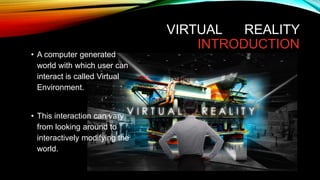
• A computer generated
world with which user can
interact is called Virtual
Environment.
• This interaction can vary
from looking around to
interactively modifying the
world.
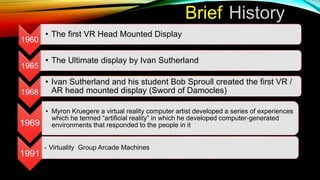
1960
• The first VR Head Mounted Display
1965
• The Ultimate display by Ivan Sutherland
1968
• Ivan Sutherland and his student Bob Sproull created the first VR /
AR head mounted display (Sword of Damocles)
Brief History
1969
• Myron Kruegere a virtual reality computer artist developed a series of experiences
which he termed “artificial reality” in which he developed computer-generated
environments that responded to the people in it
1991
• Virtuality Group Arcade Machines
TYPES OF VIRTUAL REALITY
• There are following types of virtual
reality.
Immersive
IMMERSIVE VIRTUAL REALITY
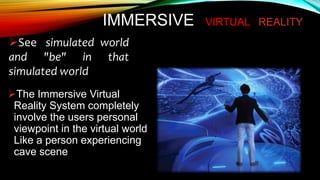
The Immersive Virtual
Reality System completely
involve the users personal
viewpoint in the virtual world
Like a person experiencing
cave scene
See simulated world
and "be" in that
simulated world
WINDOW ON WORLD VIRTUAL REALITY
(WOW)
 It is a normal virtual world. that has
been developed on a DESKTOP PC
 The most common form of the WOW
are COMPUTER GAMES. that uses 3D
simulation of the real worlds
TELE PRESENCE VIRTUAL REALITY
 This is the another technique in V.R. where we
use some remote sensors placed some where
the virtual world
That maps the human actions and correlates
them to the actions that has to be done by the
objects in the virtual world
Fire fighters uses remote controlled vehicles to
operate some dangerous conditions. This
vehicles are equipped with Telepresence
systems.
MIXED VIRTUAL REALITY
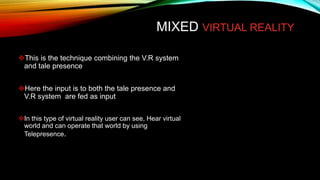
This is the technique combining the V.R system
and tale presence
Here the input is to both the tale presence and
V.R system are fed as input
In this type of virtual reality user can see, Hear virtual
world and can operate that world by using
Telepresence.
TECHNOLOGY OF VIRTUAL
REALITY
• We have easily to understand ,in V.R technology is classified
as follows
such as;
Hard wares used in V.R
 Head mounted display(H.M.D)
 BOOM
 CAVE
Software wares used in V.R
 RENDERING
 PROGRAMMING
Architecture of V.R
HARD WARES USED IN V.R
• There is a number of hard wares developed for the usage
by VIRTUALREALITY
some are explained below
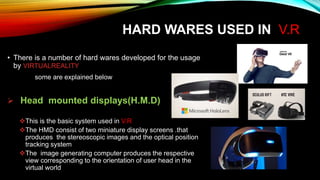
 Head mounted displays(H.M.D)
This is the basic system used in V.R
The HMD consist of two miniature display screens .that
produces the stereoscopic images and the optical position
tracking system
The image generating computer produces the respective
view corresponding to the orientation of user head in the
virtual world
 The BOOM (Binocular Omni-
Orientation Monitor) is a head-coupled
stereoscopic display device.
 Screens and optical system are
housed in a box that is attached to a
multi-link arm.
 The user looks into the box through
two holes, sees the virtual world, and
controls his motions with the arm
HARD WARES USED IN V.R
BOOM SYSTEM
HARD WARES USED IN V.R
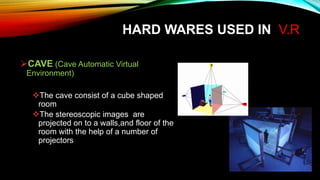
CAVE (Cave Automatic Virtual
Environment)
The cave consist of a cube shaped
room
The stereoscopic images are
projected on to a walls,and floor of the
room with the help of a number of
projectors
HARD WARES USED IN V.R
CAVE (Cave Automatic Virtual
Environment)
SOFTWARE WARES USED IN V.R
• The most commonly used software's for developing 3D worlds are;
 VRML V 1.0, VRML 97, VRML V 2.0
 3D STUDIO MAX
 RHINO 3D
 AMAPI 3D
 ALICE 99
 BLENDER
• Also there are many concepts of developing the
virtual worlds using the software.
They are:
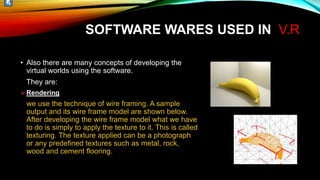
Rendering
we use the technique of wire framing. A sample
output and its wire frame model are shown below.
After developing the wire frame model what we have
to do is simply to apply the texture to it. This is called
texturing. The texture applied can be a photograph
or any predefined textures such as metal, rock,
wood and cement flooring.
SOFTWARE WARES USED IN V.R
Rendering
 Some of example images rendering and
texturing
Programming
 The other tool available for developing the virtual worlds is by programming
 people used to develop the virtual worlds using the traditional programming
language, JAVA. As we have mentioned earlier VRML is a language born from the
family of XML
 VRML is a Virtual Reality Modeling Language
SOFTWARE WARES USED IN V.R
ARCHITECTURE OF V.R
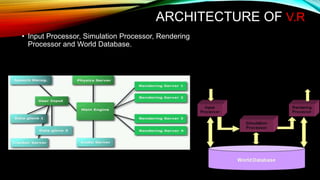
• Input Processor, Simulation Processor, Rendering
Processor and World Database.
ARCHITECTURE OF V.R
• COMPONENTS OF V.R
 Input Processor
Control the devices used to input information to
the computer. The object is to get the coordinate
data to the rest of the system with minimal lag
time.
keyboard, mouse, 3D position trackers, a voice
recognition system, etc
COMPONENTS OF V.R
 Simulation Processor
Core of a VR system.
Takes the user inputs along with any tasks
programmed into the world and determine the
actions that will take place in the virtual world
ARCHITECTURE OF V.R
• COMPONENTS OF V.R
 Rendering Processor
 Create the sensations that are output to the
user
 Separate rendering processes are used for visual,
auditory, haptic and other sensory systems
World Database
Store the objects that inhabit the world, scripts that
describe actions of those objects
ARCHITECTURE OF V.R
APPLICATIONS OF VR
ENTERTAINMENT TRAINING
ARCHITECTUR
E
MEDICINE ENGINEERING &DESIGN
APPLICATIONS OF VR
• Architecture Designing
 virtual reality has been used to
establish models of architectural
models and buildings before
construction begins
experiment with different lighting
schemes, furnishings, or even the
layout of the house itself
 Medicine
• With the simulation of the entire physiology of
the human body , the effects of various
illnesses or organ replacement will be visible.
The surgeon using an
• HMD and Data Gloves may have a complete
simulated view of the surgery. For medical
students learning how to operate, the best way
would be to start with 3D virtual patients.
APPLICATIONS OF VR
ENGINEERING DESIGNING
• VR is widely used in engineering and designing
process.
• It gives better understanding of the design and
facilitates changes wherever necessary
• It helps to reduce the time and cost factor.
Examples: Building construction, car designing, railway
construction…
APPLICATIONS OF VR
ENTERTAINMENT
• The entertainment industry is one of the most enthusiastic
advocates of virtual reality, most noticeably in games and
virtual worlds.
• Virtual Museum, e.g. interactive exhibitions
• Gaming
• Film making and theaters
• Virtual theme parks
APPLICATIONS OF VR
TRAINING
• Virtual reality environments have been used for
training simulators.
• Examples include flight simulators, battlefield
simulators for soldiers,paratrooping.
APPLICATIONS OF VR
ADVANTAGES OF VR
Training
Risk-free experience
Experiencing things you wouldn’t
normally be able to experience
Entertainment; fun, artistic
expression.
DIS ADVANTAGES OF VR
Disengagement with real world.
VR replacing reality.
People preferring VR to reality.
Difficulty of distinguishing between
virtual and real, ‘false realities
represented in VR.
Possible impacts on real body
CONCLUSION
Virtual Reality is a growing industry.
. The ability of Virtual Reality to produce realistic worlds of data,
objects and environments, with which the users can interact and
manipulate in a realistic and an intuitive manner
Virtual Reality provides a solution by providing a platform which
makes it possible by using the applications of Virtual Reality
Virtual reality ppt
Virtual reality ppt

Virtual reality ppt

  • 2.
    Submitted BY; ASHIQUE MUHAMMAD ElectronicsEngineering Govt poly technic college punalur
  • 3.
    VIRTUAL REALITY INTRODUCTION • Acomputer generated world with which user can interact is called Virtual Environment. • This interaction can vary from looking around to interactively modifying the world.
  • 4.
    1960 • The firstVR Head Mounted Display 1965 • The Ultimate display by Ivan Sutherland 1968 • Ivan Sutherland and his student Bob Sproull created the first VR / AR head mounted display (Sword of Damocles) Brief History 1969 • Myron Kruegere a virtual reality computer artist developed a series of experiences which he termed “artificial reality” in which he developed computer-generated environments that responded to the people in it 1991 • Virtuality Group Arcade Machines
  • 5.
    TYPES OF VIRTUALREALITY • There are following types of virtual reality. Immersive
  • 6.
    IMMERSIVE VIRTUAL REALITY TheImmersive Virtual Reality System completely involve the users personal viewpoint in the virtual world Like a person experiencing cave scene See simulated world and "be" in that simulated world
  • 7.
    WINDOW ON WORLDVIRTUAL REALITY (WOW)  It is a normal virtual world. that has been developed on a DESKTOP PC  The most common form of the WOW are COMPUTER GAMES. that uses 3D simulation of the real worlds
  • 8.
    TELE PRESENCE VIRTUALREALITY  This is the another technique in V.R. where we use some remote sensors placed some where the virtual world That maps the human actions and correlates them to the actions that has to be done by the objects in the virtual world Fire fighters uses remote controlled vehicles to operate some dangerous conditions. This vehicles are equipped with Telepresence systems.
  • 9.
    MIXED VIRTUAL REALITY Thisis the technique combining the V.R system and tale presence Here the input is to both the tale presence and V.R system are fed as input In this type of virtual reality user can see, Hear virtual world and can operate that world by using Telepresence.
  • 10.
    TECHNOLOGY OF VIRTUAL REALITY •We have easily to understand ,in V.R technology is classified as follows such as; Hard wares used in V.R  Head mounted display(H.M.D)  BOOM  CAVE Software wares used in V.R  RENDERING  PROGRAMMING Architecture of V.R
  • 11.
    HARD WARES USEDIN V.R • There is a number of hard wares developed for the usage by VIRTUALREALITY some are explained below  Head mounted displays(H.M.D) This is the basic system used in V.R The HMD consist of two miniature display screens .that produces the stereoscopic images and the optical position tracking system The image generating computer produces the respective view corresponding to the orientation of user head in the virtual world
  • 12.
     The BOOM(Binocular Omni- Orientation Monitor) is a head-coupled stereoscopic display device.  Screens and optical system are housed in a box that is attached to a multi-link arm.  The user looks into the box through two holes, sees the virtual world, and controls his motions with the arm HARD WARES USED IN V.R BOOM SYSTEM
  • 13.
    HARD WARES USEDIN V.R CAVE (Cave Automatic Virtual Environment) The cave consist of a cube shaped room The stereoscopic images are projected on to a walls,and floor of the room with the help of a number of projectors
  • 14.
    HARD WARES USEDIN V.R CAVE (Cave Automatic Virtual Environment)
  • 15.
    SOFTWARE WARES USEDIN V.R • The most commonly used software's for developing 3D worlds are;  VRML V 1.0, VRML 97, VRML V 2.0  3D STUDIO MAX  RHINO 3D  AMAPI 3D  ALICE 99  BLENDER
  • 16.
    • Also thereare many concepts of developing the virtual worlds using the software. They are: Rendering we use the technique of wire framing. A sample output and its wire frame model are shown below. After developing the wire frame model what we have to do is simply to apply the texture to it. This is called texturing. The texture applied can be a photograph or any predefined textures such as metal, rock, wood and cement flooring. SOFTWARE WARES USED IN V.R
  • 17.
    SOFTWARE WARES USEDIN V.R Rendering  Some of example images rendering and texturing
  • 18.
    Programming  The othertool available for developing the virtual worlds is by programming  people used to develop the virtual worlds using the traditional programming language, JAVA. As we have mentioned earlier VRML is a language born from the family of XML  VRML is a Virtual Reality Modeling Language SOFTWARE WARES USED IN V.R
  • 19.
    ARCHITECTURE OF V.R •Input Processor, Simulation Processor, Rendering Processor and World Database.
  • 20.
    ARCHITECTURE OF V.R •COMPONENTS OF V.R  Input Processor Control the devices used to input information to the computer. The object is to get the coordinate data to the rest of the system with minimal lag time. keyboard, mouse, 3D position trackers, a voice recognition system, etc
  • 21.
    COMPONENTS OF V.R Simulation Processor Core of a VR system. Takes the user inputs along with any tasks programmed into the world and determine the actions that will take place in the virtual world ARCHITECTURE OF V.R
  • 22.
    • COMPONENTS OFV.R  Rendering Processor  Create the sensations that are output to the user  Separate rendering processes are used for visual, auditory, haptic and other sensory systems World Database Store the objects that inhabit the world, scripts that describe actions of those objects ARCHITECTURE OF V.R
  • 23.
    APPLICATIONS OF VR ENTERTAINMENTTRAINING ARCHITECTUR E MEDICINE ENGINEERING &DESIGN
  • 24.
    APPLICATIONS OF VR •Architecture Designing  virtual reality has been used to establish models of architectural models and buildings before construction begins experiment with different lighting schemes, furnishings, or even the layout of the house itself
  • 25.
     Medicine • Withthe simulation of the entire physiology of the human body , the effects of various illnesses or organ replacement will be visible. The surgeon using an • HMD and Data Gloves may have a complete simulated view of the surgery. For medical students learning how to operate, the best way would be to start with 3D virtual patients. APPLICATIONS OF VR
  • 26.
    ENGINEERING DESIGNING • VRis widely used in engineering and designing process. • It gives better understanding of the design and facilitates changes wherever necessary • It helps to reduce the time and cost factor. Examples: Building construction, car designing, railway construction… APPLICATIONS OF VR
  • 27.
    ENTERTAINMENT • The entertainmentindustry is one of the most enthusiastic advocates of virtual reality, most noticeably in games and virtual worlds. • Virtual Museum, e.g. interactive exhibitions • Gaming • Film making and theaters • Virtual theme parks APPLICATIONS OF VR
  • 28.
    TRAINING • Virtual realityenvironments have been used for training simulators. • Examples include flight simulators, battlefield simulators for soldiers,paratrooping. APPLICATIONS OF VR
  • 29.
    ADVANTAGES OF VR Training Risk-freeexperience Experiencing things you wouldn’t normally be able to experience Entertainment; fun, artistic expression.
  • 30.
    DIS ADVANTAGES OFVR Disengagement with real world. VR replacing reality. People preferring VR to reality. Difficulty of distinguishing between virtual and real, ‘false realities represented in VR. Possible impacts on real body
  • 31.
    CONCLUSION Virtual Reality isa growing industry. . The ability of Virtual Reality to produce realistic worlds of data, objects and environments, with which the users can interact and manipulate in a realistic and an intuitive manner Virtual Reality provides a solution by providing a platform which makes it possible by using the applications of Virtual Reality