TITLE
Title
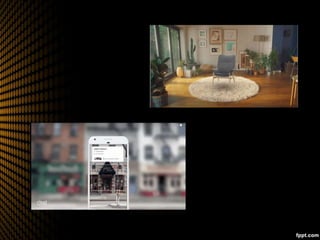
What if I told you all of this
is possible?
Then I wouldn’t be lying,
And the technology behind it
is augmented reality.
What is AR?
Augmented reality (AR) is an interactive experience of a real-world
environment where the objects that reside in the real-world are "augmented"
by computer-generated perceptual information, sometimes across multiple
sensory modalities, including visual, auditory, haptic, somatosensory,
and olfactory
• Augmented reality sounds horribly theoretical and abstract, but it's actually
very simple: real life plus topical, relevant, background information equals
something massively more useful. A quick example will make the idea
clearer:
• You're watching an IPL match on TV and there's a controversial call from
the umpire. Was that an lbw or not? The TV station runs an instant replay
with a computer animation showing the exact trajectory of the ball and
where it landed. Then a little table comes up on the screen showing the
statistics of the batsman and the bowler while the third umpire makes his
decision.
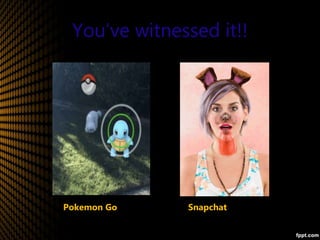
You’ve witnessed it!!
Pokemon Go Snapchat
A Brief History
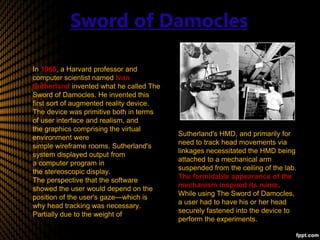
In 1968, a Harvard professor and
computer scientist named Ivan
Sutherland invented what he called The
Sword of Damocles. He invented this
first sort of augmented reality device.
The device was primitive both in terms
of user interface and realism, and
the graphics comprising the virtual
environment were
simple wireframe rooms. Sutherland's
system displayed output from
a computer program in
the stereoscopic display.
The perspective that the software
showed the user would depend on the
position of the user's gaze—which is
why head tracking was necessary.
Partially due to the weight of
Sword of Damocles
Sutherland's HMD, and primarily for
need to track head movements via
linkages necessitated the HMD being
attached to a mechanical arm
suspended from the ceiling of the lab.
The formidable appearance of the
mechanism inspired its name.
While using The Sword of Damocles,
a user had to have his or her head
securely fastened into the device to
perform the experiments.
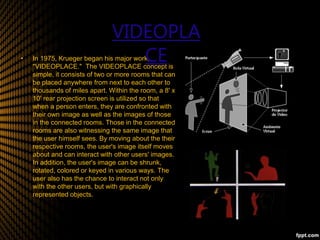
• In 1975, Krueger began his major work,
"VIDEOPLACE." The VIDEOPLACE concept is
simple, it consists of two or more rooms that can
be placed anywhere from next to each other to
thousands of miles apart. Within the room, a 8' x
10' rear projection screen is utilized so that
when a person enters, they are confronted with
their own image as well as the images of those
in the connected rooms. Those in the connected
rooms are also witnessing the same image that
the user himself sees. By moving about the their
respective rooms, the user's image itself moves
about and can interact with other users' images.
In addition, the user's image can be shrunk,
rotated, colored or keyed in various ways. The
user also has the chance to interact not only
with the other users, but with graphically
represented objects.
•
VIDEOPLA
CE
• In 1990, Tom Caudell coined the term “Augmented Reality”.
• In 1992, Louis Rosenburg created the first real operational augmented
reality system . Virtual Fixtures.
• In 1998, Sportsvision uses the 1st and Ten line computer system. This
system showed the original virtual yellow first down marker during a live
NFL game.
• In 2009, ARToolKit makes augmented reality
available to Internet browsers.ARToolKit is an
open-source computer tracking
library for creation of strong augmented reality
applications that overlay virtual imagery on the
real world
IIs augmented reality and virtual
reality the same thing?
The answer is, no.
What is Virtual reality?
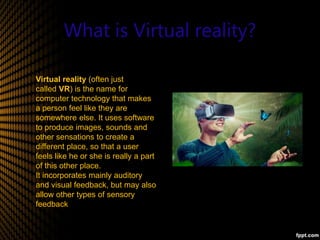
Virtual reality (often just
called VR) is the name for
computer technology that makes
a person feel like they are
somewhere else. It uses software
to produce images, sounds and
other sensations to create a
different place, so that a user
feels like he or she is really a part
of this other place.
It incorporates mainly auditory
and visual feedback, but may also
allow other types of sensory
feedback
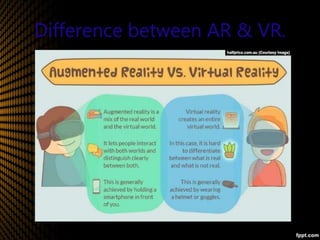
Difference between AR & VR.
How does this
work?
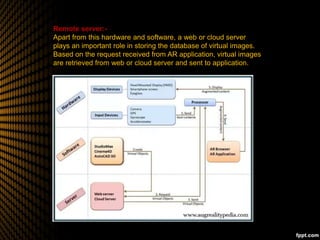
Key components of Augmented Reality System :-
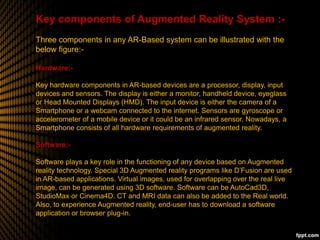
Three components in any AR-Based system can be illustrated with the
below figure:-
Hardware:-
Key hardware components in AR-based devices are a processor, display, input
devices and sensors. The display is either a monitor, handheld device, eyeglass
or Head Mounted Displays (HMD). The input device is either the camera of a
Smartphone or a webcam connected to the internet. Sensors are gyroscope or
accelerometer of a mobile device or it could be an infrared sensor. Nowadays, a
Smartphone consists of all hardware requirements of augmented reality.
Software:-
Software plays a key role in the functioning of any device based on Augmented
reality technology. Special 3D Augmented reality programs like D’Fusion are used
in AR-based applications. Virtual images, used for overlapping over the real live
image, can be generated using 3D software. Software can be AutoCad3D,
StudioMax or Cinema4D. CT and MRI data can also be added to the Real world.
Also, to experience Augmented reality, end-user has to download a software
application or browser plug-in.
Remote server:-
Apart from this hardware and software, a web or cloud server
plays an important role in storing the database of virtual images.
Based on the request received from AR application, virtual images
are retrieved from web or cloud server and sent to application.
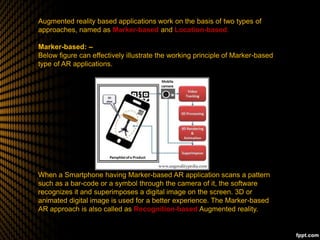
Augmented reality based applications work on the basis of two types of
approaches, named as Marker-based and Location-based.
Marker-based: –
Below figure can effectively illustrate the working principle of Marker-based
type of AR applications.
When a Smartphone having Marker-based AR application scans a pattern
such as a bar-code or a symbol through the camera of it, the software
recognizes it and superimposes a digital image on the screen. 3D or
animated digital image is used for a better experience. The Marker-based
AR approach is also called as Recognition-based Augmented reality.
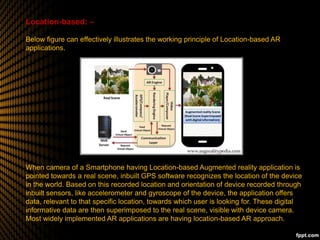
Location-based: –
Below figure can effectively illustrates the working principle of Location-based AR
applications.
When camera of a Smartphone having Location-based Augmented reality application is
pointed towards a real scene, inbuilt GPS software recognizes the location of the device
in the world. Based on this recorded location and orientation of device recorded through
inbuilt sensors, like accelerometer and gyroscope of the device, the application offers
data, relevant to that specific location, towards which user is looking for. These digital
informative data are then superimposed to the real scene, visible with device camera.
Most widely implemented AR applications are having location-based AR approach.
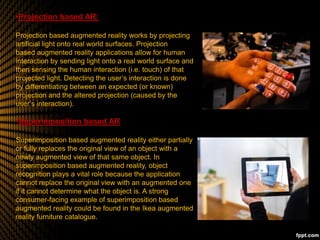
•Projection based AR:
Projection based augmented reality works by projecting
artificial light onto real world surfaces. Projection
based augmented reality applications allow for human
interaction by sending light onto a real world surface and
then sensing the human interaction (i.e. touch) of that
projected light. Detecting the user’s interaction is done
by differentiating between an expected (or known)
projection and the altered projection (caused by the
user’s interaction).
•Superimposition based AR
Superimposition based augmented reality either partially
or fully replaces the original view of an object with a
newly augmented view of that same object. In
superimposition based augmented reality, object
recognition plays a vital role because the application
cannot replace the original view with an augmented one
if it cannot determine what the object is. A strong
consumer-facing example of superimposition based
augmented reality could be found in the Ikea augmented
reality furniture catalogue.
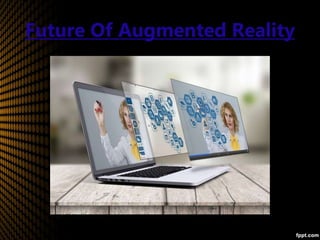
Future Of Augmented Reality
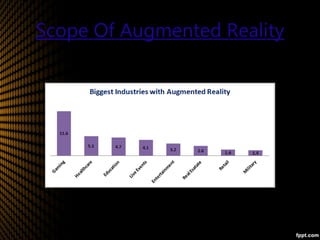
Scope Of Augmented Reality
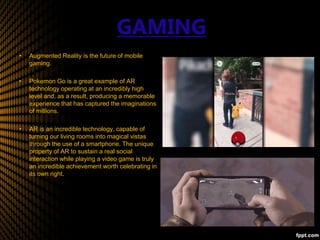
GAMING
• Augmented Reality is the future of mobile
gaming.
• Pokemon Go is a great example of AR
technology operating at an incredibly high
level and, as a result, producing a memorable
experience that has captured the imaginations
of millions.
• AR is an incredible technology, capable of
turning our living rooms into magical vistas
through the use of a smartphone. The unique
property of AR to sustain a real social
interaction while playing a video game is truly
an incredible achievement worth celebrating in
its own right.
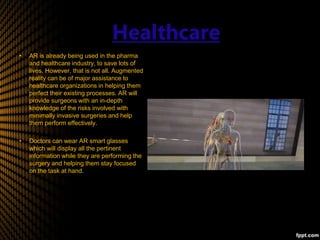
Healthcare
• AR is already being used in the pharma
and healthcare industry, to save lots of
lives. However, that is not all. Augmented
reality can be of major assistance to
healthcare organizations in helping them
perfect their existing processes. AR will
provide surgeons with an in-depth
knowledge of the risks involved with
minimally invasive surgeries and help
them perform effectively.
• Doctors can wear AR smart glasses
which will display all the pertinent
information while they are performing the
surgery and helping them stay focused
on the task at hand.
Education
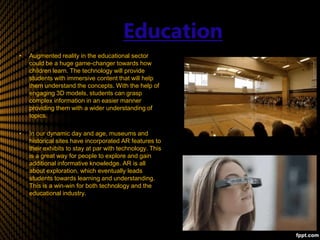
• Augmented reality in the educational sector
could be a huge game-changer towards how
children learn. The technology will provide
students with immersive content that will help
them understand the concepts. With the help of
engaging 3D models, students can grasp
complex information in an easier manner
providing them with a wider understanding of
topics.
• In our dynamic day and age, museums and
historical sites have incorporated AR features to
their exhibits to stay at par with technology. This
is a great way for people to explore and gain
additional informative knowledge. AR is all
about exploration, which eventually leads
students towards learning and understanding.
This is a win-win for both technology and the
educational industry.
Real Estate
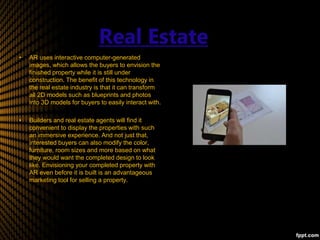
• AR uses interactive computer-generated
images, which allows the buyers to envision the
finished property while it is still under
construction. The benefit of this technology in
the real estate industry is that it can transform
all 2D models such as blueprints and photos
into 3D models for buyers to easily interact with.
• Builders and real estate agents will find it
convenient to display the properties with such
an immersive experience. And not just that,
interested buyers can also modify the color,
furniture, room sizes and more based on what
they would want the completed design to look
like. Envisioning your completed property with
AR even before it is built is an advantageous
marketing tool for selling a property.
Military
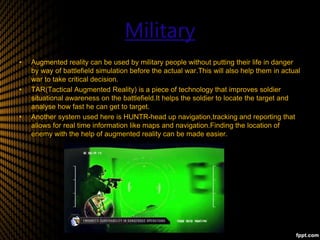
• Augmented reality can be used by military people without putting their life in danger
by way of battlefield simulation before the actual war.This will also help them in actual
war to take critical decision.
• TAR(Tactical Augmented Reality) is a piece of technology that improves soldier
situational awareness on the battlefield.It helps the soldier to locate the target and
analyse how fast he can get to target.
• Another system used here is HUNTR-head up navigation,tracking and reporting that
allows for real time information like maps and navigation.Finding the location of
enemy with the help of augmented reality can be made easier.
Advantages of Augmented Reality
• The AR system is highly interactive in nature and operates simultaneously with real
time environment.
• It reduces line between real world and virtual world.
• It enhances perception and interaction with the real world.
• It can be used by anyone as per applications.
• It can save money by testing critical situations in order to confirm their success
without actually implementing in real time. Once it is proven, it can be implemented in
real world.
• It can be applied to part of training programs as it makes things memorable and eye
catching.
Drawbacks or disadvantages of
Augmented Reality
• It is expensive to develop the AR technology based projects and to
maintain it. Moreover production of AR based devices is costly.
• Lack of privacy is a concern in AR based applications.
• In AR, people are missing out on important moments.
• Low performance level is a concern which needs to be addressed
during testing process.
• It requires basic learning to effectively use AR compliant devices.
CONCLUSION
There is no doubt that Augmented Reality will reshape more than just
these few industries. As devices adapt to the new technology, the
growth of Augmented Reality is exponentially huge. With so many
positive advantages, AR could fundamentally change what it is to be
human.

augmented_reality.ppt

  • 2.
  • 3.
  • 4.
    What if Itold you all of this is possible? Then I wouldn’t be lying, And the technology behind it is augmented reality.
  • 5.
    What is AR? Augmentedreality (AR) is an interactive experience of a real-world environment where the objects that reside in the real-world are "augmented" by computer-generated perceptual information, sometimes across multiple sensory modalities, including visual, auditory, haptic, somatosensory, and olfactory • Augmented reality sounds horribly theoretical and abstract, but it's actually very simple: real life plus topical, relevant, background information equals something massively more useful. A quick example will make the idea clearer: • You're watching an IPL match on TV and there's a controversial call from the umpire. Was that an lbw or not? The TV station runs an instant replay with a computer animation showing the exact trajectory of the ball and where it landed. Then a little table comes up on the screen showing the statistics of the batsman and the bowler while the third umpire makes his decision.
  • 6.
  • 7.
  • 8.
    In 1968, aHarvard professor and computer scientist named Ivan Sutherland invented what he called The Sword of Damocles. He invented this first sort of augmented reality device. The device was primitive both in terms of user interface and realism, and the graphics comprising the virtual environment were simple wireframe rooms. Sutherland's system displayed output from a computer program in the stereoscopic display. The perspective that the software showed the user would depend on the position of the user's gaze—which is why head tracking was necessary. Partially due to the weight of Sword of Damocles Sutherland's HMD, and primarily for need to track head movements via linkages necessitated the HMD being attached to a mechanical arm suspended from the ceiling of the lab. The formidable appearance of the mechanism inspired its name. While using The Sword of Damocles, a user had to have his or her head securely fastened into the device to perform the experiments.
  • 9.
    • In 1975,Krueger began his major work, "VIDEOPLACE." The VIDEOPLACE concept is simple, it consists of two or more rooms that can be placed anywhere from next to each other to thousands of miles apart. Within the room, a 8' x 10' rear projection screen is utilized so that when a person enters, they are confronted with their own image as well as the images of those in the connected rooms. Those in the connected rooms are also witnessing the same image that the user himself sees. By moving about the their respective rooms, the user's image itself moves about and can interact with other users' images. In addition, the user's image can be shrunk, rotated, colored or keyed in various ways. The user also has the chance to interact not only with the other users, but with graphically represented objects. • VIDEOPLA CE
  • 10.
    • In 1990,Tom Caudell coined the term “Augmented Reality”. • In 1992, Louis Rosenburg created the first real operational augmented reality system . Virtual Fixtures. • In 1998, Sportsvision uses the 1st and Ten line computer system. This system showed the original virtual yellow first down marker during a live NFL game. • In 2009, ARToolKit makes augmented reality available to Internet browsers.ARToolKit is an open-source computer tracking library for creation of strong augmented reality applications that overlay virtual imagery on the real world
  • 11.
    IIs augmented realityand virtual reality the same thing? The answer is, no.
  • 12.
    What is Virtualreality? Virtual reality (often just called VR) is the name for computer technology that makes a person feel like they are somewhere else. It uses software to produce images, sounds and other sensations to create a different place, so that a user feels like he or she is really a part of this other place. It incorporates mainly auditory and visual feedback, but may also allow other types of sensory feedback
  • 13.
  • 14.
  • 15.
    Key components ofAugmented Reality System :- Three components in any AR-Based system can be illustrated with the below figure:- Hardware:- Key hardware components in AR-based devices are a processor, display, input devices and sensors. The display is either a monitor, handheld device, eyeglass or Head Mounted Displays (HMD). The input device is either the camera of a Smartphone or a webcam connected to the internet. Sensors are gyroscope or accelerometer of a mobile device or it could be an infrared sensor. Nowadays, a Smartphone consists of all hardware requirements of augmented reality. Software:- Software plays a key role in the functioning of any device based on Augmented reality technology. Special 3D Augmented reality programs like D’Fusion are used in AR-based applications. Virtual images, used for overlapping over the real live image, can be generated using 3D software. Software can be AutoCad3D, StudioMax or Cinema4D. CT and MRI data can also be added to the Real world. Also, to experience Augmented reality, end-user has to download a software application or browser plug-in.
  • 16.
    Remote server:- Apart fromthis hardware and software, a web or cloud server plays an important role in storing the database of virtual images. Based on the request received from AR application, virtual images are retrieved from web or cloud server and sent to application.
  • 17.
    Augmented reality basedapplications work on the basis of two types of approaches, named as Marker-based and Location-based. Marker-based: – Below figure can effectively illustrate the working principle of Marker-based type of AR applications. When a Smartphone having Marker-based AR application scans a pattern such as a bar-code or a symbol through the camera of it, the software recognizes it and superimposes a digital image on the screen. 3D or animated digital image is used for a better experience. The Marker-based AR approach is also called as Recognition-based Augmented reality.
  • 18.
    Location-based: – Below figurecan effectively illustrates the working principle of Location-based AR applications. When camera of a Smartphone having Location-based Augmented reality application is pointed towards a real scene, inbuilt GPS software recognizes the location of the device in the world. Based on this recorded location and orientation of device recorded through inbuilt sensors, like accelerometer and gyroscope of the device, the application offers data, relevant to that specific location, towards which user is looking for. These digital informative data are then superimposed to the real scene, visible with device camera. Most widely implemented AR applications are having location-based AR approach.
  • 19.
    •Projection based AR: Projectionbased augmented reality works by projecting artificial light onto real world surfaces. Projection based augmented reality applications allow for human interaction by sending light onto a real world surface and then sensing the human interaction (i.e. touch) of that projected light. Detecting the user’s interaction is done by differentiating between an expected (or known) projection and the altered projection (caused by the user’s interaction). •Superimposition based AR Superimposition based augmented reality either partially or fully replaces the original view of an object with a newly augmented view of that same object. In superimposition based augmented reality, object recognition plays a vital role because the application cannot replace the original view with an augmented one if it cannot determine what the object is. A strong consumer-facing example of superimposition based augmented reality could be found in the Ikea augmented reality furniture catalogue.
  • 20.
  • 21.
  • 22.
    GAMING • Augmented Realityis the future of mobile gaming. • Pokemon Go is a great example of AR technology operating at an incredibly high level and, as a result, producing a memorable experience that has captured the imaginations of millions. • AR is an incredible technology, capable of turning our living rooms into magical vistas through the use of a smartphone. The unique property of AR to sustain a real social interaction while playing a video game is truly an incredible achievement worth celebrating in its own right.
  • 23.
    Healthcare • AR isalready being used in the pharma and healthcare industry, to save lots of lives. However, that is not all. Augmented reality can be of major assistance to healthcare organizations in helping them perfect their existing processes. AR will provide surgeons with an in-depth knowledge of the risks involved with minimally invasive surgeries and help them perform effectively. • Doctors can wear AR smart glasses which will display all the pertinent information while they are performing the surgery and helping them stay focused on the task at hand.
  • 24.
    Education • Augmented realityin the educational sector could be a huge game-changer towards how children learn. The technology will provide students with immersive content that will help them understand the concepts. With the help of engaging 3D models, students can grasp complex information in an easier manner providing them with a wider understanding of topics. • In our dynamic day and age, museums and historical sites have incorporated AR features to their exhibits to stay at par with technology. This is a great way for people to explore and gain additional informative knowledge. AR is all about exploration, which eventually leads students towards learning and understanding. This is a win-win for both technology and the educational industry.
  • 25.
    Real Estate • ARuses interactive computer-generated images, which allows the buyers to envision the finished property while it is still under construction. The benefit of this technology in the real estate industry is that it can transform all 2D models such as blueprints and photos into 3D models for buyers to easily interact with. • Builders and real estate agents will find it convenient to display the properties with such an immersive experience. And not just that, interested buyers can also modify the color, furniture, room sizes and more based on what they would want the completed design to look like. Envisioning your completed property with AR even before it is built is an advantageous marketing tool for selling a property.
  • 26.
    Military • Augmented realitycan be used by military people without putting their life in danger by way of battlefield simulation before the actual war.This will also help them in actual war to take critical decision. • TAR(Tactical Augmented Reality) is a piece of technology that improves soldier situational awareness on the battlefield.It helps the soldier to locate the target and analyse how fast he can get to target. • Another system used here is HUNTR-head up navigation,tracking and reporting that allows for real time information like maps and navigation.Finding the location of enemy with the help of augmented reality can be made easier.
  • 27.
    Advantages of AugmentedReality • The AR system is highly interactive in nature and operates simultaneously with real time environment. • It reduces line between real world and virtual world. • It enhances perception and interaction with the real world. • It can be used by anyone as per applications. • It can save money by testing critical situations in order to confirm their success without actually implementing in real time. Once it is proven, it can be implemented in real world. • It can be applied to part of training programs as it makes things memorable and eye catching.
  • 28.
    Drawbacks or disadvantagesof Augmented Reality • It is expensive to develop the AR technology based projects and to maintain it. Moreover production of AR based devices is costly. • Lack of privacy is a concern in AR based applications. • In AR, people are missing out on important moments. • Low performance level is a concern which needs to be addressed during testing process. • It requires basic learning to effectively use AR compliant devices.
  • 29.
    CONCLUSION There is nodoubt that Augmented Reality will reshape more than just these few industries. As devices adapt to the new technology, the growth of Augmented Reality is exponentially huge. With so many positive advantages, AR could fundamentally change what it is to be human.