FRAMING RESEARCH QUESTION AND
FORMULATING HYPOTHESIS FOR
TESTING: CRITICAL STEP IN RESEARCH
Presented by : Dr AMBILI NANUKUTTAN
2nd YEAR POST GRADUATE
1
CONTENTS
 Why this Article was chosen
 Introduction
 Research Question Designing
 Background Questions
 Foreground Questions
 PICO 2
 Selecting
 Scheduling
 Saving
 Research Question and Hypothesis
 Types of Hypothesis
 Conclusion
3
WHY THIS ARTICLE WAS CHOSEN
In this advancing world with day to day newer
achievements in each and every field , its very difficult to
practice without updating present knowledge or any topic
of interest.
To get updated and to improve knowledge for taking
better decision and action, unknown answers has to be
answered and is done by setting up research question. A
successful research will largely depend on its research
question. 4
INTRODUCTION
 New advances
 Need to update
 Conduct research
 Depending on various aspects of healthcare
 Need for successful research and hypothesis
5
RESEARCH QUESTION
DESIGNING
6
http://www.theresearchassistant.com/tutorial/2-1.asp
 A Research Question is a statement that identifies the
phenomenon to be studied.
To develop a strong research question :
 Know the field and its literature well
 Important research questions in the field
 Areas that need further exploration
 Should lead to greater understanding
7
 Knowledge about any other research already been
conducted in this topic area
 Has this study been done before
 Is the timing right for this question to be answered
 Would funding sources be interested
 Is the target community interested
 Will the study have a significant impact on the field
8
9
Goel et al. Framing Research Question and
Formulating Hypothesis for Testing: Critical
Step in Research. Ind. J. Youth Adol. Health
2016; 3(1)
 Already possess the required knowledge- only
reinforcement is required which is termed as
“cognitive resonance”.
 When we do not possess the required knowledge. -
A response is created within ourselves, which is
termed as “cognitive dissonance”
http://www.nonjudgmentday.org/judgment-card-
gallery--blog/a-guide-to-cognitive-resonance
 Cognitive resonance: Brain is only a receiver. In
this universe there is a core from which we gain
knowledge, inspiration, and strength.
10
McLeod, S. A. (2014). Cognitive Dissonance.
Retrieved from
www.simplypsychology.org/cognitive-
dissonance.html
 Cognitive dissonance refers to a situation involving
conflicting attitudes, beliefs or behaviors. This produces
a feeling of discomfort leading to an alteration in one of
the attitudes, beliefs or behaviors to reduce the
discomfort and restore balance etc.
 For example, when people smoke (behavior) and they
know that smoking causes cancer (cognition). 11
McLeod, S. A. (2014). Cognitive Dissonance.
Retrieved from
www.simplypsychology.org/cognitive-
dissonance.html
 Forced compliance behavior,
 Decision-making,
 Effort.
12
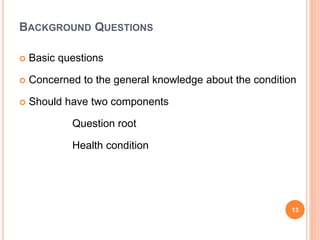
BACKGROUND QUESTIONS
 Basic questions
 Concerned to the general knowledge about the condition
 Should have two components
Question root
Health condition
13
WHSL Asking the Clinical Question: Background and
Foreground Questions:A guide to creating a successful
search strategy for EBM searching .UNIVERSITY OF
THE WITWATERSRRAND JOHANNESBURG
Background questions usually concern conditions, and
consist of two parts:
 The root question (5WH)
[who, what, when, where, why, how]
 Problem
14
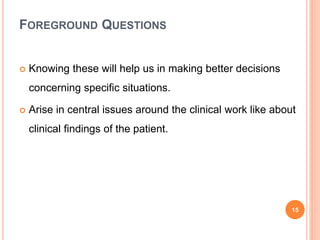
FOREGROUND QUESTIONS
 Knowing these will help us in making better decisions
concerning specific situations.
 Arise in central issues around the clinical work like about
clinical findings of the patient.
15
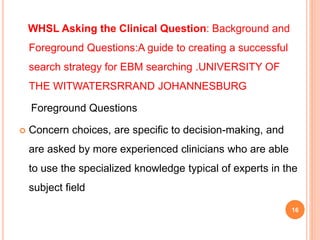
WHSL Asking the Clinical Question: Background and
Foreground Questions:A guide to creating a successful
search strategy for EBM searching .UNIVERSITY OF
THE WITWATERSRRAND JOHANNESBURG
Foreground Questions
 Concern choices, are specific to decision-making, and
are asked by more experienced clinicians who are able
to use the specialized knowledge typical of experts in the
subject field
16
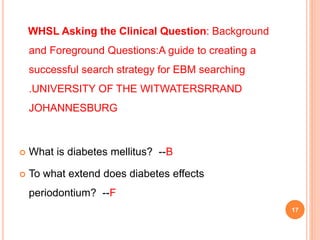
WHSL Asking the Clinical Question: Background
and Foreground Questions:A guide to creating a
successful search strategy for EBM searching
.UNIVERSITY OF THE WITWATERSRRAND
JOHANNESBURG
 What is diabetes mellitus? --B
 To what extend does diabetes effects
periodontium? --F
17
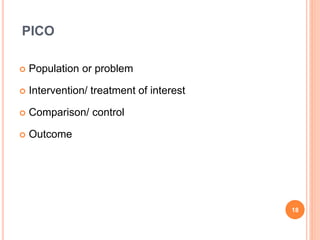
PICO
 Population or problem
 Intervention/ treatment of interest
 Comparison/ control
 Outcome
18
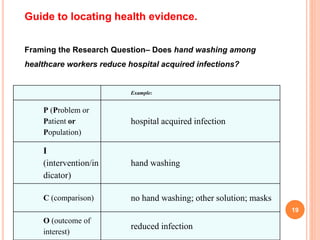
19
Example:
P (Problem or
Patient or
Population)
hospital acquired infection
I
(intervention/in
dicator)
hand washing
C (comparison) no hand washing; other solution; masks
O (outcome of
interest)
reduced infection
Guide to locating health evidence.
Framing the Research Question– Does hand washing among
healthcare workers reduce hospital acquired infections?
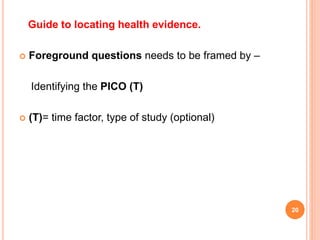
Guide to locating health evidence.
 Foreground questions needs to be framed by –
Identifying the PICO (T)
 (T)= time factor, type of study (optional)
20
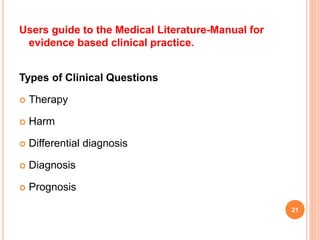
Users guide to the Medical Literature-Manual for
evidence based clinical practice.
Types of Clinical Questions
 Therapy
 Harm
 Differential diagnosis
 Diagnosis
 Prognosis
21
SELECTING
 Feasible
 Interesting
 Novel
 Ethical
 Relevant
22
23
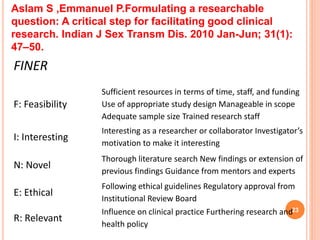
FINER
F: Feasibility
Sufficient resources in terms of time, staff, and funding
Use of appropriate study design Manageable in scope
Adequate sample size Trained research staff
I: Interesting
Interesting as a researcher or collaborator Investigator’s
motivation to make it interesting
N: Novel
Thorough literature search New findings or extension of
previous findings Guidance from mentors and experts
E: Ethical
Following ethical guidelines Regulatory approval from
Institutional Review Board
R: Relevant
Influence on clinical practice Furthering research and
health policy
Aslam S ,Emmanuel P.Formulating a researchable
question: A critical step for facilitating good clinical
research. Indian J Sex Transm Dis. 2010 Jan-Jun; 31(1):
47–50.
SCHEDULING
 Deciding whether it is appropriate to have our
question answered at this very time
24
SAVING
 Unsaved questions become unanswered questions.
 So we must record the questions for later retrieval
and searching.
25
RESEARCH QUESTION AND HYPOTHESIS
 Well-defined research question will lead the
researcher to select an appropriate study design
and methodology.
 Hypothesis can be defined as a logically
conjectured estimation or association between two
or more variables expressed in the form of a
testable statement.
26
Oral health epidemiology. Principles and practice-
Amit Chattopadhyay
 Research hypotheses:
Specific
Clear
Sequential sets of questions addressed
27
http://www.managementstudyguide.com/select-the-
correct-hypothesis-test.htm
 Hypothesis Testing
Hypothesis testing is one of the statistical method
used to confirm the effect that critical few inputs have on
the outputs. Hypothesis testing must be used when the
inputs are measured discretely.
28
Oral health epidemiology. Principles and practice-
Amit Chattopadhyay
 Hypothesis Generating
The recognition that the study was not
designed for testing the involved questions in post hoc
analysis.
Indicates that they can be used only as
indicators of potentially new information.
29
http://www.managementstudyguide.com/select-the-
correct-hypothesis-test.htm
Criteria for selecting a hypothesis:
 The Number of Groups Being Tested
 Whether the Y’s are Discrete or Continuous
 Population Parameter Being Compared
30
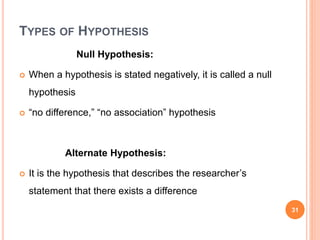
TYPES OF HYPOTHESIS
Null Hypothesis:
 When a hypothesis is stated negatively, it is called a null
hypothesis
 “no difference,” “no association” hypothesis
Alternate Hypothesis:
 It is the hypothesis that describes the researcher’s
statement that there exists a difference
31
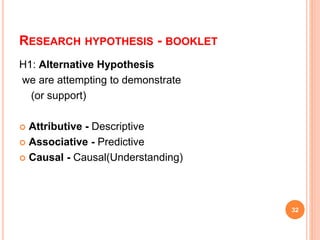
RESEARCH HYPOTHESIS - BOOKLET
H1: Alternative Hypothesis
we are attempting to demonstrate
(or support)
 Attributive - Descriptive
 Associative - Predictive
 Causal - Causal(Understanding)
32
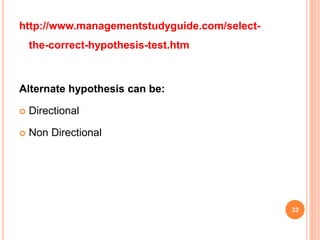
http://www.managementstudyguide.com/select-
the-correct-hypothesis-test.htm
Alternate hypothesis can be:
 Directional
 Non Directional
33
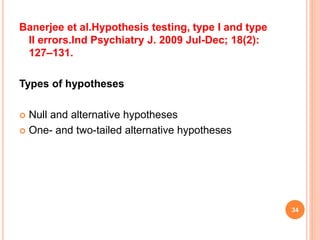
Banerjee et al.Hypothesis testing, type I and type
II errors.Ind Psychiatry J. 2009 Jul-Dec; 18(2):
127–131.
Types of hypotheses
 Null and alternative hypotheses
 One- and two-tailed alternative hypotheses
34
www.studylecturenotes.com
Types of hypothesis:
 Simple
 Complex
 Empirical
 Null
 Alternative
 Logical
 Statistical
35
CONCLUSION
For getting specific and correct answer to a
specific question, it is necessary to have a good research
question. To design a good research question, PICO criteria
is used and for selecting a question, FINER criteria is used.
Scheduling and saving questions are also important to save
time and other resources.
36
REFERENCES
 http://www.theresearchassistant.com/tutorial/2-
1.asp
 Goel et al. Framing Research Question and
Formulating Hypothesis for Testing: Critical
Step in Research. Ind. J. Youth Adol. Health
2016; 3(1)
 http://www.nonjudgmentday.org/judgment-card-
gallery--blog/a-guide-to-cognitive-resonance
37
 McLeod, S. A. (2014). Cognitive Dissonance.
Retrieved from
www.simplypsychology.org/cognitive-
dissonance.html
 WHSL Asking the Clinical Question: Background
and Foreground Questions:A guide to creating a
successful search strategy for EBM searching
.UNIVERSITY OF THE WITWATERSRRAND
JOHANNESBURG
 Guide to locating health evidence.
 Users guide to the Medical Literature-Manual for
evidence based clinical practice.
38
 Aslam S ,Emmanuel P.Formulating a
researchable question: A critical step for
facilitating good clinical research. Indian J Sex
Transm Dis. 2010 Jan-Jun; 31(1): 47–50.
 www.studylecturenotes.com
 http://www.managementstudyguide.com/select-
the-correct-hypothesis-test.htm
 Oral health epidemiology. Principles and
practice- Amit Chattopadhyay
 Research hypotheses - booklet
39

Framing research question and formulating hypothesis for

  • 1.
    FRAMING RESEARCH QUESTIONAND FORMULATING HYPOTHESIS FOR TESTING: CRITICAL STEP IN RESEARCH Presented by : Dr AMBILI NANUKUTTAN 2nd YEAR POST GRADUATE 1
  • 2.
    CONTENTS  Why thisArticle was chosen  Introduction  Research Question Designing  Background Questions  Foreground Questions  PICO 2
  • 3.
     Selecting  Scheduling Saving  Research Question and Hypothesis  Types of Hypothesis  Conclusion 3
  • 4.
    WHY THIS ARTICLEWAS CHOSEN In this advancing world with day to day newer achievements in each and every field , its very difficult to practice without updating present knowledge or any topic of interest. To get updated and to improve knowledge for taking better decision and action, unknown answers has to be answered and is done by setting up research question. A successful research will largely depend on its research question. 4
  • 5.
    INTRODUCTION  New advances Need to update  Conduct research  Depending on various aspects of healthcare  Need for successful research and hypothesis 5
  • 6.
  • 7.
    http://www.theresearchassistant.com/tutorial/2-1.asp  A ResearchQuestion is a statement that identifies the phenomenon to be studied. To develop a strong research question :  Know the field and its literature well  Important research questions in the field  Areas that need further exploration  Should lead to greater understanding 7
  • 8.
     Knowledge aboutany other research already been conducted in this topic area  Has this study been done before  Is the timing right for this question to be answered  Would funding sources be interested  Is the target community interested  Will the study have a significant impact on the field 8
  • 9.
    9 Goel et al.Framing Research Question and Formulating Hypothesis for Testing: Critical Step in Research. Ind. J. Youth Adol. Health 2016; 3(1)  Already possess the required knowledge- only reinforcement is required which is termed as “cognitive resonance”.  When we do not possess the required knowledge. - A response is created within ourselves, which is termed as “cognitive dissonance”
  • 10.
    http://www.nonjudgmentday.org/judgment-card- gallery--blog/a-guide-to-cognitive-resonance  Cognitive resonance:Brain is only a receiver. In this universe there is a core from which we gain knowledge, inspiration, and strength. 10
  • 11.
    McLeod, S. A.(2014). Cognitive Dissonance. Retrieved from www.simplypsychology.org/cognitive- dissonance.html  Cognitive dissonance refers to a situation involving conflicting attitudes, beliefs or behaviors. This produces a feeling of discomfort leading to an alteration in one of the attitudes, beliefs or behaviors to reduce the discomfort and restore balance etc.  For example, when people smoke (behavior) and they know that smoking causes cancer (cognition). 11
  • 12.
    McLeod, S. A.(2014). Cognitive Dissonance. Retrieved from www.simplypsychology.org/cognitive- dissonance.html  Forced compliance behavior,  Decision-making,  Effort. 12
  • 13.
    BACKGROUND QUESTIONS  Basicquestions  Concerned to the general knowledge about the condition  Should have two components Question root Health condition 13
  • 14.
    WHSL Asking theClinical Question: Background and Foreground Questions:A guide to creating a successful search strategy for EBM searching .UNIVERSITY OF THE WITWATERSRRAND JOHANNESBURG Background questions usually concern conditions, and consist of two parts:  The root question (5WH) [who, what, when, where, why, how]  Problem 14
  • 15.
    FOREGROUND QUESTIONS  Knowingthese will help us in making better decisions concerning specific situations.  Arise in central issues around the clinical work like about clinical findings of the patient. 15
  • 16.
    WHSL Asking theClinical Question: Background and Foreground Questions:A guide to creating a successful search strategy for EBM searching .UNIVERSITY OF THE WITWATERSRRAND JOHANNESBURG Foreground Questions  Concern choices, are specific to decision-making, and are asked by more experienced clinicians who are able to use the specialized knowledge typical of experts in the subject field 16
  • 17.
    WHSL Asking theClinical Question: Background and Foreground Questions:A guide to creating a successful search strategy for EBM searching .UNIVERSITY OF THE WITWATERSRRAND JOHANNESBURG  What is diabetes mellitus? --B  To what extend does diabetes effects periodontium? --F 17
  • 18.
    PICO  Population orproblem  Intervention/ treatment of interest  Comparison/ control  Outcome 18
  • 19.
    19 Example: P (Problem or Patientor Population) hospital acquired infection I (intervention/in dicator) hand washing C (comparison) no hand washing; other solution; masks O (outcome of interest) reduced infection Guide to locating health evidence. Framing the Research Question– Does hand washing among healthcare workers reduce hospital acquired infections?
  • 20.
    Guide to locatinghealth evidence.  Foreground questions needs to be framed by – Identifying the PICO (T)  (T)= time factor, type of study (optional) 20
  • 21.
    Users guide tothe Medical Literature-Manual for evidence based clinical practice. Types of Clinical Questions  Therapy  Harm  Differential diagnosis  Diagnosis  Prognosis 21
  • 22.
    SELECTING  Feasible  Interesting Novel  Ethical  Relevant 22
  • 23.
    23 FINER F: Feasibility Sufficient resourcesin terms of time, staff, and funding Use of appropriate study design Manageable in scope Adequate sample size Trained research staff I: Interesting Interesting as a researcher or collaborator Investigator’s motivation to make it interesting N: Novel Thorough literature search New findings or extension of previous findings Guidance from mentors and experts E: Ethical Following ethical guidelines Regulatory approval from Institutional Review Board R: Relevant Influence on clinical practice Furthering research and health policy Aslam S ,Emmanuel P.Formulating a researchable question: A critical step for facilitating good clinical research. Indian J Sex Transm Dis. 2010 Jan-Jun; 31(1): 47–50.
  • 24.
    SCHEDULING  Deciding whetherit is appropriate to have our question answered at this very time 24
  • 25.
    SAVING  Unsaved questionsbecome unanswered questions.  So we must record the questions for later retrieval and searching. 25
  • 26.
    RESEARCH QUESTION ANDHYPOTHESIS  Well-defined research question will lead the researcher to select an appropriate study design and methodology.  Hypothesis can be defined as a logically conjectured estimation or association between two or more variables expressed in the form of a testable statement. 26
  • 27.
    Oral health epidemiology.Principles and practice- Amit Chattopadhyay  Research hypotheses: Specific Clear Sequential sets of questions addressed 27
  • 28.
    http://www.managementstudyguide.com/select-the- correct-hypothesis-test.htm  Hypothesis Testing Hypothesistesting is one of the statistical method used to confirm the effect that critical few inputs have on the outputs. Hypothesis testing must be used when the inputs are measured discretely. 28
  • 29.
    Oral health epidemiology.Principles and practice- Amit Chattopadhyay  Hypothesis Generating The recognition that the study was not designed for testing the involved questions in post hoc analysis. Indicates that they can be used only as indicators of potentially new information. 29
  • 30.
    http://www.managementstudyguide.com/select-the- correct-hypothesis-test.htm Criteria for selectinga hypothesis:  The Number of Groups Being Tested  Whether the Y’s are Discrete or Continuous  Population Parameter Being Compared 30
  • 31.
    TYPES OF HYPOTHESIS NullHypothesis:  When a hypothesis is stated negatively, it is called a null hypothesis  “no difference,” “no association” hypothesis Alternate Hypothesis:  It is the hypothesis that describes the researcher’s statement that there exists a difference 31
  • 32.
    RESEARCH HYPOTHESIS -BOOKLET H1: Alternative Hypothesis we are attempting to demonstrate (or support)  Attributive - Descriptive  Associative - Predictive  Causal - Causal(Understanding) 32
  • 33.
  • 34.
    Banerjee et al.Hypothesistesting, type I and type II errors.Ind Psychiatry J. 2009 Jul-Dec; 18(2): 127–131. Types of hypotheses  Null and alternative hypotheses  One- and two-tailed alternative hypotheses 34
  • 35.
    www.studylecturenotes.com Types of hypothesis: Simple  Complex  Empirical  Null  Alternative  Logical  Statistical 35
  • 36.
    CONCLUSION For getting specificand correct answer to a specific question, it is necessary to have a good research question. To design a good research question, PICO criteria is used and for selecting a question, FINER criteria is used. Scheduling and saving questions are also important to save time and other resources. 36
  • 37.
    REFERENCES  http://www.theresearchassistant.com/tutorial/2- 1.asp  Goelet al. Framing Research Question and Formulating Hypothesis for Testing: Critical Step in Research. Ind. J. Youth Adol. Health 2016; 3(1)  http://www.nonjudgmentday.org/judgment-card- gallery--blog/a-guide-to-cognitive-resonance 37
  • 38.
     McLeod, S.A. (2014). Cognitive Dissonance. Retrieved from www.simplypsychology.org/cognitive- dissonance.html  WHSL Asking the Clinical Question: Background and Foreground Questions:A guide to creating a successful search strategy for EBM searching .UNIVERSITY OF THE WITWATERSRRAND JOHANNESBURG  Guide to locating health evidence.  Users guide to the Medical Literature-Manual for evidence based clinical practice. 38
  • 39.
     Aslam S,Emmanuel P.Formulating a researchable question: A critical step for facilitating good clinical research. Indian J Sex Transm Dis. 2010 Jan-Jun; 31(1): 47–50.  www.studylecturenotes.com  http://www.managementstudyguide.com/select- the-correct-hypothesis-test.htm  Oral health epidemiology. Principles and practice- Amit Chattopadhyay  Research hypotheses - booklet 39