Intercultural Business Communication Crucial points about intercultural encounters 06/02/09 Intercultural Business Communication
Crucial points about  communication Connectivity is more important than what is communicated Communication activities involve continuous acts of translation and negotiation More nationalities, cultures and languages are in articulate communication now than ever before in human history: mainly to link organizations together. Intercultural communication facilitates collective acts of knowledge sharing, group learning and networking 06/02/09 Intercultural Business Communication
The challenges of intercultural communication Ambiguity Interference Lack of equivalence Prejudice Stereotypes Lack of knowledge of body language and non-verbal cues Lack of knowledge about the other culture level of operation 06/02/09 Intercultural Business Communication
A profile of an intercultural  effective person (IEP) Adaptation skills Attitude of modesty and respect Understanding of the concept of culture knowledge of the host country and culture Relationship-building Self-knowledge Intercultural communication Organizational skills Personal and professional commitment (Canadian Foreign Service Institute, Centre for Intercultural Learning, 2000) 06/02/09 Intercultural Business Communication
Intercultural competencies:  Stahl 2001 Tolerance for ambiguity Behavioral flexibility Goal orientation Sociability & interest  in other people Empathy Non-judgment  Meta-communication skills 06/02/09 Intercultural Business Communication
Personal qualifications for international work Open-mindedness Flexibility Interaction Adaptation skills Motivation (Petteri Niitamo, 2003) 06/02/09 Intercultural Business Communication
Competencies  of the stars ” ... ability to read emotional messages in people with backgrounds vastly different from their own, even when they couldn't understand the language being spoken – a competence crucial not only for diplomats but throughout today's work world for capitalizing on diversity.”  (Daniel Coleman. 1999. Working with Emotional Intelligence ) 06/02/09 Intercultural Business Communication
Intercultural dialogue Understanding Listening Empathy Openness Trust Atmosphere Responsibility 06/02/09 Intercultural Business Communication
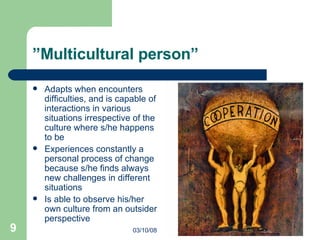
” Multicultural person” Adapts when encounters difficulties, and is capable of interactions in various situations irrespective of the culture where s/he happens to be Experiences constantly a personal process of change because s/he finds always new challenges in different situations Is able to observe his/her own culture from an outsider perspective 06/02/09 Intercultural Business Communication
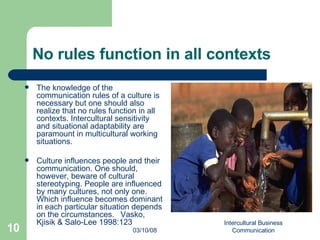
No rules function in all contexts The knowledge of the communication rules of a culture is necessary but one should also realize that no rules function in all contexts. Intercultural sensitivity and situational adaptability are paramount in multicultural working situations. Culture influences people and their communication. One should, however, beware of cultural stereotyping. People are influenced by many cultures, not only one. Which influence becomes dominant in each particular situation depends on the circumstances.  Vasko, Kjisik & Salo-Lee 1998:123 06/02/09 Intercultural Business Communication
Conclusions, Questions and Role Play 06/02/09 Intercultural Business Communication

Intercultural Business Communication Ppp

  • 1.
    Intercultural Business CommunicationCrucial points about intercultural encounters 06/02/09 Intercultural Business Communication
  • 2.
    Crucial points about communication Connectivity is more important than what is communicated Communication activities involve continuous acts of translation and negotiation More nationalities, cultures and languages are in articulate communication now than ever before in human history: mainly to link organizations together. Intercultural communication facilitates collective acts of knowledge sharing, group learning and networking 06/02/09 Intercultural Business Communication
  • 3.
    The challenges ofintercultural communication Ambiguity Interference Lack of equivalence Prejudice Stereotypes Lack of knowledge of body language and non-verbal cues Lack of knowledge about the other culture level of operation 06/02/09 Intercultural Business Communication
  • 4.
    A profile ofan intercultural effective person (IEP) Adaptation skills Attitude of modesty and respect Understanding of the concept of culture knowledge of the host country and culture Relationship-building Self-knowledge Intercultural communication Organizational skills Personal and professional commitment (Canadian Foreign Service Institute, Centre for Intercultural Learning, 2000) 06/02/09 Intercultural Business Communication
  • 5.
    Intercultural competencies: Stahl 2001 Tolerance for ambiguity Behavioral flexibility Goal orientation Sociability & interest in other people Empathy Non-judgment Meta-communication skills 06/02/09 Intercultural Business Communication
  • 6.
    Personal qualifications forinternational work Open-mindedness Flexibility Interaction Adaptation skills Motivation (Petteri Niitamo, 2003) 06/02/09 Intercultural Business Communication
  • 7.
    Competencies ofthe stars ” ... ability to read emotional messages in people with backgrounds vastly different from their own, even when they couldn't understand the language being spoken – a competence crucial not only for diplomats but throughout today's work world for capitalizing on diversity.” (Daniel Coleman. 1999. Working with Emotional Intelligence ) 06/02/09 Intercultural Business Communication
  • 8.
    Intercultural dialogue UnderstandingListening Empathy Openness Trust Atmosphere Responsibility 06/02/09 Intercultural Business Communication
  • 9.
    ” Multicultural person”Adapts when encounters difficulties, and is capable of interactions in various situations irrespective of the culture where s/he happens to be Experiences constantly a personal process of change because s/he finds always new challenges in different situations Is able to observe his/her own culture from an outsider perspective 06/02/09 Intercultural Business Communication
  • 10.
    No rules functionin all contexts The knowledge of the communication rules of a culture is necessary but one should also realize that no rules function in all contexts. Intercultural sensitivity and situational adaptability are paramount in multicultural working situations. Culture influences people and their communication. One should, however, beware of cultural stereotyping. People are influenced by many cultures, not only one. Which influence becomes dominant in each particular situation depends on the circumstances. Vasko, Kjisik & Salo-Lee 1998:123 06/02/09 Intercultural Business Communication
  • 11.
    Conclusions, Questions andRole Play 06/02/09 Intercultural Business Communication