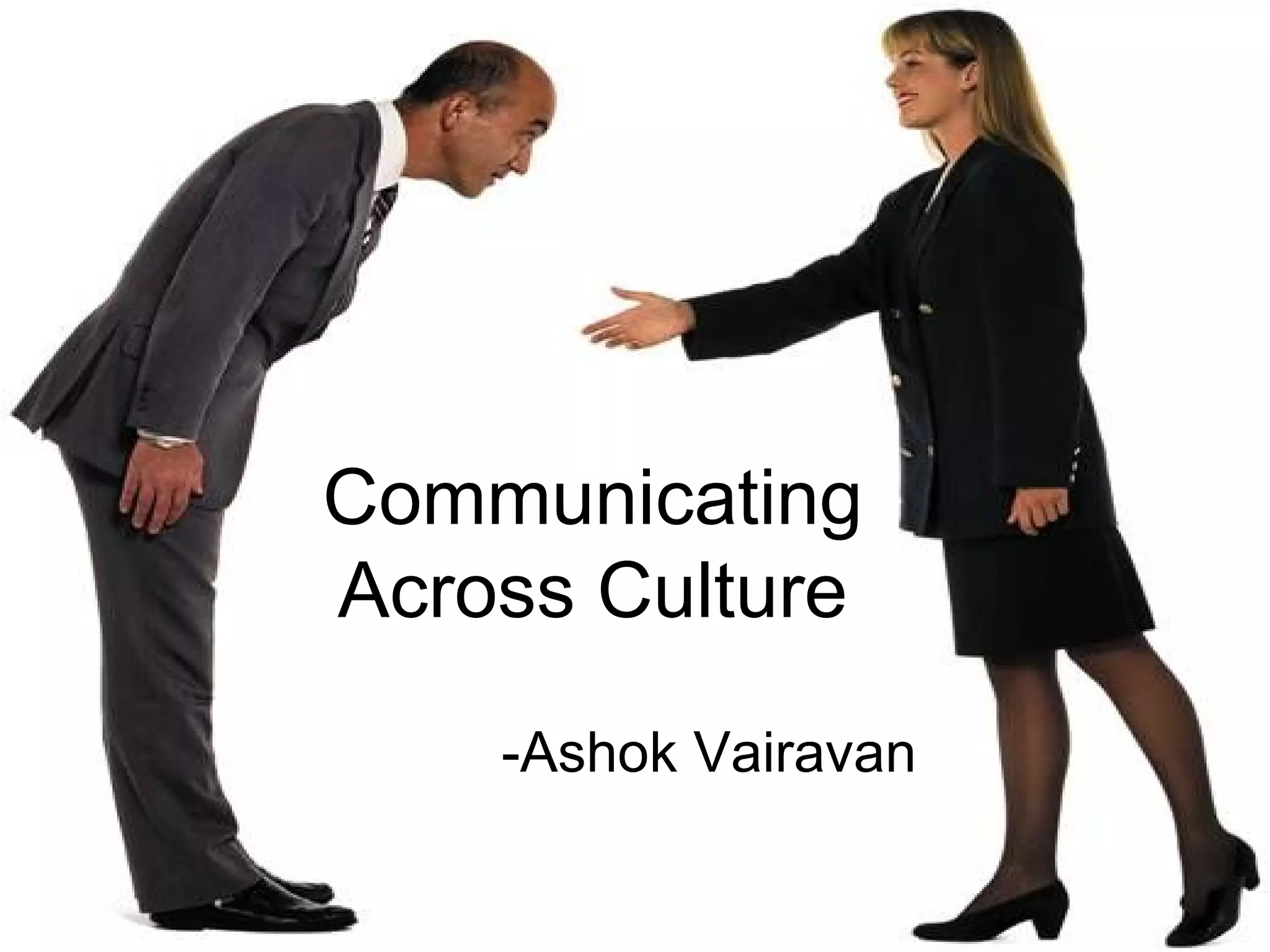
Communicating
Across Culture
    -Ashok Vairavan
Globalization


• Opportunity to conduct business across the world.
• Made us to work with people from different cultures..
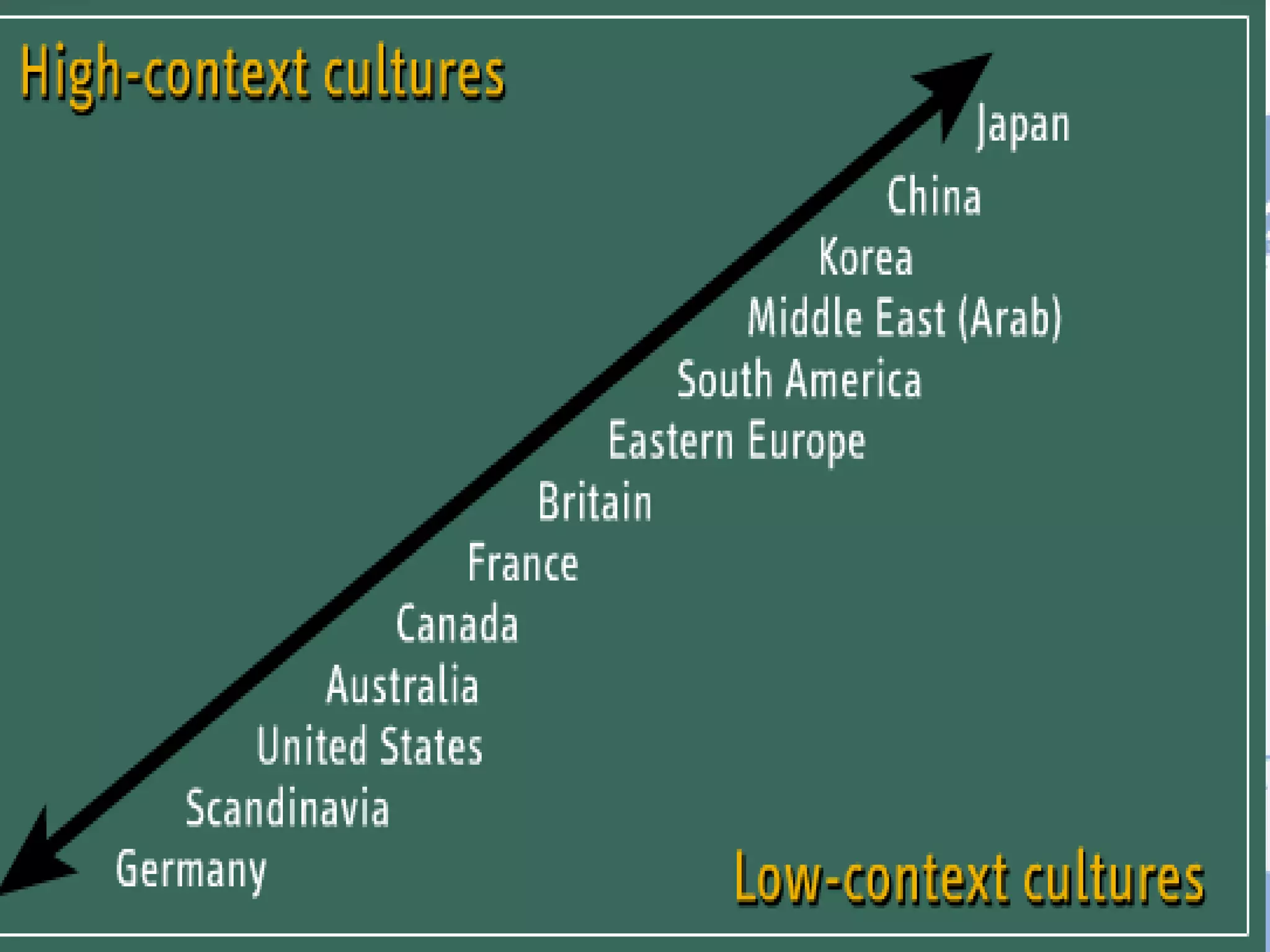
Types of Cultural Contexts
• Low Context Culture
   – Explicit
   – Presented & received in a logical, linear sequence
   – Silence indicates uncomfortableness /
     disagreement

• High Context Culture
   – Implicit
   – Unspoken word has rich meaning than spoken
     word
   – Silence indicates acceptance / thinking
   – Avoids confrontation (Will never say “no)
Examples
High Context: We have some important visitors
  coming in today. It would reflect well on us if
  they are impressed by the orderliness of our
  office.
Low Context: Ashok, cleanup your desk. It is in
  total mess and we have clients coming in today.
High Context: It is somewhat cold today. Please
  close the window.
Low Context: Can you close that window before I
  get pneumonia.
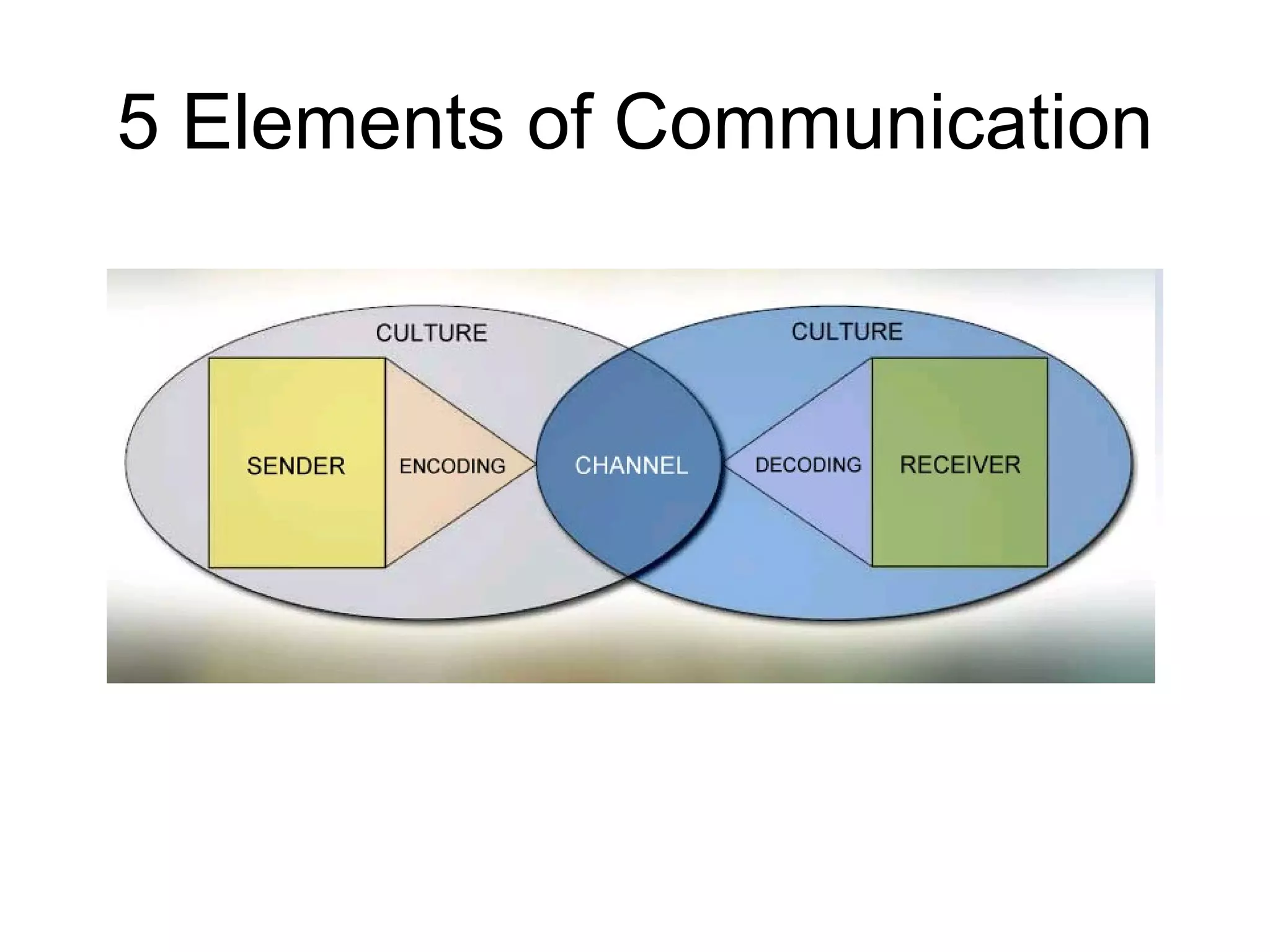
5 Elements of Communication
Adjust your message for other
        culture to hear
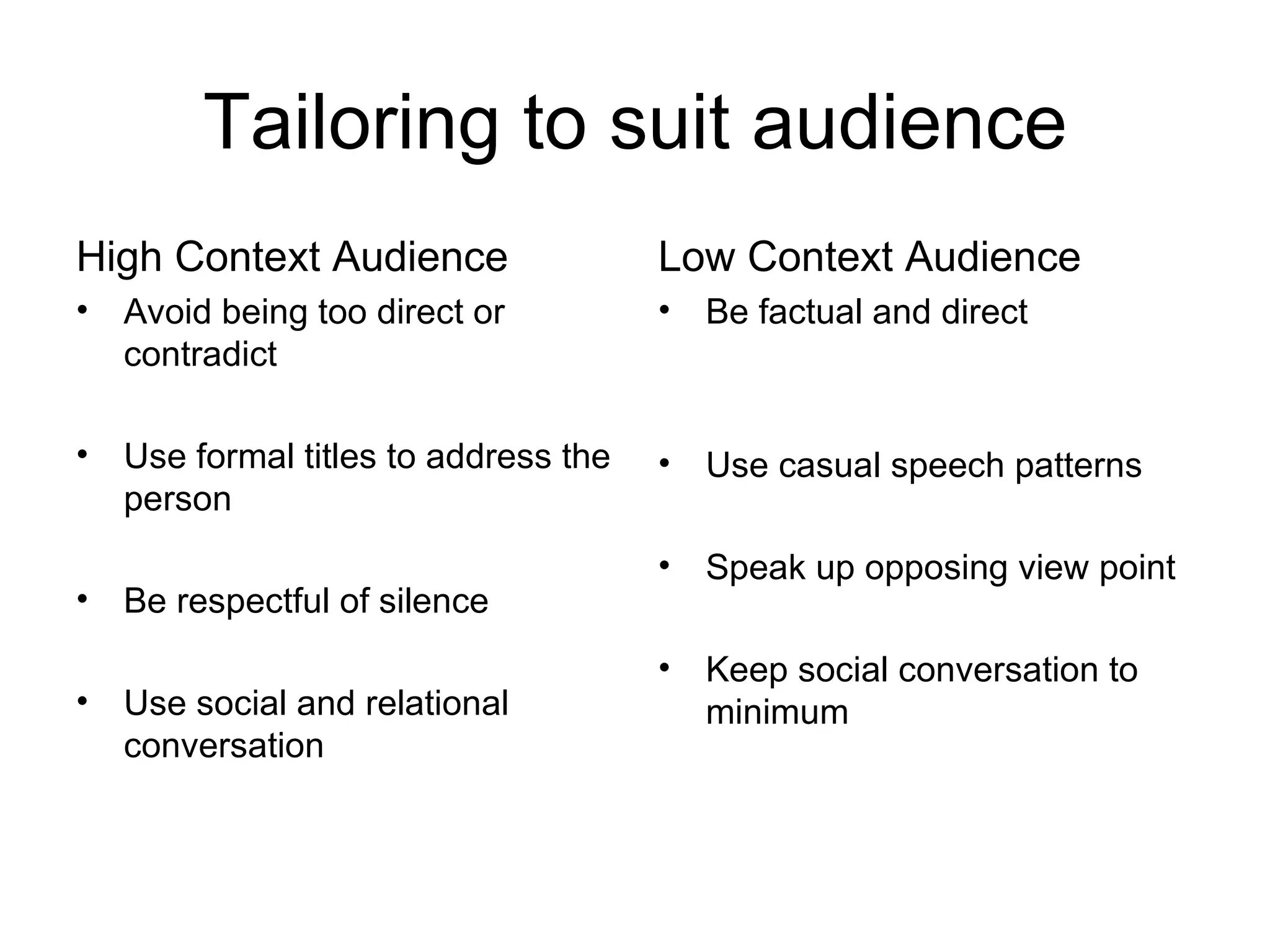
Tailoring to suit audience
High Context Audience                Low Context Audience
• Avoid being too direct or          •   Be factual and direct
  contradict

• Use formal titles to address the   •   Use casual speech patterns
  person
                                     •   Speak up opposing view point
• Be respectful of silence
                                     •   Keep social conversation to
• Use social and relational              minimum
  conversation
Workout
• Chief Executive Officer Kim, I heard that you are
  very fond of playing golf. Perhaps you could tell
  me about local courses.
• I don’t want to waste your time, so I’ll get right to
  the point.
• Vice President Yi has presented a issue that is
  worth taking time to consider.
• I am leaving the country tomorrow, so I will need
  a definite answer by the end of today.
Questions
High Context Communication
              Technique


•   Avoid being too direct or contradict
•   Use formal titles to address the person
•   Be respectful of silence
•   Use social and relational conversation
Low Context Communication
             Technique

•   Be factual and direct
•   Speak up opposing view point
•   Use casual speech patterns
•   Keep social conversation to minimum

Communicating across culture

  • 1.
  • 2.
    Globalization • Opportunity toconduct business across the world. • Made us to work with people from different cultures..
  • 4.
    Types of CulturalContexts • Low Context Culture – Explicit – Presented & received in a logical, linear sequence – Silence indicates uncomfortableness / disagreement • High Context Culture – Implicit – Unspoken word has rich meaning than spoken word – Silence indicates acceptance / thinking – Avoids confrontation (Will never say “no)
  • 5.
    Examples High Context: Wehave some important visitors coming in today. It would reflect well on us if they are impressed by the orderliness of our office. Low Context: Ashok, cleanup your desk. It is in total mess and we have clients coming in today. High Context: It is somewhat cold today. Please close the window. Low Context: Can you close that window before I get pneumonia.
  • 6.
    5 Elements ofCommunication
  • 7.
    Adjust your messagefor other culture to hear
  • 8.
    Tailoring to suitaudience High Context Audience Low Context Audience • Avoid being too direct or • Be factual and direct contradict • Use formal titles to address the • Use casual speech patterns person • Speak up opposing view point • Be respectful of silence • Keep social conversation to • Use social and relational minimum conversation
  • 9.
    Workout • Chief ExecutiveOfficer Kim, I heard that you are very fond of playing golf. Perhaps you could tell me about local courses. • I don’t want to waste your time, so I’ll get right to the point. • Vice President Yi has presented a issue that is worth taking time to consider. • I am leaving the country tomorrow, so I will need a definite answer by the end of today.
  • 10.
  • 11.
    High Context Communication Technique • Avoid being too direct or contradict • Use formal titles to address the person • Be respectful of silence • Use social and relational conversation
  • 12.
    Low Context Communication Technique • Be factual and direct • Speak up opposing view point • Use casual speech patterns • Keep social conversation to minimum

Editor's Notes

  • #3 The culture in which the people socialize influence the manner in which they work. Imperative to know how it affects communication. In organization with cross cultural teams, the miscommunication creates conflicts and results in low productivity.
  • #5 The cultures can be broadly classified into high context and low context cultures. In low context culture, all the communication will be simple, direct and explicit. Facts and data are given more importance than the status and position. Saying “no” seen as an honest answer. In high context communication, there is a implicit meaning associated with the status/rank of the presenter. Saying “no” is considered as an offence. Silence is much appreciated. High context people wants to infer the information from the presentation rather than presenting it directly to them. Likes formal titles while addressing.
  • #6 Knowing your audience will help you to present your views effectively. Presenting a low context presentation to high context audience will lead to misunderstanding and conflicts.
  • #7 Miscommunication occurs during encoding and decoding. The sender has to know audience to encode properly and similarly the decoder has to know presenter to decode properly. The sender has to know the audience’s culture and the receiver has to know presenter’s culture to avoid miscommunication. Cultural context affects each of these elements.
  • #10 Thus if you know your audience, you can find out which contexts they belong. By knowing the context, you can tailor your presentation to communicate effectively. By understanding the audience’s context, you can run effective meetings and can enhance the productivity.