Reward
Management
Contents
1. Sanrich Restaurant
i. Restaurant profile
ii. Vision & Mission
iii. Employee Statistics
2. Reward Management
i. Definition
ii. Types of Rewards
iii. Principles of Rewards
iv. Purpose of Rewards
v. Motivation theories based on rewarding
3. Reward strategy of Sanrich Restaurant
4. Conclusion
Company profile
• Sanrich is a fast food take away restaurant.
• It has 3 branches in Moratuwa, Mt. Lavinia and Rawathawatta.
• Rawathawatta branch is the main branch.
• Market leader in the Moratuwa area.
• The General Manager of the organization is Chaminda Kanangara.
• 63 people are employed in this organization.
• They provide Chinese, Thai, Indian, Italian and Sri Lankan foods.
• They have the online ordering and delivery service too.
• They are in the field since 2012.
(Kanangara, 2016)
Vision & Mission
• Vision
“To provide all in one customer satisfaction,
delicious foods, qualitative process and reliable
customer service.”
• Mission
“To provide customer dedicated and quality
management service, by using that policy to attract
a large customer base in Sri Lanka with reputation.”
(Kanangara, 2016)
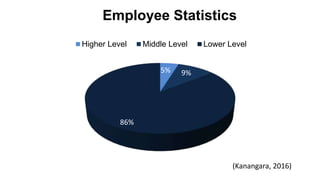
5% 9%
86%
Percentage of Employees
Higher Level Middle Level Lower Level
(Kanangara, 2016)
Employee Statistics
Higher
Level
General
Manager
HR
manager
Accountant
Middle
Level
Supervisors
Head Chef
Web
Operator
Cashier
Lower
Level
Delivery
Boys
Chef
Waiters
Other
workers (Kanangara, 2016)
Employee Statistics…
What is Reward Management?
Reward management is concerned with the
strategies, policies and processes required to
ensure that the value of people and the
contribution they make to achieving organizational,
departmental and team goals is recognized and
rewarded (Armstrong, 2010).
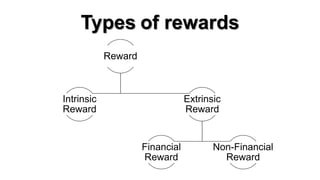
Types of rewards
Reward
Intrinsic
Reward
Extrinsic
Reward
Financial
Reward
Non-Financial
Reward
(Armstrong, 2010)
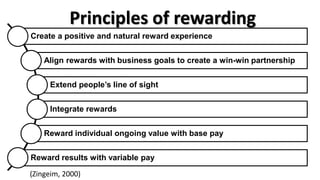
Create a positive and natural reward experience
Align rewards with business goals to create a win-win partnership
Extend people’s line of sight
Integrate rewards
Reward individual ongoing value with base pay
Reward results with variable pay
Principles of rewarding
(Zingeim, 2000)
Attracting and
retaining good
employees
Motivating
enhanced
performance
Reducing
absenteeism
Developing
employee skills
Facilitating
organizational
culture and
strategic
objectives
Defining and
reinforcing
organizational
structure
Purpose of rewarding
(HR WALE, 2010)
Motivation theories based on
rewarding
• Vroom’s Expectancy theory
• Adam’s Equity theory
• Locke’s Goal Setting theory
(Armstrong, 2007)
The process of motivation
Establish
goals
Take
actions
Attain
goal
Need
(Armstrong, 2007)
Vroom’s Expectancy theory
• “Is about the mental processes regarding choice, or
choosing.”
• This is the core process theory.
Performance
outcome
Return for
performance
Value of the
reward
(Armstrong, 2007)
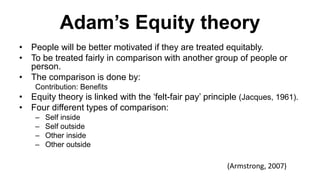
Adam’s Equity theory
• People will be better motivated if they are treated equitably.
• To be treated fairly in comparison with another group of people or
person.
• The comparison is done by:
Contribution: Benefits
• Equity theory is linked with the ‘felt-fair pay’ principle (Jacques, 1961).
• Four different types of comparison:
– Self inside
– Self outside
– Other inside
– Other outside
(Armstrong, 2007)
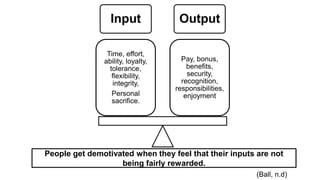
Input Output
Time, effort,
ability, loyalty,
tolerance,
flexibility,
integrity,
Personal
sacrifice.
Pay, bonus,
benefits,
security,
recognition,
responsibilities,
enjoyment
People get demotivated when they feel that their inputs are not
being fairly rewarded.
(Ball, n.d)
Locke’s Goal Setting theory
• Setting a specific goal will improve motivation.
• Factors which influence performance:
Goal
Commitment
Self efficiency
(Armstrong, 2007)
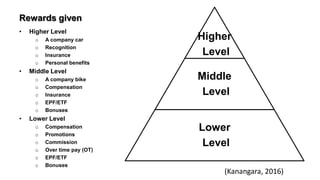
Rewards given
Higher
Level
Middle
Level
Lower
Level
• Higher Level
o A company car
o Recognition
o Insurance
o Personal benefits
• Middle Level
o A company bike
o Compensation
o Insurance
o EPF/ETF
o Bonuses
• Lower Level
o Compensation
o Promotions
o Commission
o Over time pay (OT)
o EPF/ETF
o Bonuses
(Kanangara, 2016)
Conclusion
Rewarding the employees, for the work done
by them will motivate them, then the employees
will perform well to achieve the goals of the
organization.
The management of rewards should be done
in a strategic manner to be successful. If not it will
be quite difficult to retain the employees as well as
the employees will be unsatisfied.
List of Reference
1. Armstrong, M., 2007. Motivation and Reward. In Improving
performance through reward. 2nd ed. p.133.
2. HR WALE, 2010. HR WALE. [Online] HR WALE Productions
Available at: http://www.hrwale.com [Accessed 11 May 2016].
3. Jaques, E., 1961. In Equitable Payment.
4. Kanangara, C., 2016. About Sanrich Restaurant. Moratuwa, Sri
Lanka, 11 May 2016.
5. Ball, B., n.d. In Summary of motivation theories. P. 15.
6. Zingeim, P.K..J.R.S., 2000. Pay People Right. [Online] Schuster-
Zingeim and Associates, Inc. Available at:
http://www.paypeopleright.com [Accessed 7 May 2016].
Our
Team
Aadel
Amanath

Reward mangement

  • 1.
  • 2.
    Contents 1. Sanrich Restaurant i.Restaurant profile ii. Vision & Mission iii. Employee Statistics 2. Reward Management i. Definition ii. Types of Rewards iii. Principles of Rewards iv. Purpose of Rewards v. Motivation theories based on rewarding 3. Reward strategy of Sanrich Restaurant 4. Conclusion
  • 3.
    Company profile • Sanrichis a fast food take away restaurant. • It has 3 branches in Moratuwa, Mt. Lavinia and Rawathawatta. • Rawathawatta branch is the main branch. • Market leader in the Moratuwa area. • The General Manager of the organization is Chaminda Kanangara. • 63 people are employed in this organization. • They provide Chinese, Thai, Indian, Italian and Sri Lankan foods. • They have the online ordering and delivery service too. • They are in the field since 2012. (Kanangara, 2016)
  • 4.
    Vision & Mission •Vision “To provide all in one customer satisfaction, delicious foods, qualitative process and reliable customer service.” • Mission “To provide customer dedicated and quality management service, by using that policy to attract a large customer base in Sri Lanka with reputation.” (Kanangara, 2016)
  • 5.
    5% 9% 86% Percentage ofEmployees Higher Level Middle Level Lower Level (Kanangara, 2016) Employee Statistics
  • 6.
  • 7.
    What is RewardManagement? Reward management is concerned with the strategies, policies and processes required to ensure that the value of people and the contribution they make to achieving organizational, departmental and team goals is recognized and rewarded (Armstrong, 2010).
  • 8.
  • 9.
    Create a positiveand natural reward experience Align rewards with business goals to create a win-win partnership Extend people’s line of sight Integrate rewards Reward individual ongoing value with base pay Reward results with variable pay Principles of rewarding (Zingeim, 2000)
  • 10.
    Attracting and retaining good employees Motivating enhanced performance Reducing absenteeism Developing employeeskills Facilitating organizational culture and strategic objectives Defining and reinforcing organizational structure Purpose of rewarding (HR WALE, 2010)
  • 11.
    Motivation theories basedon rewarding • Vroom’s Expectancy theory • Adam’s Equity theory • Locke’s Goal Setting theory (Armstrong, 2007)
  • 12.
    The process ofmotivation Establish goals Take actions Attain goal Need (Armstrong, 2007)
  • 13.
    Vroom’s Expectancy theory •“Is about the mental processes regarding choice, or choosing.” • This is the core process theory. Performance outcome Return for performance Value of the reward (Armstrong, 2007)
  • 14.
    Adam’s Equity theory •People will be better motivated if they are treated equitably. • To be treated fairly in comparison with another group of people or person. • The comparison is done by: Contribution: Benefits • Equity theory is linked with the ‘felt-fair pay’ principle (Jacques, 1961). • Four different types of comparison: – Self inside – Self outside – Other inside – Other outside (Armstrong, 2007)
  • 15.
    Input Output Time, effort, ability,loyalty, tolerance, flexibility, integrity, Personal sacrifice. Pay, bonus, benefits, security, recognition, responsibilities, enjoyment People get demotivated when they feel that their inputs are not being fairly rewarded. (Ball, n.d)
  • 16.
    Locke’s Goal Settingtheory • Setting a specific goal will improve motivation. • Factors which influence performance: Goal Commitment Self efficiency (Armstrong, 2007)
  • 17.
    Rewards given Higher Level Middle Level Lower Level • HigherLevel o A company car o Recognition o Insurance o Personal benefits • Middle Level o A company bike o Compensation o Insurance o EPF/ETF o Bonuses • Lower Level o Compensation o Promotions o Commission o Over time pay (OT) o EPF/ETF o Bonuses (Kanangara, 2016)
  • 18.
    Conclusion Rewarding the employees,for the work done by them will motivate them, then the employees will perform well to achieve the goals of the organization. The management of rewards should be done in a strategic manner to be successful. If not it will be quite difficult to retain the employees as well as the employees will be unsatisfied.
  • 19.
    List of Reference 1.Armstrong, M., 2007. Motivation and Reward. In Improving performance through reward. 2nd ed. p.133. 2. HR WALE, 2010. HR WALE. [Online] HR WALE Productions Available at: http://www.hrwale.com [Accessed 11 May 2016]. 3. Jaques, E., 1961. In Equitable Payment. 4. Kanangara, C., 2016. About Sanrich Restaurant. Moratuwa, Sri Lanka, 11 May 2016. 5. Ball, B., n.d. In Summary of motivation theories. P. 15. 6. Zingeim, P.K..J.R.S., 2000. Pay People Right. [Online] Schuster- Zingeim and Associates, Inc. Available at: http://www.paypeopleright.com [Accessed 7 May 2016].
  • 20.