DIVERSITY DEFINED
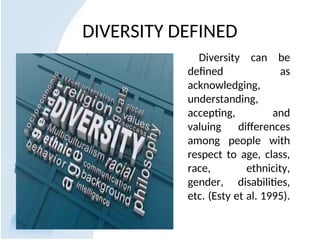
Diversity canbe
defined as
acknowledging,
understanding,
accepting, and
valuing differences
among people with
respect to age, class,
race, ethnicity,
gender, disabilities,
etc. (Esty et al. 1995).
3.
DIVERSITY in Workplace:
Diversity in the workplace refers to the
variety of differences among people in an
organization. It encompasses cultural,
racial, religious, age, gender, sexual
orientation, and disability differences.
Embracing this diversity is essential as it
fosters creativity and innovation,
benefiting both the organization and its
employees.
4.
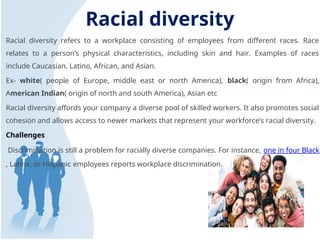
Racial diversity refersto a workplace consisting of employees from different races. Race
relates to a person’s physical characteristics, including skin and hair. Examples of races
include Caucasian, Latino, African, and Asian.
Ex- white( people of Europe, middle east or north America), black( origin from Africa),
American Indian( origin of north and south America), Asian etc
Racial diversity affords your company a diverse pool of skilled workers. It also promotes social
cohesion and allows access to newer markets that represent your workforce’s racial diversity.
Challenges
Discrimination is still a problem for racially diverse companies. For instance, one in four Black
, Latinx, or Hispanic employees reports workplace discrimination.
Racial diversity
5.
Educational Mismatches
• specificallythe disparity between an
individual's education/skills and job
requirements, significantly impact human
behavior, primarily through psychological,
career development, and economic channels.
These mismatches influence job satisfaction,
mental health, career trajectories, and even
family-related decisions.
7.
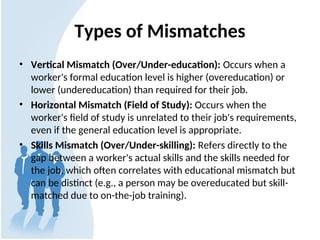
Types of Mismatches
•Vertical Mismatch (Over/Under-education): Occurs when a
worker's formal education level is higher (overeducation) or
lower (undereducation) than required for their job.
• Horizontal Mismatch (Field of Study): Occurs when the
worker's field of study is unrelated to their job's requirements,
even if the general education level is appropriate.
• Skills Mismatch (Over/Under-skilling): Refers directly to the
gap between a worker's actual skills and the skills needed for
the job, which often correlates with educational mismatch but
can be distinct (e.g., a person may be overeducated but skill-
matched due to on-the-job training).
8.
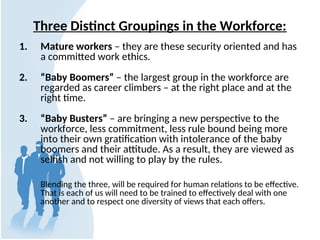
Three Distinct Groupingsin the Workforce:
1. Mature workers – they are these security oriented and has
a committed work ethics.
2. “Baby Boomers” – the largest group in the workforce are
regarded as career climbers – at the right place and at the
right time.
3. “Baby Busters” – are bringing a new perspective to the
workforce, less commitment, less rule bound being more
into their own gratification with intolerance of the baby
boomers and their attitude. As a result, they are viewed as
selfish and not willing to play by the rules.
Blending the three, will be required for human relations to be effective.
That is each of us will need to be trained to effectively deal with one
another and to respect one diversity of views that each offers.
10.
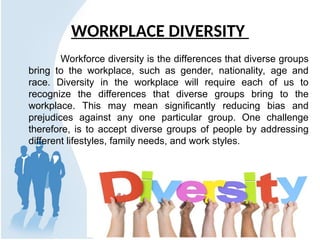
WORKPLACE DIVERSITY
Workforce diversityis the differences that diverse groups
bring to the workplace, such as gender, nationality, age and
race. Diversity in the workplace will require each of us to
recognize the differences that diverse groups bring to the
workplace. This may mean significantly reducing bias and
prejudices against any one particular group. One challenge
therefore, is to accept diverse groups of people by addressing
different lifestyles, family needs, and work styles.
11.
Benefits of WorkplaceDiversity
An organization’s success and competitiveness depends upon its ability to embrace diversity and
realize the benefits. When organizations actively assess their handling of workplace diversity
issues, develop and implement diversity plans, multiple benefits are reported such as:
Increased adaptability
Organizations employing a diverse workforce can supply a greater variety of solutions to problems
in service, sourcing, and allocation of resources. Employees from diverse backgrounds bring
individual talents and experiences in suggesting ideas that are flexible in adapting to fluctuating
markets and customer demands.
Broader service range
• A diverse collection of skills and experiences (e.g. languages, cultural understanding) allows a
company to provide service to customers on a global basis.
Variety of viewpoints
• A diverse workforce that feels comfortable communicating varying points of view provides a larger
pool of ideas and experiences. The organization can draw from that pool to meet business strategy
needs and the needs of customers more effectively.
More effective execution
• Companies that encourage diversity in the workplace inspire all of their employees to perform to
their highest ability. Company-wide strategies can then be executed; resulting in higher
productivity, profit, and return on investment.
12.
Challenges of Diversityin the Workplace
Taking full advantage of the benefits of diversity in the workplace is not without its
challenges. Some of those challenges are:
• Resistance to change - There are always employees who will refuse to accept the fact
that the social and cultural make up of their workplace is changing. The “we’ve
always done it this way” mentality silences new ideas and inhibits progress.
• Implementation of diversity in the workplace policies - This can be the overriding
challenge to all diversity advocates. Armed with the results of employee assessments
and research data, they must build and implement a customized strategy to maximize
the effects of diversity in the workplace for their particular organization.
• Successful Management of Diversity in the Workplace - Diversity training alone is
not sufficient for your organization’s diversity management plan. A strategy must be
created and implemented to create a culture of diversity that permeates every
department and function of the organization.
13.
Challenges of Diversityin the Workplace
• Negative attitudes and behaviors can be barriers to organizational diversity
because they can harm working relationships and damage morale and work
productivity (Esty et al. 1995). Negative attitudes and behaviors in the workplace
include prejudice, stereotyping, and discrimination, which should never be used
by management for hiring, retention, and termination practices (could lead to
costly litigation).
• Prejudices and Discrimination - Managers may also be challenged with losses in
personnel and work productivity due to prejudice and discrimination, as well as
complaints and legal actions against the organization (Devoe 1999).
• Communication - Perceptual, cultural and language barriers need to be overcome
for diversity programs to succeed. Ineffective communication of key objectives
results in confusion, lack of teamwork, and low morale.
14.
Required Tools forManaging
Diversity
Effective managers are aware that certain skills are necessary for
creating a successful, diverse workforce.
• First, managers must understand discrimination and its consequences.
• Second, managers must recognize their own cultural biases and
prejudices (Koonce 2001). Diversity is not about differences among
groups, but rather about differences among individuals. Each individual is
unique and does not represent or speak for a particular group.
• Finally, managers must be willing to change the organization if necessary
(Koonce 2001). Organizations need to learn how to manage diversity in
the workplace to be successful in the future (Flagg 2002).
15.
Managing Conflict
According toRoosevelt (2001), managing diversity is a comprehensive process for creating
a work environment that includes everyone. When creating a successful diverse workforce,
an effective manager should focus on personal awareness. Both managers and associates
need to be aware of their personal biases. Therefore, organizations need to develop,
implement, and maintain ongoing training because a one-day session of training will not
change people’s behaviors (Koonce 2001). Managers must also understand that fairness is
not necessarily equality. There are always exceptions to the rule.
Managing diversity is about more than equal employment opportunity and affirmative
action (Losyk 1996).
Managers should expect change to be slow, while at the same time encouraging change
(Koonce 2001).
Another vital requirement when dealing with diversity is promoting a safe place for
associates to communicate (Koonce 2001)..
Managers should implement policies such as mentoring programs to provide associates
access to information and opportunities. Also, associates should never be denied necessary,
constructive, critical feedback for learning about mistakes and successes (Flagg 2002)
17.
Why Human Relations?
Humanrelations is an
interdisciplinary field
because the study of human
behavior in organizational
settings draws on the fields
of communications,
management, psychology,
and sociology. It is an
important field of study
because all workers engage
in human relations activities.
18.
Advantage to HavingGood Human Relations;
From a personal perspective, there are many advantages to having good human relations
skills.
• First, of the top ten reasons people are fired, several reasons relate back to lack of
human relations skills—for example, the inability to work within a team, personality
issues, sexual harassment, and dishonesty. Other reasons, perhaps not directly related
to human relations, include absenteeism, poor performance, stealing, political reasons,
downsizing, and sabotage.
• Second, people who are competent team players and have a good work ethic tend to
get promoted faster. In fact, according to guru on personal development Brian Tracy, 85
percent of your success in life is determined by social skills and the ability to interact
positively and effectively with others.
• Another reason to develop good relationships with others relates to your own personal
happiness. According to psychologist Sydney Jourard, most joy in life comes from happy
relationships with other people.
19.
Human Relations
Consider John,a very talented project manager but lacking in human
relations skills. While he is easily able to plan and execute the finest details
for a project, no one likes to work with him. He doesn’t make efforts to get
to know his team members and he comes across as unfriendly and
unapproachable. How successful do you think John will be in his workplace?
While he has the skills necessary to do the job, he doesn’t have the people
skills that can help him excel at it. One could say he does not have emotional
intelligence skills—that is, the ability to understand others—therefore, he
may always find himself wondering why he isn’t more successful at work.
• While project management skills are something we can learn, managers
find it difficult to hire people without the soft skills, or human relations
skills. We aren’t saying that skills are not important, but human relations
skills are equally as important as technical skills to determine career and
personal success.
20.
Human Relations
Julie talksbehind people’s backs and doesn’t follow through on her
promises. She exhibits body language that says “get away from me” and
rarely smiles or asks people about themselves. It is likely that Julie will have
very few, if any, friends. If Julie had positive human relations skills, there is
a much better chance she could improve her personal relationships.
• Human relations skills such as communication and handling conflict can
help us create better relationships.
• Positive human relations skills reduce conflict in the workplace, thereby
making the workplace more productive.
• If people are not able to get along and resolve conflicts, the organization as
a whole will be less productive, which could affect profitability.
21.
Human Relations
Kathy isdoing a great job at work but suddenly starts to arrive late, leave early,
and take longer lunches. Upon further examination, we might find that Kathy is
having childcare issues because of her divorce. Because of a total person
approach perspective, her organization might be able to rearrange her
schedule or work with her to find a reasonable solution. This relates to human
relations because we are not just people going to work every day; we are
people who live our personal lives, and one affects the other.
• Most organizations employ a total person approach. This approach recognizes
that an organization does not just employ someone with skills, but rather, the
whole person. This person comes with biases, personal challenges, human
relations skills, and technical skills but also comes with experiences. By looking
at a person from this perspective, an organization can begin to understand that
what happens to an employee outside of work can affect his or her job
performance.
22.
Fourteen Principles ofManagement
1. Division of work. Work should be divided in the most efficient way. Fayol
believed work specialization, or the focus on specific tasks for teams or
individuals, to be crucial to success.
2. Authority. Authority is the right to give orders and accountability within
those orders. Fayol believed that along with giving orders and expecting
them to be met, that person in authority also assumes responsibility to
make sure tasks are met.
3. Discipline. Discipline is penalties applied to encourage common effort, as a
successful organization requires the common effort of all workers.
4. Unity of command. Workers should receive orders from only one
manager. In other words, reporting to two or more managers would
violate Fayol’s Fourteen Principles of Management.
5. Unity of direction. Everyone in the organization should move toward a
common goal and understand how the team will achieve that goal.
23.
Fourteen Principles ofManagement
6. Subordination of individual interests to general interests. The interests of one
person shouldn’t have priority over the interests of the organization as a whole. This
focuses on teamwork and the importance of everyone acting toward the same goal.
7. Remuneration. Many things should be considered when paying employees,
including cost of living, supply of qualified people, and business success.
8. Centralization. The degree of importance in the subordinates’ (employees’) role in
their organization and the amount of decision making that occurs at a central level
versus a decentralized level. For example, in many organizations decisions are made
centrally (i.e., in the “corporate office”), which does not allow as much flexibility as
decentralized decision making; this would mean each individual area can make its
own decisions.
9. Scalar chain. This refers to how authority is divided among managers. Specifically,
Fayol said lower-level managers should always keep upper-level managers informed.
10. Order. All materials and people related to one kind of work should be organized and
neat. Things should be easy to find.
24.
Fourteen Principles ofManagement
11. Equity. All employees should be treated equally.
12. Stability of tenure of personnel. Retention of employees should be a
high management priority. The cost of hiring a new worker is expensive,
so efforts should be maintained to keep current employees.
13. Initiative. Management should take steps to encourage workers to take
initiative. In addition, workers should be self-directed and not need a lot
of management control to accomplish tasks.
14. Esprit de corps. Managers should encourage harmony among
employees. This harmony creates good feelings among employees.
25.
Globalization
The world wasrapidly changing with other countries making
significant inroads into traditional market. It was only late
1980s did US businesses begin to get the message and late
1990 did Philippine businesses join the Wagon The Philippines
for one became more aggressive and began to expand into
what is commonly called the global village.
A global village recognizes that organizations are no longer
constrained by national borders. With this, people must adapt
to cultures, systems and techniques that are different from
their own.
Globalization has long been with US. Different countries were
able to trade in the US and western countries. But it was that
multinational corporations (MNCs) who initiated the rapid
growth in international trade.
26.
Multinational corporations arethose that maintain
significant operations in two or more countries
simultaneously but are based in one home country.
Globalization is extending the reach and goals on
MNCs to create and even more generic global organization
– the transnational corporation (TNC). This type of
organization doesn’t seek to repeat its domestic successors
by managing foreign operations from home. Decision
making in TNC takes place at the local level. Individuals in
the host countries called nationals typically are hired to run
operations in each country. And marketing and products for
each country are uniquely tailored to the country’s culture.
27.
How Does GlobalizationAffect
Human Relations?
A boundary less world introduces new challenges for us. These
include our views of people from foreign lands, to an
understanding of their culture. Our specific challenge is
recognizing the differences that might exist and finding ways to
make our interactions more effective.
Parochialism means that use often see things solely through
our own eyes and within our perspectives. We believe what we
do is best. We simply do not recognize that other people have
different ways of doing things and live differently than us. In
essence, our parochialism leads to what is technically called
our ethnocentric view. That is, we view our way as being better
than these in other cultures. This perception first requires us to
understand the different cultures and environment.
28.
Understanding cultural environmentsthen is
the success of interacting with others in the global
village. These become relevant if we find that our
jobs take us abroad. That is if you go to another
country, you must understand that country’s legal,
political, economic and cultural systems. Failure to
do so may result to cultural shock. Cultural shock is
cause by the confusion and the frustration that
occurs when we are first exposed to different
culture.