Made By:
Fareeha hassan.
COMPENSATION &
BENEFITS MANAGEMENT
• SALARY
• WAGES
• COMPENSATION
WHAT IS THE
MEANING OF
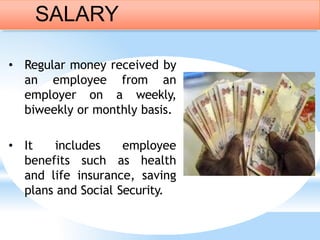
• Regular money received by
an employee from an
employer on a weekly,
biweekly or monthly basis.
• It includes employee
benefits such as health
and life insurance, saving
plans and Social Security.
SALARY
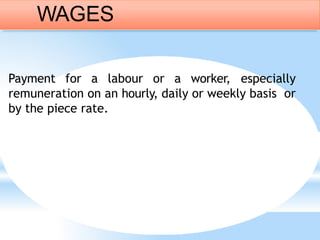
Payment for a labour or a worker, especially
remuneration on an hourly, daily or weekly basis or
by the piece rate.
WAGES
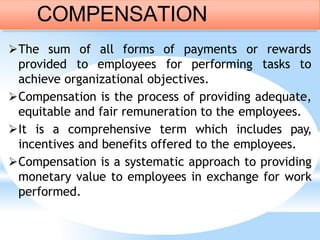
COMPENSATION
The sum of all forms
provided to employees
of payments or rewards
for performing tasks to
achieve organizational objectives.
Compensation is the process of providing adequate,
equitable and fair remuneration to the employees.
It is a comprehensive term which includes pay,
incentives and benefits offered to the employees.
Compensation is a systematic approach to providing
monetary value to employees in exchange for work
performed.
Supportive Corporate Culture
Executive Sponsorship
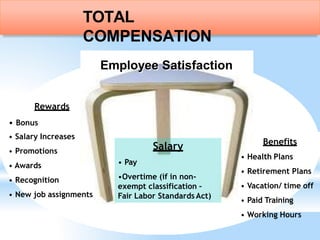
Salary
• Pay
•Overtime (if in non-
exempt classification –
Fair Labor Standards Act)
Benefits
• Health Plans
• Retirement Plans
• Vacation/ time off
• Paid Training
• Working Hours
TOTAL
COMPENSATION
Employee Satisfaction
Rewards
• Bonus
• Salary Increases
• Promotions
• Awards
• Recognition
• New job assignments
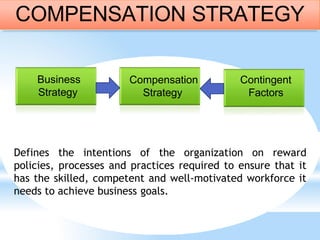
COMPENSATION STRATEGY
Business
Strategy
Compensation
Strategy
Contingent
Factors
Defines the intentions of the organization on reward
policies, processes and practices required to ensure that it
has the skilled, competent and well-motivated workforce it
needs to achieve business goals.
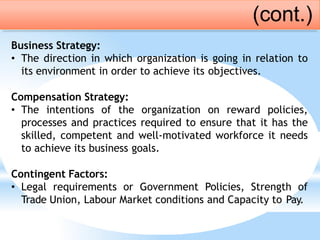
Business Strategy:
• The direction in which organization is going in relation to
its environment in order to achieve its objectives.
Compensation Strategy:
• The intentions of the organization on reward policies,
processes and practices required to ensure that it has the
skilled, competent and well-motivated workforce it needs
to achieve its business goals.
Contingent Factors:
• Legal requirements or Government Policies, Strength of
Trade Union, Labour Market conditions and Capacity to Pay.
(cont.)
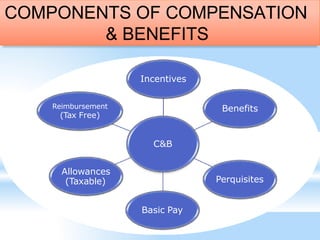
COMPONENTS OF COMPENSATION
& BENEFITS
C&B
Incentives
Benefits
Perquisites
Basic Pay
Allowances
(Taxable)
Reimbursement
(Tax Free)
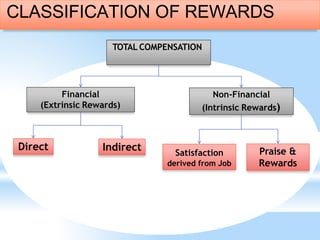
TOTAL COMPENSATION
Financial
(Extrinsic Rewards)
Non-Financial
(Intrinsic Rewards)
Direct Indirect Satisfaction
derived from Job
Praise &
Rewards
CLASSIFICATION OF REWARDS
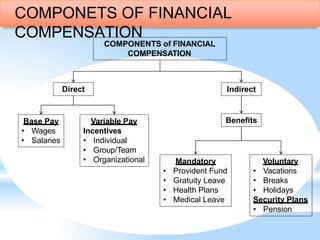
COMPONETS OF FINANCIAL
COMPENSATION
COMPONENTS of FINANCIAL
COMPENSATION
Direct Indirect
Base Pay
• Wages
• Salaries
Variable Pay
Incentives
• Individual
• Group/Team
• Organizational
Benefits
Mandatory
• Provident Fund
• Gratuity Leave
• Health Plans
• Medical Leave
Voluntary
• Vacations
• Breaks
• Holidays
Security Plans
• Pension
The direct financial compensation an individual receives based on the
time Worked.
 Bases of calculation:
• Hourly/wage: payment for the number of hours worked.
• Salaried: receive consistent payments at the end of specific period
regardless of number of hours worked Nature.
 Generally Market Driven:
(Demand > Supply = Increase in Pay)
 Job Evaluation:
• The formal systematic means used to identify the relative worth of
jobs within an organization.
BASE PAY
 Variable Pay/ Incentives
• Any plan that ties pay to productivity or profitability (i.e.) the
standard by which managers tie compensation to employee effort and
performance.
• It is linked to individual, group, or organizational performance and not
to time worked.
• Establish a performance “threshold” to qualify for incentive payments.
• Emphasize a shared focus on organizational objectives.
• Create shared commitment in that every individual contributes to
organizational performance and success.
VARIABLE
• Link the incentive with your strategy.
• Make sure effort and rewards are directly related.
• Make the plan easy for employees to understand.
• Get employees’ support for the plan.
• Use good measurement systems.
• Emphasize long-term as well as short-term success.
• Adopt a comprehensive, commitment-oriented approach.
IMPLEMENTING EFFECTIVE
INCENTIVE PLAN
 Are most effective as motivators when the award is
combined with a meaningful employee recognition program.
NON FINANCIAL
COMPENSATION
THANK YOU!!!

compensation benefits management

  • 1.
  • 2.
    • SALARY • WAGES •COMPENSATION WHAT IS THE MEANING OF
  • 3.
    • Regular moneyreceived by an employee from an employer on a weekly, biweekly or monthly basis. • It includes employee benefits such as health and life insurance, saving plans and Social Security. SALARY
  • 4.
    Payment for alabour or a worker, especially remuneration on an hourly, daily or weekly basis or by the piece rate. WAGES
  • 5.
    COMPENSATION The sum ofall forms provided to employees of payments or rewards for performing tasks to achieve organizational objectives. Compensation is the process of providing adequate, equitable and fair remuneration to the employees. It is a comprehensive term which includes pay, incentives and benefits offered to the employees. Compensation is a systematic approach to providing monetary value to employees in exchange for work performed.
  • 6.
    Supportive Corporate Culture ExecutiveSponsorship Salary • Pay •Overtime (if in non- exempt classification – Fair Labor Standards Act) Benefits • Health Plans • Retirement Plans • Vacation/ time off • Paid Training • Working Hours TOTAL COMPENSATION Employee Satisfaction Rewards • Bonus • Salary Increases • Promotions • Awards • Recognition • New job assignments
  • 7.
    COMPENSATION STRATEGY Business Strategy Compensation Strategy Contingent Factors Defines theintentions of the organization on reward policies, processes and practices required to ensure that it has the skilled, competent and well-motivated workforce it needs to achieve business goals.
  • 8.
    Business Strategy: • Thedirection in which organization is going in relation to its environment in order to achieve its objectives. Compensation Strategy: • The intentions of the organization on reward policies, processes and practices required to ensure that it has the skilled, competent and well-motivated workforce it needs to achieve its business goals. Contingent Factors: • Legal requirements or Government Policies, Strength of Trade Union, Labour Market conditions and Capacity to Pay. (cont.)
  • 9.
    COMPONENTS OF COMPENSATION &BENEFITS C&B Incentives Benefits Perquisites Basic Pay Allowances (Taxable) Reimbursement (Tax Free)
  • 10.
    TOTAL COMPENSATION Financial (Extrinsic Rewards) Non-Financial (IntrinsicRewards) Direct Indirect Satisfaction derived from Job Praise & Rewards CLASSIFICATION OF REWARDS
  • 11.
    COMPONETS OF FINANCIAL COMPENSATION COMPONENTSof FINANCIAL COMPENSATION Direct Indirect Base Pay • Wages • Salaries Variable Pay Incentives • Individual • Group/Team • Organizational Benefits Mandatory • Provident Fund • Gratuity Leave • Health Plans • Medical Leave Voluntary • Vacations • Breaks • Holidays Security Plans • Pension
  • 12.
    The direct financialcompensation an individual receives based on the time Worked.  Bases of calculation: • Hourly/wage: payment for the number of hours worked. • Salaried: receive consistent payments at the end of specific period regardless of number of hours worked Nature.  Generally Market Driven: (Demand > Supply = Increase in Pay)  Job Evaluation: • The formal systematic means used to identify the relative worth of jobs within an organization. BASE PAY
  • 13.
     Variable Pay/Incentives • Any plan that ties pay to productivity or profitability (i.e.) the standard by which managers tie compensation to employee effort and performance. • It is linked to individual, group, or organizational performance and not to time worked. • Establish a performance “threshold” to qualify for incentive payments. • Emphasize a shared focus on organizational objectives. • Create shared commitment in that every individual contributes to organizational performance and success. VARIABLE
  • 14.
    • Link theincentive with your strategy. • Make sure effort and rewards are directly related. • Make the plan easy for employees to understand. • Get employees’ support for the plan. • Use good measurement systems. • Emphasize long-term as well as short-term success. • Adopt a comprehensive, commitment-oriented approach. IMPLEMENTING EFFECTIVE INCENTIVE PLAN
  • 15.
     Are mosteffective as motivators when the award is combined with a meaningful employee recognition program. NON FINANCIAL COMPENSATION
  • 16.