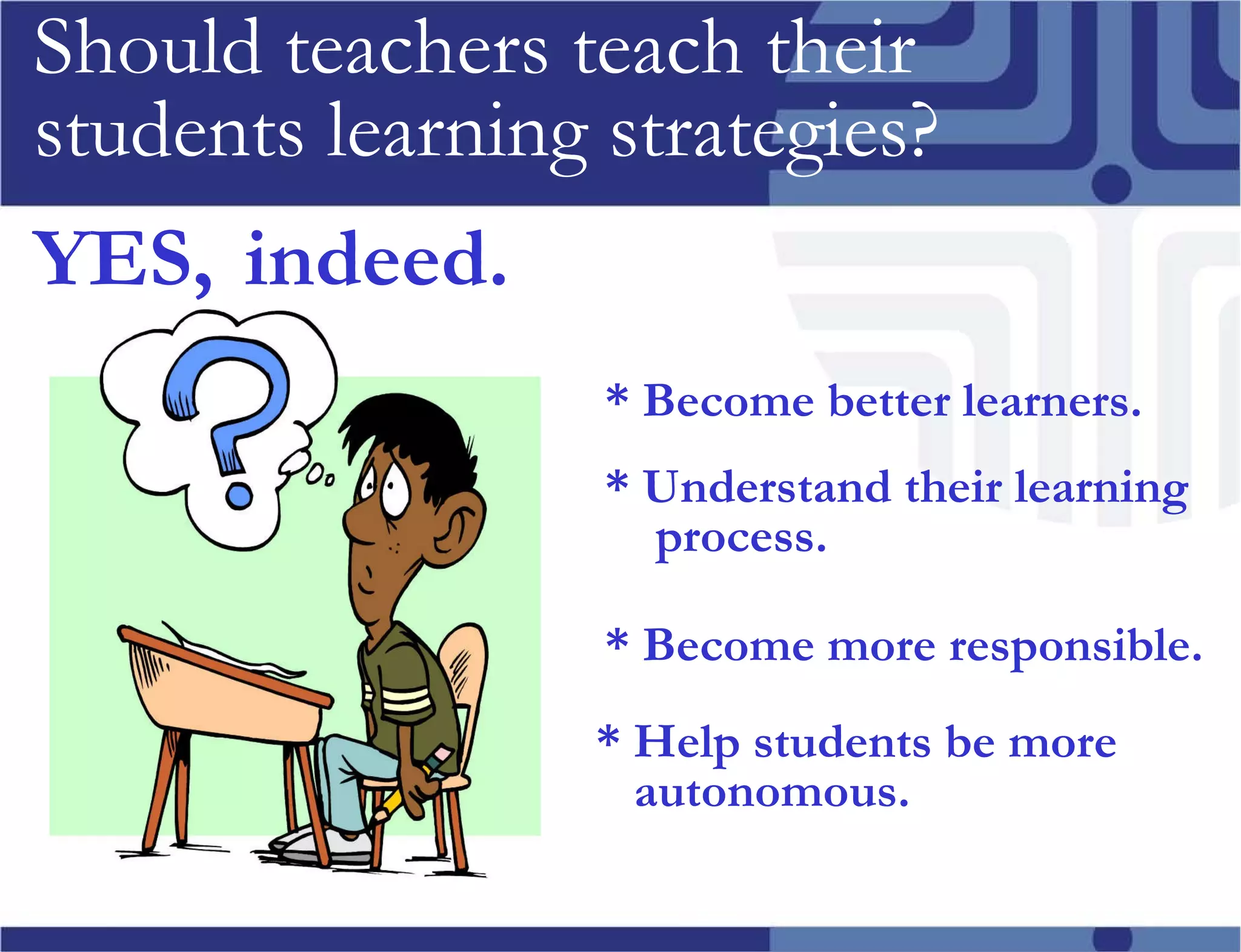
Should teachers teach their students learning strategies? YES, * Become better learners. * Understand their learning  process. * Become more responsible. indeed. * Help students be more autonomous.
The beauty of metacognitive awareness * Self-learning leads to reflection * If a student knows “how to learn”  he/she will be a more successful language learner.
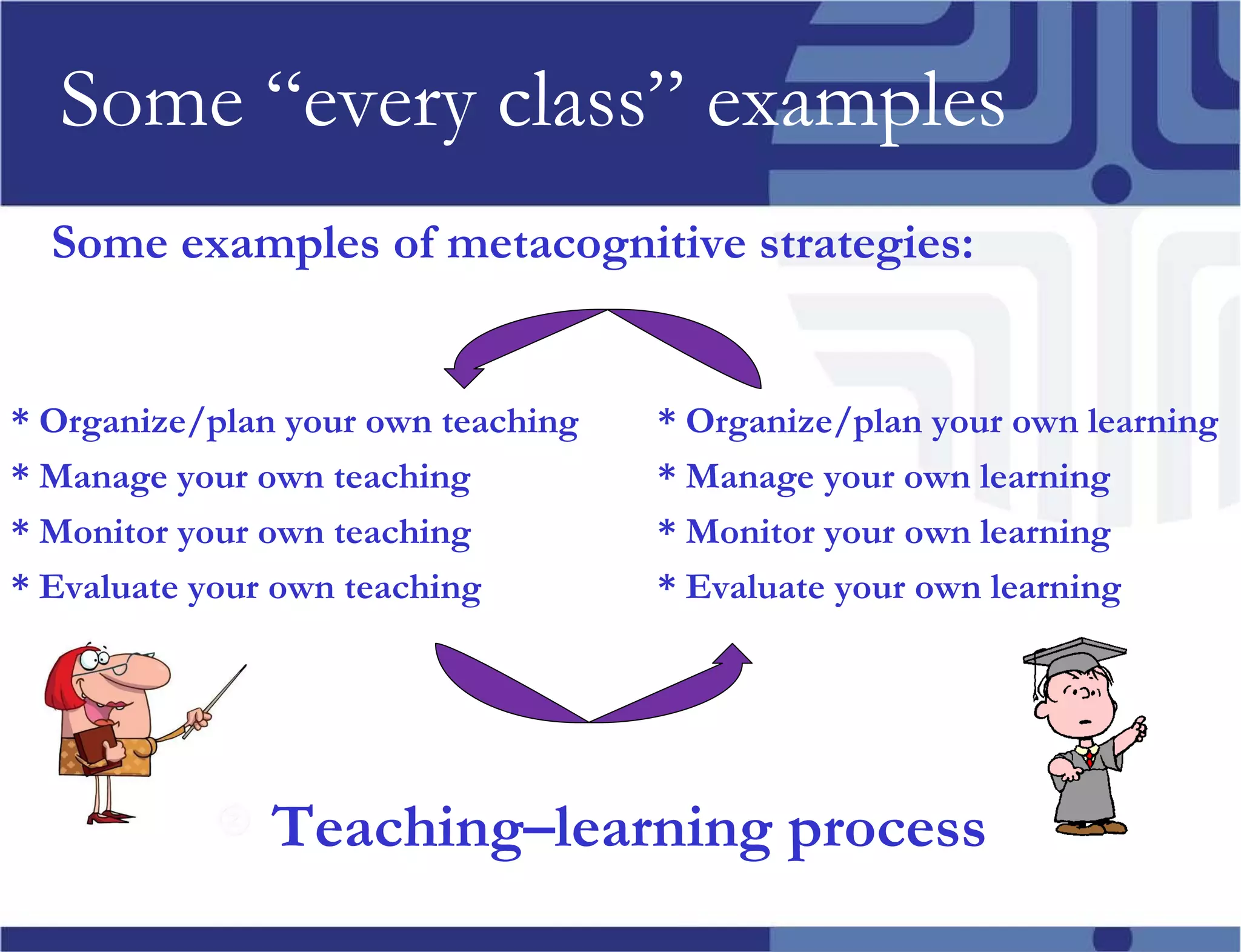
Some “every class” examples Some examples of metacognitive strategies: * Organize/plan your own teaching * Manage your own teaching * Monitor your own teaching * Evaluate your own teaching * Organize/plan your own learning * Manage your own learning * Monitor your own learning * Evaluate your own learning Teaching–learning process
Are we putting our money where our  mouth is?
 
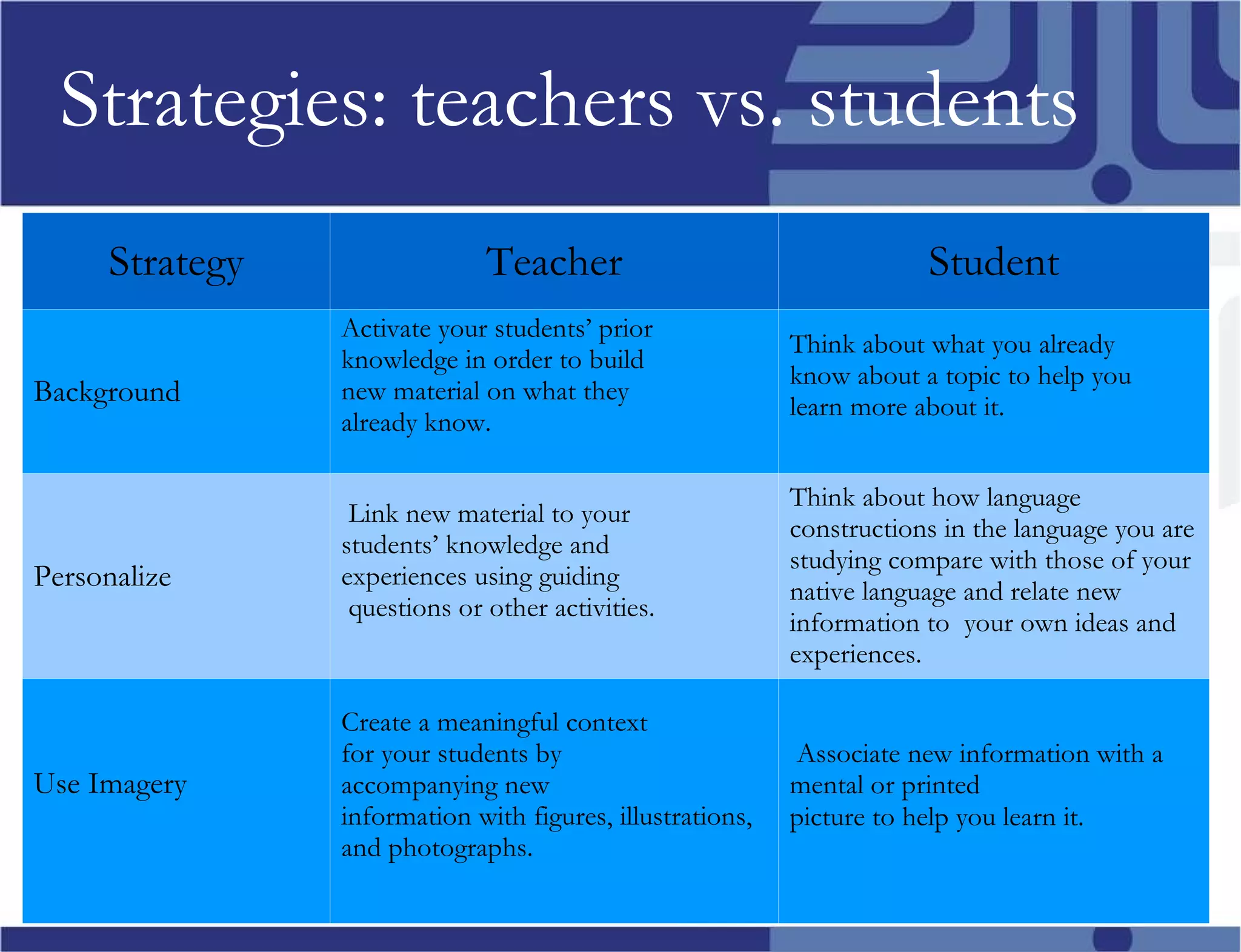
Strategies: teachers vs. students  Strategy Teacher Student Background Activate your students’ prior knowledge in order to build new material on what they already know. Think about what you already know about a topic to help you learn more about it. Personalize Link new material to your students’ knowledge and experiences using guiding questions or other activities. Think about how language constructions in the language you are studying compare with those of your native language and relate new information to  your own ideas and experiences. Use Imagery Create a meaningful context for your students by accompanying new information with figures, illustrations, and photographs. Associate new information with a mental or printed picture to help you learn it.
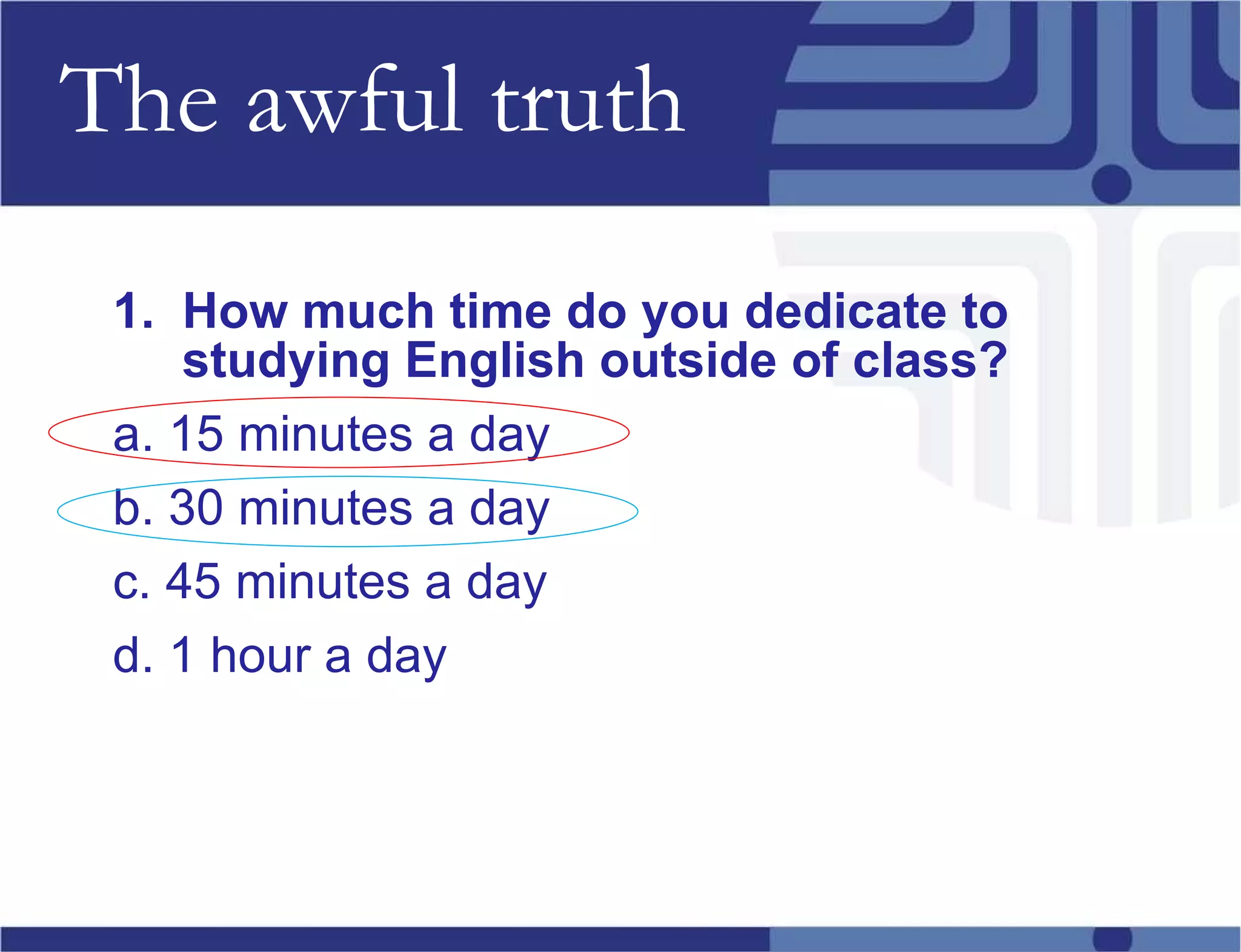
The awful truth 1.  How much time do you dedicate to studying English outside of class? a. 15 minutes a day b. 30 minutes a day c. 45 minutes a day d. 1 hour a day
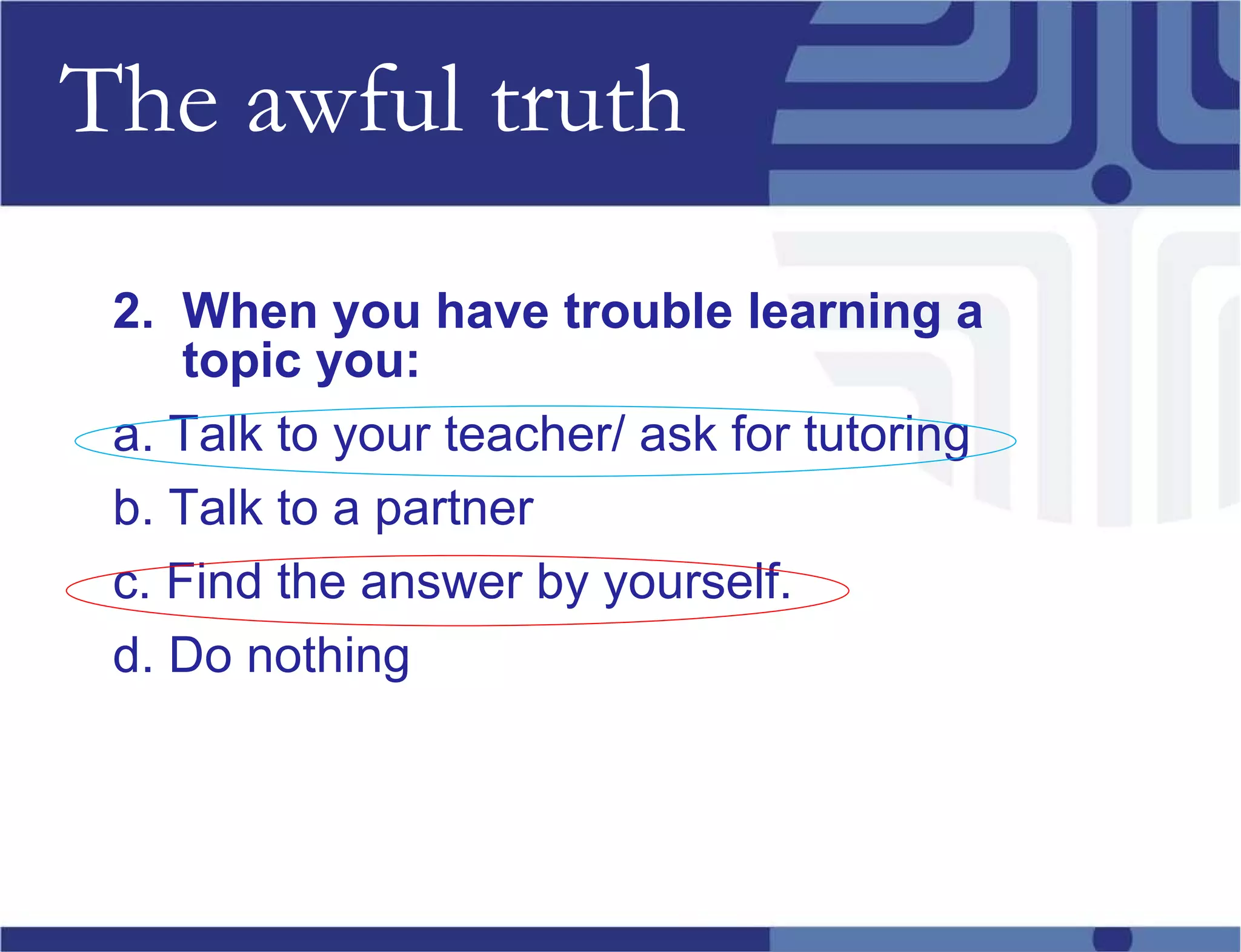
The awful truth 2.  When you have trouble learning a topic you:   a. Talk to your teacher/ ask for tutoring b. Talk to a partner c. Find the answer by yourself.  d. Do nothing
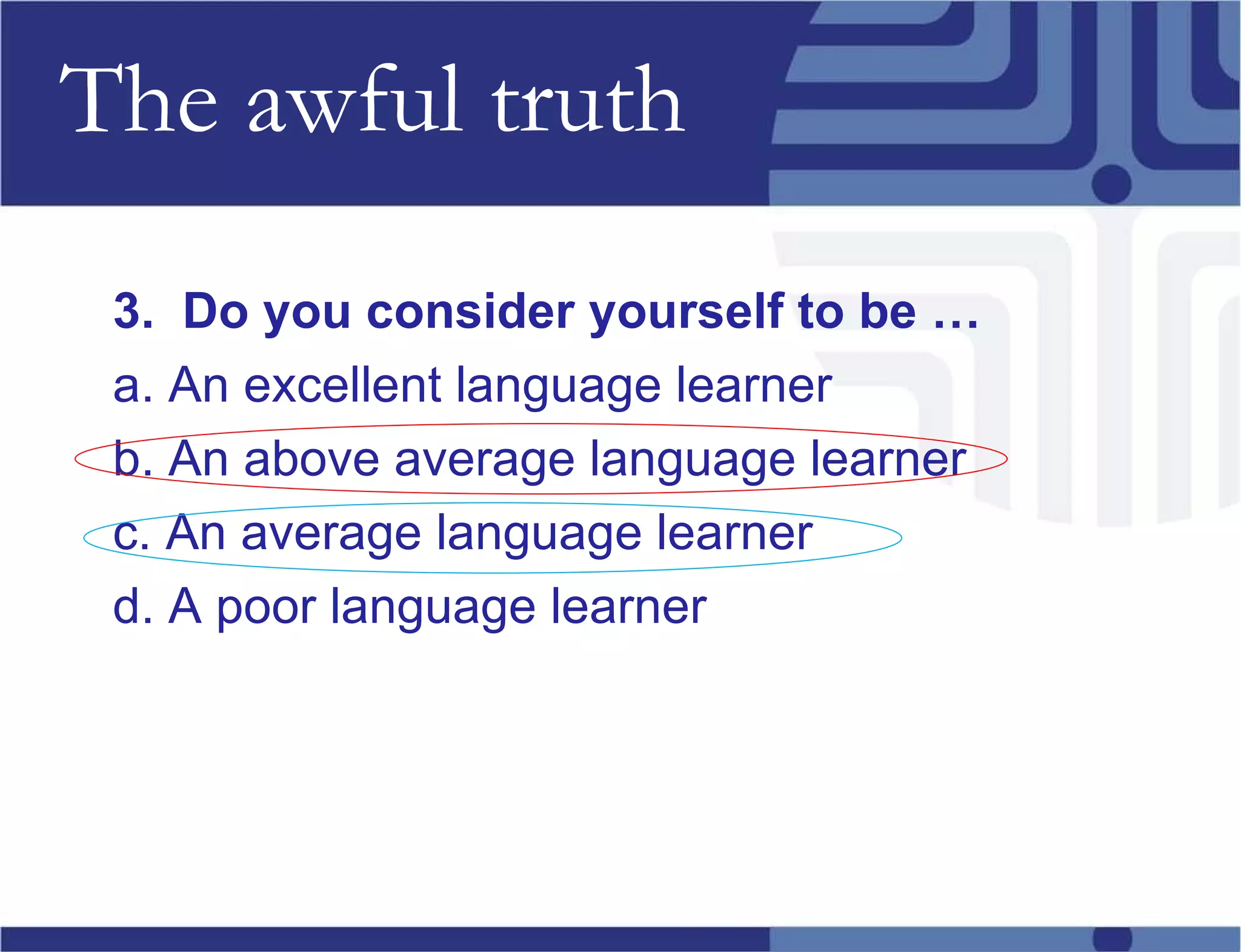
The awful truth 3.  Do you consider yourself to be … a. An excellent language learner b. An above average language learner c. An average language learner d. A poor language learner
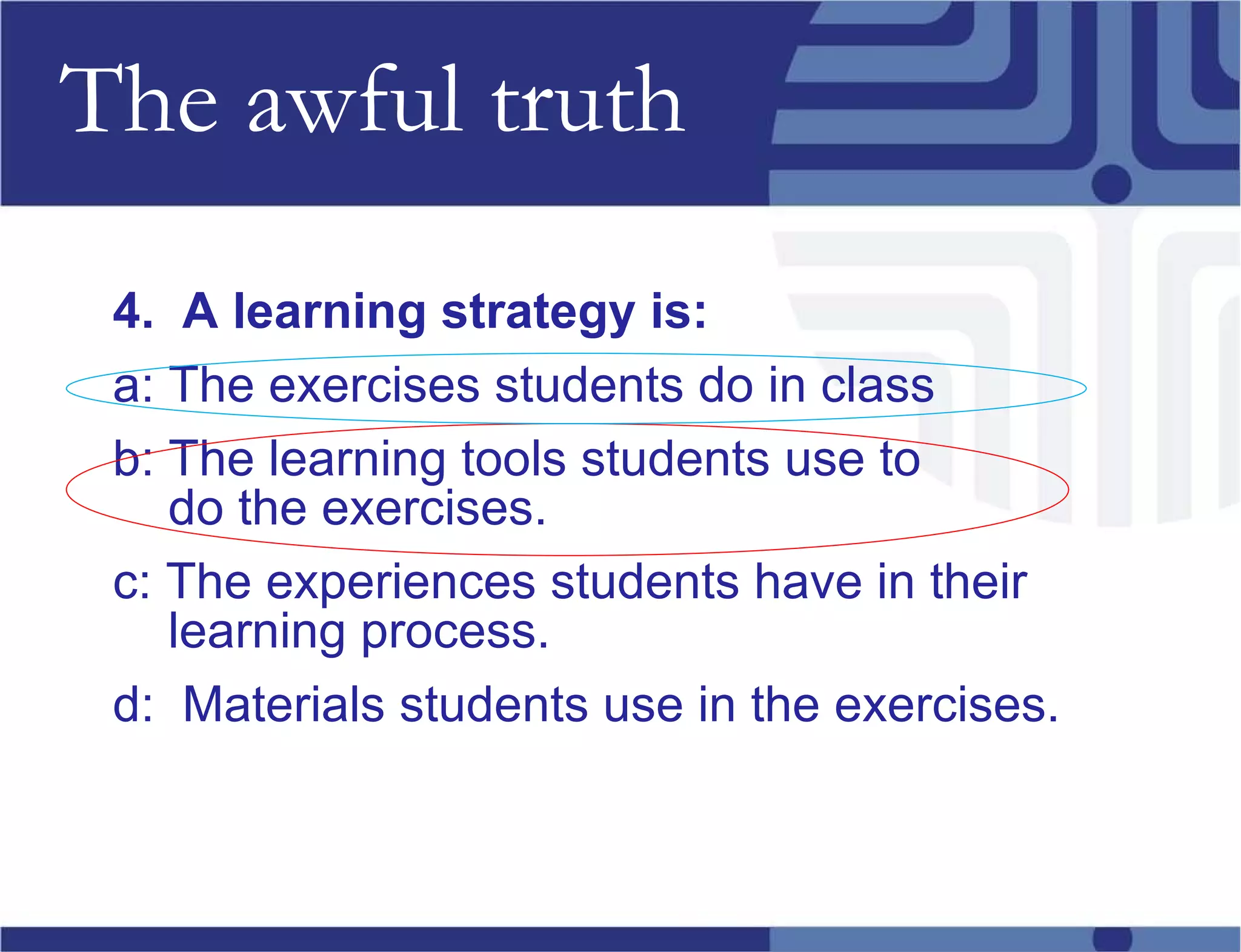
The awful truth 4.  A learning strategy is: a: The exercises students do in class b: The learning tools students use to  do the exercises. c: The experiences students have in their learning process. d:  Materials students use in the exercises.
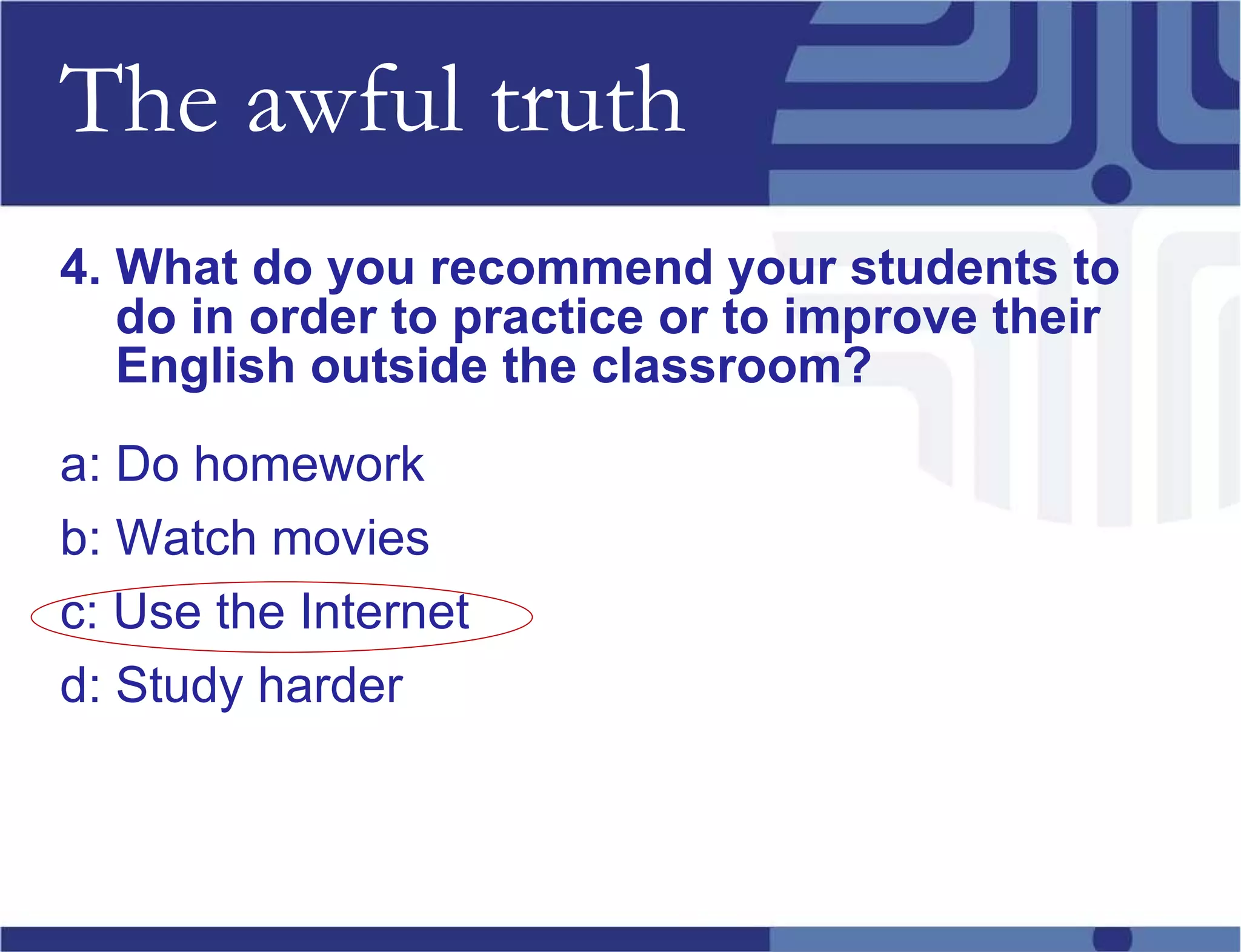
The awful truth 4. What do you recommend your students to do in order to practice or to improve their English outside the classroom? a: Do homework b: Watch movies c: Use the Internet d: Study harder
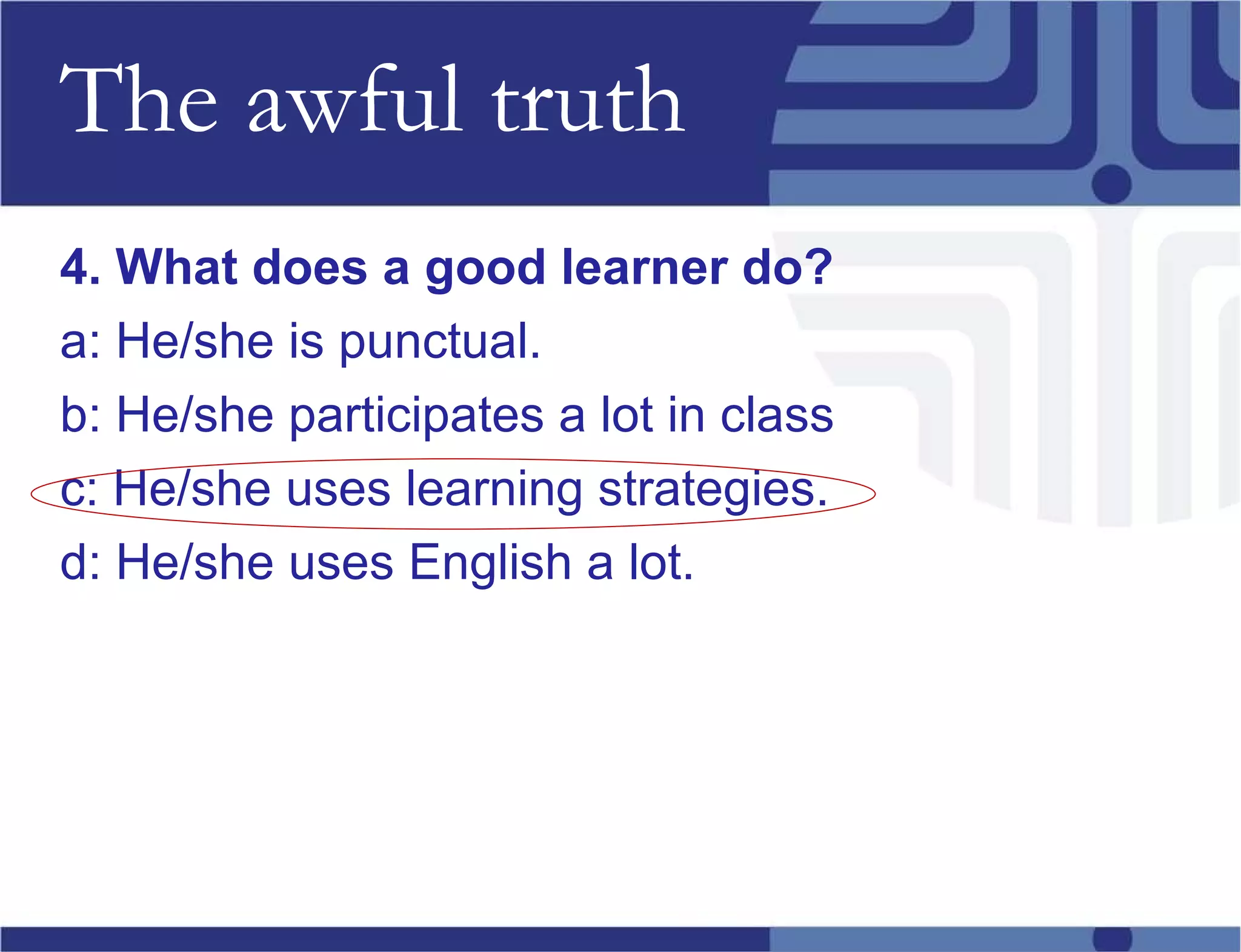
The awful truth 4. What does a good learner do? a: He/she is punctual. b: He/she participates a lot in class c: He/she uses learning strategies. d: He/she uses English a lot.
Our challenges Basic and Beginner students don’t have a clear idea of what learning styles and  learning strategies are.
Our challenges Teachers are not suggesting  learning tools or tutoring sessions to help students out with their learning process.
Our challenges Basic and beginner students think they have a low level in oral production.
Our challenges High level students say that when they have learning difficulties, they find the solution on their own.
Our challenges Teachers suggest students do a variety of activities to do outside the classroom. However, they don’t explain to students how to carry out such tasks.
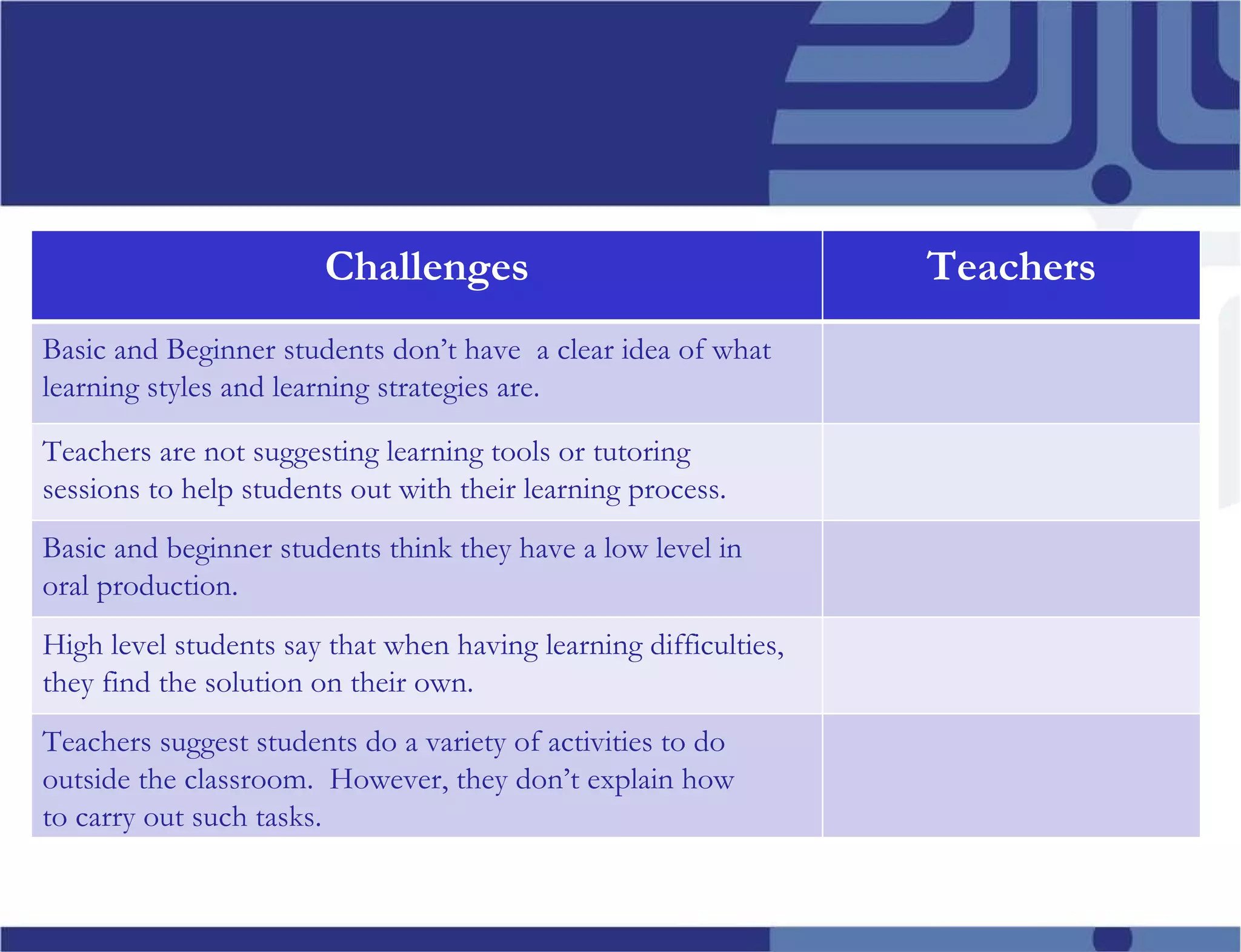
Challenges Teachers Basic and Beginner students don’t have  a clear idea of what  learning styles and learning strategies are. Teachers are not suggesting learning tools or tutoring  sessions to help students out with their learning process. Basic and beginner students think they have a low level in  oral production. High level students say that when having learning difficulties, they find the solution on their own.  Teachers suggest students do a variety of activities to do outside the classroom.  However, they don’t explain how to carry out such tasks.
 

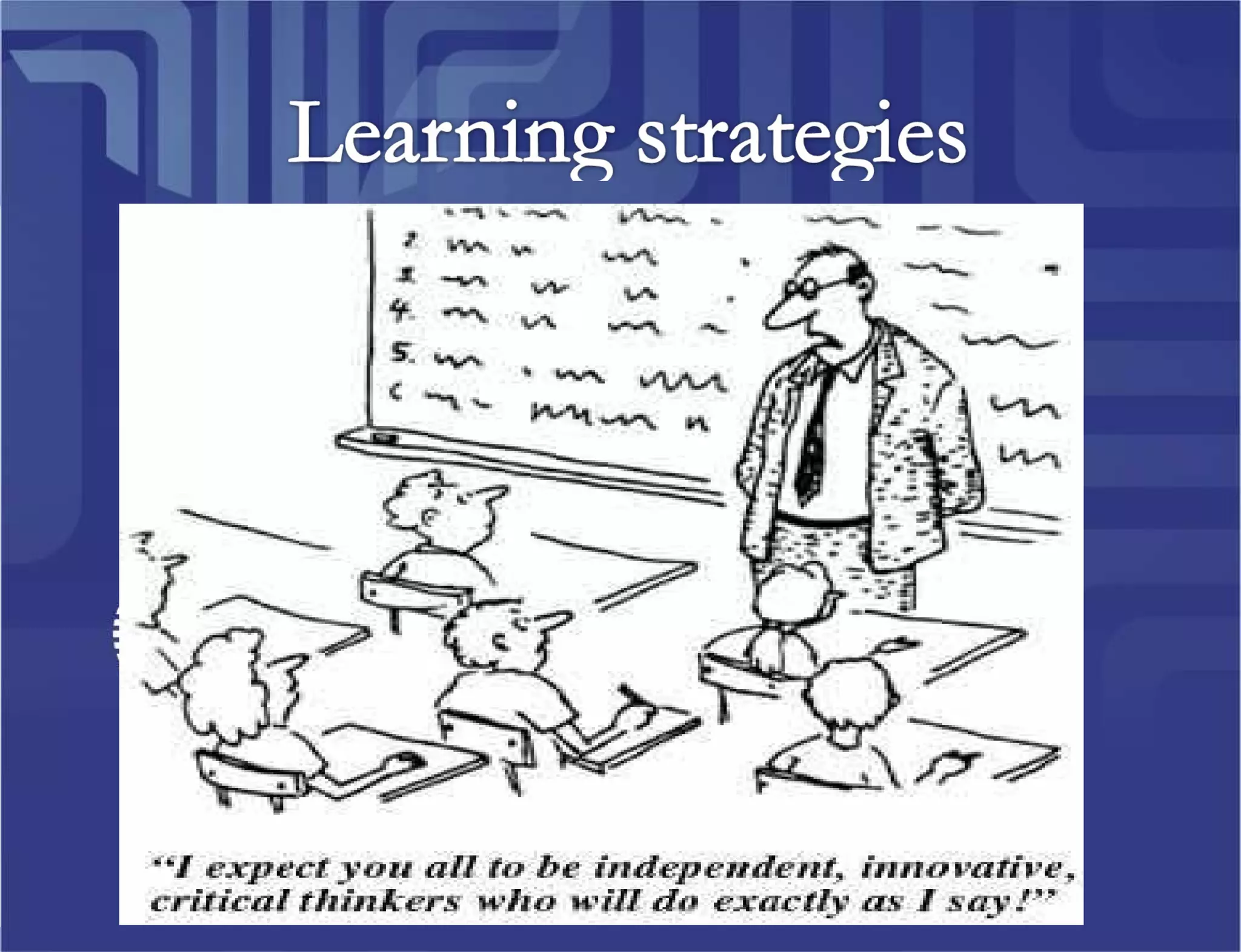
Learning strategies

  • 1.
  • 2.
    Should teachers teachtheir students learning strategies? YES, * Become better learners. * Understand their learning process. * Become more responsible. indeed. * Help students be more autonomous.
  • 3.
    The beauty ofmetacognitive awareness * Self-learning leads to reflection * If a student knows “how to learn” he/she will be a more successful language learner.
  • 4.
    Some “every class”examples Some examples of metacognitive strategies: * Organize/plan your own teaching * Manage your own teaching * Monitor your own teaching * Evaluate your own teaching * Organize/plan your own learning * Manage your own learning * Monitor your own learning * Evaluate your own learning Teaching–learning process
  • 5.
    Are we puttingour money where our mouth is?
  • 6.
  • 7.
    Strategies: teachers vs.students Strategy Teacher Student Background Activate your students’ prior knowledge in order to build new material on what they already know. Think about what you already know about a topic to help you learn more about it. Personalize Link new material to your students’ knowledge and experiences using guiding questions or other activities. Think about how language constructions in the language you are studying compare with those of your native language and relate new information to your own ideas and experiences. Use Imagery Create a meaningful context for your students by accompanying new information with figures, illustrations, and photographs. Associate new information with a mental or printed picture to help you learn it.
  • 8.
    The awful truth1. How much time do you dedicate to studying English outside of class? a. 15 minutes a day b. 30 minutes a day c. 45 minutes a day d. 1 hour a day
  • 9.
    The awful truth2. When you have trouble learning a topic you:   a. Talk to your teacher/ ask for tutoring b. Talk to a partner c. Find the answer by yourself. d. Do nothing
  • 10.
    The awful truth3. Do you consider yourself to be … a. An excellent language learner b. An above average language learner c. An average language learner d. A poor language learner
  • 11.
    The awful truth4. A learning strategy is: a: The exercises students do in class b: The learning tools students use to do the exercises. c: The experiences students have in their learning process. d: Materials students use in the exercises.
  • 12.
    The awful truth4. What do you recommend your students to do in order to practice or to improve their English outside the classroom? a: Do homework b: Watch movies c: Use the Internet d: Study harder
  • 13.
    The awful truth4. What does a good learner do? a: He/she is punctual. b: He/she participates a lot in class c: He/she uses learning strategies. d: He/she uses English a lot.
  • 14.
    Our challenges Basicand Beginner students don’t have a clear idea of what learning styles and learning strategies are.
  • 15.
    Our challenges Teachersare not suggesting learning tools or tutoring sessions to help students out with their learning process.
  • 16.
    Our challenges Basicand beginner students think they have a low level in oral production.
  • 17.
    Our challenges Highlevel students say that when they have learning difficulties, they find the solution on their own.
  • 18.
    Our challenges Teacherssuggest students do a variety of activities to do outside the classroom. However, they don’t explain to students how to carry out such tasks.
  • 19.
    Challenges Teachers Basicand Beginner students don’t have a clear idea of what learning styles and learning strategies are. Teachers are not suggesting learning tools or tutoring sessions to help students out with their learning process. Basic and beginner students think they have a low level in oral production. High level students say that when having learning difficulties, they find the solution on their own. Teachers suggest students do a variety of activities to do outside the classroom. However, they don’t explain how to carry out such tasks.
  • 20.