















www.slideshare.net/ashraf eladawy
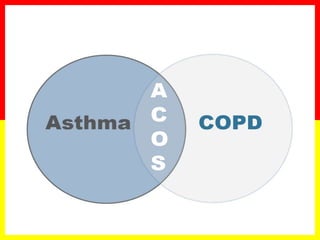
 Asthma and chronic obstructive pulmonary disease
(COPD) have traditionally been viewed as distinct
clinical entities.
 Recently, however, much attention has been focused
on patients with overlapping features of both asthma
and COPD : those with asthma COPD overlap
syndrome (ACOS).
6
Background
 Separating asthma from COPD in clinical practice is
difficult due to the overlapping features common to
both diseases.
 The pitfall is to presume that both conditions can not
possisbly exist in the same patient.
7
Background
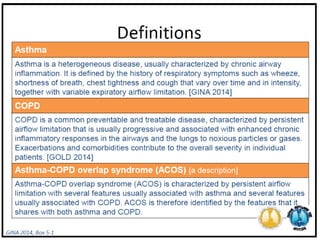
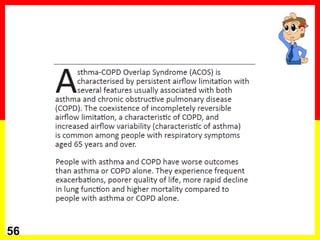
 The Asthma COPD overlap syndrome (ACOS) is a
newly recognized diagnosis, one that has long been
neglected in part because clinical trials for decades
have consistently excluded patients with overlapping
asthma and COPD, using strict inclusion & exclusion
criteria.
 These criteria routinely excluded asthma patients from
COPD studies, and COPD patients from asthma
studies .
8
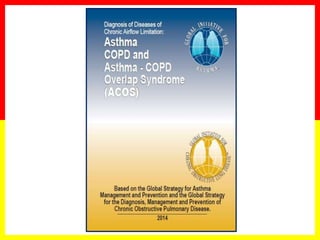
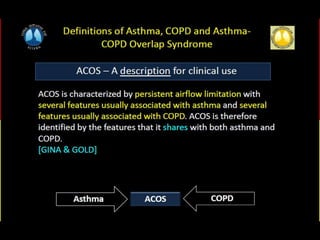
 A consensus ACOS description for clinical use has
recently been published by both the Global Initiative
for Asthma (GINA) and the Global Initiative for
Chronic Obstructive Lung Disease (GOLD) in 2014
 This syndrome represents an important population
with worse outcomes than asthma or COPD alone.
9
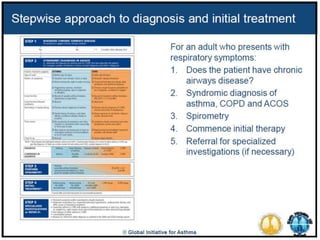
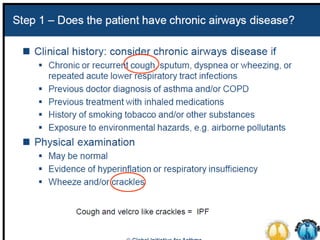
 This document provides a stepwise approach for
patients with respiratory symptoms suggestive of
chronic disease.
 It uses clinical, spirometric, and radiographic features
to help delineate if an adult patient is most likely
suffering from asthma or COPD or fulfills enough
shared features to be considered within ACOS.
10
© Global Initiative for Asthma
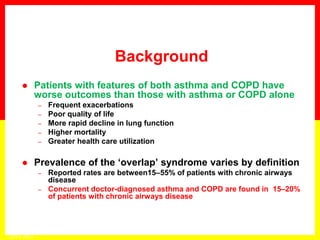
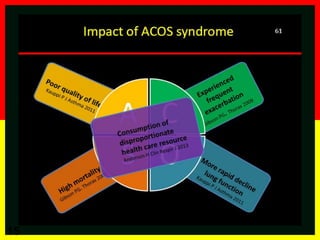
 Patients with features of both asthma and COPD have
worse outcomes than those with asthma or COPD alone
– Frequent exacerbations
– Poor quality of life
– More rapid decline in lung function
– Higher mortality
– Greater health care utilization
 Prevalence of the ‘overlap’ syndrome varies by definition
– Reported rates are between15–55% of patients with chronic airways
disease
– Concurrent doctor-diagnosed asthma and COPD are found in 15–20%
of patients with chronic airways disease
Background
GINA 2014
15
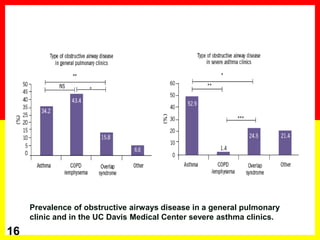
16
Prevalence of obstructive airways disease in a general pulmonary
clinic and in the UC Davis Medical Center severe asthma clinics.
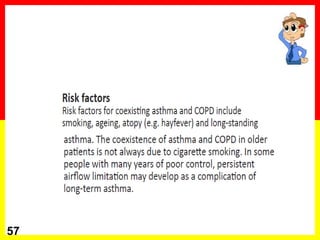
 Patients with ACOS have the combined risk factors of
smoking and atopy, and are generally younger than
patients with COPD.
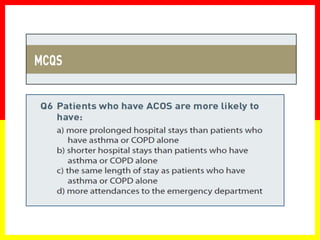
 ACOS patients have acute exacerbations with higher
frequency and greater severity than COPD, manifest
more air-trapping, and require more healthcare
visits,despite a lower burden of cigarette smoking.
17
Reversibility of Airway Obstruction
 One of the defining characteristics of asthma is
reversible airway obstruction with bronchodilators;
however, the degree of reversibility can diminish as the
disease progresses.
 Studies indicated up to 44% and 50% airway obstruction
reversibility in COPD although COPD is traditionally
characterized by irreversible airway obstruction.
 In COPD reversibility does not decrease the risk for
exacerbation, hospitalization, or death.
18
Atopy in Asthma and COPD
 Atopy is an allergic syndrome characterized by
eczema, allergic rhinitis, and/or allergic asthma.
 Atopy is a risk factor for both asthma and COPD.
 The European Respiratory Society Study on Chronic
Obstructive Pulmonary Disease (EUROSCOPE) showed
that up to 18% of patients with COPD had atopy and that
atopic patients suffered more from cough and phlegm.
19
Bronchial Hyperresponsiveness
 Bronchial hyperresponsiveness is associated with
asthma, but is not a good diagnostic tool because it can
occur in response to both specific and nonspecific
stimulants (i.e., specific allergens or cold, dry air).
 Reports indicate there is a 60% prevalence of bronchial
hyperresponsiveness in COPD.
 Studies show that patients with COPD and bronchial
hyperresponsiveness have accelerated declines in FEV1.
 In asthma and COPD, the presence of bronchial
hyperresponsiveness indicates more severe disease.
20
21
24
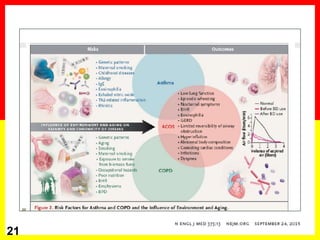
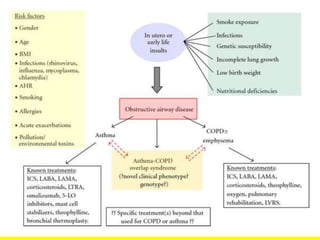
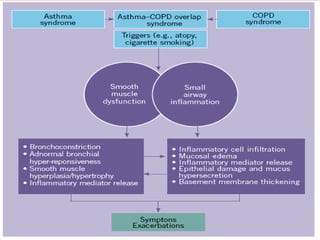
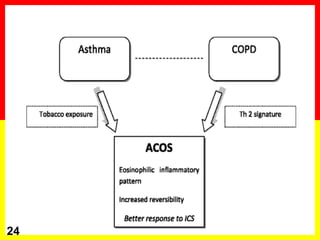
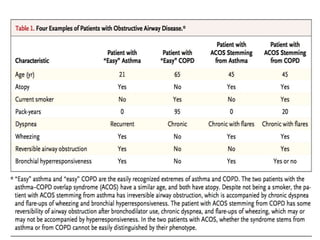
Clinical expression of the asthma-COPD
overlap syndrome (ACOS).
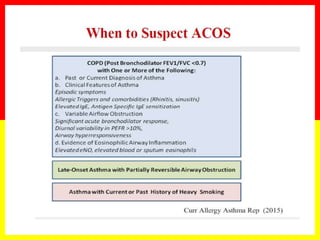
 The ACOS usually corresponds to a smoker asthmatic
patient that develops non fully reversible airway
obstruction and/or
 a COPD individual (with or without a known history of
asthma) with a Th2 signature (increased blood and lung
eosinophilia, increased airway hyper-responsiveness,
and better response to ICS).
25
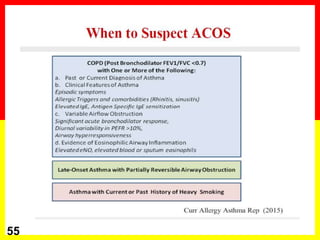
 ACOS has been defined as symptoms of increased
variability of airflow in association with incompletely
reversible airflow obstruction .
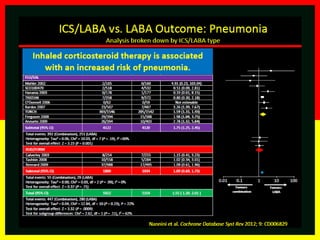
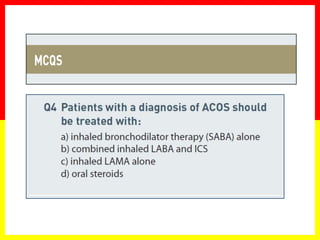
 Identifying patients with ACOS has significant therapeutic
implications particularly with the need for early use of ICS
and the avoidance of use of long-acting bronchodilators
alone in such patients.
26
 The interest in recognizing these individuals lies in
their better response to inhaled corticosteroids (ICS)
compared to those with COPD.
 This specific and differential treatment justifies the
efforts to differentiate the subgroup of patients with
ACOS from the large population of COPD patients.
 However, unlike asthma and COPD, no evidence-
based guidelines for the management of ACOS
currently exist.
27
Commentary
28
33
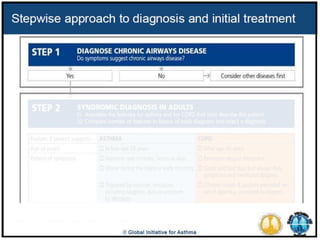
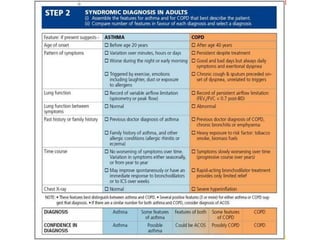
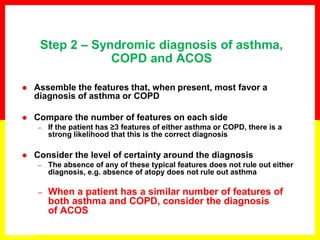
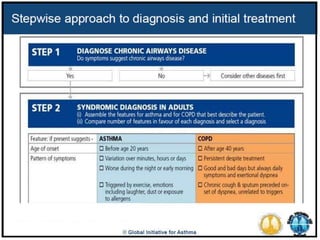
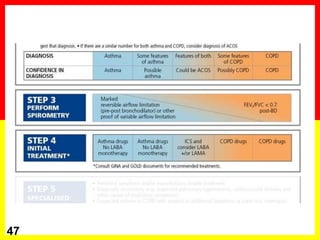
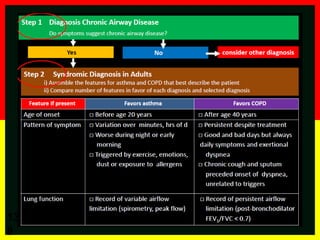
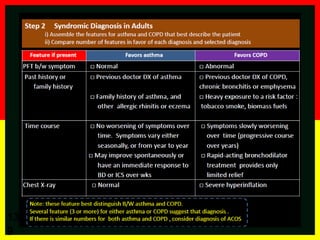
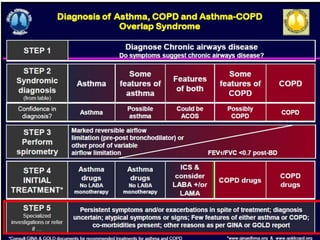
 Assemble the features that, when present, most favor a
diagnosis of asthma or COPD
 Compare the number of features on each side
– If the patient has ≥3 features of either asthma or COPD, there is a
strong likelihood that this is the correct diagnosis
 Consider the level of certainty around the diagnosis
– The absence of any of these typical features does not rule out either
diagnosis, e.g. absence of atopy does not rule out asthma
– When a patient has a similar number of features of
both asthma and COPD, consider the diagnosis
of ACOS
Step 2 – Syndromic diagnosis of asthma,
COPD and ACOS
GINA 2014
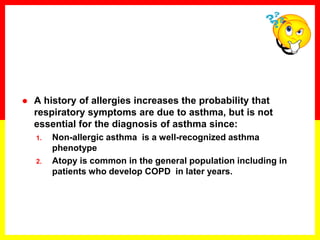
 A history of allergies increases the probability that
respiratory symptoms are due to asthma, but is not
essential for the diagnosis of asthma since:
1. Non-allergic asthma is a well-recognized asthma
phenotype
2. Atopy is common in the general population including in
patients who develop COPD in later years.
© Global Initiative for AsthmaGINA 2014
© Global Initiative for Asthma
40
42
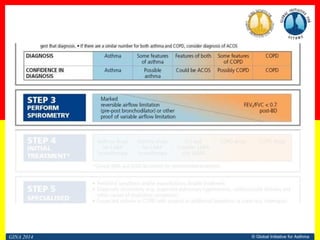
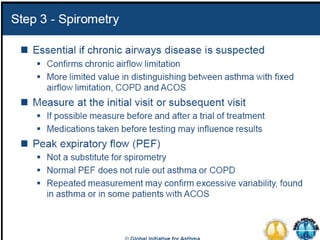
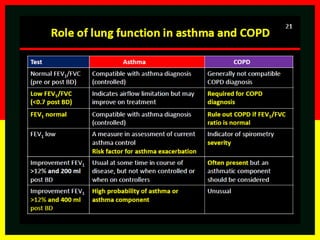
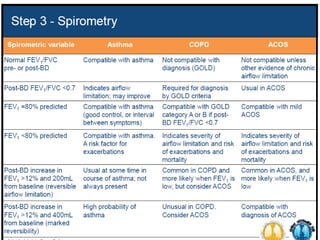
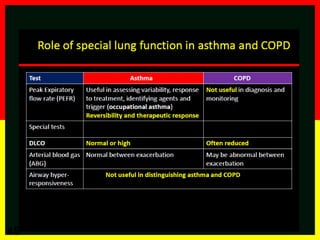
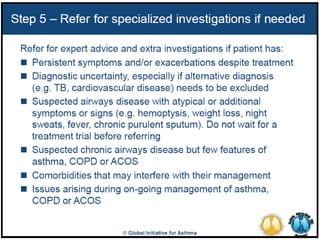
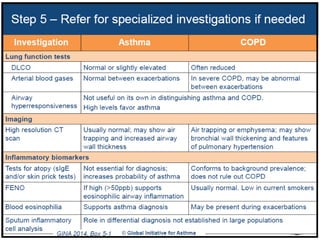
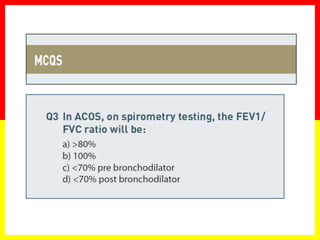
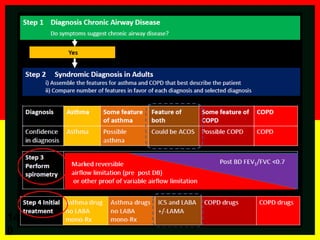
 Spirometry at a single visit is not always confirmatory
of a diagnosis, and results must be considered in the
context of the clinical presentation, and whether
treatment has been commenced.
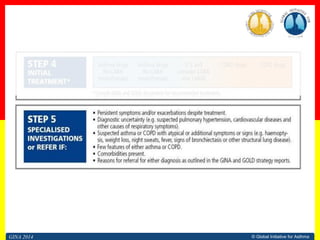
 Further tests might therefore be necessary either to
confirm the diagnosis or to assess the response to
initial and subsequent treatment.
44
45
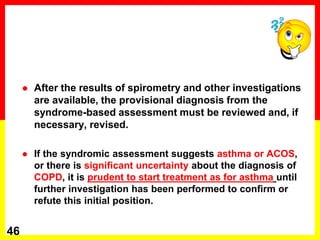
 After the results of spirometry and other investigations
are available, the provisional diagnosis from the
syndrome-based assessment must be reviewed and, if
necessary, revised.
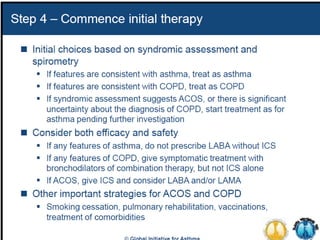
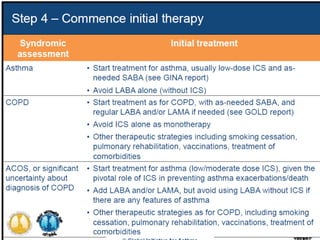
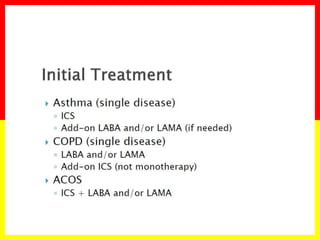
 If the syndromic assessment suggests asthma or ACOS,
or there is significant uncertainty about the diagnosis of
COPD, it is prudent to start treatment as for asthma until
further investigation has been performed to confirm or
refute this initial position.
46
47
© Global Initiative for Asthma
© Global Initiative for AsthmaGINA 2014
© Global Initiative for Asthma
53
54
55
56
57
58
59
60
© Global Initiative for Asthma
GINA 2014
64
Potential for
tiotropium
Step 5Step 4Step 3Step 2Step 1
Asthma education, environmental control
As-needed rapid-
acting β2-agonists
As needed rapid-acting β2-agonist
Controller options***
Select one Select one
To Step 3 treatment,
select one or more
To Step 4 treatment,
add either
Low-dose ICS*
Low-dose ICS plus
LABA
Medium- or high-dose
ICS plus LABA
Oral
glucocorticosteroid
(lowest dose)
Leukotriene modifier**
Medium- or high-
dose ICS
Low-dose ICS plus
leukotriene modifier
Leukotriene modifier
Sustained-release
theophylline
Anti-IgE treatment
Low-dose ICS plus
sustained release
theophylline
GINA 2013
68
69
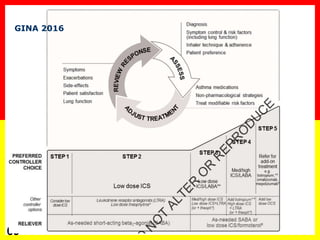
GINA 2016
70
71
© Global Initiative for Asthma
74
75
GOLD 2016
76
77
© Global Initiative for Asthma
79
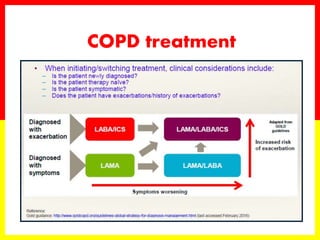
COPD treatment
84
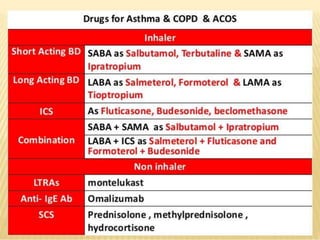
Drugs for
Asthma& COPD& ACOS
87
88
89
90
91
92
93
94
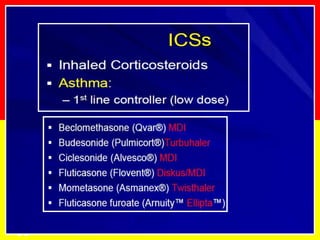
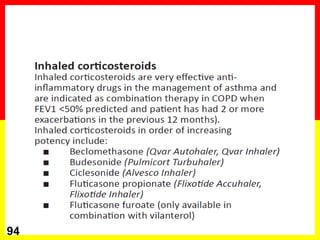
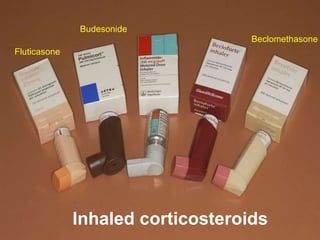
Beclomethasone
Budesonide
Fluticasone
Inhaled corticosteroids
96
97
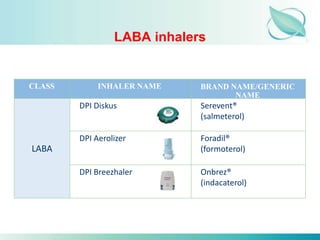
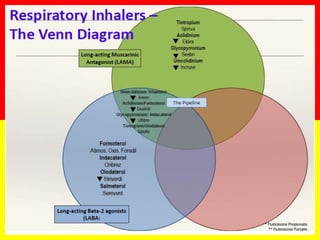
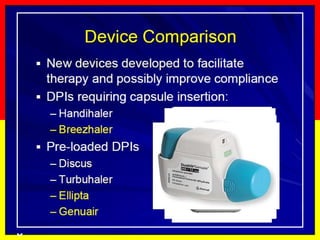
LABA inhalers
LABA
DPI Diskus Serevent®
(salmeterol)
DPI Aerolizer Foradil®
(formoterol)
DPI Breezhaler Onbrez®
(indacaterol)
CLASS INHALER NAME BRAND NAME/GENERIC
NAME
99
10
0
10
1
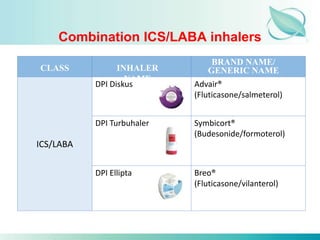
Combination ICS/LABA inhalers
ICS/LABA
DPI Diskus Advair®
(Fluticasone/salmeterol)
DPI Turbuhaler Symbicort®
(Budesonide/formoterol)
DPI Ellipta Breo®
(Fluticasone/vilanterol)
CLASS INHALER
NAME
BRAND NAME/
GENERIC NAME
10
4
10
5
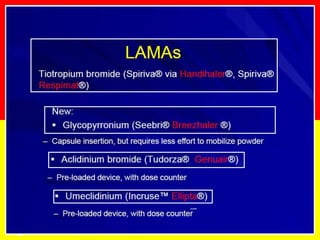
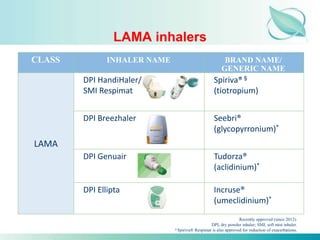
LAMA inhalers
LAMA
DPI HandiHaler/
SMI Respimat
Spiriva®§
(tiotropium)
DPI Breezhaler Seebri®
(glycopyrronium)*
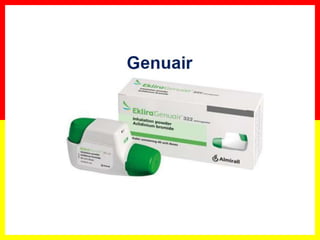
DPI Genuair Tudorza®
(aclidinium)*
DPI Ellipta Incruse®
(umeclidinium)*
CLASS INHALER NAME BRAND NAME/
GENERIC NAME
Recently approved (since 2012).
DPI, dry powder inhaler; SMI, soft mist inhaler.
§ Spiriva® Respimat is also approved for reduction of exacerbations.
10
7
10
8
10
9
11
3
11
8
12
0
12
1
12
2
13
5
13
8
13
9
14
0
© Global Initiative for Asthma
14
2
14
3

Asthma-COPD Overlap Syndrome (ACOS)

  • 2.
  • 5.
     Asthma andchronic obstructive pulmonary disease (COPD) have traditionally been viewed as distinct clinical entities.  Recently, however, much attention has been focused on patients with overlapping features of both asthma and COPD : those with asthma COPD overlap syndrome (ACOS). 6 Background
  • 6.
     Separating asthmafrom COPD in clinical practice is difficult due to the overlapping features common to both diseases.  The pitfall is to presume that both conditions can not possisbly exist in the same patient. 7 Background
  • 7.
     The AsthmaCOPD overlap syndrome (ACOS) is a newly recognized diagnosis, one that has long been neglected in part because clinical trials for decades have consistently excluded patients with overlapping asthma and COPD, using strict inclusion & exclusion criteria.  These criteria routinely excluded asthma patients from COPD studies, and COPD patients from asthma studies . 8
  • 8.
     A consensusACOS description for clinical use has recently been published by both the Global Initiative for Asthma (GINA) and the Global Initiative for Chronic Obstructive Lung Disease (GOLD) in 2014  This syndrome represents an important population with worse outcomes than asthma or COPD alone. 9
  • 9.
     This documentprovides a stepwise approach for patients with respiratory symptoms suggestive of chronic disease.  It uses clinical, spirometric, and radiographic features to help delineate if an adult patient is most likely suffering from asthma or COPD or fulfills enough shared features to be considered within ACOS. 10
  • 12.
  • 13.
     Patients withfeatures of both asthma and COPD have worse outcomes than those with asthma or COPD alone – Frequent exacerbations – Poor quality of life – More rapid decline in lung function – Higher mortality – Greater health care utilization  Prevalence of the ‘overlap’ syndrome varies by definition – Reported rates are between15–55% of patients with chronic airways disease – Concurrent doctor-diagnosed asthma and COPD are found in 15–20% of patients with chronic airways disease Background GINA 2014
  • 14.
  • 15.
    16 Prevalence of obstructiveairways disease in a general pulmonary clinic and in the UC Davis Medical Center severe asthma clinics.
  • 16.
     Patients withACOS have the combined risk factors of smoking and atopy, and are generally younger than patients with COPD.  ACOS patients have acute exacerbations with higher frequency and greater severity than COPD, manifest more air-trapping, and require more healthcare visits,despite a lower burden of cigarette smoking. 17
  • 17.
    Reversibility of AirwayObstruction  One of the defining characteristics of asthma is reversible airway obstruction with bronchodilators; however, the degree of reversibility can diminish as the disease progresses.  Studies indicated up to 44% and 50% airway obstruction reversibility in COPD although COPD is traditionally characterized by irreversible airway obstruction.  In COPD reversibility does not decrease the risk for exacerbation, hospitalization, or death. 18
  • 18.
    Atopy in Asthmaand COPD  Atopy is an allergic syndrome characterized by eczema, allergic rhinitis, and/or allergic asthma.  Atopy is a risk factor for both asthma and COPD.  The European Respiratory Society Study on Chronic Obstructive Pulmonary Disease (EUROSCOPE) showed that up to 18% of patients with COPD had atopy and that atopic patients suffered more from cough and phlegm. 19
  • 19.
    Bronchial Hyperresponsiveness  Bronchialhyperresponsiveness is associated with asthma, but is not a good diagnostic tool because it can occur in response to both specific and nonspecific stimulants (i.e., specific allergens or cold, dry air).  Reports indicate there is a 60% prevalence of bronchial hyperresponsiveness in COPD.  Studies show that patients with COPD and bronchial hyperresponsiveness have accelerated declines in FEV1.  In asthma and COPD, the presence of bronchial hyperresponsiveness indicates more severe disease. 20
  • 20.
  • 23.
  • 24.
    Clinical expression ofthe asthma-COPD overlap syndrome (ACOS).  The ACOS usually corresponds to a smoker asthmatic patient that develops non fully reversible airway obstruction and/or  a COPD individual (with or without a known history of asthma) with a Th2 signature (increased blood and lung eosinophilia, increased airway hyper-responsiveness, and better response to ICS). 25
  • 25.
     ACOS hasbeen defined as symptoms of increased variability of airflow in association with incompletely reversible airflow obstruction .  Identifying patients with ACOS has significant therapeutic implications particularly with the need for early use of ICS and the avoidance of use of long-acting bronchodilators alone in such patients. 26
  • 26.
     The interestin recognizing these individuals lies in their better response to inhaled corticosteroids (ICS) compared to those with COPD.  This specific and differential treatment justifies the efforts to differentiate the subgroup of patients with ACOS from the large population of COPD patients.  However, unlike asthma and COPD, no evidence- based guidelines for the management of ACOS currently exist. 27 Commentary
  • 27.
  • 32.
  • 33.
     Assemble thefeatures that, when present, most favor a diagnosis of asthma or COPD  Compare the number of features on each side – If the patient has ≥3 features of either asthma or COPD, there is a strong likelihood that this is the correct diagnosis  Consider the level of certainty around the diagnosis – The absence of any of these typical features does not rule out either diagnosis, e.g. absence of atopy does not rule out asthma – When a patient has a similar number of features of both asthma and COPD, consider the diagnosis of ACOS Step 2 – Syndromic diagnosis of asthma, COPD and ACOS GINA 2014
  • 34.
     A historyof allergies increases the probability that respiratory symptoms are due to asthma, but is not essential for the diagnosis of asthma since: 1. Non-allergic asthma is a well-recognized asthma phenotype 2. Atopy is common in the general population including in patients who develop COPD in later years.
  • 36.
    © Global Initiativefor AsthmaGINA 2014
  • 37.
  • 39.
  • 41.
  • 42.
     Spirometry ata single visit is not always confirmatory of a diagnosis, and results must be considered in the context of the clinical presentation, and whether treatment has been commenced.  Further tests might therefore be necessary either to confirm the diagnosis or to assess the response to initial and subsequent treatment.
  • 43.
  • 44.
  • 45.
     After theresults of spirometry and other investigations are available, the provisional diagnosis from the syndrome-based assessment must be reviewed and, if necessary, revised.  If the syndromic assessment suggests asthma or ACOS, or there is significant uncertainty about the diagnosis of COPD, it is prudent to start treatment as for asthma until further investigation has been performed to confirm or refute this initial position. 46
  • 46.
  • 47.
  • 48.
  • 49.
    © Global Initiativefor AsthmaGINA 2014
  • 50.
  • 51.
  • 52.
  • 53.
  • 54.
  • 55.
  • 56.
  • 57.
  • 58.
  • 59.
  • 60.
  • 62.
  • 63.
  • 66.
    Potential for tiotropium Step 5Step4Step 3Step 2Step 1 Asthma education, environmental control As-needed rapid- acting β2-agonists As needed rapid-acting β2-agonist Controller options*** Select one Select one To Step 3 treatment, select one or more To Step 4 treatment, add either Low-dose ICS* Low-dose ICS plus LABA Medium- or high-dose ICS plus LABA Oral glucocorticosteroid (lowest dose) Leukotriene modifier** Medium- or high- dose ICS Low-dose ICS plus leukotriene modifier Leukotriene modifier Sustained-release theophylline Anti-IgE treatment Low-dose ICS plus sustained release theophylline GINA 2013
  • 67.
  • 68.
  • 69.
  • 70.
  • 71.
  • 73.
  • 74.
  • 75.
  • 76.
  • 77.
  • 78.
  • 79.
  • 83.
  • 86.
  • 87.
  • 88.
  • 89.
  • 90.
  • 91.
  • 92.
  • 93.
  • 94.
  • 95.
  • 96.
  • 97.
    LABA inhalers LABA DPI DiskusSerevent® (salmeterol) DPI Aerolizer Foradil® (formoterol) DPI Breezhaler Onbrez® (indacaterol) CLASS INHALER NAME BRAND NAME/GENERIC NAME
  • 98.
  • 99.
  • 100.
  • 101.
    Combination ICS/LABA inhalers ICS/LABA DPIDiskus Advair® (Fluticasone/salmeterol) DPI Turbuhaler Symbicort® (Budesonide/formoterol) DPI Ellipta Breo® (Fluticasone/vilanterol) CLASS INHALER NAME BRAND NAME/ GENERIC NAME
  • 103.
  • 104.
  • 105.
    LAMA inhalers LAMA DPI HandiHaler/ SMIRespimat Spiriva®§ (tiotropium) DPI Breezhaler Seebri® (glycopyrronium)* DPI Genuair Tudorza® (aclidinium)* DPI Ellipta Incruse® (umeclidinium)* CLASS INHALER NAME BRAND NAME/ GENERIC NAME Recently approved (since 2012). DPI, dry powder inhaler; SMI, soft mist inhaler. § Spiriva® Respimat is also approved for reduction of exacerbations.
  • 106.
  • 107.
  • 108.
  • 112.
  • 117.
  • 119.
  • 120.
  • 121.
  • 134.
  • 137.
  • 138.
  • 139.
  • 140.
  • 141.
  • 142.