Chronic obstructiveChronic obstructive
pulmonary diseasepulmonary disease
((COPDCOPD((
Dr. Walaa NasrDr. Walaa Nasr
Lecturer of Adult NursingLecturer of Adult Nursing
Second yearSecond year
COPDCOPD
 Out linesOut lines
 What is the COPD?What is the COPD?
 OverviewOverview
 Causes of COPDCauses of COPD
 Symptoms of COPDSymptoms of COPD
 What's the difference between COPD andWhat's the difference between COPD and
asthma?asthma?
 Diagnostic tests needed for COPDDiagnostic tests needed for COPD
 Medical management of COPDMedical management of COPD
 Preventive measuresPreventive measures
 Nursing interventionNursing intervention
 Outlook and PrognosisOutlook and Prognosis
COPDCOPD
DefinitionDefinition
COPDCOPD, or chronic, or chronic
obstructive pulmonaryobstructive pulmonary
disease, is a progressivedisease, is a progressive
disease that makes it harddisease that makes it hard
to breathe. "Progressive"to breathe. "Progressive"
means the disease getsmeans the disease gets
worse over time.worse over time.
COPDCOPD
OverviewOverview
COPDCOPD
OverviewOverview
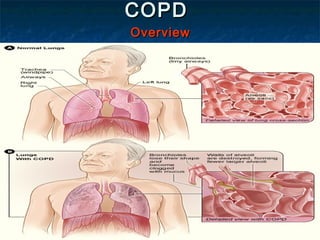
 In COPD, less air flows in and out of
the airways because of one or more of
the following:
 The airways and air sacs lose their
elastic quality.
 The walls between many of the air
sacs are destroyed.
 The walls of the airways become thick
and inflamed.
 The airways make more mucus than
usual, which tends to clog them.
COPDCOPD
CausesCauses
SmokingSmoking
Air pollutionAir pollution
geneticgenetic (hereditary) risk(hereditary) risk
COPDCOPD
SymptomsSymptoms
 Productive cough
 Breathlessness
 Chest infection
 Other symptoms of COPD can
be more vague, weight loss,
tiredness and ankle swelling.
Difference between COPD and
Asthma
 In COPD there is permanent damage to the airways.
The narrowed airways are fixed, and so symptoms are
chronic (persistent). Treatment to open up the
airways, is therefore limited.
 In asthma there is inflammation in the airways which
makes the muscles in the airways constrict. This
causes the airways to narrow. The symptoms tend to
come and go, and vary in severity from time to time.
Treatment to reduce inflammation and to open up the
airways usually works well.
 COPD is more likely than asthma to cause a chronic
(ongoing) cough with sputum.
Difference between COPD and asthma
(cont…(
 Night time waking with breathlessnessNight time waking with breathlessness
or wheeze is common inor wheeze is common in asthmaasthma andand
uncommon in COPD.uncommon in COPD.
 COPDCOPD is rare before the age of 35is rare before the age of 35
whilst asthma is common in under-35.whilst asthma is common in under-35.
COPDCOPD
Diagnostic tests
 Symptoms
 Physical examination
 Sample of sputum
 Chest x-ray
 High-resolution CT (HRCT scan)
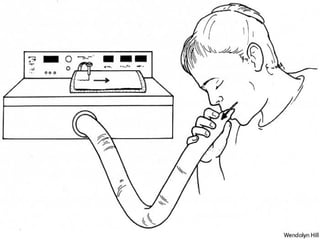
 Pulmonary function test
(spirometery)
 Arterial blood gases test
 Pulse oximeter
COPDCOPD
Medical management
 Give antibiotics to treat infection
 Give bronchodilators to relieve bronchospasm, reduce
airway obstruction, mucosal edema and liquefy
secretions.
 Chest physiotherapy and postural drainage to improve
pulmonary ventilation.
 Proper hydration helps to cough up secretions or
tracheal suctioning when the patient is unable to
cough.
 Steroid therapy if the patient fails to respond to more
conservative treatment.
COPDCOPD
Medical management (cont…(
 SStop smokingtop smoking
 OOxygenation with low concentration during the acute episodesxygenation with low concentration during the acute episodes
 InIn asthma adrenaline ( epinephrine) SC if the bronchospasmasthma adrenaline ( epinephrine) SC if the bronchospasm
not relieved.not relieved.
 AAminophylins IV if the above treatment does not help.minophylins IV if the above treatment does not help.
 IVIV corticosteroids for patients with chronic asthma or frequentcorticosteroids for patients with chronic asthma or frequent
attack.attack.
 SSedative or tranquilizers to calm the patient.edative or tranquilizers to calm the patient.
 IIncrease fluids intake to correct loss of diaphoresis andncrease fluids intake to correct loss of diaphoresis and
inaccessible loss of hyperventilation.inaccessible loss of hyperventilation.
 IIntubations and mechanical ventilation if there is respiratoryntubations and mechanical ventilation if there is respiratory
failurefailure..
 To prevent irritation and infection of theTo prevent irritation and infection of the
airways, instruct the patient to:airways, instruct the patient to:
 Avoid exposure to cigarette, pipe, and cigarAvoid exposure to cigarette, pipe, and cigar
smoke as well as to dusts and powders.smoke as well as to dusts and powders.
 Avoid use of aerosol sprays.Avoid use of aerosol sprays.
 Stay indoors when the pollen count is high.Stay indoors when the pollen count is high.
 Stay indoors when temperature andStay indoors when temperature and
humidity are both highhumidity are both high
COPD
Preventive measures
 Use air conditioning to help decrease
pollutants and control temperature
 Avoid exposure to persons known to have
colds or other respiratory tract infection
 Avoid enclosed, crowded areas during cold
and flu season.
 Obtain immunization against influenza and
streptococcal pneumonia.
COPD
Preventive measures (cont…(
COPD
Preventive measures (cont…(
 To ensure prompt, effective treatmentTo ensure prompt, effective treatment
of a developing respiratory infection,of a developing respiratory infection,
instruct the patient to do theinstruct the patient to do the
following:-following:-
 Report any change in sputum colorReport any change in sputum color
character, increased tightness of thecharacter, increased tightness of the
chest, increased dyspnea, or fatigue.chest, increased dyspnea, or fatigue.
 Call the physician if ordered antibioticsCall the physician if ordered antibiotics
do not relieve symptoms within 24do not relieve symptoms within 24
COPD
Nursing interventionNursing intervention
 AssessmentAssessment
 HistoryHistory
 Patient's environmentPatient's environment
 Work history, exercise pattern,Work history, exercise pattern,
smoking habitssmoking habits
 The onset & development ofThe onset & development of
symptomssymptoms
 Sleeping positionsSleeping positions
COPD
Nursing intervention (contNursing intervention (cont…(…(
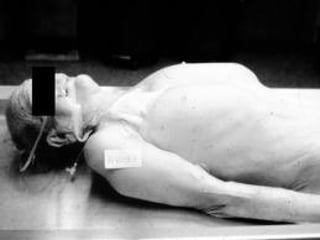
 Physical examination
Signs of heavy smokers
 Observe for clubbing
 Distended neck vein on expiration
 The presence of barrel chest
 Observe for abdominal breathing
 The use of pursed lips breathing and
chest movement
 Auscultate the chest& listen for
musical wheezes characteristics of
chronic bronchitis
COPD
Nursing intervention (contNursing intervention (cont…(…(
 review the results of diagnostic procedure:
 Arterial blood gases
 Pulmonary function tests
 X-ray films
 Nursing diagnosis
 Ineffective breathing pattern related to increase
need of O2
 Ineffective airway clearance related to excessive
accumulation of secretions
 Impaired gas exchange related to impaired
expiration &co2 retention
COPD
Nursing intervention (contNursing intervention (cont…(…(
 Activity intolerance related to inadequate
oxygenation
 High risk for ineffective individual coping
related to chronic disease, its effects& its
treatment
 High risk for altered health maintenance
related to insufficient knowledge of
prevention, identification and treatment of
respiratory complication of COPD
Copd

Copd

  • 1.
    Chronic obstructiveChronic obstructive pulmonarydiseasepulmonary disease ((COPDCOPD(( Dr. Walaa NasrDr. Walaa Nasr Lecturer of Adult NursingLecturer of Adult Nursing Second yearSecond year
  • 2.
    COPDCOPD  Out linesOutlines  What is the COPD?What is the COPD?  OverviewOverview  Causes of COPDCauses of COPD  Symptoms of COPDSymptoms of COPD  What's the difference between COPD andWhat's the difference between COPD and asthma?asthma?  Diagnostic tests needed for COPDDiagnostic tests needed for COPD  Medical management of COPDMedical management of COPD  Preventive measuresPreventive measures  Nursing interventionNursing intervention  Outlook and PrognosisOutlook and Prognosis
  • 3.
    COPDCOPD DefinitionDefinition COPDCOPD, or chronic,or chronic obstructive pulmonaryobstructive pulmonary disease, is a progressivedisease, is a progressive disease that makes it harddisease that makes it hard to breathe. "Progressive"to breathe. "Progressive" means the disease getsmeans the disease gets worse over time.worse over time.
  • 4.
  • 5.
    COPDCOPD OverviewOverview  In COPD,less air flows in and out of the airways because of one or more of the following:  The airways and air sacs lose their elastic quality.  The walls between many of the air sacs are destroyed.  The walls of the airways become thick and inflamed.  The airways make more mucus than usual, which tends to clog them.
  • 6.
  • 7.
    COPDCOPD SymptomsSymptoms  Productive cough Breathlessness  Chest infection  Other symptoms of COPD can be more vague, weight loss, tiredness and ankle swelling.
  • 8.
    Difference between COPDand Asthma  In COPD there is permanent damage to the airways. The narrowed airways are fixed, and so symptoms are chronic (persistent). Treatment to open up the airways, is therefore limited.  In asthma there is inflammation in the airways which makes the muscles in the airways constrict. This causes the airways to narrow. The symptoms tend to come and go, and vary in severity from time to time. Treatment to reduce inflammation and to open up the airways usually works well.  COPD is more likely than asthma to cause a chronic (ongoing) cough with sputum.
  • 9.
    Difference between COPDand asthma (cont…(  Night time waking with breathlessnessNight time waking with breathlessness or wheeze is common inor wheeze is common in asthmaasthma andand uncommon in COPD.uncommon in COPD.  COPDCOPD is rare before the age of 35is rare before the age of 35 whilst asthma is common in under-35.whilst asthma is common in under-35.
  • 10.
    COPDCOPD Diagnostic tests  Symptoms Physical examination  Sample of sputum  Chest x-ray  High-resolution CT (HRCT scan)  Pulmonary function test (spirometery)  Arterial blood gases test  Pulse oximeter
  • 12.
    COPDCOPD Medical management  Giveantibiotics to treat infection  Give bronchodilators to relieve bronchospasm, reduce airway obstruction, mucosal edema and liquefy secretions.  Chest physiotherapy and postural drainage to improve pulmonary ventilation.  Proper hydration helps to cough up secretions or tracheal suctioning when the patient is unable to cough.  Steroid therapy if the patient fails to respond to more conservative treatment.
  • 13.
    COPDCOPD Medical management (cont…( SStop smokingtop smoking  OOxygenation with low concentration during the acute episodesxygenation with low concentration during the acute episodes  InIn asthma adrenaline ( epinephrine) SC if the bronchospasmasthma adrenaline ( epinephrine) SC if the bronchospasm not relieved.not relieved.  AAminophylins IV if the above treatment does not help.minophylins IV if the above treatment does not help.  IVIV corticosteroids for patients with chronic asthma or frequentcorticosteroids for patients with chronic asthma or frequent attack.attack.  SSedative or tranquilizers to calm the patient.edative or tranquilizers to calm the patient.  IIncrease fluids intake to correct loss of diaphoresis andncrease fluids intake to correct loss of diaphoresis and inaccessible loss of hyperventilation.inaccessible loss of hyperventilation.  IIntubations and mechanical ventilation if there is respiratoryntubations and mechanical ventilation if there is respiratory failurefailure..
  • 14.
     To preventirritation and infection of theTo prevent irritation and infection of the airways, instruct the patient to:airways, instruct the patient to:  Avoid exposure to cigarette, pipe, and cigarAvoid exposure to cigarette, pipe, and cigar smoke as well as to dusts and powders.smoke as well as to dusts and powders.  Avoid use of aerosol sprays.Avoid use of aerosol sprays.  Stay indoors when the pollen count is high.Stay indoors when the pollen count is high.  Stay indoors when temperature andStay indoors when temperature and humidity are both highhumidity are both high COPD Preventive measures
  • 15.
     Use airconditioning to help decrease pollutants and control temperature  Avoid exposure to persons known to have colds or other respiratory tract infection  Avoid enclosed, crowded areas during cold and flu season.  Obtain immunization against influenza and streptococcal pneumonia. COPD Preventive measures (cont…(
  • 16.
    COPD Preventive measures (cont…( To ensure prompt, effective treatmentTo ensure prompt, effective treatment of a developing respiratory infection,of a developing respiratory infection, instruct the patient to do theinstruct the patient to do the following:-following:-  Report any change in sputum colorReport any change in sputum color character, increased tightness of thecharacter, increased tightness of the chest, increased dyspnea, or fatigue.chest, increased dyspnea, or fatigue.  Call the physician if ordered antibioticsCall the physician if ordered antibiotics do not relieve symptoms within 24do not relieve symptoms within 24
  • 17.
    COPD Nursing interventionNursing intervention AssessmentAssessment  HistoryHistory  Patient's environmentPatient's environment  Work history, exercise pattern,Work history, exercise pattern, smoking habitssmoking habits  The onset & development ofThe onset & development of symptomssymptoms  Sleeping positionsSleeping positions
  • 18.
    COPD Nursing intervention (contNursingintervention (cont…(…(  Physical examination Signs of heavy smokers  Observe for clubbing  Distended neck vein on expiration  The presence of barrel chest  Observe for abdominal breathing  The use of pursed lips breathing and chest movement  Auscultate the chest& listen for musical wheezes characteristics of chronic bronchitis
  • 20.
    COPD Nursing intervention (contNursingintervention (cont…(…(  review the results of diagnostic procedure:  Arterial blood gases  Pulmonary function tests  X-ray films  Nursing diagnosis  Ineffective breathing pattern related to increase need of O2  Ineffective airway clearance related to excessive accumulation of secretions  Impaired gas exchange related to impaired expiration &co2 retention
  • 21.
    COPD Nursing intervention (contNursingintervention (cont…(…(  Activity intolerance related to inadequate oxygenation  High risk for ineffective individual coping related to chronic disease, its effects& its treatment  High risk for altered health maintenance related to insufficient knowledge of prevention, identification and treatment of respiratory complication of COPD