BRONCHODILATOR DRUGS
PREPARED BY,
MRS. RIJO LIJO
INTRODUCTION
• Bronchodilators are medications that open (dilate) the airways (bronchial
tubes) of the lung by relaxing bronchial muscles and allow people who have
difficulty breathing to breath better.
INDICATIONS
• Asthma
• Chronic obstructive pulmonary disease (COPD
• Allergic reactions
• Related conditions that cause breathing problems
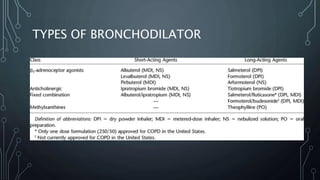
TYPES OF BRONCHODILATOR
TYPES OF BRONCHODILATORS
• Beta-adrenergic bronchodilators dilate bronchial airways by relaxing the muscles
that surround the airways. Beta-adrenergic bronchodilators are beta-2 agonists.
These medications stimulate beta-2 receptors on the smooth muscle cells that line
the airways, causing these muscle cells to relax, thus, opening airways.
• Anticholinergic bronchodilators block the effect of acetylcholine on airways
and nasal passages. Acetylcholine is a chemical that nerves use to
communicate with muscle cells. In asthma, cholinergic nerves going to the
lungs cause narrowing of the airways by stimulating muscles surrounding the
airways to contract. The "anticholinergic" effect of anticholinergic
bronchodilators blocks the effect of cholinergic nerves, causing the muscles
to relax and airways to dilate.
• Xanthine derivatives open airways by relaxing the smooth muscles in the walls
of the airways and they also suppress the response of the airways to stimuli. The
mechanism of action of xanthines is not fully understood. Xanthine derivatives
may dilate bronchi by blocking the action of phosphodiesterase (PDE) enzymes
which ultimately leads to increased concentration of chemicals that dilate
bronchial airways.
SIDE EFFECTS OF BETA-ADRENERGIC
BRONCHODILATORS
• Migraine headaches
• Non-migraine headaches
• Nausea
• Stomach upset
• Flu-like symptoms
• Cold symptoms
• Ear infections (otitis media)
• Bronchitis
• Cough
• Bronchospasm (worsening of asthma)
• Serious allergic reactions (anaphylaxis)
• Hypokalemia
• Abnormal heart rhythm (palpitations)
• Fast heart rate
• Hypertension
• Chest pain
ANTICHOLINERGIC BRONCHODILATORS
SIDE EFFECTS
• Dry mouth
• Cough
• Headache
• Nausea
• Dizziness
• Difficulty breathing
• Rash
• Itching
• Flu-like symptoms
• Indigestion
• Back pain
• Sinusitis
• Bronchitis
XANTHINES SIDE EFFECTS
• Nausea
• Vomiting
• Diarrhea
• Headaches
• Irritability
CONTRAINDICATIONS
• Patient with uncontrolled arrythmias.
• Prolonged use of albuterol may cause hypokalemia.
NURSES RESPONSIBILITIES
•Nurse should monitor the patient’s blood pressure, pulse, respiratory rate, and
breathing sounds.
•Teach the patients that how to use inhalers.
•Instruct the patient to avoid respiratory irritants, such as smoke, dust, and strong
smell.
Bronchodilator drugs

Bronchodilator drugs

  • 1.
  • 2.
    INTRODUCTION • Bronchodilators aremedications that open (dilate) the airways (bronchial tubes) of the lung by relaxing bronchial muscles and allow people who have difficulty breathing to breath better.
  • 3.
    INDICATIONS • Asthma • Chronicobstructive pulmonary disease (COPD • Allergic reactions • Related conditions that cause breathing problems
  • 4.
  • 5.
    TYPES OF BRONCHODILATORS •Beta-adrenergic bronchodilators dilate bronchial airways by relaxing the muscles that surround the airways. Beta-adrenergic bronchodilators are beta-2 agonists. These medications stimulate beta-2 receptors on the smooth muscle cells that line the airways, causing these muscle cells to relax, thus, opening airways.
  • 6.
    • Anticholinergic bronchodilatorsblock the effect of acetylcholine on airways and nasal passages. Acetylcholine is a chemical that nerves use to communicate with muscle cells. In asthma, cholinergic nerves going to the lungs cause narrowing of the airways by stimulating muscles surrounding the airways to contract. The "anticholinergic" effect of anticholinergic bronchodilators blocks the effect of cholinergic nerves, causing the muscles to relax and airways to dilate.
  • 7.
    • Xanthine derivativesopen airways by relaxing the smooth muscles in the walls of the airways and they also suppress the response of the airways to stimuli. The mechanism of action of xanthines is not fully understood. Xanthine derivatives may dilate bronchi by blocking the action of phosphodiesterase (PDE) enzymes which ultimately leads to increased concentration of chemicals that dilate bronchial airways.
  • 8.
    SIDE EFFECTS OFBETA-ADRENERGIC BRONCHODILATORS • Migraine headaches • Non-migraine headaches • Nausea • Stomach upset • Flu-like symptoms • Cold symptoms • Ear infections (otitis media) • Bronchitis • Cough
  • 9.
    • Bronchospasm (worseningof asthma) • Serious allergic reactions (anaphylaxis) • Hypokalemia • Abnormal heart rhythm (palpitations) • Fast heart rate • Hypertension • Chest pain
  • 10.
    ANTICHOLINERGIC BRONCHODILATORS SIDE EFFECTS •Dry mouth • Cough • Headache • Nausea • Dizziness • Difficulty breathing
  • 11.
    • Rash • Itching •Flu-like symptoms • Indigestion • Back pain • Sinusitis • Bronchitis
  • 12.
    XANTHINES SIDE EFFECTS •Nausea • Vomiting • Diarrhea • Headaches • Irritability
  • 13.
    CONTRAINDICATIONS • Patient withuncontrolled arrythmias. • Prolonged use of albuterol may cause hypokalemia.
  • 14.
    NURSES RESPONSIBILITIES •Nurse shouldmonitor the patient’s blood pressure, pulse, respiratory rate, and breathing sounds. •Teach the patients that how to use inhalers. •Instruct the patient to avoid respiratory irritants, such as smoke, dust, and strong smell.