SeizurePresentation by:Crishona Battle, SNAngela Funderburk, SNShanna Helton, SNKrystle Kelly, SNGeorge Ndirangu-Kamau, SNStefanie Smith, SNElizabeth Snyder, SN
What is a Seizure?Abnormal, sudden, excessive, uncontrolled electrical discharge of neurons within the brain.Results in a change in:Level  of consciousnessMotor or sensory abilityAnd/or behaviorMay occur for no reason or may be pathological in nature- resulting from another cause.Epilepsy: is defined by the National Institute of Neurological disorders and stroke as:Two or more seizures experienced by a person.A chronic disorder in which repeated unprovoked seizure activity occurs. Ignatavicius, D., & Workman, L. (2010). Medial-surgical nursing: Patient Centered Collaborative Care (6th ed.). Philadelphia: W.B Saunders.
Types of SeizuresGeneralized: involves both hemispheres of the brain.Tonic-clonic: 2-5 minutes, begins with stiffening then rhythmic jerking of all extremities.Tonic: abrupt increase in muscle tone, loss of consciousness, & autonomic changes. Lasts 30 seconds- several minutes.Clonic: muscle contraction and relaxation. Lasts several minutes.Absence: brief loss of consciousness that consists of staring and automatisms. Mostly in children, may happen 100+/day.Myoclonic: brief jerking or stiffening of extremities, may be symmetric or asymmetric lasting just a few seconds.Atonic (akinetic): sudden loss of muscle tone causing the person to fall, lasting for seconds, and most resistant to medications.Ignatavicius, D., & Workman, L. (2010). Medial-surgical nursing: Patient Centered Collaborative Care (6th ed.). Philadelphia: W.B Saunders.
Types of seizuresPartial: begin in a part of one cerebral hemisphere.Complex-partial: causes syncope for 1-3 minutes- temporal lobe- psychomotor/ temporal lobe seizures. Impairs consciousness; person may wander and have amnesia.Simple-partial: consciousness intact. May experience one sided movement of extremities, unusual sensations, & autonomic changes. Unclassified: occur for no known reason.Primary: not associated with any identifiable brain lesion or other cause. Idiopathic. Secondary: result from underlying brain lesion (tumor/trauma). May be caused by:Metabolic disorders, electrolyte imbalance, high fever, stroke, head injury, substance abuse, & heart disease.Ignatavicius, D., & Workman, L. (2010). Medial-surgical nursing: Patient Centered Collaborative Care (6th ed.). Philadelphia: W.B Saunders.
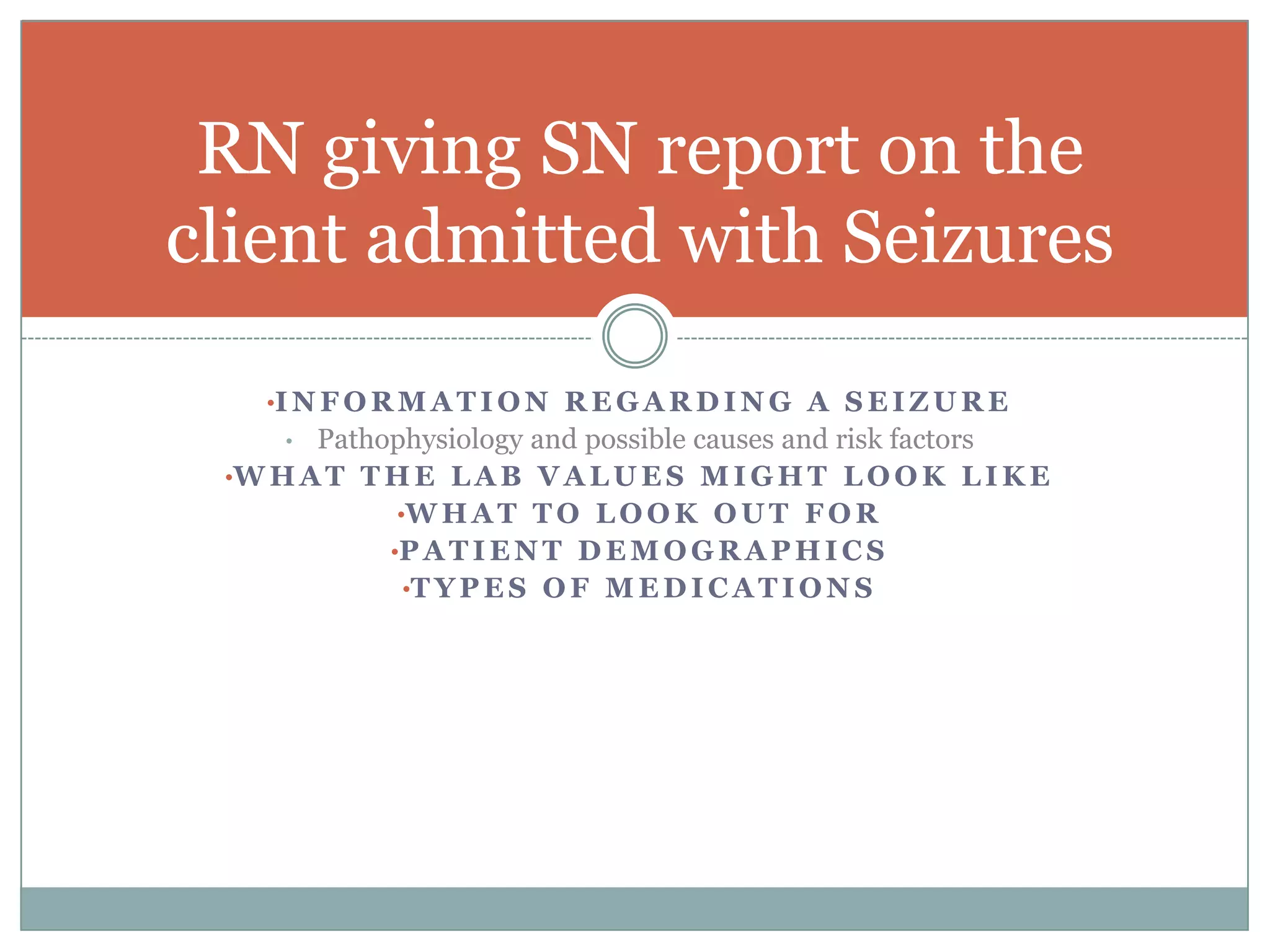
Information regarding a seizure
Pathophysiology and possible causes and risk factors
What the lab values might look like
What to look out for
Patient demographics
Types of medicationsRN giving SN report on the client admitted with Seizures
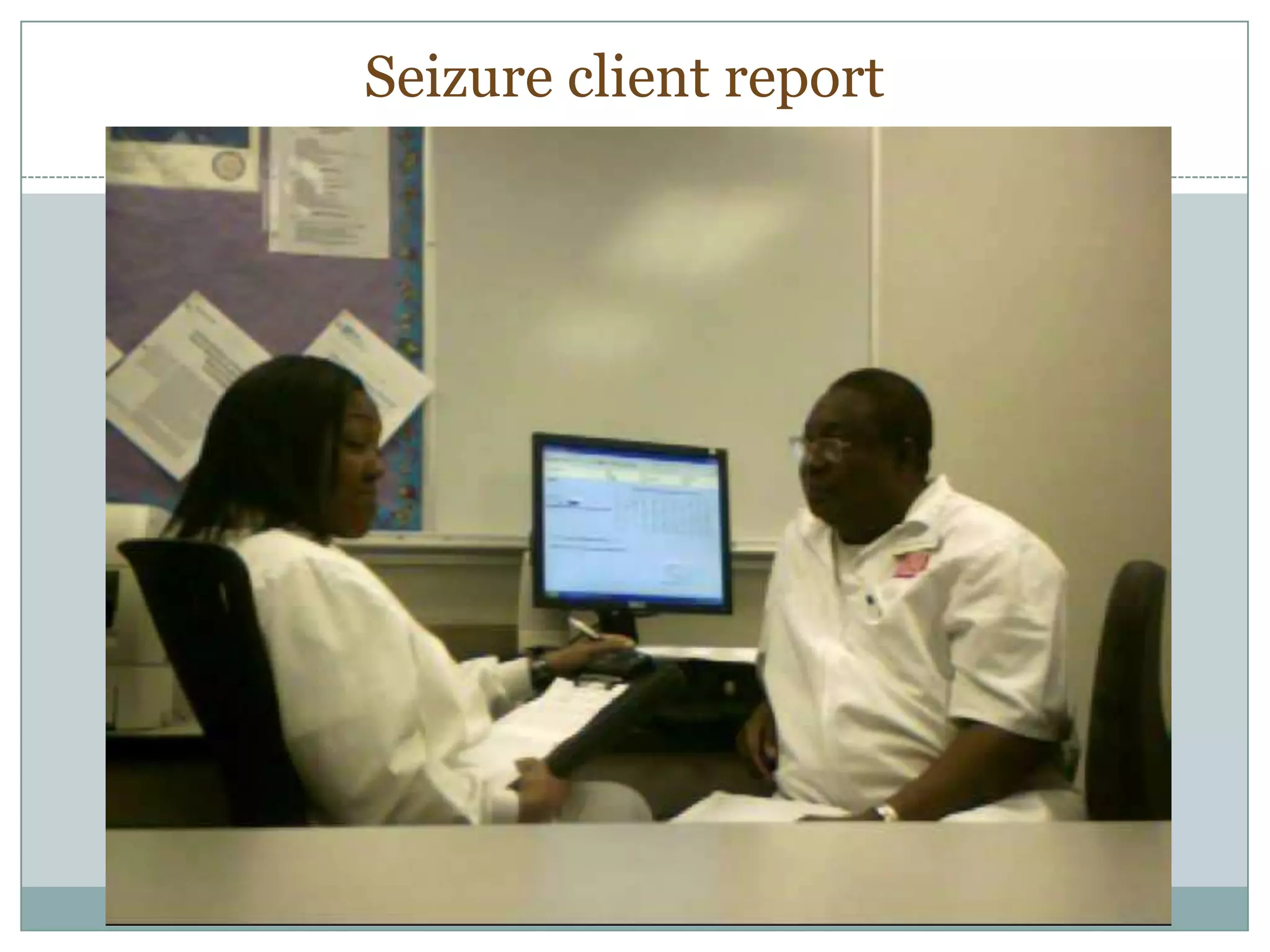
Seizure client report
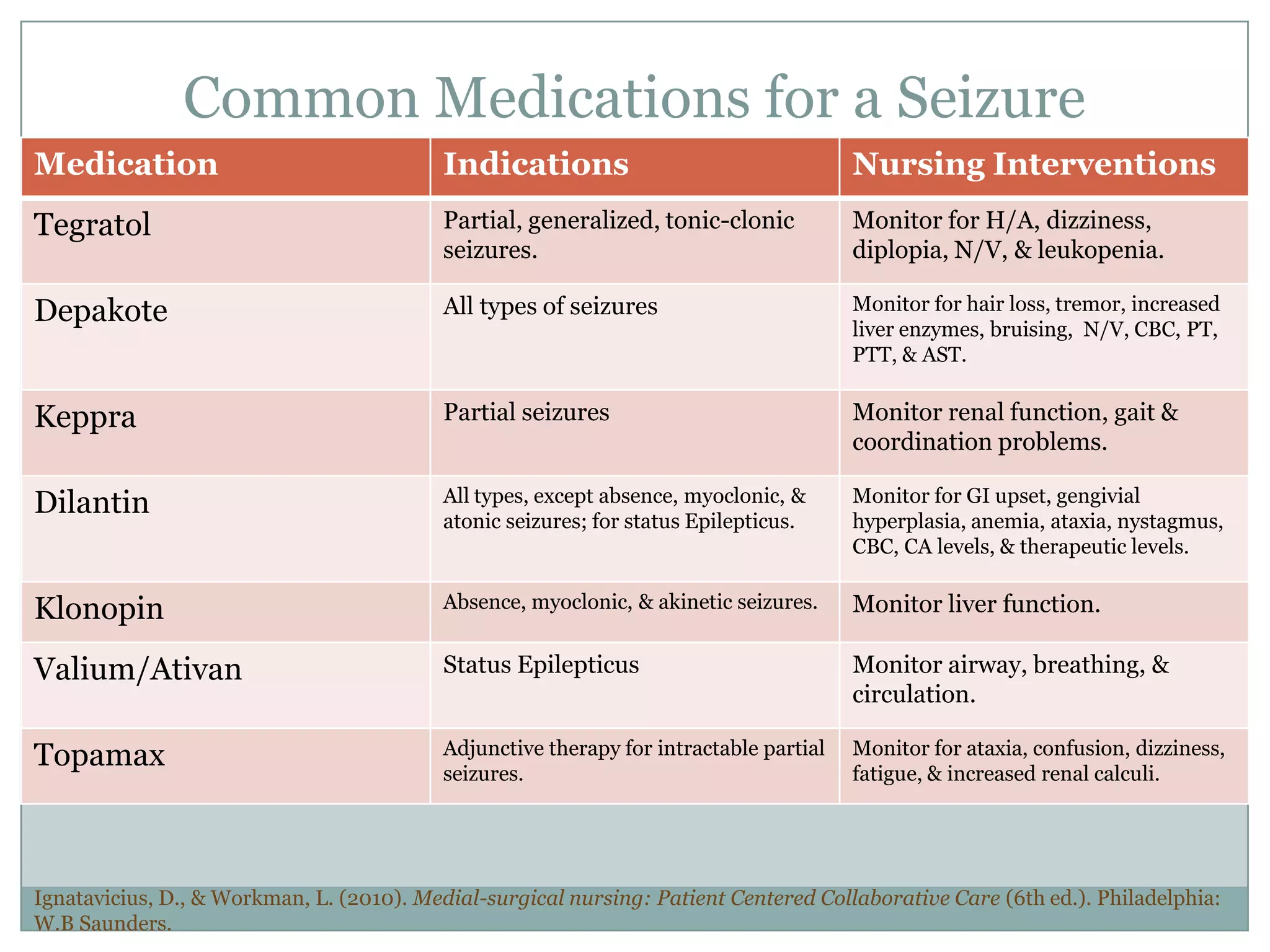
Common Medications for a SeizureIgnatavicius, D., & Workman, L. (2010). Medial-surgical nursing: Patient Centered Collaborative Care (6th ed.). Philadelphia: W.B Saunders.

Seizure power point

  • 1.
    SeizurePresentation by:Crishona Battle,SNAngela Funderburk, SNShanna Helton, SNKrystle Kelly, SNGeorge Ndirangu-Kamau, SNStefanie Smith, SNElizabeth Snyder, SN
  • 2.
    What is aSeizure?Abnormal, sudden, excessive, uncontrolled electrical discharge of neurons within the brain.Results in a change in:Level of consciousnessMotor or sensory abilityAnd/or behaviorMay occur for no reason or may be pathological in nature- resulting from another cause.Epilepsy: is defined by the National Institute of Neurological disorders and stroke as:Two or more seizures experienced by a person.A chronic disorder in which repeated unprovoked seizure activity occurs. Ignatavicius, D., & Workman, L. (2010). Medial-surgical nursing: Patient Centered Collaborative Care (6th ed.). Philadelphia: W.B Saunders.
  • 3.
    Types of SeizuresGeneralized:involves both hemispheres of the brain.Tonic-clonic: 2-5 minutes, begins with stiffening then rhythmic jerking of all extremities.Tonic: abrupt increase in muscle tone, loss of consciousness, & autonomic changes. Lasts 30 seconds- several minutes.Clonic: muscle contraction and relaxation. Lasts several minutes.Absence: brief loss of consciousness that consists of staring and automatisms. Mostly in children, may happen 100+/day.Myoclonic: brief jerking or stiffening of extremities, may be symmetric or asymmetric lasting just a few seconds.Atonic (akinetic): sudden loss of muscle tone causing the person to fall, lasting for seconds, and most resistant to medications.Ignatavicius, D., & Workman, L. (2010). Medial-surgical nursing: Patient Centered Collaborative Care (6th ed.). Philadelphia: W.B Saunders.
  • 4.
    Types of seizuresPartial:begin in a part of one cerebral hemisphere.Complex-partial: causes syncope for 1-3 minutes- temporal lobe- psychomotor/ temporal lobe seizures. Impairs consciousness; person may wander and have amnesia.Simple-partial: consciousness intact. May experience one sided movement of extremities, unusual sensations, & autonomic changes. Unclassified: occur for no known reason.Primary: not associated with any identifiable brain lesion or other cause. Idiopathic. Secondary: result from underlying brain lesion (tumor/trauma). May be caused by:Metabolic disorders, electrolyte imbalance, high fever, stroke, head injury, substance abuse, & heart disease.Ignatavicius, D., & Workman, L. (2010). Medial-surgical nursing: Patient Centered Collaborative Care (6th ed.). Philadelphia: W.B Saunders.
  • 5.
  • 6.
    Pathophysiology and possiblecauses and risk factors
  • 7.
    What the labvalues might look like
  • 8.
  • 9.
  • 10.
    Types of medicationsRNgiving SN report on the client admitted with Seizures
  • 11.
  • 12.
    Common Medications fora SeizureIgnatavicius, D., & Workman, L. (2010). Medial-surgical nursing: Patient Centered Collaborative Care (6th ed.). Philadelphia: W.B Saunders.
  • 13.
  • 14.
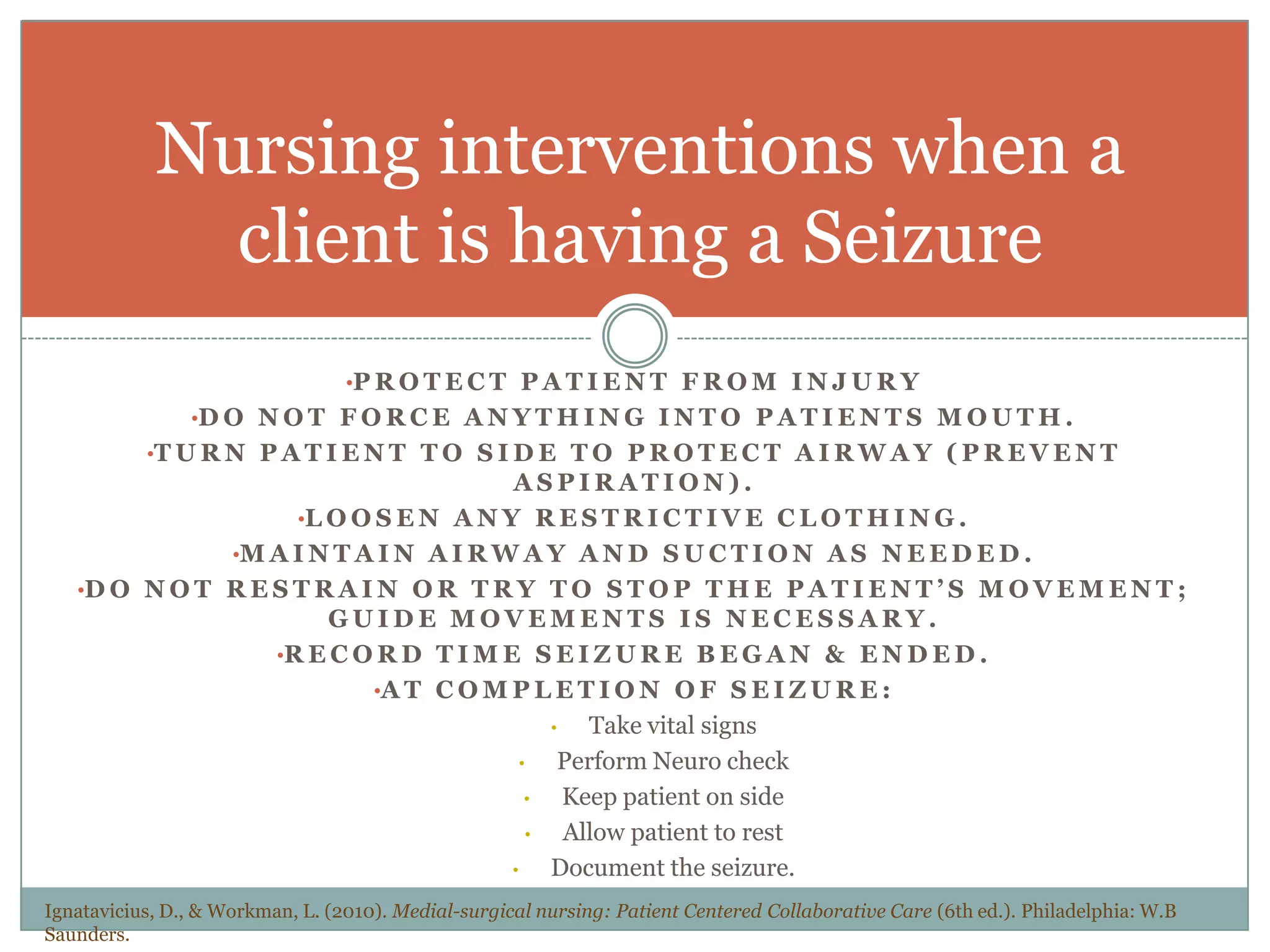
    Do not forceanything into patients mouth.
  • 15.
    Turn patient toside to protect airway (prevent aspiration).
  • 16.
  • 17.
    Maintain airway andsuction as needed.
  • 18.
    Do not restrainor try to stop the patient’s movement; guide movements is necessary.
  • 19.
    Record time seizurebegan & ended.
  • 20.
  • 21.
  • 22.
  • 23.
  • 24.
  • 25.
    Document the seizure.Nursinginterventions when a client is having a SeizureIgnatavicius, D., & Workman, L. (2010). Medial-surgical nursing: Patient Centered Collaborative Care (6th ed.). Philadelphia: W.B Saunders.
  • 26.
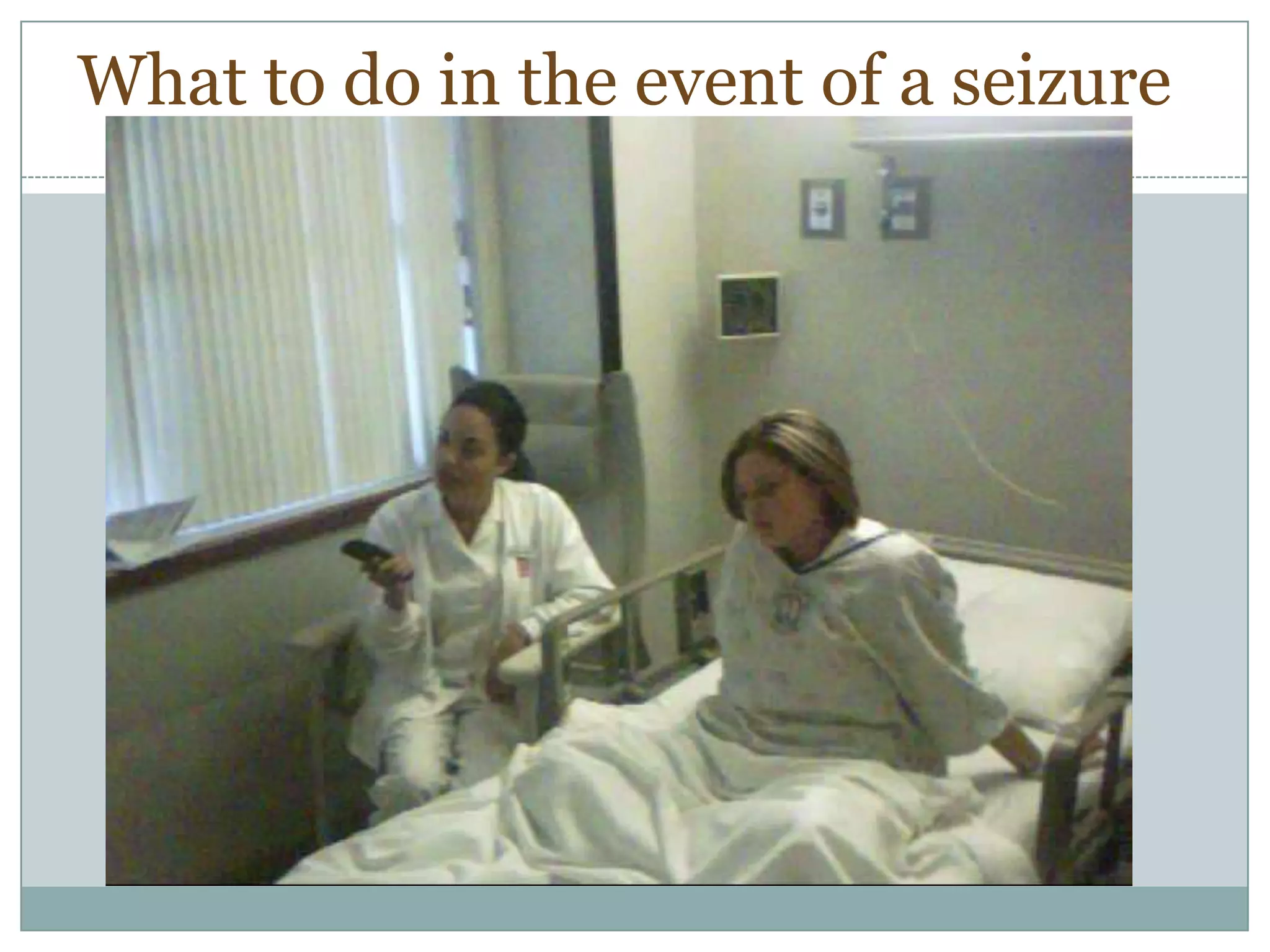
    What to doin the event of a seizure
  • 27.
  • 28.
  • 29.
    Maintenance of therapeuticlevels- blood draws.
  • 30.
    Do not takeany meds unless you talk to your dr. first.
  • 31.
  • 32.
    f/u with Dr./neurologist.
  • 33.
    Wear a medicalalert bracelet.
  • 34.
    Be sure afamily member/ friend is with you at all times.
  • 35.
    Be sure family/friendsknow what to do if you have a seizure.
  • 36.
    Do not drive/operate heavy machinery.
  • 37.
    Avoid alcohol andexcessive stress.
  • 38.
  • 39.
  • 40.
    Use pre-cut items-avoid knives
  • 41.
    No baths, onlyshowers- use a shower chair
  • 42.
  • 43.
    Keep home freeof clutter.D/C Teaching for the client with Seizures…Home safety and health maintenance. Ignatavicius, D., & Workman, L. (2010). Medial-surgical nursing: Patient Centered Collaborative Care (6th ed.). Philadelphia: W.B Saunders.
  • 44.
  • 45.
    ReferencesIgnatavicius, D., &Workman, L. (2010). Medial-surgical nursing: Patient Centered Collaborative Care (6th ed.). Philadelphia: W.B Saunders.We would like to thank 4 Ardmore at Wake Forrest Baptist Medical Center for lending us space to film and being so helpful with our project and clinical rotation. Thank you!!!!