Anatomy of
the Eye
BY:
Parita Jayswal
Eye Parts -
Diagram
Introduction
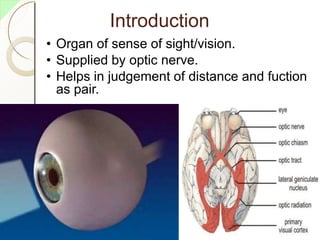
• Organ of sense of sight/vision.
• Supplied by optic nerve.
• Helps in judgement of distance and fuction
as pair.
•I t is spherical inshape
•I t is about 2.5 cm indiameter
•situated in the orbital cavity
•STRUCTURE OF THE EYE: MAIN 3 LAYERS
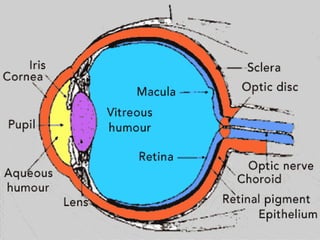
1. Outer fibrous layer [sclera, cornea]
2. Middle vascular layer [choroid, ciliary
body, irish]
3. Inner nervous tissue layer [retina]
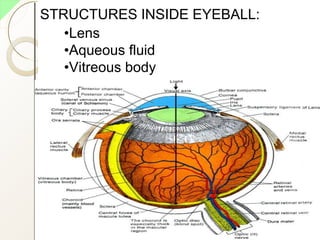
STRUCTURES INSIDE EYEBALL:
•Lens
•Aqueous fluid
•Vitreous body
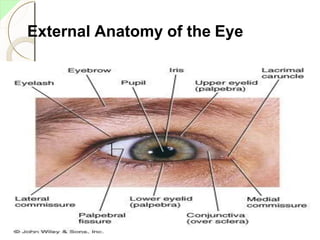
External Anatomy of the Eye
Accessory Organs & Eye
Protection
•Orbital cavities (bony sockets) –
house & protect the eye
• Adipose tissue – cushions the eye
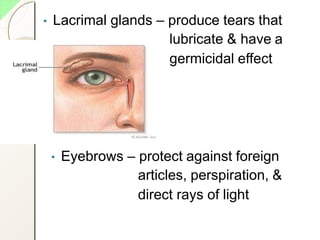
• Lacrimal glands – produce tears that
lubricate & have a
germicidal effect
• Eyebrows – protect against foreign
articles, perspiration, &
direct rays of light
Eyelids – folds of skin that cover the
surface of the eye; close
by reflex action when an
object approaches
• Eyelashes – secrete oils that prevent
lids from sticking
together
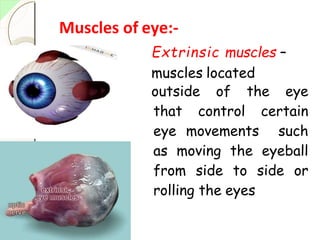
Muscles of eye:-
Extrinsic muscles –
muscles located
outside of the eye
that control certain
eye movements such
as moving the eyeball
from side to side or
rolling the eyes
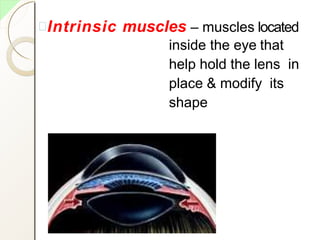
Intrinsic muscles – muscles located
inside the eye that
help hold the lens in
place & modify its
shape
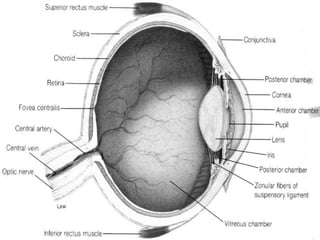
Layers:- There are three layer of the eye
Sclera – white, outer layer of the eyeball;
tough, fibrous membrane that helps
to maintain the spherical shape of
the eyeball & gives attachment to
extrinsic muscle.
Cornea – Transparent Layer, front part of
eyeball through which light waves
pass to reach Retina – no blood
vessels but lots of nerve endings.
Convex anteriorly & involving in
bending lightrays to focus them on
Retina.
Canals of Schlem – venous passages
that drain the fluid
that accumulates
behind the cornea;
located where the
sclera & cornea meet
Conjuctiva – thin - transparent
mucous membrane
that covers the eyeball
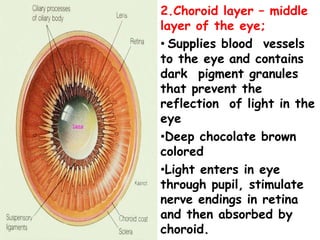
2.Choroid layer – middle
layer of the eye;
• Supplies blood vessels
to the eye and contains
dark pigment granules
that prevent the
reflection of light in the
eye
•Deep chocolate brown
colored
•Light enters in eye
through pupil, stimulate
nerve endings in retina
and then absorbed by
choroid.
Ciliary body –
•Anteriorly continued with choroid.
•Consist ciliary muscles & epithelial cell which
secreste aqueous fluid.
•Cotraction and relexation of ciliary muscles
•Help in change thickness of lens.
•Supply: parasympathetic branch of occulomotor
nerve
Iris –
• visible coloured part of eye lies behind cornea.
• It has pigmented cell.
• Colored portion of eye formed by circularly
and radially arranged smooth muscle fibers;
regulates amount of light entering eye by
constricting or dilating the pupil.
• IRISH SUPPLY:
sympathetic and parasympathetic nerve
parasympathetic Stimulates constriction
of pupil and Sympathetic nerve cause
dilatation of pupil.
Irish and its pigmented cells decide the
colour of eye. [blue eye:few pigmentcell]
PUPIL – rounded opening of the iris
through which light passes
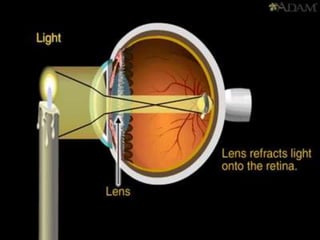
LENS – High elastic circular biconvex
body.
Lying on behind the pupil.
Lens bend light rays reflected by
objects in front of eye.
3.Retina – innermost layer of the eye;
•Extremly delicate structure
•It composed of several layers of nerve cell,
cell body, axon, etc.
•This layer is highly sensitive to light, layer of
receptive cells “rods & cones”
•lines its surface and contains photoreceptors
(cells responsible for converting light into
nerve impulses – rods & cones)
•In centre area there is little depression called
“fovea centralis” (it consist ‘cones’)
•Rods & cones contains photosensitive pigments
which convert lights into impulse.
•Near centre of posterier part is “macula lutea”
or “yellow spot”
Eye Parts
Rods – cylindrical photoreceptors
found in greatest
concentration on the edges
of the retina; most common
type of receptor; more
sensitive than cones, they
are stimulated by low intensity
or dim light.
Cones – Conical photoreceptors found
in greatest concentration
near the center of the retina;
there are three varieties of
cones, each most sensitive
to a particular bright light,
and colors– blue, green, &
red; allow for visual acuity
(sharp vision) and color
vision
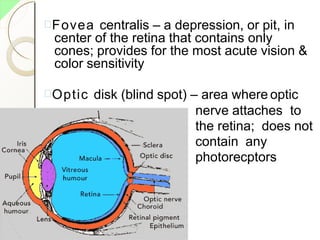
Fovea centralis – a depression, or pit, in
center of the retina that contains only
cones; provides for the most acute vision &
color sensitivity
Optic disk (blind spot) – area where optic
nerve attaches to
the retina; does not
contain any
photorecptors
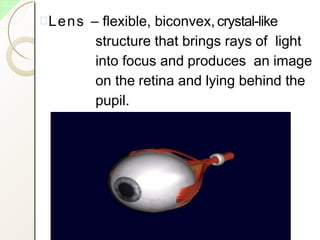
Lens – flexible, biconvex, crystal-like
structure that brings rays of light
into focus and produces an image
on the retina and lying behind the
pupil.
• Suspensory ligament – holds the lens
in place;
attached to
the ciliary body,
which controls
the amount of
tension exerted
on the lens
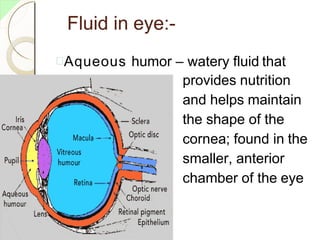
Aqueous humor – watery fluid that
provides nutrition
and helps maintain
the shape of the
cornea; found in the
smaller, anterior
chamber of the eye
Fluid in eye:-
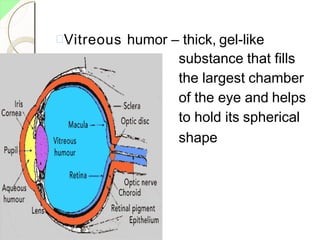
Vitreous humor – thick, gel-like
substance that fills
the largest chamber
of the eye and helps
to hold its spherical
shape
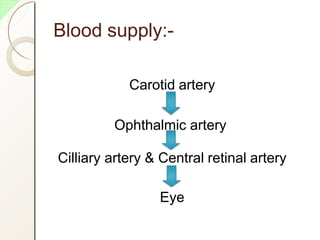
Blood supply:-
Carotid artery
Ophthalmic artery
Cilliary artery & Central retinal artery
Eye
PHYSIOLOGY
OF
VISION/SIGHT
Eye Anatomy & Physiology

Eye Anatomy & Physiology

  • 1.
  • 3.
  • 4.
    Introduction • Organ ofsense of sight/vision. • Supplied by optic nerve. • Helps in judgement of distance and fuction as pair.
  • 5.
    •I t isspherical inshape •I t is about 2.5 cm indiameter •situated in the orbital cavity •STRUCTURE OF THE EYE: MAIN 3 LAYERS 1. Outer fibrous layer [sclera, cornea] 2. Middle vascular layer [choroid, ciliary body, irish] 3. Inner nervous tissue layer [retina]
  • 6.
  • 7.
  • 8.
    Accessory Organs &Eye Protection •Orbital cavities (bony sockets) – house & protect the eye • Adipose tissue – cushions the eye
  • 9.
    • Lacrimal glands– produce tears that lubricate & have a germicidal effect • Eyebrows – protect against foreign articles, perspiration, & direct rays of light
  • 10.
    Eyelids – foldsof skin that cover the surface of the eye; close by reflex action when an object approaches • Eyelashes – secrete oils that prevent lids from sticking together
  • 11.
    Muscles of eye:- Extrinsicmuscles – muscles located outside of the eye that control certain eye movements such as moving the eyeball from side to side or rolling the eyes
  • 12.
    Intrinsic muscles –muscles located inside the eye that help hold the lens in place & modify its shape
  • 13.
    Layers:- There arethree layer of the eye Sclera – white, outer layer of the eyeball; tough, fibrous membrane that helps to maintain the spherical shape of the eyeball & gives attachment to extrinsic muscle. Cornea – Transparent Layer, front part of eyeball through which light waves pass to reach Retina – no blood vessels but lots of nerve endings. Convex anteriorly & involving in bending lightrays to focus them on Retina.
  • 14.
    Canals of Schlem– venous passages that drain the fluid that accumulates behind the cornea; located where the sclera & cornea meet Conjuctiva – thin - transparent mucous membrane that covers the eyeball
  • 15.
    2.Choroid layer –middle layer of the eye; • Supplies blood vessels to the eye and contains dark pigment granules that prevent the reflection of light in the eye •Deep chocolate brown colored •Light enters in eye through pupil, stimulate nerve endings in retina and then absorbed by choroid.
  • 16.
    Ciliary body – •Anteriorlycontinued with choroid. •Consist ciliary muscles & epithelial cell which secreste aqueous fluid. •Cotraction and relexation of ciliary muscles •Help in change thickness of lens. •Supply: parasympathetic branch of occulomotor nerve Iris – • visible coloured part of eye lies behind cornea. • It has pigmented cell. • Colored portion of eye formed by circularly and radially arranged smooth muscle fibers; regulates amount of light entering eye by constricting or dilating the pupil.
  • 17.
    • IRISH SUPPLY: sympatheticand parasympathetic nerve parasympathetic Stimulates constriction of pupil and Sympathetic nerve cause dilatation of pupil. Irish and its pigmented cells decide the colour of eye. [blue eye:few pigmentcell] PUPIL – rounded opening of the iris through which light passes LENS – High elastic circular biconvex body. Lying on behind the pupil. Lens bend light rays reflected by objects in front of eye.
  • 18.
    3.Retina – innermostlayer of the eye; •Extremly delicate structure •It composed of several layers of nerve cell, cell body, axon, etc. •This layer is highly sensitive to light, layer of receptive cells “rods & cones” •lines its surface and contains photoreceptors (cells responsible for converting light into nerve impulses – rods & cones) •In centre area there is little depression called “fovea centralis” (it consist ‘cones’) •Rods & cones contains photosensitive pigments which convert lights into impulse. •Near centre of posterier part is “macula lutea” or “yellow spot”
  • 19.
    Eye Parts Rods –cylindrical photoreceptors found in greatest concentration on the edges of the retina; most common type of receptor; more sensitive than cones, they are stimulated by low intensity or dim light.
  • 20.
    Cones – Conicalphotoreceptors found in greatest concentration near the center of the retina; there are three varieties of cones, each most sensitive to a particular bright light, and colors– blue, green, & red; allow for visual acuity (sharp vision) and color vision
  • 21.
    Fovea centralis –a depression, or pit, in center of the retina that contains only cones; provides for the most acute vision & color sensitivity Optic disk (blind spot) – area where optic nerve attaches to the retina; does not contain any photorecptors
  • 22.
    Lens – flexible,biconvex, crystal-like structure that brings rays of light into focus and produces an image on the retina and lying behind the pupil.
  • 23.
    • Suspensory ligament– holds the lens in place; attached to the ciliary body, which controls the amount of tension exerted on the lens
  • 24.
    Aqueous humor –watery fluid that provides nutrition and helps maintain the shape of the cornea; found in the smaller, anterior chamber of the eye Fluid in eye:-
  • 25.
    Vitreous humor –thick, gel-like substance that fills the largest chamber of the eye and helps to hold its spherical shape
  • 26.
    Blood supply:- Carotid artery Ophthalmicartery Cilliary artery & Central retinal artery Eye
  • 27.