Chapter 6  The Muscular System Disclaimer:  Included in this presentation are pictures you will not find in your book, make note of the information and move on. Working smarter is not working harder.
Muscle Lecture 2  Motor Neuron pathways and Body Movements
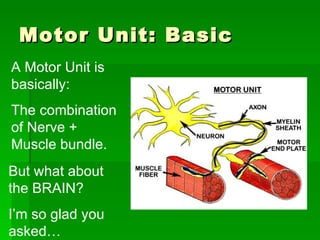
Motor Unit: Basic A Motor Unit is basically: The combination of Nerve + Muscle bundle.  But what about the BRAIN? I’m so glad you asked…
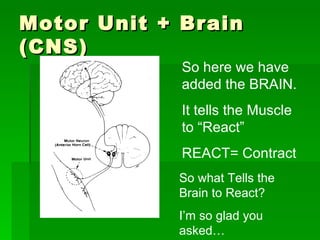
Motor Unit + Brain (CNS) So here we have added the BRAIN.  It tells the Muscle to “React”  REACT= Contract  So what Tells the Brain to React? I’m so glad you asked…
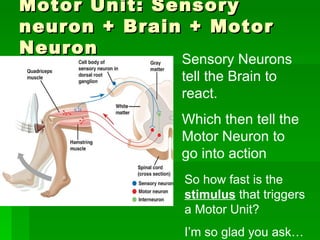
Motor Unit: Sensory neuron + Brain + Motor Neuron Sensory Neurons tell the Brain to react.  Which then tell the Motor Neuron to go into action So how fast is the  stimulus  that triggers a Motor Unit? I’m so glad you ask…
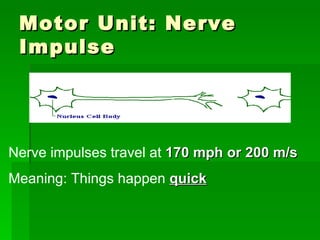
Motor Unit: Nerve Impulse Nerve impulses travel at  170 mph or 200 m/s  Meaning: Things happen  quick
Motor Unit: Now Sensory neurons are triggered Impulse is sent to the Brain Brain sends impulses to the Motor Unit Then…
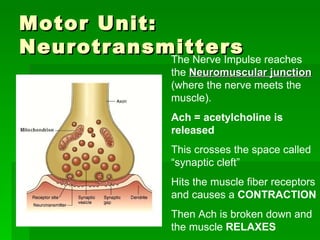
Motor Unit: Neurotransmitters  The Nerve Impulse reaches the  Neuromuscular junction  (where the nerve meets the muscle). Ach = acetylcholine is released   This crosses the space called “synaptic cleft”  Hits the muscle fiber receptors and causes a  CONTRACTION Then Ach is broken down and the muscle  RELAXES
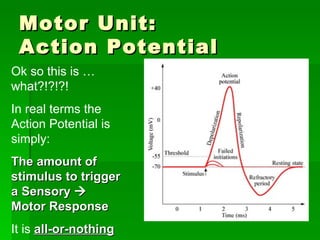
Motor Unit:  Action Potential Ok so this is …what?!?!?! In real terms the Action Potential is simply: The amount of stimulus to trigger a Sensory    Motor Response   It is  all-or-nothing
Motor Unit: Action Potential  In action…. Hold please while I get out the needle.  Just Kidding…
Motor Unit: Summation Sensory neuron is tripped  Sends a signal to the CNS  Nerve impulse's are sent to Muscle Fibers Action Potential is reached  Ach is released Muscle Contraction Ach is Broken down Muscle Relaxes  Heavy Breathing occurs and High fives are Exchanged
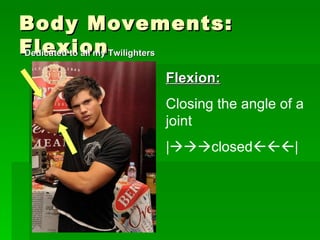
Body Movements: Flexion Dedicated to all my Twilighters  Flexion: Closing the angle of a joint  |  closed  |
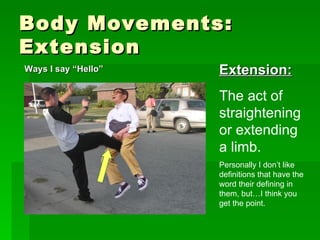
Body Movements: Extension Extension: The act of straightening or extending a limb.  Personally I don’t like definitions that have the word their defining in them, but…I think you get the point. Ways I say “Hello”
Body Movements: Rotation Turn your head left Turn your head right =ROTATION Ok now I’m going to do something alittle extreme now… Hold please.
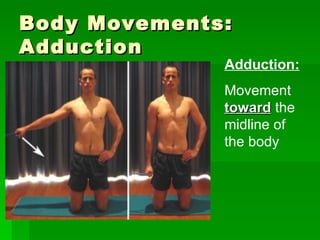
Body Movements: Adduction Adduction: Movement  toward  the midline of the body
Body Movements: Abduction Abduction:  The act of moving a body away from the planet to be anally probed by curious aliens.  Wait…WHAT?!?!?! NEXT SLIDE!!!!
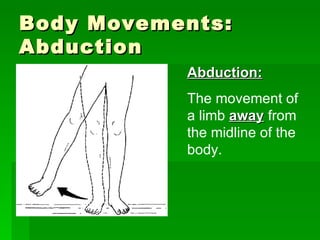
Body Movements: Abduction Abduction: The movement of a limb  away  from the midline of the body.
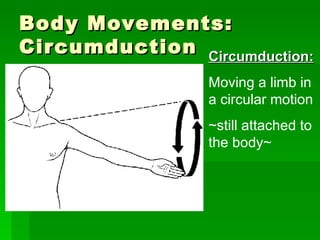
Body Movements: Circumduction Circumduction: Moving a limb in a circular motion  ~still attached to the body~
Summation: if you need to write this down, you weren’t paying attention. Nerve impulses are received and then sent to Motor Units  If a strong enough signal is sent (Action Potential is reached) Neurotransmitters are released (Ach) “Contraction” occurs and then broken down “Relaxation” occurs Body movements I am holding you responsible for knowing: Flexion, Extension, Rotation, Abduction, Adduction and Circumduction
Chapter 6  If you are not done with your labs finish them.  If you are done, start learning the muscles so you are not stalled for time during the test.  If you know all the muscles, help your classmates to learn them.

Chapter 6 lecture 2

  • 1.
    Chapter 6 The Muscular System Disclaimer: Included in this presentation are pictures you will not find in your book, make note of the information and move on. Working smarter is not working harder.
  • 2.
    Muscle Lecture 2 Motor Neuron pathways and Body Movements
  • 3.
    Motor Unit: BasicA Motor Unit is basically: The combination of Nerve + Muscle bundle. But what about the BRAIN? I’m so glad you asked…
  • 4.
    Motor Unit +Brain (CNS) So here we have added the BRAIN. It tells the Muscle to “React” REACT= Contract So what Tells the Brain to React? I’m so glad you asked…
  • 5.
    Motor Unit: Sensoryneuron + Brain + Motor Neuron Sensory Neurons tell the Brain to react. Which then tell the Motor Neuron to go into action So how fast is the stimulus that triggers a Motor Unit? I’m so glad you ask…
  • 6.
    Motor Unit: NerveImpulse Nerve impulses travel at 170 mph or 200 m/s Meaning: Things happen quick
  • 7.
    Motor Unit: NowSensory neurons are triggered Impulse is sent to the Brain Brain sends impulses to the Motor Unit Then…
  • 8.
    Motor Unit: Neurotransmitters The Nerve Impulse reaches the Neuromuscular junction (where the nerve meets the muscle). Ach = acetylcholine is released This crosses the space called “synaptic cleft” Hits the muscle fiber receptors and causes a CONTRACTION Then Ach is broken down and the muscle RELAXES
  • 9.
    Motor Unit: Action Potential Ok so this is …what?!?!?! In real terms the Action Potential is simply: The amount of stimulus to trigger a Sensory  Motor Response It is all-or-nothing
  • 10.
    Motor Unit: ActionPotential In action…. Hold please while I get out the needle. Just Kidding…
  • 11.
    Motor Unit: SummationSensory neuron is tripped Sends a signal to the CNS Nerve impulse's are sent to Muscle Fibers Action Potential is reached Ach is released Muscle Contraction Ach is Broken down Muscle Relaxes Heavy Breathing occurs and High fives are Exchanged
  • 12.
    Body Movements: FlexionDedicated to all my Twilighters Flexion: Closing the angle of a joint |  closed  |
  • 13.
    Body Movements: ExtensionExtension: The act of straightening or extending a limb. Personally I don’t like definitions that have the word their defining in them, but…I think you get the point. Ways I say “Hello”
  • 14.
    Body Movements: RotationTurn your head left Turn your head right =ROTATION Ok now I’m going to do something alittle extreme now… Hold please.
  • 15.
    Body Movements: AdductionAdduction: Movement toward the midline of the body
  • 16.
    Body Movements: AbductionAbduction: The act of moving a body away from the planet to be anally probed by curious aliens. Wait…WHAT?!?!?! NEXT SLIDE!!!!
  • 17.
    Body Movements: AbductionAbduction: The movement of a limb away from the midline of the body.
  • 18.
    Body Movements: CircumductionCircumduction: Moving a limb in a circular motion ~still attached to the body~
  • 19.
    Summation: if youneed to write this down, you weren’t paying attention. Nerve impulses are received and then sent to Motor Units If a strong enough signal is sent (Action Potential is reached) Neurotransmitters are released (Ach) “Contraction” occurs and then broken down “Relaxation” occurs Body movements I am holding you responsible for knowing: Flexion, Extension, Rotation, Abduction, Adduction and Circumduction
  • 20.
    Chapter 6 If you are not done with your labs finish them. If you are done, start learning the muscles so you are not stalled for time during the test. If you know all the muscles, help your classmates to learn them.