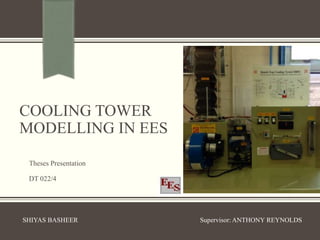
COOLING TOWER
MODELLING IN EES
Theses Presentation
DT 022/4
SHIYAS BASHEER Supervisor: ANTHONY REYNOLDS
Objectives
Study on Cooling Towers
Recent developments
Create a mathematical model
Implement it on EES (Engineering
Equation Solver)
Verify the results
Create a user interface
Sensitivity analysis
Implementation
Mathematical modelling
(governing equations)
Input
· variables
· fixed
parameters
Results
Database of
thermodynamic
properties
Write the
code
Run the
program
Engineering Equation Solver
Equation solving program
Useful in thermodynamic and heat
transfer problems
Equations entered in any order
High accuracy
Graphical Input/output
No real programming
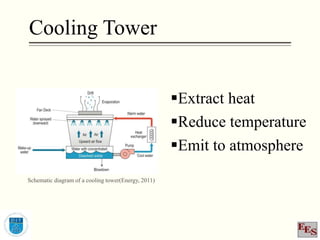
Cooling Tower
Extract heat
Reduce temperature
Emit to atmosphere
Schematic diagram of a cooling tower(Energy, 2011)
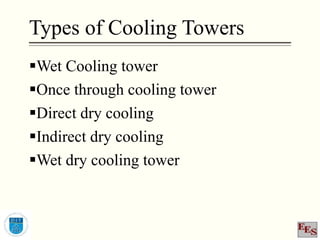
Types of Cooling Towers
Wet Cooling tower
Once through cooling tower
Direct dry cooling
Indirect dry cooling
Wet dry cooling tower
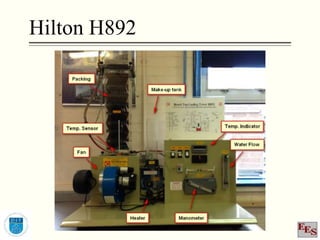
Hilton H892
Theory
Assumptions
Steady state
Relative Humidity – 100%
Negligible Kinetic and potential energy
Fully saturated
Ambient temperature of air going in
Control
Volume
Control
Volume
Mathematical Model
Mass Balance
𝒊𝒏
𝒎 =
𝒐𝒖𝒕
𝒎
Conservation of mass for water:
𝑚 𝑎 𝜔1 + 𝑚 𝑤1 = 𝑚 𝑎 𝜔2 + 𝑚 𝑤2
Conservation of mass for air:
𝑚 𝑎,𝑖𝑛 = 𝑚 𝑎,𝑜𝑢𝑡 = 𝑚 𝑎𝑖𝑟
Mathematical Model
Energy Balance
𝑬𝒊𝒏 = 𝑬 𝒐𝒖𝒕
At the water side:
𝑄 = 𝑚 𝑤1ℎ3 − 𝑚 𝑤2ℎ4
On the moist air side :
𝑄 = 𝑚 𝑎(ℎ2 − ℎ2)
Mathematical Model
Mass Balance
𝒊𝒏
𝒎 =
𝒐𝒖𝒕
𝒎
Conservation of mass principle
𝑚 𝑚𝑎𝑘𝑒−𝑢𝑝 + 𝑚 𝑐𝑜𝑙𝑑 𝑤𝑎𝑡𝑒𝑟,𝑖𝑛 = 𝑚ℎ𝑜𝑡𝑒 𝑤𝑎𝑡𝑒𝑟.𝑜𝑢𝑡
Mathematical Model
At the mixing point:
𝑄ℎ𝑒𝑎𝑡𝑒𝑟 − 𝑊𝑝𝑢𝑚𝑝 = 𝑚 𝑤1ℎ3 − 𝑚 𝑤2ℎ4
Energy Balance
𝑬𝒊𝒏 = 𝑬 𝒐𝒖𝒕
Implementation in EES
35 Equations
Results
Experimental Modelled
TEST No. Units 1 2 3 4 1 2 3 4
Air inlet Dry Bulb (t1) oC 19 19 19.4 19.7 19 19 19.4 19.7
Air inlet Wet Bulb (t2) oC 15.6 15.4 15.8 16.5 15.34 15.34 15.7 15.97
Air Outlet Dry Bulb (t3) oC 16.8 18.4 20.5 23 16.02 18.72 21.44 23.81
Air Outlet Wet Bulb (t4) oC 16 18 20.4 23 15.85 18.54 21.24 23.6
Water Inlet Temperature (t5) oC 17 21.6 27.2 32.7 16.84 21.47 27.09 33.34
Water Outlet Temperature (t6) oC 16.4 18.6 21.3 23.9 16.28 18.7 21.5 24.0
Cooling Load (Q) kW 0 0.5 1 1.5 0 0.5 1 1.5
Make-up Quantity (me) kg 0.25 0.25 0.25 0.25 0.25 0.25 0.25 0.25
Time Interval (y) s 600 600 600 600 600 600 600 600
Water Flow Rate (Mw) g/s 40 40 40 40 40 40 40 40
CALCULATIONS
Air Flow Rate (ma) kg/s 0.05728 0.05728 0.05728 0.05728 0.05728 0.05728 0.05728 0.05728
Evaporation Rate kg/s 0.00049 0.00049 0.00049 0.00049 0.00049 0.00049 0.00049 0.00049
Make-up Rate kg/s 9.6E-07 9.6E-07 9.6E-07 9.6E-07 9.6E-07 9.6E-07 9.6E-07 9.6E-07
Rate of Make-up Quantity (mE) kg/s 0.00042 0.00042 0.00042 0.00042 0.00042 0.00042 0.00042 0.00042
Approach to Wet Bulb oC 0.8 3.2 5.5 7.4 0.88 3.36 5.8 7.7
Cooling Range oC 0.6 3 5.9 8.8 0.56 2.77 5.59 9.34
Verification of Results
y = 1.0292x - 0.5149
R² = 0.9992
15
16
17
18
19
20
21
22
23
24
25
15 16 17 18 19 20 21 22 23 24 25
Modelled
Experimental
Comparison of Water outlet temperature 0C
Verification of Results
y = 1.0631x - 0.2988
R² = 0.9933
0
1
2
3
4
5
6
7
8
9
10
0 1 2 3 4 5 6 7 8 9 10
Modelled
Experimental
Comparison of Cooling Range 0C
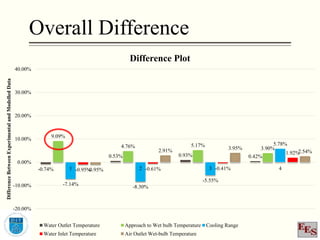
Overall Difference
-0.74%
0.53% 0.93% 0.42%
9.09%
4.76% 5.17%
3.90%
-7.14%
-8.30%
-5.55%
5.78%
-0.95% -0.61% -0.41%
1.92%
-0.95%
2.91% 3.95%
2.54%
-20.00%
-10.00%
0.00%
10.00%
20.00%
30.00%
40.00%
1 2 3 4
DifferenceBetweenExperimentalandModelledData
Difference Plot
Water Outlet Temperature Approach to Wet bulb Temperature Cooling Range
Water Inlet Temperature Air Outlet Wet-bulb Temperature
Overall Difference
-5%
-6%
-4% -4% -4%
20%
7%
32%
-2% -2%-2%
7%
-5%
-3%
36%
-14%
-7%
-23% -23%
4%
-4%
-1%
-4% -3%
1%
-30%
-20%
-10%
0%
10%
20%
30%
40%
1 2 3 4 5
Differencebetweenexperimentalandmodelleddata
Difference Plot
Water outlet temperature Approach to wet bulb Cooling Range Air outlet wet bulb Water inlet temperature
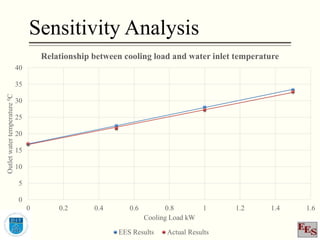
Sensitivity Analysis
0
5
10
15
20
25
30
35
40
0 0.2 0.4 0.6 0.8 1 1.2 1.4 1.6
Outletwatertemperature0C
Cooling Load kW
Relationship between cooling load and water inlet temperature
EES Results Actual Results
Sensitivity Analysis
0
5
10
15
20
25
30
35
40
0 0.2 0.4 0.6 0.8 1 1.2 1.4 1.6
Temperature0C
Cooling Load kW
Relationship between cooling load and range
EES Water outlet temperature EES Water inlet temperature EES Wet bulb temperature
Actual water outlet temp Actual water inlet temperature Actual wet bulb temperature
Cooling Range
Sensitivity Analysis
0
2
4
6
8
10
12
14
16
18
0 0.5 1 1.5 2 2.5 3
Approachtowetbulbtemperature0C
Air Velocity m/s
Relationship between Air velocity and approach
EES Results
Actual Results
User Interface
Conclusion and Future Work
All objectives met
Low simulation time
High accuracy
Investigate more into the errors
Investigate the equations
Add Merkel’s Theory of evaporation
Thank you
Reference
 2013a. ACHE [Online]. Available: http://www.thermopedia.com/content/663/.
 2013b. EES: Engineering Equation Solver | F-Chart Software : Engineering Software [Online].
Available: http://www.fchart.com/ees/.
 2013c. Natural Draft Cooling Towers | Hamon Group [Online]. Available:
http://www.hamon.com/en/cooling-systems/wet-cooling-systems/natural-draft-cooling-
towers/natural-draft/.
 BURGER, R. 1994. Cooling Tower Technology. Maintenance, Upgrading and Rebuilding.
United States of America: The Fairmont Press, Inc. .
 ENERGY, U. S. D. O. 2011. Cooling Towers: Understanding Key Components of Cooling
Towers and How to Improve Water Efficiency. In: ENERGY (ed.).
 HEATING, A. I. O. A. C. R. A. 2009. Types of Cooling Towers In: Selecting a Cooling Tower
Level 1 – Participant Guide Version 1.0.
 TAWNEY, R., KHAN, Z. & ZACHARY, J. 2005. Economic and performance evauation of heat
sink Options in combined cycle applications. Journal of engineering for Gas Turbine and Power,
127, 397-403.
Cooling Tower Technical Site of Daeil Aqua Co., L. (n.d.). Cooling Tower Thermal Design Manual. Retrieved
from http://myhome.hanafos.com/~criok/english/publication/thermal/thermal12eng.html
Ltd, P. H. (2003, February). Experimental operating and maintanence manual.

Modelling of a cooling tower in EES

  • 1.
    COOLING TOWER MODELLING INEES Theses Presentation DT 022/4 SHIYAS BASHEER Supervisor: ANTHONY REYNOLDS
  • 2.
    Objectives Study on CoolingTowers Recent developments Create a mathematical model Implement it on EES (Engineering Equation Solver) Verify the results Create a user interface Sensitivity analysis
  • 3.
    Implementation Mathematical modelling (governing equations) Input ·variables · fixed parameters Results Database of thermodynamic properties Write the code Run the program
  • 4.
    Engineering Equation Solver Equationsolving program Useful in thermodynamic and heat transfer problems Equations entered in any order High accuracy Graphical Input/output No real programming
  • 5.
    Cooling Tower Extract heat Reducetemperature Emit to atmosphere Schematic diagram of a cooling tower(Energy, 2011)
  • 6.
    Types of CoolingTowers Wet Cooling tower Once through cooling tower Direct dry cooling Indirect dry cooling Wet dry cooling tower
  • 7.
  • 8.
  • 9.
    Assumptions Steady state Relative Humidity– 100% Negligible Kinetic and potential energy Fully saturated Ambient temperature of air going in
  • 10.
  • 11.
  • 12.
    Mathematical Model Mass Balance 𝒊𝒏 𝒎= 𝒐𝒖𝒕 𝒎 Conservation of mass for water: 𝑚 𝑎 𝜔1 + 𝑚 𝑤1 = 𝑚 𝑎 𝜔2 + 𝑚 𝑤2 Conservation of mass for air: 𝑚 𝑎,𝑖𝑛 = 𝑚 𝑎,𝑜𝑢𝑡 = 𝑚 𝑎𝑖𝑟
  • 13.
    Mathematical Model Energy Balance 𝑬𝒊𝒏= 𝑬 𝒐𝒖𝒕 At the water side: 𝑄 = 𝑚 𝑤1ℎ3 − 𝑚 𝑤2ℎ4 On the moist air side : 𝑄 = 𝑚 𝑎(ℎ2 − ℎ2)
  • 14.
    Mathematical Model Mass Balance 𝒊𝒏 𝒎= 𝒐𝒖𝒕 𝒎 Conservation of mass principle 𝑚 𝑚𝑎𝑘𝑒−𝑢𝑝 + 𝑚 𝑐𝑜𝑙𝑑 𝑤𝑎𝑡𝑒𝑟,𝑖𝑛 = 𝑚ℎ𝑜𝑡𝑒 𝑤𝑎𝑡𝑒𝑟.𝑜𝑢𝑡
  • 15.
    Mathematical Model At themixing point: 𝑄ℎ𝑒𝑎𝑡𝑒𝑟 − 𝑊𝑝𝑢𝑚𝑝 = 𝑚 𝑤1ℎ3 − 𝑚 𝑤2ℎ4 Energy Balance 𝑬𝒊𝒏 = 𝑬 𝒐𝒖𝒕
  • 16.
  • 17.
    Results Experimental Modelled TEST No.Units 1 2 3 4 1 2 3 4 Air inlet Dry Bulb (t1) oC 19 19 19.4 19.7 19 19 19.4 19.7 Air inlet Wet Bulb (t2) oC 15.6 15.4 15.8 16.5 15.34 15.34 15.7 15.97 Air Outlet Dry Bulb (t3) oC 16.8 18.4 20.5 23 16.02 18.72 21.44 23.81 Air Outlet Wet Bulb (t4) oC 16 18 20.4 23 15.85 18.54 21.24 23.6 Water Inlet Temperature (t5) oC 17 21.6 27.2 32.7 16.84 21.47 27.09 33.34 Water Outlet Temperature (t6) oC 16.4 18.6 21.3 23.9 16.28 18.7 21.5 24.0 Cooling Load (Q) kW 0 0.5 1 1.5 0 0.5 1 1.5 Make-up Quantity (me) kg 0.25 0.25 0.25 0.25 0.25 0.25 0.25 0.25 Time Interval (y) s 600 600 600 600 600 600 600 600 Water Flow Rate (Mw) g/s 40 40 40 40 40 40 40 40 CALCULATIONS Air Flow Rate (ma) kg/s 0.05728 0.05728 0.05728 0.05728 0.05728 0.05728 0.05728 0.05728 Evaporation Rate kg/s 0.00049 0.00049 0.00049 0.00049 0.00049 0.00049 0.00049 0.00049 Make-up Rate kg/s 9.6E-07 9.6E-07 9.6E-07 9.6E-07 9.6E-07 9.6E-07 9.6E-07 9.6E-07 Rate of Make-up Quantity (mE) kg/s 0.00042 0.00042 0.00042 0.00042 0.00042 0.00042 0.00042 0.00042 Approach to Wet Bulb oC 0.8 3.2 5.5 7.4 0.88 3.36 5.8 7.7 Cooling Range oC 0.6 3 5.9 8.8 0.56 2.77 5.59 9.34
  • 18.
    Verification of Results y= 1.0292x - 0.5149 R² = 0.9992 15 16 17 18 19 20 21 22 23 24 25 15 16 17 18 19 20 21 22 23 24 25 Modelled Experimental Comparison of Water outlet temperature 0C
  • 19.
    Verification of Results y= 1.0631x - 0.2988 R² = 0.9933 0 1 2 3 4 5 6 7 8 9 10 0 1 2 3 4 5 6 7 8 9 10 Modelled Experimental Comparison of Cooling Range 0C
  • 20.
    Overall Difference -0.74% 0.53% 0.93%0.42% 9.09% 4.76% 5.17% 3.90% -7.14% -8.30% -5.55% 5.78% -0.95% -0.61% -0.41% 1.92% -0.95% 2.91% 3.95% 2.54% -20.00% -10.00% 0.00% 10.00% 20.00% 30.00% 40.00% 1 2 3 4 DifferenceBetweenExperimentalandModelledData Difference Plot Water Outlet Temperature Approach to Wet bulb Temperature Cooling Range Water Inlet Temperature Air Outlet Wet-bulb Temperature
  • 21.
    Overall Difference -5% -6% -4% -4%-4% 20% 7% 32% -2% -2%-2% 7% -5% -3% 36% -14% -7% -23% -23% 4% -4% -1% -4% -3% 1% -30% -20% -10% 0% 10% 20% 30% 40% 1 2 3 4 5 Differencebetweenexperimentalandmodelleddata Difference Plot Water outlet temperature Approach to wet bulb Cooling Range Air outlet wet bulb Water inlet temperature
  • 22.
    Sensitivity Analysis 0 5 10 15 20 25 30 35 40 0 0.20.4 0.6 0.8 1 1.2 1.4 1.6 Outletwatertemperature0C Cooling Load kW Relationship between cooling load and water inlet temperature EES Results Actual Results
  • 23.
    Sensitivity Analysis 0 5 10 15 20 25 30 35 40 0 0.20.4 0.6 0.8 1 1.2 1.4 1.6 Temperature0C Cooling Load kW Relationship between cooling load and range EES Water outlet temperature EES Water inlet temperature EES Wet bulb temperature Actual water outlet temp Actual water inlet temperature Actual wet bulb temperature Cooling Range
  • 24.
    Sensitivity Analysis 0 2 4 6 8 10 12 14 16 18 0 0.51 1.5 2 2.5 3 Approachtowetbulbtemperature0C Air Velocity m/s Relationship between Air velocity and approach EES Results Actual Results
  • 25.
  • 26.
    Conclusion and FutureWork All objectives met Low simulation time High accuracy Investigate more into the errors Investigate the equations Add Merkel’s Theory of evaporation
  • 27.
  • 28.
    Reference  2013a. ACHE[Online]. Available: http://www.thermopedia.com/content/663/.  2013b. EES: Engineering Equation Solver | F-Chart Software : Engineering Software [Online]. Available: http://www.fchart.com/ees/.  2013c. Natural Draft Cooling Towers | Hamon Group [Online]. Available: http://www.hamon.com/en/cooling-systems/wet-cooling-systems/natural-draft-cooling- towers/natural-draft/.  BURGER, R. 1994. Cooling Tower Technology. Maintenance, Upgrading and Rebuilding. United States of America: The Fairmont Press, Inc. .  ENERGY, U. S. D. O. 2011. Cooling Towers: Understanding Key Components of Cooling Towers and How to Improve Water Efficiency. In: ENERGY (ed.).  HEATING, A. I. O. A. C. R. A. 2009. Types of Cooling Towers In: Selecting a Cooling Tower Level 1 – Participant Guide Version 1.0.  TAWNEY, R., KHAN, Z. & ZACHARY, J. 2005. Economic and performance evauation of heat sink Options in combined cycle applications. Journal of engineering for Gas Turbine and Power, 127, 397-403. Cooling Tower Technical Site of Daeil Aqua Co., L. (n.d.). Cooling Tower Thermal Design Manual. Retrieved from http://myhome.hanafos.com/~criok/english/publication/thermal/thermal12eng.html Ltd, P. H. (2003, February). Experimental operating and maintanence manual.